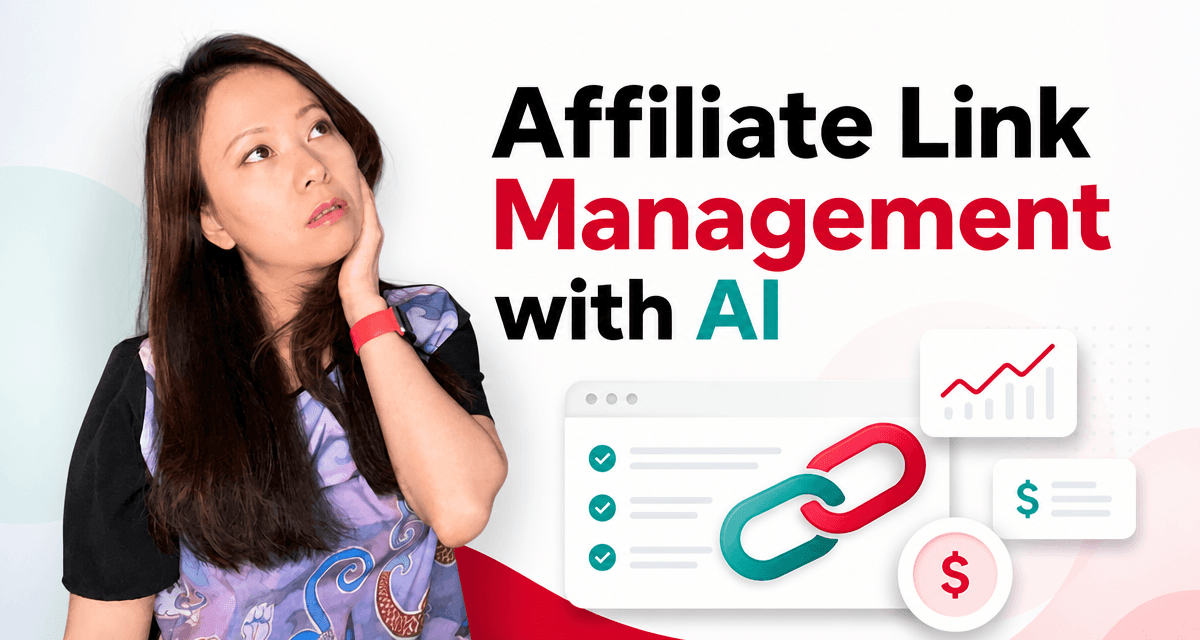
The affiliate links did not break dramatically. That was the annoying part.
There was no single morning where every partner link failed, alarms went off, and the whole site told us what to fix. That would have been easier.
The real problem was quieter. A link would still redirect, but I would not fully trust where it pointed. A partner dashboard would change, but the old link in a post would keep living its own life. I would open Ops, search for a slug, then realize the harder question was not “does this URL load?” It was “where have we recommended this, and do we still mean it?”
A tutorial would mention a product that had moved, rebranded, changed its offer, or stopped being the thing we would recommend first. The link was not broken in the simple sense. It was stale in the editorial sense.
That is the part people miss when they talk about affiliate link management.
At a small scale, an affiliate link is a URL. At Feisworld scale, after 15+ years of publishing, interviews, videos, tutorials, courses, partner work, and blog posts, an affiliate link becomes a tiny piece of public trust.
If we use a Feisworld-owned path like /go/v0, /go/vercel, /go/squarespace, or any other partner link we talk about, the link is not just monetization. It is a claim. It says, “This is still relevant enough for us to send you there.”
That is why we eventually built our own affiliate link system inside Feisworld Ops.
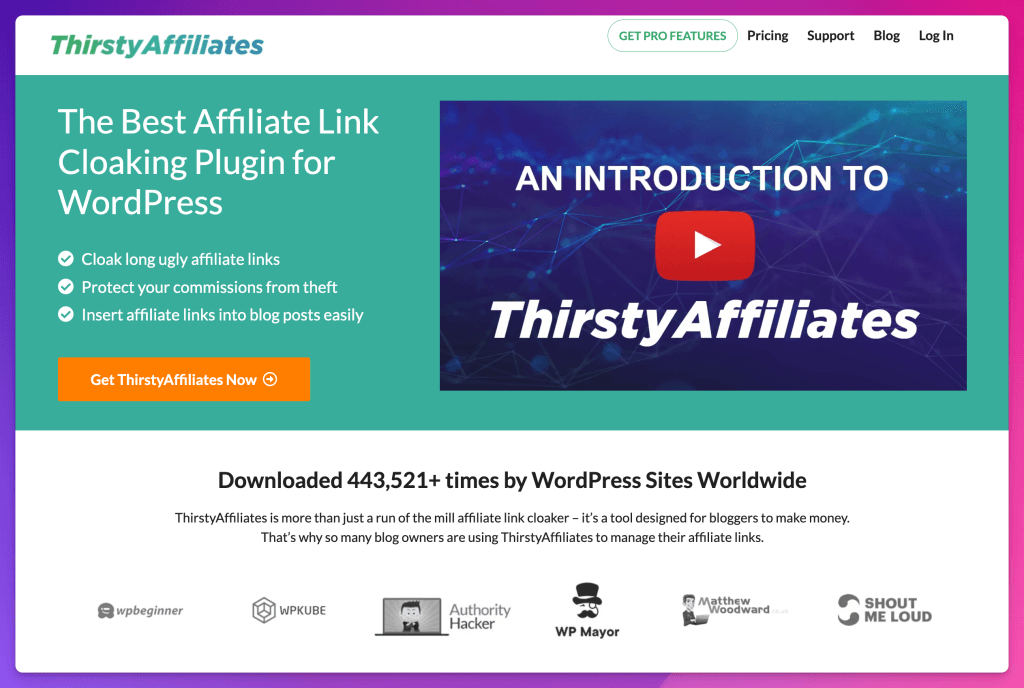
Not because ThirstyAffiliates failed us. It helped us for years. Not because plugins are bad. I said the opposite in Article 4 of this migration series. The reason was simpler and more specific: affiliate links had become operational data, not just cloaked redirects.
This is Article 5 in our Feisworld site migration series. In Article 1, I explained why we rebuilt the site for AI brand visibility. In Article 2, I showed why we kept WordPress for writing but stopped letting it make every public decision. In Article 3, I walked through the AI-assisted content audit. In Article 4, I mapped the plugin jobs we moved to Vercel, Next.js, Turso, and Ops.
This article is about the affiliate piece, why we replaced plugin-owned link management with a system that knows about partners, destinations, health checks, revenue workflows, disclosures, source posts, and human review.
The Short Version
Here is the plain answer:
We built our own affiliate link management system because our links needed to be reviewed, monitored, mapped to content, and connected to partner data. They were no longer just short URLs.
ThirstyAffiliates did the WordPress-era job well. It helped us create branded redirects, organize affiliate links, and avoid replacing the same long destination URL across many posts. Its WordPress.org listing describes link cloaking, categories, redirect choices, click statistics, reports, CSV import and export, and even Amazon API importing in the Pro version.
That is a lot of value for a WordPress site. Our issue was not that ThirstyAffiliates lacked features. Our issue was that the center of the Feisworld site had moved.
WordPress remained the writing source. The public site moved to Next.js on Vercel. Approved content moved through Ops and Turso. Redirects, metadata, sitemaps, image cleanup, and content monitoring all moved into a more explicit review workflow.
Affiliate links had to move with that workflow.
That is the migration thesis in miniature. Plugins can hide decisions when the site outgrows them. Ops made those decisions reviewable.
Why Affiliate Links Become Messy Over Time
Affiliate links are easy to underestimate because each one looks small. You create a link. You paste it into a post. A reader clicks. The destination loads. Maybe you earn a commission. Done.
That version is true for about five minutes.
Then the post gets updated. The partner changes its dashboard. The product changes pricing. The affiliate program moves to a network. The destination page adds tracking parameters. The old offer disappears. A reader lands on the wrong country version. A YouTube description contains an older version of the link. A blog post from 2019 still ranks, but the recommendation is no longer the recommendation we would make in 2026.
Now the link is not a small object anymore.
It has a destination. It has a partner. It has a source post. It may appear in YouTube descriptions, podcast show notes, partner pages, and tutorials. It may need a disclosure. It may need rel="sponsored nofollow". It may need to be excluded from cloaking if a program requires that. It may need a health check. It may need revenue tracking. It may need a human to decide whether the recommendation still matches Feisworld’s current position.
That is the difference between a link shortener and affiliate link management.
The search data confirmed this was worth explaining carefully. In Google Search Console, Feisworld already sees impressions around affiliate topics, especially YouTube affiliate queries and older affiliate marketing posts like AI Tools for YouTube and How to Set Up the YouTube Shopping Affiliate Program. Ahrefs showed small but useful opportunities around “affiliate link tracker,” “affiliate link management,” “affiliate link cloaking,” “affiliate link monitoring,” “affiliate disclosure,” and “affiliate API integration.”
That told me not to write a generic “best affiliate link plugin” article. There are plenty of those already. The useful gap is the operating story: what happens when a creator business outgrows plugin-only affiliate links, but still needs transparency and trust?
What ThirstyAffiliates Solved for Us
I want to give ThirstyAffiliates its huge credit.
For a traditional WordPress site, a plugin like ThirstyAffiliates solves real problems. You can create a branded link path, organize links by category, change one destination instead of editing dozens of posts, track clicks, and make affiliate URLs easier to manage inside WordPress. On its WordPress.org listing, ThirstyAffiliates describes itself as a tool for affiliate link branding, link tracking, redirects, management, reports, and link insertion inside the editor.
That was extremely useful for us!
Before the migration, WordPress was the place where posts lived and public pages rendered. An affiliate plugin living inside WordPress made sense because the whole site was still WordPress-shaped. If a post needed a link, the editor workflow and public output were close together.
But after the migration, WordPress no longer rendered the public page. We no longer needed the affiliate system to live only beside the WordPress editor. We needed it to live beside public routing, redirects, content review, broken link scans, partner records, and the source-post map. We also needed the public site to be able to serve /go/* links without depending on a WordPress plugin at request time.
That is where the old setup started feeling too small for the new job.
The System We Built Instead
Our public affiliate links now use a simple shape:
https://www.feisworld.com/go/v0
Or:
https://www.feisworld.com/go/vercel
The simplicity is intentional. Readers see a Feisworld-owned path. Editors can remember it. The public site can route it. Ops can inspect it. Behind that small URL, the system has more context.
At the route level, /go/[slug] looks up an enabled affiliate link, redirects to the approved destination, and logs the click without making the redirect feel heavy. We also added basic safety decisions: disabled links should not keep silently sending people to the wrong place, unknown slugs should have a safe fallback, and click logging should avoid obvious abuse.
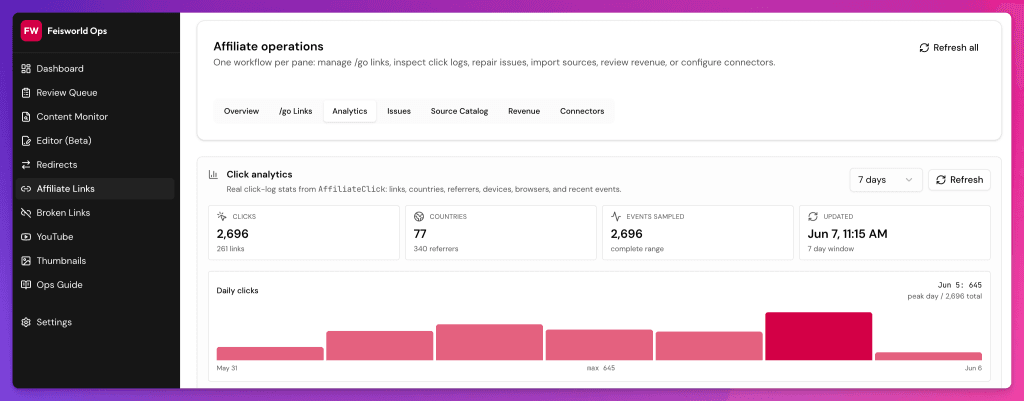
Behind that route, the link is not just a slug and a destination.
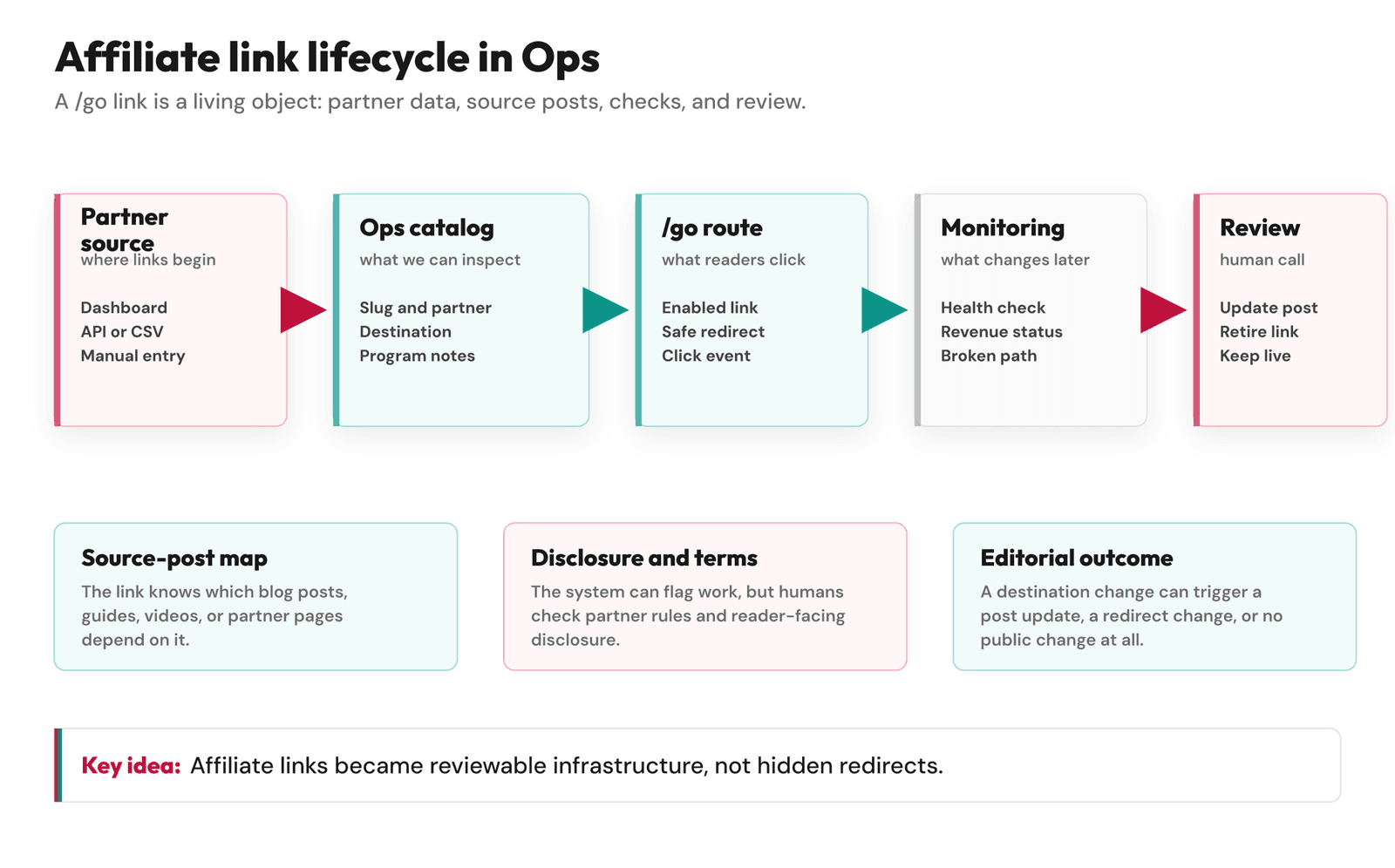
In Ops, we designed the link record to carry the details we actually need to review: partner name, program, category, dashboard provider, dashboard URL, notes, health status, last check, click count, revenue sync status, and imported external program data where it exists. That sounds like a lot until you remember what affiliate links touch inside a media company.
A link can be part of a blog post, a YouTube description, a podcast resource list, a partner page, an AI tools roundup, a course-related post, or a new article like Best Platforms to Create Websites with AI in 2026. The same destination may appear across years of content.
If the link is stale, it is not only a redirect issue. It is an editorial issue.
Why Structured Partner Data Changed the Decision
One reason this custom system became worth it is that partner data is less trapped than it used to be.
Not every affiliate platform is beautifully integrated, and I do not want to pretend the world is cleaner than it is. Some dashboards still require manual exports. Some partner programs still send email updates. Some links still need a human to create, label, and review.
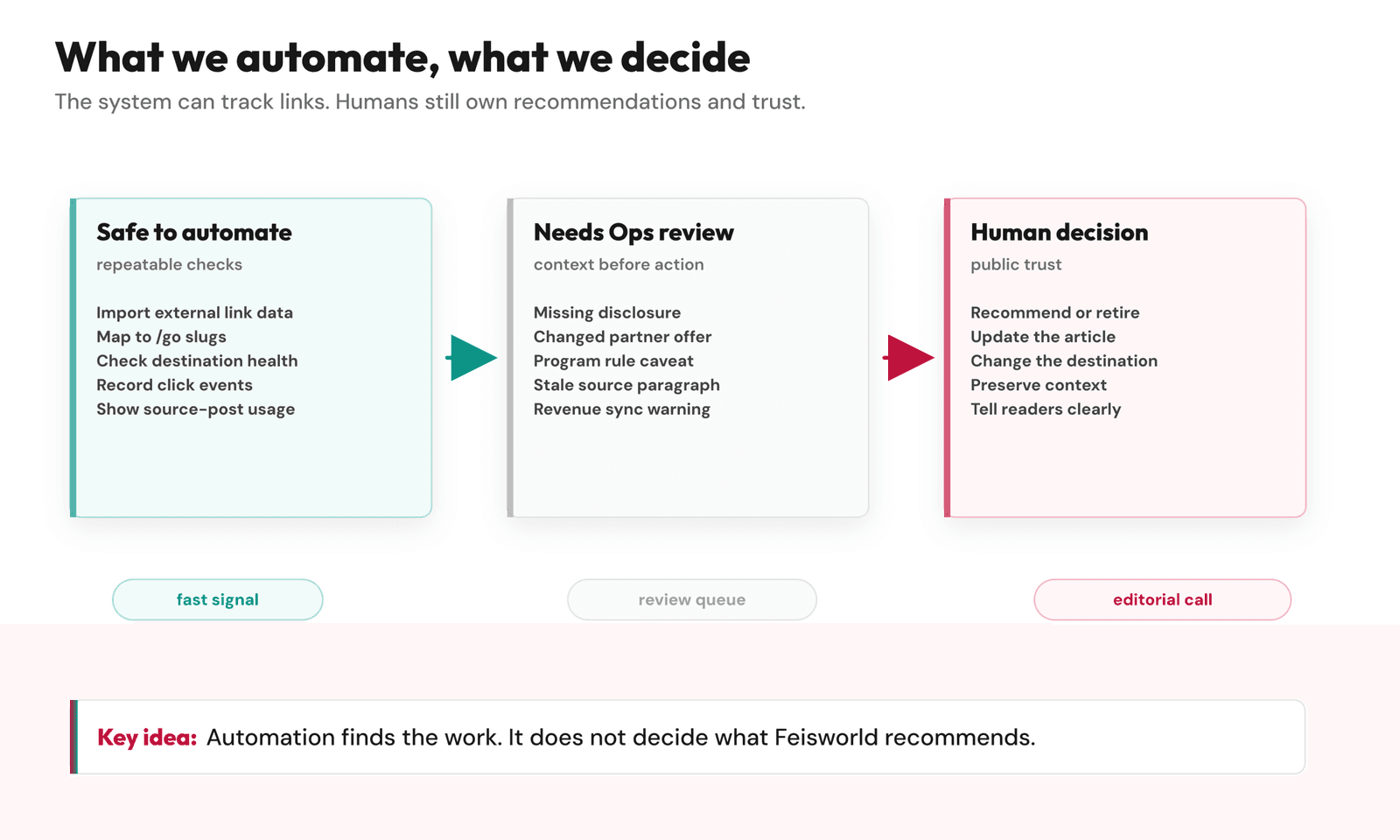
But more of the platforms we work with now expose APIs, structured exports, webhooks, partner dashboards, or integration paths that can be pulled into a workflow. In 2026, that matters. The dream is not “AI magically manages affiliate marketing.” The useful version is much more boring: import the external list, map the partner’s link to our internal /go/* URL, monitor the destination, and make the stale or broken ones visible before readers find them.
I am careful with the word API here. Not every partner gives you a clean API, and some never will. The point is that the system can accept structured external data when it exists, while still letting us handle manual links honestly when it does not.
That is the kind of work Ops is good at. Ops can say: this external program exists, this external link maps to this internal slug, this destination was last checked, this source post uses it, this partner dashboard is where revenue data lives, this one should be reviewed.
A plugin can manage links. Ops can manage the relationship between the link and the rest of the business.
That difference sounds subtle until you are the person trying to answer, “Where have we recommended this tool, and is that recommendation still current?”
The Compliance Piece Is Not Optional
Here is the part I do not want to gloss over: building your own affiliate link system does not make disclosure easier. It makes your responsibility clearer.
The FTC’s Endorsement Guides are very direct about material connections. Their guidance says readers may need to know if clicking a link can generate a commission, and the disclosure should be hard to miss, not hidden behind a vague legal link. For YouTube videos with affiliate links, the FTC also warns that description-only disclosures can be missed, and says the affiliate relationship should be disclosed in the video and near the links in the description.
That matters for Feisworld because our content is not only written posts. It is blog posts, YouTube, podcast resources, partner collaborations, tutorials, and guides. We need disclosures to be understandable across those formats.
On the HTML side, we also treat affiliate links differently from normal editorial links. Sponsored links should use the right attributes, commonly rel="sponsored nofollow", and open in a way that does not pretend the link is a neutral citation.
That is not a cosmetic detail. It is part of the trust system.
The mistake would be to treat link cloaking as a way to hide what is happening. Our goal is the opposite. A Feisworld /go/* link should be easier for us to monitor and easier for readers to understand, with disclosure around the recommendation where it belongs.
There is one more practical caveat: partner terms matter. Some programs have rules about redirects, cloaking, geo-routing, or how their links can be displayed. If a program says not to cloak, the system has to respect that. A custom link system is not a permission slip.
What We Track in Ops
The first thing I wanted from Ops was visibility. Not a vanity dashboard! Real visibility.
I wanted to open one place and see the slug, destination, partner, program, source posts, status, notes, and the last time we checked it. If a destination changes, I do not only want to change the redirect. I want to know which posts may need editorial review.
Maybe the destination still works, but the surrounding paragraph is outdated. Maybe the link is fine, but the product is no longer our first choice. Maybe the post needs a better disclosure. Maybe the link appears in an old YouTube description that should be updated. That last case leads directly into the next article in this series, how we connected YouTube, podcast, blog, and search signals.
That is what I mean when I say affiliate link management at scale. Not “more links.” More context around each link.
The Mistake I Would Avoid
The mistake is building a custom affiliate system because it feels more advanced. That is not a good reason.
A plugin maintained by a dedicated team gives you updates, support, edge cases, documentation, and thousands of users testing the product in ways you would not think of. When a plugin solves the problem cleanly, use the plugin. Your custom system becomes your responsibility the minute you ship it.
We accepted that responsibility because affiliate links are close to Feisworld’s business model, content strategy, partner relationships, and reader trust. They are not an optional widget for us.
I would not rebuild this for a site with 20 links and no need for partner-data mapping. I would not rebuild it for a team that cannot maintain the route, health checks, and compliance workflow. I would not rebuild it if the only benefit is a prettier URL.
The custom path only makes sense when the operational clarity is worth the maintenance.
When a Plugin Is Still Better
I would keep a plugin if the site is still traditional WordPress, the editors live entirely in WordPress, the affiliate catalog is small, and the main needs are branded redirects, categories, and basic click reports.
That is a perfectly reasonable setup.
I would also keep a plugin if the team does not have the technical background to maintain a custom redirect system. Affiliate links are small until they break trust. A half-maintained custom system is worse than a good plugin.
Where I would start questioning the plugin-only setup is when the links need to connect with:
- Partner API data or structured exports.
- Revenue checks across multiple dashboards.
- Broken link monitoring.
- Source-post mapping.
- YouTube and podcast description updates.
- Redirect and destination review.
- Editorial approval before public changes.
- Content freshness decisions.
That is where a link stops being a plugin feature and starts becoming part of operations.
A Smaller Version I Would Recommend
If you are not going to build a full Ops dashboard, you can still borrow the thinking.
Start with a simple inventory. I would literally do this on a Monday morning before opening a new tool.
- List every affiliate slug or destination.
- Record the partner, program, category, and source posts.
- Mark whether the link has a visible disclosure near it.
- Check whether the destination still works.
- Note the last date someone reviewed the recommendation, not just the link.
- Separate “destination broken” from “recommendation stale.”
- Keep a small changelog for links that affect important posts.
Even a spreadsheet can reveal the real problem. You will usually learn that your links are not just scattered. Your decisions are scattered.
That is where the work begins.
What I Would Tell Another Creator
If you are just starting, do not overbuild.
Create clean links. Add clear disclosures. Use a good plugin or a trusted link management tool. Keep a basic inventory. Do not make affiliate marketing feel like a secret layer of the site.
If your archive grows, revisit the system before it becomes painful.
The moment you start asking “Which posts will be affected if this partner changes?” or “Which YouTube descriptions contain this old link?” you are no longer managing only links. You are maintaining trust across the archive.
That is the place Feisworld reached.
We built the system because the work around the link had become more important than the redirect itself.
FAQ
What is affiliate link management?
Affiliate link management is the process of organizing, redirecting, monitoring, disclosing, and maintaining affiliate links across a site. For a small site, it may mean using a plugin to create branded links. For a larger media archive, it can include health checks, source-post mapping, partner dashboards, revenue workflows, and editorial review.
What is affiliate link cloaking?
Affiliate link cloaking usually means using a shorter branded URL, such as /go/tool-name, that redirects to a longer affiliate destination. It can make links easier to manage and read, but it should not be used to hide the nature of the relationship from readers. Some affiliate programs also have rules about cloaking, so always check the program terms.
Is ThirstyAffiliates still a good option?
Yes, especially for WordPress sites that need branded affiliate links, categories, redirects, and click reports inside WordPress. We moved away from plugin-owned affiliate links because Feisworld’s public site, content review, monitoring, and partner workflows moved beyond traditional WordPress rendering.
Should I build my own affiliate link system?
Only if the workflow justifies the maintenance. A custom system can give you better fit, but it also requires routing, testing, monitoring, disclosure discipline, and someone responsible for keeping it working. If a plugin solves your problem, use the plugin.
Do affiliate links need disclosures?
Yes, when the relationship could affect how readers understand the recommendation. The FTC’s Endorsement Guides explain that disclosures should be clear, conspicuous, and hard to miss. For creator content, that means the disclosure needs to appear where people actually see the recommendation, not only on a separate legal page.
What is the difference between a link tracker and an affiliate operations system?
A link tracker focuses on clicks and destinations. An affiliate operations system also connects links to partners, source posts, health checks, revenue workflows, compliance notes, and editorial review. The second version matters when links affect the business and the reader experience.
You might also enjoy…
- WordPress Plugin Alternatives on Vercel: WP Rocket, Optimole, Rank Math, and ThirstyAffiliates
- Headless WordPress with Next.js: Our Human-Reviewed Publishing System
- YouTube and Podcast SEO Workflow: How We Connected Video, Blog, and Search Data
- AI Tools for YouTube
- How to Set Up the YouTube Shopping Affiliate Program
- How You Get Started in Affiliate Marketing Without Salesy Pitches
- 7 Ways to Make Your First Affiliate Sale
- Best Platforms to Create Websites with AI in 2026

Written by
Germán CeballosGermán Ceballos has worked with Feisworld Media since 2016 and serves as Editorial Director. He co-created and edited the documentary Feisworld: Live Your Art, has overseen the editorial direction of the podcast across 300+ episodes, and shapes Feisworld's coverage of AI tools, creator workflows, video production, and content strategy.
View all posts by Germán Ceballos→Stay updated
Weekly insights on content, AI, and digital media.
Keep Reading