Working alongside my mom, artist Xiang Li, has changed how I think about art, technology, and the journey an artwork takes after it leaves the studio.
My mom spent decades mastering traditional Chinese silk painting. Her work is slow, precise, and deeply rooted in history. She paints Chinese empresses, Guanyin, dragons, pandas, zodiac animals, and other cultural subjects with techniques that cannot be rushed. Some pieces take months. Larger works can take much longer.
For most of my life, I understood her as an artist first. But in recent years, especially since bringing Xiang Li Art to more audiences in the United States, I’ve also come to understand the many layers involved in helping an artist’s work become visible, understandable, and memorable.
The artwork itself is only the beginning.
A single exhibition might require a presentation, wall labels, event graphics, pricing sheets, QR codes, social posts, video clips, printed cards, take-home materials, and follow-up content. A school visit might need a visual deck, simplified explanations, activity sheets, and ways for students to connect with the work. A museum or community event might call for signage, educational materials, short videos, and something visitors can bring home.
This is the part of an artist’s career that is rarely romanticized, but it matters deeply.
Over the past few years, Xiang Li Art has appeared in schools, galleries, libraries, museums, community spaces, and cultural events across Massachusetts. Some of these opportunities have taken us into major cultural and educational spaces, including the Museum of Fine Arts, Boston, Worcester Art Museum, Harvard-related settings, New England Botanic Garden at Tower Hill, JMAC in Worcester, LabCentral in Cambridge, and other community venues.
Through these experiences, the work has grown beyond a collection of paintings. It has become a way to invite people into Chinese history, women’s stories, traditional materials, cultural memory, and cross-generational conversation.
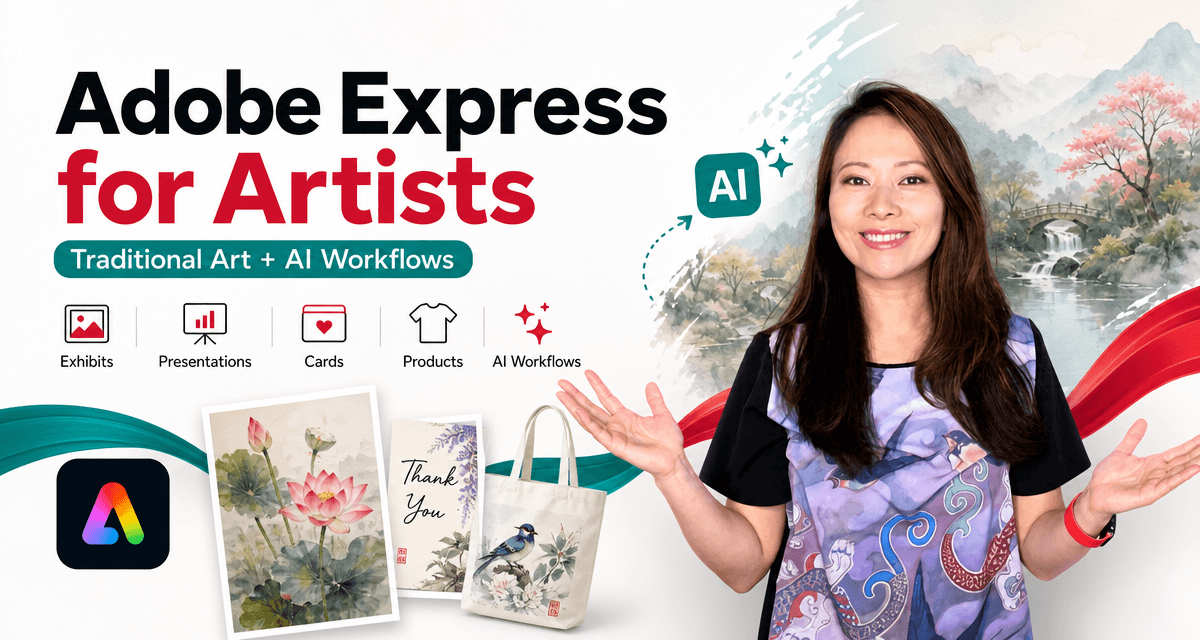
That journey is the reason I’m creating a new course, planned for release by the end of June 2026:
Traditional Art Meets AI: Building a Cultural Brand with Adobe Express
This course is not about replacing art with technology. It is about helping original artwork travel farther.
Disclaimer: This article and upcoming course are sponsored by Adobe Express, with full creative control and storytelling coming from my own experience working with Xiang Li Art.
Why Adobe Express Became Part of Our Art Practice
I first turned to Adobe Express because exhibitions move quickly.
No matter how carefully we prepare, every show seems to create new design needs. A venue asks for a flyer. A visitor wants to scan a QR code. A table needs a clean price sheet. A reception needs a welcome sign. A social post needs to go out today. Cards need to be designed, printed, and displayed. A presentation needs to feel polished enough for a school, gallery, museum, or cultural partner.
Adobe Express became a practical place to bring many of those pieces together.
For Xiang Li Art, it has supported presentation decks, social graphics, event announcements, printed cards, exhibit materials, QR-code signs, and promotional visuals. It has also worked alongside Firefly-powered workflows when exploring animation, mockups, backgrounds, and visual storytelling around my mom’s paintings.
What I appreciate most is the flexibility. A painting can become an Instagram post, LinkedIn image, YouTube thumbnail, website banner, event flyer, vertical story, or reel cover without rebuilding the entire design from scratch. That matters because traditional silk paintings were never created for modern content dimensions. Preserving the face, robe, headpiece, posture, and cultural details requires care.
Adobe Express gives us a way to adapt the work while still protecting what makes it special.
What Artists Actually Struggle With
Most artists I meet are not looking for another abstract conversation about personal branding.
They are trying to solve real, practical problems.
How do I explain my work clearly before a school visit?
How do I create an event flyer without hiring a designer every time?
How do I announce a workshop, exhibition, or book signing?
How do I create signage that welcomes people without overwhelming them?
How do I sell cards or prints at a table and make the display look professional?
How do I document an exhibition before everything comes down?
How do I turn one event into meaningful follow-up content?
How do I turn my designs and artworks into coloring books?
Artists are also navigating a new question: where does AI belong in all of this?
That is the balance I want this course to explore.
Not “AI will make the art for you.”
Not “every artist must become a full-time content creator.”
Instead, the course asks something more grounded:
How can Adobe Express, with thoughtful support from Firefly and generative AI features, help artists organize their work, tell clearer stories, and create more opportunities?
The Xiang Li Art Case Study
This course is built around our real experience with Xiang Li Art.
My mom’s Chinese empress collection began long before Adobe Express or Firefly existed. The work comes from her training, her years in China, her knowledge of traditional painting, and her devotion to cultural storytelling. No software can replace that.
Modern tools enter the picture after the artwork exists.
They help us prepare for public talks, develop social content, explore merchandise, design exhibit materials, and create educational resources. I’ve also shared tutorials using Xiang Li Art examples, including Adobe Firefly Custom Models with her Chinese panda watercolor collection, holiday card workflows in Adobe Express, and generative AI background experiments with traditional Chinese art.
At JMAC in Worcester, our recent multi-sensory Chinese Empress Art and Culture Experience brought many of these ideas together. The exhibition was not only about hanging paintings on walls. We considered how adults and children could engage with the work through sight, touch, scent, story, and activity. That meant creating printed materials, tote-bag-based activity experiences, signage, take-home cards, and supporting visuals that made the space easier to navigate and enjoy.
That is the kind of work I want to teach.
Not just how to make a nice-looking graphic, but how to support a real artistic experience from beginning to end.
What the Course Will Cover
The course will be practical, case-study driven, and designed for artists and art educators who want to expand the reach of their work without feeling overwhelmed.
A few areas I plan to explore include:
Artist presentations
Creating Adobe Express presentations for schools, galleries, museums, libraries, community partners, and artist talks.
Social media and video storytelling
Turning artwork, events, process footage, and visitor moments into posts, reels, stories, YouTube assets, and short videos.
Printed materials
Designing signage, QR cards, price sheets, postcards, greeting cards, activity sheets, and simple take-home pieces for exhibits and events.
Books and educational assets
Looking at full-color art books, coloring books, classroom materials, and family-friendly learning experiences.
Merchandise and mockups
Exploring tote bags, cards, prints, scarves, notebooks, and other products before committing to production.
AI-assisted visual exploration
Using Firefly and generative AI features for backgrounds, animation ideas, wall mockups, atmospheric scenes, and creative variations while keeping the original artwork at the center.
The course will also touch on scheduling and repurposing content, because artists need systems that are realistic. One exhibition can become a flyer, a video, a recap post, a LinkedIn reflection, an email, a YouTube Short, a card design, and a future pitch.
This is not about creating more content for the sake of being busy. It is about making sure meaningful work does not disappear after one event.
What I’ve Learned From My Mom
The most important lessons in this course do not come from software.
They come from working with my mom.
I’ve learned that art needs patience. Cultural stories need context. Audiences respond when they are invited in gently. Children often notice details adults overlook. Museums and community spaces are not only places to display art; they are places to build relationships.
I’ve also seen how much invisible labor goes into an artist’s career.
Beyond the studio, there are bios to write, applications to submit, websites to update, photos to organize, talks to prepare, cards to print, prices to decide, venues to follow up with, and stories to share online.
That workload can become overwhelming, especially for independent artists.
My hope is that this course helps artists feel more capable, not more pressured.
Adobe Express has lowered friction in our own process. It allows me to move from idea to design faster, whether I’m preparing an event sign, a social post, a presentation, or a printed card. Firefly adds another layer when we want to imagine a background, animate a feeling, test a museum wall, or explore a product direction before producing something physically.
But the artist remains the center.
Always.
Why I’m Sharing This Now
Since becoming an Adobe Ambassador, I’ve had the opportunity to explore Adobe tools in a deeper and more public way. I’ve written and produced videos about Adobe Express, Adobe Firefly, Adobe Podcast Enhance Speech, Firefly AI Assistant, Adobe integrations, and the ways these tools show up in real creator workflows.
This course feels like a natural next step.
It brings together my work as a creator, educator, daughter, marketer, and collaborator. It also reflects the work my mom and I have been doing in real spaces with real audiences: setting up exhibits, speaking with visitors, designing printed materials, experimenting with AI, selling cards, documenting events, and finding new ways for traditional Chinese art to meet modern audiences.
Who This Course Is For
This course is for artists who want to share their work more clearly, for art educators developing materials for students, families, or community audiences, for cultural organizations and small teams that need practical design workflows without a large staff, for artists who are curious about AI but do not want to lose the human heart of their practice.
And it is for anyone who has looked at a finished artwork and wondered:
What else can this become? I don’t have all the answers but I’m curious to see what comes next.
Final Thoughts
For us, Adobe Express has not replaced the art. It has helped the art move through the world.
It has helped us prepare for exhibitions, communicate with venues, create visitor materials, design products, tell stories online, and invite people into my mom’s world.
That is what I want to share in this course.
Not a perfect system. Not a promise that every artist needs to become a marketer. Just a practical, honest look at how one artist’s work can become presentations, videos, books, cards, products, educational experiences, and community connections.
Traditional art and AI do not have to be in conflict.
When used thoughtfully, modern tools can help traditional work reach more people across generations, languages, and spaces.
That is the heart of Traditional Art Meets AI: Building a Cultural Brand with Adobe Express, coming by the end of June 2026.

Written by
Fei WuFei Wu is the founder and CEO of Feisworld Media, a Massachusetts-based digital media company helping brands get discovered by people and by AI. An Adobe Global Ambassador and brand partner to ElevenLabs, Synthesia, and 50+ other tech and AI companies, she hosts the Feisworld Podcast (400+ episodes, 500K+ downloads — guests have included Seth Godin, Steve Wozniak, Chris Voss, and Arianna Huffington) and co-created the documentary Feisworld: Live Your Art on Amazon Prime. Fei writes for CNET, Lifehacker, and PCMag, and her work has been featured in Forbes, Harvard Business Review, and WIRED. She has been publishing on the internet since 2014 — long before AI discoverability had a name.
View all posts by Fei Wu→Stay updated
Weekly insights on content, AI, and digital media.