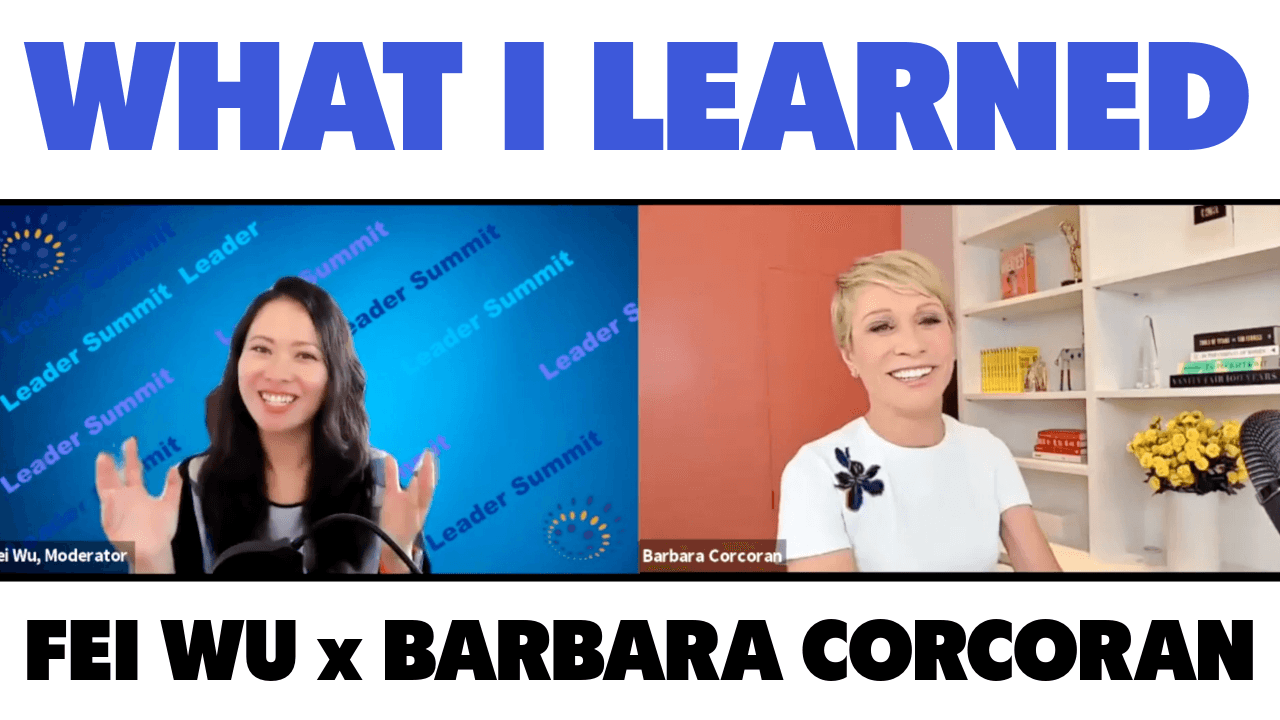
When Barbara Corcoran joins a Zoom room, the energy changes.
During our Women Leaders Association session, I was supposed to “moderate” the conversation – but honestly, it felt more like hanging onto a very fast train of stories, punchlines, and hard-won truths from someone who has seen it all: 20+ years building The Corcoran Group, 13 seasons on Shark Tank, and a lifetime of leading humans.
This post is my reflection on that conversation – what I heard, what stayed with me, and how it applies to anyone building a business, a team, or a creative career in 2026 and beyond.
1. “I always hire happy people.”
We started with a deceptively simple question: How do you approach interviews? What are you looking for in people?
Barbara didn’t hesitate:
- She always hires happy people.
- She rates attitude from 1–10.
- She ignores the resume and hunts for talent instead.
Earlier in her career, she hired based on experience: the polished résumé, the impressive track record. Over time she realized something:
If someone isn’t fundamentally happy, you’re not going to fix that as a boss. Their parents couldn’t do it. You can’t either.
Happy people, she said, naturally bring:
- Team spirit
- Open-mindedness
- Enthusiasm
Those three things alone, if you think about it, are a superpower in any small business or startup.
Then there’s attitude over experience. Barbara literally scores people on attitude in her mind during an interview. Experience is teachable. Attitude is jet fuel – or an anchor. With the right attitude, “they’ll climb mountains for you – and drag a few people up there with them.”
And résumés? She barely looks at them.
Instead, she wants to know: What is this person’s natural, God-given talent? If she can spot that and then build a role around that talent, everything gets easier: they’re happier, they perform better, and you don’t waste your energy trying to squeeze them into the wrong shape.
Takeaway for us: If you’re hiring (even freelancers, even part-time help), try this:
- Ask yourself: Is this person fundamentally happy?
- Rate their attitude 1–10.
- Look for one natural talent. Not a bullet on their résumé. And see if you can design the role around it.
2. Time management without the “balance” fantasy
Barbara has a very strong opinion about “work–life balance”:
“Forget it. There’s no such thing as balance.”
Her reality changed when she had her first child at 46. Before that, she describes herself as “floating around like a guy” – focused mainly on her own ambitions. After kids, she had to create something more practical than “balance”: chunking.
She chunks her life into two compartments with an iron curtain between them:
- Work mode:
- Kids don’t call the office unless it’s truly urgent.
- Her husband doesn’t call with random questions.
- She’s 100% there.
- Home mode:
- Nothing interrupts family time, kid time, or vacations.
- She protects this with the same intensity she brings to business.
On top of this, she lives by a to-do list – every single day – categorized into:
- A’s – directly build the business or make money
- B’s – may lead to future opportunities
- C’s – the fun stuff she loves (thank-you notes, planning parties, etc.)
She doesn’t touch the B’s or C’s until the A’s are done. And yes, she admits to adding things she has already done to the list just so she can cross them off. (Same.)
Takeaway for us: You don’t need perfect balance. You need clear boundaries and priorities.
- Decide what’s “work mode” and what’s “home mode” and protect both.
- Try an A/B/C list tomorrow morning and force yourself to do the A’s first.
3. What she actually looks for as an investor
After years on Shark Tank and decades building a sales-driven business, Barbara has a mental checklist when she invests. It’s not about pitch decks or MBAs. It’s this:
- Wild energy.
If the founder isn’t practically bouncing off the walls with enthusiasm, Barbara is out. Quiet confidence is fine; low energy is not. She’s watched enough careers to believe: people with high energy usually make it to the finish line. - Sales ability.
It doesn’t matter if you’re “in tech” or “in food.” If you can’t sell her on your idea on that carpet, how will you sell customers, partners, or future investors? - Long-term persistence vs short-term passion.
Everyone arrives with passion. Passion lasts six months.
Persistence – the willingness to get slammed by obstacles and keep going – is the real predictor. - The “injury.”
This one surprised people. She loves investing in entrepreneurs who carry some deep early wound – a parent who didn’t believe in them, humiliation in school, being written off. She calls it a “fault,” but what she actually sees is a powerful engine: People with something to prove “run like they’re on fire.” They’re not just working for money – they’re working to rewrite a story. And that often makes Barbara a lot of money.
Takeaway for us: Energy, sales, persistence, and your “injury” matter more than any perfect business plan. Your wound might actually be your competitive advantage.
4. How she knows a business will probably fail
This part was a little brutal – and incredibly useful.
Barbara has invested in more than 80 businesses from Shark Tank. She now has a “ready-fire” system to know when she’s likely to lose her money. Two big red flags:
Red flag 1: They treat her advice like a magic formula
After the deal closes, Barbara invites founders to her office. Most are starstruck and grateful. That’s not the problem.
The problem is when they:
- Take furious notes on everything she says
- Ask her to repeat it
- Leave the office thinking they just received the formula
The best founders listen… and then do what they were going to do anyway. They might adjust slightly, but they follow their own drum. Barbara sees that as a good sign.
Red flag 2: They blame instead of owning
After a Shark Tank airing, sales often spike – and something inevitably goes wrong:
- Inventory is defective
- A patent issue pops up
- A vendor messes up
When that happens, most people start blaming: manufacturer, lawyer, partner, whoever.
As soon as Barbara hears that, she mentally writes the investment off.
The ones who succeed respond with something closer to:
“Okay, so what do we do now?”
No drama. Just action.
Takeaway for us: Listen to mentors – but don’t outsource your instincts. And when something breaks (it will), skip the blame and get straight to next move.
5. Failing well (and using insults as rocket fuel)
If I had to pick one phrase to describe Barbara, it would be this: she fails well.
She tries a lot, fails a lot, and refuses to give herself the luxury of self-pity. She gets embarrassed like everyone else – especially for the big public flops – but she doesn’t stay there.
Her metaphor:
The harder the ball is thrown to the ground, the higher it bounces.
One story she shared: when her long-time partner (and boyfriend) left her for her secretary, he told her on the way out:
“You’ll never succeed without me.”
She describes that line as pure fuel. She decided, in that moment, she’d rather die than let him be right. She turned that insult into momentum and built his biggest rival.
Takeaway for us:
- You don’t have to like failing.
- But you can decide to bounce higher every time – and quietly thank a few insults for the push.
6. Storytelling as a business strategy (not a “nice-to-have”)
Another under-rated superpower: Barbara knows how to tell a story.
Early on, she created The Corcoran Report, a market “study” based on just 11 sales. In a city full of old-guard firms, the press still quoted her – because she was quotable. She could frame information in a way that was:
- Clear
- Visual
- Emotionally sticky
She used the press relentlessly to build her image – then had to sprint to build an actual business that matched it.
Takeaway for us: Your ability to tell the story of your work – to the press, to your newsletter, to your LinkedIn – is not extra. It’s part of the job of being a founder or creator.
7. Leading like her mother: love, protection, and strengths
One of my favorite parts of the conversation was about Barbara’s mother.
Barbara grew up one of ten children. Her mom was the real leader of the household (even though she let Barbara’s father think he was in charge). She:
- Loved her kids fiercely
- Took full responsibility for them
- Built their identities around their strengths, not their weaknesses
Barbara copied this directly into her business.
She saw herself as working for her salespeople and employees, not the other way around. Her job was to make them successful, protect them, and build around what they did best.
Her mom would literally “label” each child’s strength:
- One brother: future ballet dancer (he became one).
- Barbara: not a strong reader or writer, but “a wonderful imagination.”
That label mattered. It gave Barbara a sense of having a gift, even when school told a different story.
She does the same with employees:
- Listen and observe what people do naturally well
- Move them away from what they’re terrible at
- Give them more and more of what they’re great at
This isn’t “soft.” It’s highly practical. Happy, aligned people perform better and stay longer.
Takeaway for us:
- You don’t have to fix everything your team (or your kids, or yourself) are bad at.
- Start by naming and amplifying one clear strength.
8. Rewarding failure and budgeting for experiments
A lot of leaders say they embrace failure. Barbara actually pays for it.
At The Corcoran Group, she:
- Publicly celebrated failed attempts – with ribbons, funny awards, small bonuses
- Told stories about her own belly flops and laughed at them
- Gave managers 5% of revenue as an “experiment budget” each year
If they didn’t spend that 5% trying things, they lost it. So they raced to experiment – and yes, “waste” money – on new ideas. That culture of sanctioned experimentation made Corcoran the “innovative invaders” of their industry.
Takeaway for us: If you’re leading a team (even a tiny one), ask:
- Have I actually made it safe to fail?
- Is there a small budget or time block every month where the only goal is: try something new?
9. Dressing the part (and why it’s not shallow)
Barbara has strong feelings about appearances, and she’s unapologetic about it.
If a founder comes into Shark Tank and doesn’t look like the person who would obviously do that kind of business (the chef who doesn’t look like a chef, the hardware founder who doesn’t look like someone who’s ever held a drill), she moves on.
Why? Because if she’s reacting that way, she assumes customers will too.
When she closed her first real estate deal, she took her $340 commission check, went straight to Bergdorf Goodman, and spent almost all of it on one very fancy (and, in her words, “horrific”) coat with a fur collar.
But that coat became her armor. She wore it for six winters, walking around Manhattan feeling like the real estate queen – even when everything underneath was still “tatty.”
Dressing well did two things:
- It changed how others saw her
- It changed how she saw herself
Takeaway for us: Dressing for success isn’t about luxury brands. It’s about creating a version of yourself that you believe in – enough to walk into a room, pitch, sell, and lead. Even on Zoom.
10. “You don’t have to get it right. You just have to get it going.”
We ended on a line Barbara is famous for – and I truly love:
“You don’t have to get it right. You just have to get it going.”
In a world obsessed with business plans, ROI charts, and perfect LinkedIn posts, she pointed out something we all secretly know:
Most people never get off first base.
They’re still rewriting their plan. Redrafting their website. Re-recording their first video. Meanwhile, the real business plan only shows up when you’re in the streets, talking to customers, hearing “no,” iterating in real time.
And if you’re afraid that everyone will see you stumble?
Her reminder: “Nobody’s watching as closely as you think. They’re all busy watching themselves.”
As a podcaster, YouTuber, and creator, I felt that in my bones. Your first episodes, your first brand deals, your first product – they might not be great. That’s not the point. The point is: they exist.
Takeaway for us: Your next step is not “get it perfect.” It’s “ship the messy first version.”
What you can do this week, inspired by Barbara
If you want to turn this from “nice blog post” into action, here are a few tiny experiments you can try this week:
- Hiring or collaborating?
- Ask: Is this person happy?
- Give their attitude a 1–10 in your head.
- Make one decision based on that, not just their résumé.
- Overwhelmed by life/admin/content?
- Try an A/B/C to-do list tomorrow and force yourself to finish one “A” before touching anything else.
- Nursing an old insult or doubt?
- Write it down.
- Decide, quietly: I’m going to use this as rocket fuel, not a weight.
- Leading a team or community?
- Tell one person what you genuinely think their natural talent is.
- Adjust one task or role to give them more of that.
- Stuck waiting to “get it right”?
- Publish the draft.
- Launch the pilot offer.
- Record the first episode.
- Let it be imperfect and in motion.
Interviewing Barbara for Women Leaders Association felt like getting a live masterclass in leadership, entrepreneurship, and culture-building – but in her style: funny, sharp, no fluff, and full of very specific stories.
You might also enjoy…

Written by
Fei WuFei Wu is the founder and CEO of Feisworld Media, a Massachusetts-based digital media company helping brands get discovered by people and by AI. An Adobe Global Ambassador and brand partner to ElevenLabs, Synthesia, and 50+ other tech and AI companies, she hosts the Feisworld Podcast (400+ episodes, 500K+ downloads — guests have included Seth Godin, Steve Wozniak, Chris Voss, and Arianna Huffington) and co-created the documentary Feisworld: Live Your Art on Amazon Prime. Fei writes for CNET, Lifehacker, and PCMag, and her work has been featured in Forbes, Harvard Business Review, and WIRED. She has been publishing on the internet since 2014 — long before AI discoverability had a name.
View all posts by Fei Wu→Stay updated
Weekly insights on content, AI, and digital media.