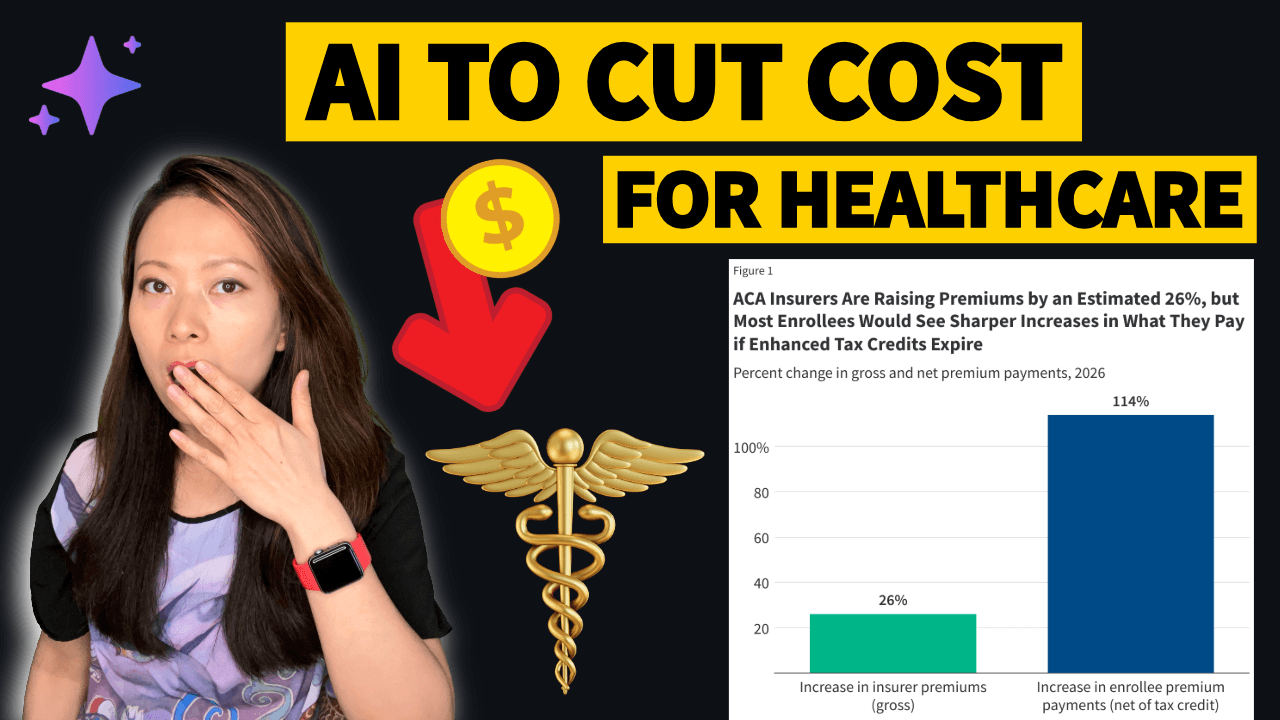
By the end of 2025, you’ve probably heard about the significant price increase that are happening to health insurance in the U.S.
What can you do with AI and other means to cut your healthcare costs in 2026? Is this even possible?
In short, employers will expect a 9% increase before plan design changes, a rate change that’s significantly higher than inflation (Christensen Group Insurance). For individuals with health insurance through the Affordable Care Act (ACA) Marketplace, the increases are much sharper. The estimated average out-of-pocket premiums projected to more than double if federal subsidies expire. Enrollees could see a net premium payments increase by an average of 114%. The Medicare Part B deductible is set to increase to $283 in 2026, a 10% increase from 2025.

U.S. healthcare can feel like a maze with no exit. It’s expensive, confusing, and emotionally draining. This is about to get much worse in 2026.
But here’s the part we don’t hear enough:
You’re not helpless.
And no, you don’t need to “hack the system,” argue with anyone, or take risks with your health.
Here at Feisworld, we are creators who are also impacted by these changes. We know AI can’t simply reduce your healthcare costs, but perhaps we can discuss what AI can do to help you prepare and ease this transition.
So we prepared this article for everyday consumers, creators, small business owners and nonprofit leaders to think creatively about how to approach healthcare in 2026.
In the past year, everyday people are quietly discovering a new kind of tool—one that makes navigating healthcare easier, cheaper, and less overwhelming. I think of it as a personal assistant for your medical life. Not a doctor, not a replacement for one, just a smart helper that keeps you organized, confident, and informed.
Let’s discuss and uncover safe, ethical, high-impact ways you can use AI to lower healthcare costs and reduce stress starting today.
1. AI to Prepare for Appointments (This Alone Saves Hundreds)
A huge portion of healthcare costs comes from miscommunication:
- forgetting symptoms,
- missing details in your history,
- walking out without asking the real questions you meant to ask.
AI can help you show up prepared by turning your thoughts into:
- A 1-page health snapshot
- A short summary of symptoms
- A clean medical timeline
- A list of the top 3–5 questions to ask your provider
- A reminder list of medications and past procedures
So how do you do this easily under pressure and time constraint?
- Open ChatGPT Voice or phone dictation.
- Talk freely for 1–2 minutes.
- Then say:
“Please summarize everything I just said into a health snapshot.”
You can use this method for nearly any AI app, not just ChatGPT.
When doctors get the full picture instantly, they make faster, better decisions.
That means fewer repeat visits, fewer unnecessary tests, and fewer “Let’s get some imaging to be safe” situations.
Savings: $100–$2,000+ per year
Bonus: Your doctor will love you for being organized.
2. AI to Decode Medical Reports, Lab Results & Discharge Notes
Medical language often feels like another universe. Many of us will receive highly technical notes that seem cryptic before we receive a letter from our doctors to explain the diagnosis.
AI can turn confusing reports into normal human language:
- MRI or CT scan impressions
- Bloodwork
- Post-surgery instructions
- Visit summaries
- Medication explanations
You can literally ask:
- “Explain this like I’m 12.”
- “What are the most important things here?”
- “Turn this into a checklist my mom can follow.”
Understanding what’s happening in your own body prevents complications and unnecessary follow-up care—which is where costs explode.
A Personal Story:
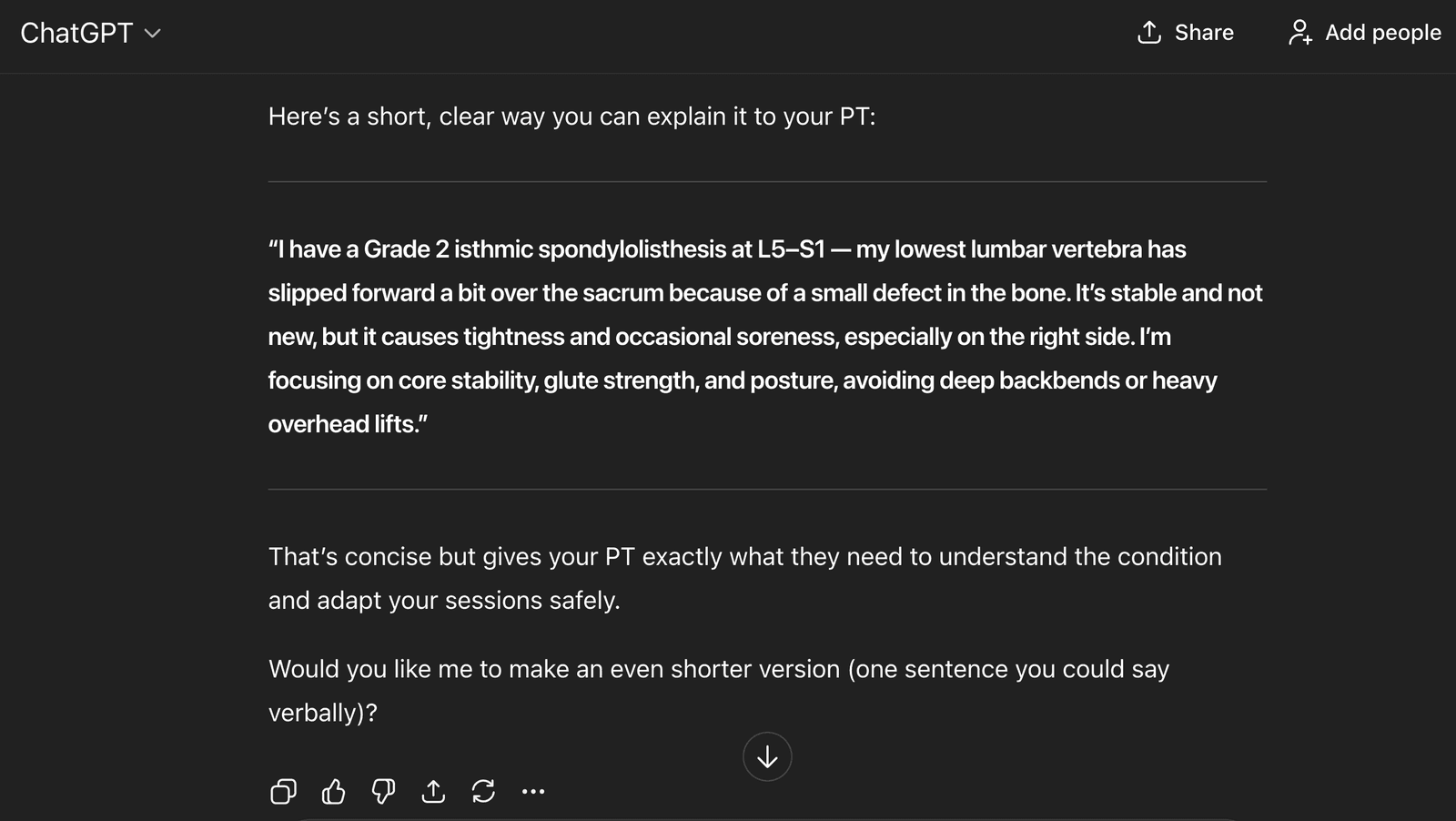
About a year ago, I received an X-ray for my lower back. It was weeks later before I received a simple letter from the doctor confirming my sciatic symptoms. Then it was weeks ago before I was able to request physical therapy (PT) referrals and secure a series of sessions. However, I wasn’t able to explain details of my diagnosis other than the symptoms I was experiencing. As a result, PT wasn’t all that effective for me and I felt even more frustrated about the little progress I was making.
When I uploaded my X-ray to ChatGPT a year later, I found out that I had Grade 2 Spondylolisthesis, specifically in L5-S1 region of my lumbar. ChatGPT was able to further clarify that it was likely due to an injury in my early childhood, provided me with a list of exercises and stretches I should consider and ones I should avoid.
This helped me pay much closer attention to the exercises I do regularly including CrossFit, yoga and barre. When I brought these details to my new physical therapist, she was able to immediately pinpoint treatments for my condition. Within a few treatment, I started to feel significant better. Above all, I felt educated and informed about my own condition and not just a general diagnosis.
3. AI to Fight Bills & Insurance Denials (AI Is Shockingly Good at This)
If you’ve ever received a denial letter or a bill that made your jaw drop, you’re not alone. Here’s where AI becomes your secret weapon.
In ChatGPT, Gemini or another AI tool of your choice, paste in:
- Insurance denials
- EOBs (Explanation of Benefits)
- Itemized hospital bills
- Financial aid forms
- CPT codes
AI can help you:
- Spot errors and duplicate charges
- Identify upcoding
- Draft appeal letters in the exact language insurers respond to
- Prepare negotiation scripts
- Understand what you’re actually being billed for
The truth:
Most denials get overturned when you push back.
Most bills shrink when you negotiate.
AI makes you much more effective even if you’ve never appealed anything in your life.
Savings: $200–$5,000+ depending on the situation
4. AI to Research the Right Place for Care
IMPORTANT
If you experience severe chest pain, sudden difficulty breathing, signs of stroke (like face drooping or slurred speech), a sudden “worst ever” headache, uncontrolled bleeding, major injuries, severe abdominal pain, signs of a serious allergic reaction, vomiting or coughing up blood, fainting, confusion, or any sudden loss of movement or sensation, go to the ER immediately. These are red-flag symptoms that should never wait.
With that said, there are non-medical emergencies that can cost differently depending on where you seek medical care:
- $0–$40 via telehealth
- $70–$120 at urgent care
- $1,200+ in the ER
Many people panic and default to the ER because the system doesn’t make triage easy. AI can help you understand where your symptoms typically fit:
- “Urgent but not an emergency”
- “Telehealth is appropriate”
- “Safe to monitor for 24–48 hours”
- “Absolute red flags—go to the ER now”
This is NOT about self-diagnosing or avoiding care. It’s about avoiding a $1,200 bill for something urgent care could’ve handled.
Once we are better educated about our health, our bodies, arguably speaking it will make our health system better and stronger as well to leave space for those who have urgent medical needs.
5. AI to Find Cheaper Medication Options
Medication prices vary wildly even for the same drug, same dosage, same pharmacy.
AI can help you:
- Ask your provider for therapeutically equivalent, lower-cost alternatives
- Find generic versions
- Compare GoodRx, SingleCare, and pharmacy cash prices
- Draft a simple ask for your doctor:
“Is there a clinically similar medication that’s more affordable?”
For chronic conditions, this can be one of the biggest money savers.
Savings: $20–$300 per month
In 2022, I had the privilege of interviewing Mark Cuban as part of Women Leaders Association webinar. That’s when I learned about GoodRx. I downloaded the app (which is free) and I was able to save so much money for me and my mom by simply showing the app to the pharmacist.
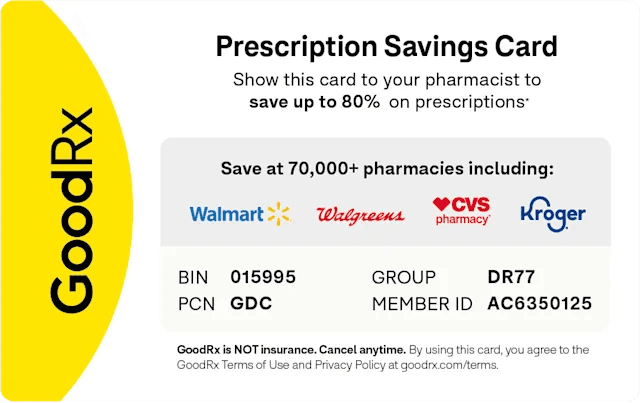
If you are using GoodRx for the first time, don’t be intimidated.
1. Go to GoodRx.com or download the GoodRx app
You don’t need an account to start searching. It works on any phone or computer.
2. Type your medication into the search bar
Enter the exact name — for example:
“Atorvastatin 20mg”
GoodRx will automatically show common doses and forms.
3. Select the correct dosage and quantity
Example:
- 20mg
- 30 tablets
- 1-month supply
This matters because prices change depending on the dose and amount.
4. Compare prices at nearby pharmacies
GoodRx shows a list of pharmacies with real prices — Walmart, CVS, Walgreens, etc.
You’ll often see big differences: a med that’s $140 at one place might be $12 somewhere else.
5. Choose the best price and tap “Get Coupon”
You can:
- Save it on your phone
- Screenshot it
- Print it
- Or just show it directly in the app
You don’t need to call ahead.
6. Bring the coupon to the pharmacy
Tell the pharmacist:
“I’m using a GoodRx coupon for this prescription.”
They’ll type in the BIN/PCN numbers from the coupon and apply the discount.
7. Pay the discounted price (often cheaper than insurance)
Many people use GoodRx instead of their insurance when the cash price is lower.
There’s nothing sketchy about this — it’s routine.
8. Optional: Ask your doctor for a 90-day prescription
90-day fills often cost less on GoodRx than three separate 30-day fills.
Additional pro tips: You can create a free account to save meds and get alerts using GoodRx.
6. Use AI as a Chronic Care Companion
Chronic conditions are exhausting to manage and they’re one of the main drivers of healthcare costs in the U.S.
AI can help you track and organize:
- Weekly symptoms
- Medication effects
- Pain patterns
- Triggers
- Dietary changes
- Wearable or CGM data
AI can also help you prepare questions before specialist visits, so nothing gets lost in the rush.
The goal isn’t to treat yourself. Rather it’s to show up organized, calm, and informed so your care team can do their best work quickly.
7. AI to Find Benefits, Discounts and Reimbursements
One of my favorite, highly underrated uses of AI is scanning long benefit statements and reimbursement guides, especially those 30–60 page PDFs from health insurers or employers.
I use Adobe Acrobat’s AI Assistant for this all the time.
Instead of reading every page, I upload the PDF and ask questions like: “Does my plan include fitness reimbursement? What are the rules? What documentation do I need? What’s the dollar limit?”
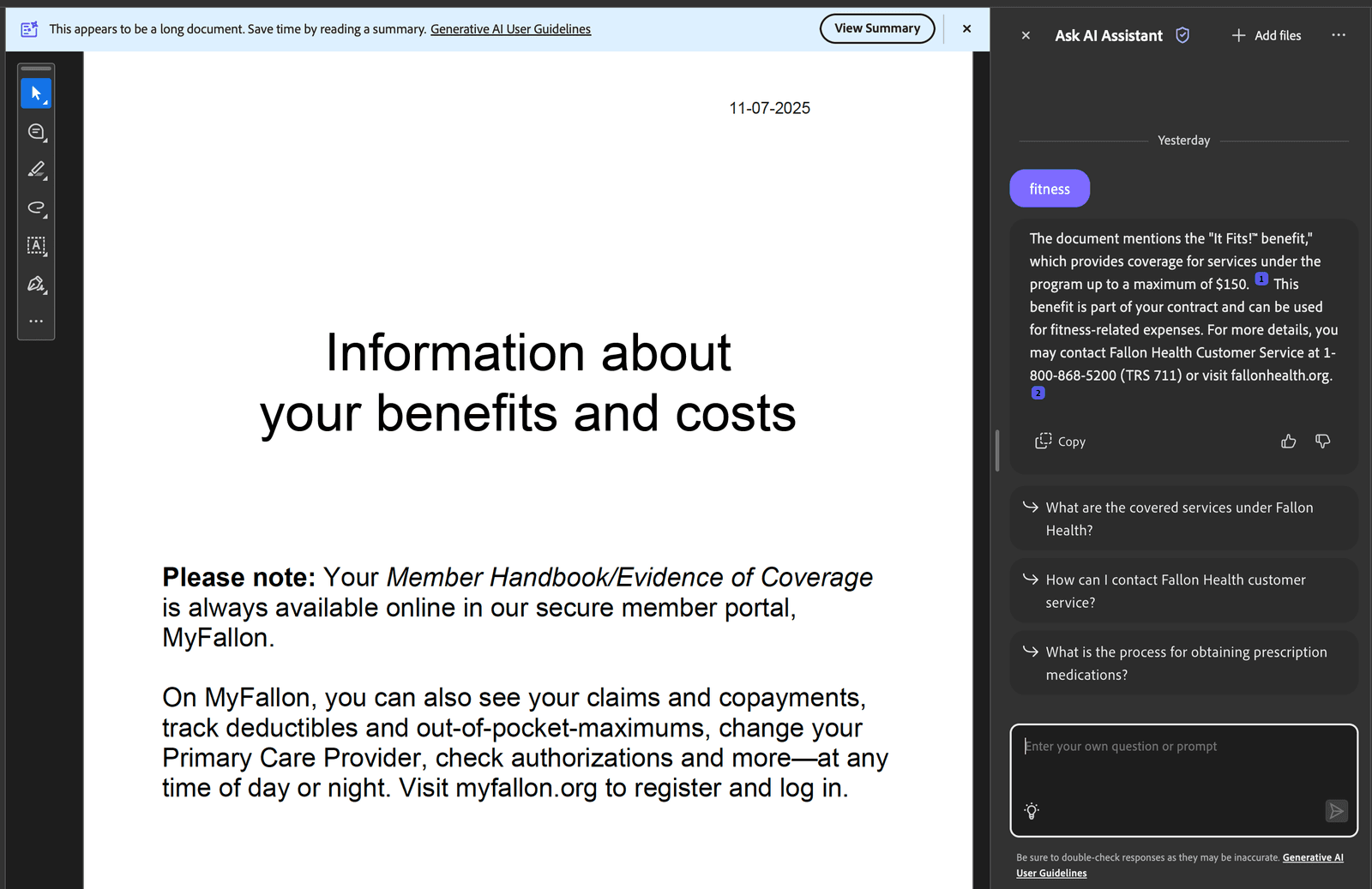
Acrobat instantly surfaces the exact paragraphs, summarizes them, and gives me a clean list of requirements.
This also works beautifully for vision and dental allowances, telehealth copay differences, out-of-network rules, HSA/FSA eligible expenses, and even yearly plan changes (like what’s new for 2026). You end up understanding your benefits better in five minutes than most people do all year—without guessing or digging through pages of fine print.
8. Organize Your Entire Health Life
Most of us don’t have the health equivalent of a “household binder.” AI can create one for you.
Ask it to build:
- A master medication list
- A diagnosis and procedure timeline
- Allergies, vaccinations, and key history
- Emergency information sheets
- Daily care checklists for aging parents
- Summaries to share with new doctors
Being organized prevents unnecessary tests, repeat imaging, and “We don’t have that on file, so we need to redo it” scenarios.
Those moments seem small—until you get the bill.
9. What AI Should Not Do
To stay safe, keep these boundaries clear. AI should never:
- Diagnose you
- Tell you to stop or change medications
- Replace medical care
- Dismiss concerning symptoms
- Override professional advice
Think of AI as a translator, organizer, researcher, and advocate—not a doctor. The safest approach is when you and your care team stay in charge, and AI helps you communicate better.
The way I think about AI as an medical assistant is what I can learn from it in addition to what my doctors provide, not instead of.
10. The Healthcare System Isn’t Getting Simpler. But You Can Be More Prepared
Using AI doesn’t magically fix the complexity of U.S. healthcare. But it does give you:
- Clarity
- Better questions
- Fewer mistakes
- Faster decisions
- Lower costs
- More control
And in a system as chaotic as ours, that’s real power.
You deserve care that makes sense, doesn’t bankrupt you, and lets you focus on living, not paperwork. AI won’t replace doctors, but it will help you show up as the most informed, empowered version of yourself.
And that alone can change everything.
You might also enjoy…

Written by
Fei WuFei Wu is the founder and CEO of Feisworld Media, a Massachusetts-based digital media company helping brands get discovered by people and by AI. An Adobe Global Ambassador and brand partner to ElevenLabs, Synthesia, and 50+ other tech and AI companies, she hosts the Feisworld Podcast (400+ episodes, 500K+ downloads — guests have included Seth Godin, Steve Wozniak, Chris Voss, and Arianna Huffington) and co-created the documentary Feisworld: Live Your Art on Amazon Prime. Fei writes for CNET, Lifehacker, and PCMag, and her work has been featured in Forbes, Harvard Business Review, and WIRED. She has been publishing on the internet since 2014 — long before AI discoverability had a name.
View all posts by Fei Wu→Stay updated
Weekly insights on content, AI, and digital media.
Keep Reading
Related Articles

Best Smart Locks for Your Home in 2026 (Researched & Compared)

The Day I Interviewed Jack Canfield (After Reading Chicken Soup 60 Times)