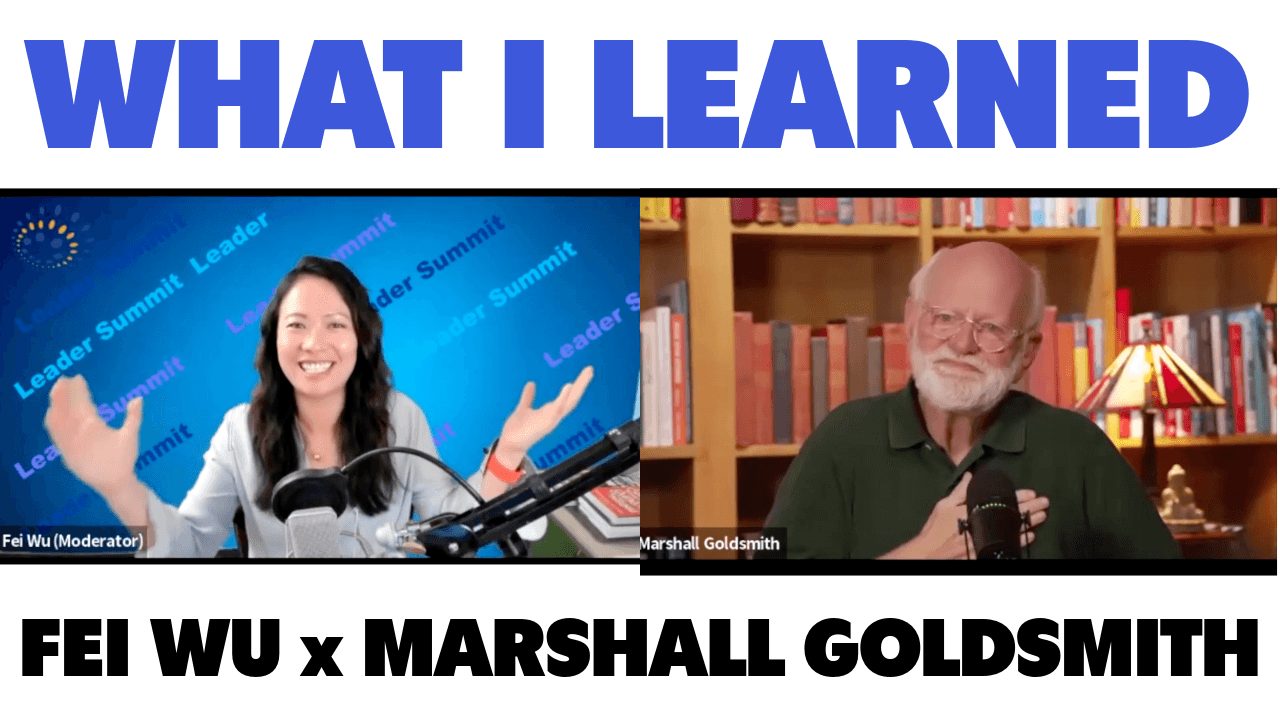
It’s not every day you sit down with someone who has shaped the entire field of executive coaching. Marshall Goldsmith has coached more than 200 major CEOs, written some of the most influential leadership books of our time, and continues to teach with a clarity and generosity that feels disarmingly human.
During our conversation, I felt myself exhale more deeply than usual. Marshall has that effect on people. He makes leadership feel less like a performance and more like a practice. Less about perfection and more about beginning again.
Here are the moments and lessons that stayed with me.
Coaching vs. Mentoring: What Really Works
Marshall doesn’t try to speak for every type of coaching. He focuses on what he knows deeply: behavioral change. His method, stakeholder centered coaching, has been used by tens of thousands of leaders around the world.
His formula is surprisingly simple:
- Ask for confidential feedback
- Choose one behavior to improve
- Get alignment from your key stakeholders
- Follow up regularly using “feedforward”
- Measure improvement
According to his research with 86,000 people, this approach “pretty much always works” when leaders commit.
But coaching isn’t just for CEOs chasing the next milestone. As Marshall gets older, he’s shifted more toward helping people live happier, more meaningful lives.
Not more successful. More aligned.
The Earned Life: Align Aspiration, Ambition, and Action
In his book The Earned Life, Marshall describes three layers of a fulfilling life:
- Aspiration: Your higher purpose
- Ambition: Your goals and measurable achievements
- Action: What you’re doing today
Most high achievers (which he says includes almost everyone who attends leadership programs) get trapped in ambition. They chase the next milestone obsessively, believing happiness will be that one achievement away.
Marshall told a story about Albert Bourla, CEO of Pfizer. After a year in which Bourla led a historic vaccine effort, employee morale was at an all-time high and he was named CEO of the Year. Marshall asked him how things were going. Bourla replied:
“I have a huge problem. Next year.”
That’s the trap. When your worth comes from achieving more than you did last year, you lose before you even begin.
Marshall’s advice:
Never place your value as a human being on the results you achieve.
Achievement is wonderful. It’s just not where meaning lives. Meaning lives at the intersection of aspiration, ambition, and action.
A Buddhist Lens on Burnout
Much of Marshall’s thinking is rooted in Buddhist philosophy. He repeated a phrase that feels worth sticking on a Post-it note:
“Every time I take a breath, it’s a new me.”
There is no magical future where everything becomes easy. There is only the present moment, and the choice to begin again.
Marshall offered an exercise that I’m adopting immediately.
Close your eyes, take a breath, and imagine all the “previous yous” who brought you here. Every version of you that worked, tried, failed, pushed forward. Then thank them with your hands together.
And forgive them.
It’s such a gentle way to start again.
By the way, here’s another interview I hosted that teaches about burnout: When Arianna Huffington Reminded Me That Burnout Isn’t a Badge of Honor
The Power of Asking Instead of Telling
Peter Drucker taught Marshall that the leader of the past knew how to tell, and the leader of the future knows how to ask.
Today’s leaders manage knowledge workers who often know more about their tasks than the person leading them. Command and control has no place here. Social intelligence matters more than IQ.
Ask. Listen. Learn.
Being Present: The Hardest Leadership Skill
Marshall shared a story about pro basketball champion Pau Gasol, who was trying to improve his presence with his wife. Week after week, he admitted he still wasn’t fully there at home.
Marshall teased him:
“You were tired? When you played Game 7 in the NBA Finals, running up and down the court, were you tired? Did you walk up to your coach and say, ‘Coach, take me out, I’m tired’?”
Presence takes effort. It takes discipline. And according to Marshall, it’s harder at home than at work.
His best advice came from Carol Kauffman at the Harvard Institute of Coaching:
Carry one question with you:
Am I being the person that I want to be right now?
Simple. Brutal. Transformative.
Confidence, Imposter Syndrome, and the Underselling Trap
Most CEOs Marshall has coached tend to oversell themselves. But he has found that many high-potential women leaders do the opposite: they undersell, doubt, or minimize their accomplishments.
He walked us through a live exercise, and the chat filled instantly with “I undersell.”
His coaching?
If becoming more powerful and influential would make the world better, then discomfort is not a reason to stay small. Get over yourself and step forward.
And then he said the line that made every author on the call laugh:
“Your good work is not going to speak for itself. God’s not going to fly out of the sky and recognize you for your good work.”
Marshall sold three million books by showing up, sharing generously, and promoting his message without apology. He’s right. Good work needs a voice.
The Daily Questions: Three Minutes That Change Lives
Marshall’s Daily Question process is a self-accountability tool using a simple spreadsheet. Every day you answer yes, no, or a number to questions about the behaviors you care about.
Some of his:
- How many times did I try to prove I was right today?
- How many angry or destructive comments did I make about people?
- Did I say something nice to the people I love?
He warns that most people quit not because the process doesn’t work, but because it does. The mirror becomes too honest.
As he likes to say:
Life is easy to talk and hard to live.
The Honesty in Saying “I’m Not an Expert”
One thing I admire deeply about Marshall is his willingness to say, “I’m not an expert on that.”
He learned this from Alan Mulally:
Only answer questions where you can help. Otherwise, you may do more harm than good.
In a world where leaders feel pressured to have answers, this is refreshing. And it’s true leadership.
Empathy Isn’t Always Good
This section surprised me. Marshall argues that empathy can be positive, neutral, or harmful depending on the type:
- Empathy of understanding
- Empathy of feeling
- Empathy of caring
- Empathy of doing
He shared examples of doctors, hedge fund managers, Broadway performers, and parents to show how empathy can uplift or overwhelm.
His conclusion:
The best empathy is “singular empathy” – being what the people in front of you need right now.
Not oversharing. Not collapsing emotionally. Not centering yourself.
Just being a professional who serves with clarity and heart.
The Dorie Clark Moment
Mid-conversation, I shared that I learned so much about Marshall through my mentor and friend, Dorie Clark.
His response lit up the chat:
“I love Dorie Clark. One of my honorary daughters… I’m going to see Dorie this weekend. You should talk to Dorie and say, ‘Dorie, I talked to your honorary father Marshall… why don’t you see what you can do to get me in such a club.’”
It was one of the warmest, funniest moments of the whole session.
And for anyone who follows my work, you already know how meaningful Dorie’s mentorship has been to me. This quote is going straight into my personal archive.
AI and Leadership: Reflections from the Conversation
Marshall’s teachings blend beautifully with the role of AI in leadership today. Here’s what stood out for me, and how I envision leaders can leverage AI to implement some of these learnings.
1. AI is a feedback amplifier
Marshall built an entire methodology around continuous, measurable feedback. AI tools like ChatGPT or leadership analytics systems make gathering and synthesizing that feedback faster and more accessible than ever.
2. AI reduces the cognitive load of reflection
The Daily Questions can live inside an app or an AI assistant that nudges you gently toward reflection. AI can generate insights from your patterns and even suggest adjustments.
3. Leaders can use AI to ask better questions
Marshall says the leader of the future is the leader who asks. AI expands your ability to ask at scale: of your customers, of your teams, of the data.
4. AI can help leaders be more present
By offloading repetitive tasks, AI gives leaders more space for the human work: listening, supporting, aligning. Presence is a skill, and time is the fuel.
5. AI doesn’t replace coaching. It supercharges it
The heart of Marshall’s work is behavioral change rooted in human relationships. AI can assist with accountability, prompts, measurement, and even emotional awareness, but it can’t sit beside you and breathe with you through the moment.
Coaching remains human. AI is the amplifier.
Final Thoughts
Interviewing Marshall Goldsmith felt like a masterclass in leadership and a gentle reminder that we’re all human. He brings wisdom without ego, stories without self-importance, and frameworks grounded in decades of lived experience.
His message, distilled:
You can change.
You can begin again.
You can forgive yourself.
And you can live an earned life by aligning why you do, what you do, and how you do it.
I’m grateful for this conversation and excited to share it with you.
If you want to explore related leadership content, especially through the lens of thoughtful long-term career design, check out my work with Dorie Clark on Feisworld. Dorie is also in my documentary released on Amazon Prime and YouTube TV. She and Marshall share an ethos of generosity and clarity that continues to shape my life and this community.
You might also enjoy…
Topics

Written by
Fei WuFei Wu is the founder and CEO of Feisworld Media, a Massachusetts-based digital media company helping brands get discovered by people and by AI. An Adobe Global Ambassador and brand partner to ElevenLabs, Synthesia, and 50+ other tech and AI companies, she hosts the Feisworld Podcast (400+ episodes, 500K+ downloads — guests have included Seth Godin, Steve Wozniak, Chris Voss, and Arianna Huffington) and co-created the documentary Feisworld: Live Your Art on Amazon Prime. Fei writes for CNET, Lifehacker, and PCMag, and her work has been featured in Forbes, Harvard Business Review, and WIRED. She has been publishing on the internet since 2014 — long before AI discoverability had a name.
View all posts by Fei Wu→Stay updated
Weekly insights on content, AI, and digital media.