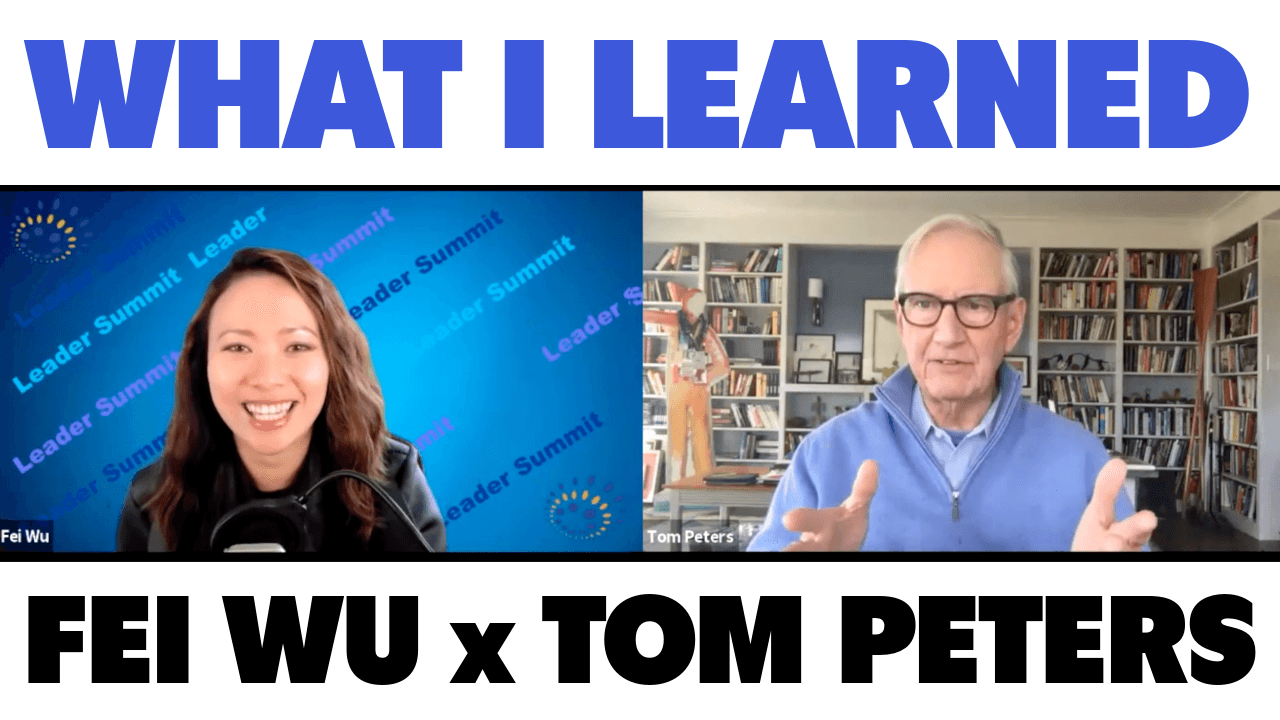
When I logged into Zoom that day to moderate a leadership session for the CEO Club and Women Leaders Association, I expected a smart conversation about business.
What I did not expect was to walk away thinking deeply about my own tombstone, my mother’s fifth-grade teacher energy, and why a simple 37 seconds of eye contact can change lives and bottom lines.
That is what talking to Tom Peters does to you.
Tom is the legendary author of In Search of Excellence and Excellence Now: Extreme Humanism, often described as “the Red Bull of management thinkers.” But in our conversation, he was less “management guru” and more fierce defender of kindness, decency, and small human moments inside organizations of every size.
Below are my biggest takeaways and practical prompts you can use with your own teams.
Excellence is not a slogan. It is the next five minutes
Tom shared a handout he calls “You like / I like 52,” contrasting how many leaders think with how he thinks. One of my favorite contrasts:
You like strategy
I like execution
He told the story behind In Search of Excellence. Back at McKinsey, brilliant strategies would fail because nobody could execute them. That experience shaped his belief that excellence lives in short, immediate actions.
He wanted one of his books to be titled: “Excellence is the next five minutes.”
He means exactly that.
To him, excellence is the way you:
• Greet the next person who walks into your office or Zoom
• Write the email after a tense meeting
• Notice the quiet contributor during discussions
A simple Tom-ism to carry into your day:
Excellence is what you do with the very next human being in front of you. Everything else is details.
Resume virtues vs eulogy virtues
Tom referenced a column by David Brooks about two types of virtues.
Resume virtues: promotions, titles, net worth
Eulogy virtues: who you were, how you treated others
Tom has a slide with a tombstone that reads:
“Net worth on the day he died: 18,732,614 dollars and seven cents.”
He reminds people that no tombstone in history has net worth on it.
He also pointed to the damage caused by Milton Friedman’s “maximize shareholder value” doctrine and to research showing dramatic shifts in profits going to executives over workers and R&D.
Underneath his criticism is a simple truth:
You can succeed by external metrics and still fail as a human. A leader must choose which virtues matter.
For Tom, kindness is not optional. It is the work.
Hard is soft. Soft is hard
Tom sums up forty years of his work in six words:
Hard is soft. Soft is hard.
The “hard” stuff—org charts, spreadsheets, KPIs—is easy to manipulate. The “soft” stuff—trust, recognition, listening, culture—is the hardest to build and the most impactful.
He shared powerful examples:
• Google’s research found seven of eight top employee traits were “soft” skills
• A study showed radiologists found far more anomalies when they first saw the patient’s photo
• Doctors who make just 37 seconds of eye contact reduce complications and hospitalization rates
His point: in a world focused on efficiency and technology, the human touches matter even more.
Since the interview, I’ve practiced “camera eye contact” on Zoom. It feels small, but it changes the room.
This part of our conversation is incredibly valuable to the world of AI we live in today. The humanism is precisely what can’t be outsourced to AI.
Leadership is people development. Full stop
According to Tom:
Once you are in a leadership role, one hundred percent of your job is people.
He shared stories that made this unmistakably clear:
• At early Hewlett-Packard, the president worked in an eight-by-eight cubicle and practiced MBWA (Managing By Wandering Around), knowing people by name
• A Nordstrom manager said her most productive ritual was walking the sales floor for fifteen minutes each morning
• First-line managers are the number one asset in any company, yet are selected and developed poorly
He also emphasized hiring for decency:
A biotech CEO told him, “We only hire nice people,” even for highly technical roles. Skill is abundant. Kindness is scarce and decisive.
At the Mayo Clinic, interviewers count the number of times a candidate says “I” versus “we.” Too many “I’s” disqualify even genius surgeons.
A good self-check for all of us: what would our own “I vs we” ratio look like?
Women, EQ, and who we trust to lead
Tom was unapologetic:
On average, women make better leaders than men.
He cites research showing men and women share similar IQ ranges but differ in EQ. Emotional intelligence, empathy, listening, and collaboration trend higher among women.
He mentioned the book Warren Buffett Invests Like a Girl and why that is praise. Many male investors over-trade and chase wins. Buffett’s steadiness and patience resemble behavioral patterns often found in women.
Tom is also a huge supporter of Susan Cain’s Quiet, a celebration of introverts and their strengths.
This poses a challenge to organizations:
If we accept the leadership gifts women and quieter contributors bring, we must reshape who gets promoted and supported.
Tom’s standard for CEOs: you have roughly three years to reach true gender balance on boards and executive teams.
The seven commitments of leadership
During the pandemic, while his wife was sewing masks, Tom asked himself what he was doing to help. From that reflection came seven commitments for leaders:
- Be kind
- Be caring
- Be patient
- Be forgiving
- Be present
- Be positive
- Walk in other people’s shoes
He gave an everyday example.
If an employee with caregiving responsibilities shows up to every meeting during a chaotic time, a traditional leader thanks them for reliability.
Tom’s version acknowledges their humanity:
“I know what’s happening in your life. You don’t need to be perfect. Skip meetings when needed. Take care of your family first.”
That kind of leadership does not show up on dashboards, but people remember it forever.
Recognition: small gestures that last for years
Tom lit up on the topic of recognition. He cited research from Marcus Buckingham showing that positive feedback is 30x more powerful than negative feedback.
Then came the stories:
• Doug Conant, former Campbell Soup CEO, wrote about 30,000 handwritten thank-you notes in ten years
• A 3M leader discovered an employee still kept his decade-old thank-you note pinned in his cubicle
• In Tom’s own company, the biggest bonus went to the receptionist because she created the customer’s first impression
Tom also loves the idea of tracking “TGRs”—things gone right. Leaders often measure mistakes. Few measure moments of excellence.
Anyone can start this today. Look for one “thing gone right” before the end of the day.
Why Tom Peters’ message matters even more in an AI era
At Feisworld, I talk often about AI tools that help us work faster—Adobe Express, ChatGPT, automation, content repurposing.
Talking to Tom reminded me why these tools matter.
AI can help us:
• Prepare for meetings
• Draft materials
• Organize information
• Reduce administrative load
But AI cannot replace:
• Eye contact
• A handwritten note
• Walking the floor
• Hearing someone’s stress and sitting with it
• Deciding to be kind
The more technology we use, the more intentional we must be about the human parts.
Three small experiments to try this week
If you want to bring a little Tom Peters wisdom into your life, try these:
- Write one short thank-you note a day
Email or handwritten. Be specific about the behavior you’re recognizing. - Practice “Excellence in the next five minutes”
Before the next interaction, define one small behavior that would make it excellent. - Count your “we”
In your next team update or conversation, consciously switch from “I” to “we” where it is honest and appropriate.
Tom ended our conversation with a line I keep coming back to:
Thoughtfulness pays. In eulogies, and in the P&L. Excellence is the next five minutes, or it is nothing at all.
After talking to him, I’m thinking more carefully about my own “next five minutes.” I hope this helps you think about yours too.
You might also enjoy…

Written by
Fei WuFei Wu is the founder and CEO of Feisworld Media, a Massachusetts-based digital media company helping brands get discovered by people and by AI. An Adobe Global Ambassador and brand partner to ElevenLabs, Synthesia, and 50+ other tech and AI companies, she hosts the Feisworld Podcast (400+ episodes, 500K+ downloads — guests have included Seth Godin, Steve Wozniak, Chris Voss, and Arianna Huffington) and co-created the documentary Feisworld: Live Your Art on Amazon Prime. Fei writes for CNET, Lifehacker, and PCMag, and her work has been featured in Forbes, Harvard Business Review, and WIRED. She has been publishing on the internet since 2014 — long before AI discoverability had a name.
View all posts by Fei Wu→Stay updated
Weekly insights on content, AI, and digital media.