When I first walked into a Whole Foods at the age 18, I didn’t have the language for what I was feeling. I just knew I wanted to stay. At the time I was a freshman at Northeastern University. There was a Whole Foods Market steps away from my dorm. I’d wander the aisles like I was in a museum, picking up products I’d never seen before, reading labels, discovering new foods.
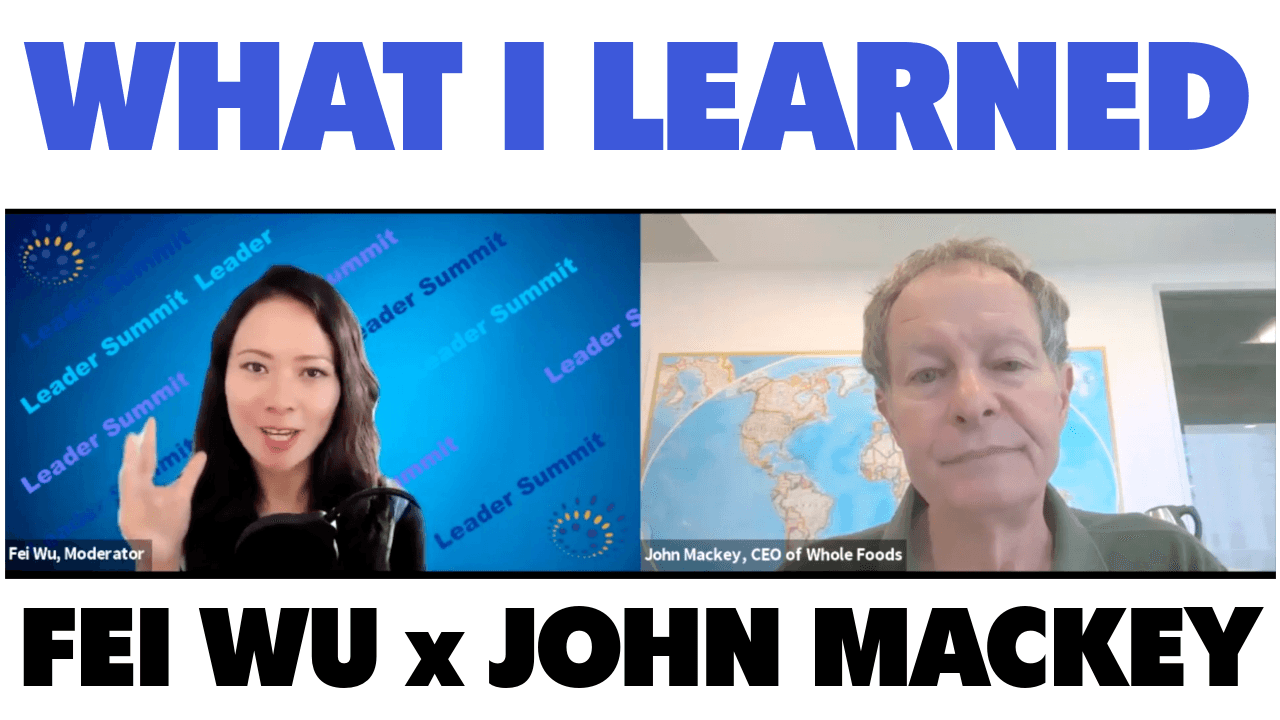
Years later, moderating a fireside chat with John Mackey, co-founder and CEO of Whole Foods Market and co-author of Conscious Capitalism, I finally heard the words for that feeling: purpose, beauty, service, and love.
This wasn’t just a chat about groceries. It was a masterclass in how to build a company (or a one-person business, or a creative practice) that people want to belong to — and yes, what that means in a world where data, AI and tech are everywhere.
Below are my biggest takeaways, woven with what I heard on stage and what I’ve lived as a small creator running Feisworld.
Note: John Mackey and I didn’t specifically talk about AI and this interview came before the popularity of ChatGPT and other LLMs. However, reflecting on our conversation taught me more about how we need to think about business, content and AI.
1. Higher purpose is already in you — it just isn’t always articulated
John said something that really stuck with me:
“Most businesses already have a higher purpose baked into the founders. It’s just not always conscious or articulated.”
Founders are usually “on fire” about something — they want to change the world in some specific way. That fire is the higher purpose. Early on, they’re too busy living it to describe it. Only later, with reflection, do they realize what it always was.
At Whole Foods, that higher purpose showed up in how they thought about food:
- Nourishing people, not just selling products
- Elevating health, vitality, joy
- Making the experience of buying food feel different
John’s reminder to “put purpose first” wasn’t abstract. He warned that if purpose isn’t explicit and protected, it gets crowded out by short-term profit pressures, metrics, and “just this quarter” decisions.
Feisworld reflection:
I didn’t start Feisworld thinking, “My higher purpose is XYZ.” I just knew I wanted to create stories and tools that help people — especially small creators, immigrants, and multi-hyphenate humans — feel less alone and more capable.
If you’re building something right now (a business, a course, a podcast, a Substack, a team inside a large company), one simple exercise from this conversation is:
- Ask yourself: What am I on fire about?
- Then ask: How is that fire already showing up in what I do, even if I’ve never written a purpose statement?
That’s your starting point. You can use AI tools to help you draft a “purpose narrative,” but the raw material has to come from your own emotion and history.
2. Passion is your internal GPS
There’s a quote John loves:
“Don’t ask kids what they want to be when they grow up. Ask them what they love to do.”
He expanded on that: our emotions are “windows into our souls.” The things that excite us, obsess us, and move us — those are clues. Life is too short, he said, not to align our work with what we care about most.
When work and values line up, “it stops feeling like work and starts feeling like play.”
Feisworld reflection:
This line made me tear up a little. I’ve had many moments where editing a video at 1am or rewriting a script for the 5th time didn’t feel like “overtime” — it felt like play. The same with helping my mom, Xiang Li, bring her art to major museums.
Passion also shows up in how we approach technology and AI:
- If you love helping people learn, then AI becomes a way to scale that teaching.
- If you love design, AI becomes a collaborator to explore more options, faster.
- If you love community, AI helps you listen and respond at scale — without losing the human heartbeat.
Ask yourself: What do I actually look forward to doing? Then let that guide which tech and AI tools you adopt — not the other way around.
3. Design for beauty, not just utility
When I asked John about visualization and store experience, he didn’t go to “layout optimization” or “conversion funnels.” He went straight to beauty.
He said our spirits need beauty the way our bodies need vitamin B. Most buildings we spend time in — offices, hospitals, even some schools — are purely utilitarian. Functional, but dead.
Whole Foods deliberately designed stores to be beautiful and energizing:
- Warm lighting, fresh colors, open spaces
- Team members who actually enjoy being there
- An atmosphere where people say, “I don’t know why, I just like being here”
That’s not an accident; it’s a design choice.
Feisworld reflection (and AI twist):
In a digital and AI-heavy world, we can forget that our users still feel their way through experiences. Whether it’s:
- A landing page built with web tools and AI design assistants
- A video thumbnail generated with AI
- A podcast script drafted in ChatGPT
The question remains: Is it beautiful? Does it feel good to be here?
AI can help us iterate layouts, test colors, and generate variations, but that quiet sense of “this feels like a place I want to stay” still comes from human taste and care.
4. Profit is a byproduct, not the goal
One of John’s most powerful analogies compared profit to happiness:
- If you chase happiness directly, obsessing over “Am I happy yet?”, it becomes elusive.
- But if you serve others, love deeply, and live a meaningful life, happiness tends to show up as a result.
Profit works the same way. If you focus solely on maximizing profit, you usually sub-optimize it in the long run.
Profit is a result of:
- Creating real value for customers
- Living your higher purpose
- Building a culture where people flourish
- Innovating continuously
You still measure it. You still care about it. But you don’t worship it.
Feisworld reflection:
This is a huge lesson for creators and tech founders in the AI space:
- If your only question is “How do we monetize this AI thing?” you’ll probably end up with something extractive or gimmicky.
- If your primary question is “How can this AI help someone solve a real problem or feel more seen?”, the revenue has a better chance of following.
For Feisworld, the best partnerships (Adobe, healthcare content, small business tools) came when I focused first on: “Is this genuinely helping my audience?” The money conversations came after.
5. Innovation requires safety to fail
We also talked about innovation. Whole Foods essentially created a new category of grocery: natural and organic supermarkets at scale. Then everyone tried to copy them.
John’s view: in the long run, innovation is the only durable competitive advantage. Everything else can be copied.
How do you build an innovative culture?
- Talk about it constantly – make innovation explicit, not accidental
- Reward successes – and when something works, study it and scale it
- Don’t over-punish failure – people will make mistakes if they’re truly experimenting
- Learn from competitors and other industries – innovation doesn’t respect category boundaries
One powerful line was about emotionally releasing failed ideas: if the market isn’t buying, if customers don’t like it, you have to let it go, even if you loved the idea.
Feisworld reflection (and where AI comes in):
Innovation is where AI can be a gift and a trap:
AI makes it cheap and fast to try new things (scripts, thumbnails, formats, funnels).
It also makes it tempting to throw “more content” at a problem instead of stepping back and asking: Is this actually working?
The Mackey takeaway for me:
- Use AI to experiment faster.
- Use your human judgment to kill what’s not working and double down on what truly serves your people.
6. Think like a stakeholder system, not a hero
Whole Foods’ survival story after a catastrophic flood in 1981 became John’s early lesson in stakeholder interdependence.
The company didn’t survive because John was a hero. It survived because:
- Customers cared enough to help
- Suppliers extended grace instead of cutting ties
- Employees showed up
- The community wanted them to exist
From that point on, John started seeing the business as a stakeholder system:
- Customers
- Team members
- Suppliers
- Investors
- The communities they serve
He uses a deceptively simple question for big decisions:
“Are any stakeholders losing in this decision?”
If the answer is yes — if customers, employees, suppliers or communities are clearly harmed — it’s probably a bad strategy in the long run, even if the numbers look good in the short term.
For a small creator or tech business, your stakeholder system might look like:
- Audience / users
- Clients or customers
- Collaborators and contractors
- Platform partners (YouTube, Substack, sponsors, vendors)
- Your own family and health
It’s easy to make decisions that secretly “charge” one stakeholder – like burning yourself out to serve everyone else, or over-serving one client while neglecting your wider audience.
John’s question is a powerful check:
- Is my audience winning?
- Are my clients winning?
- Am I (and my team/family) winning?
- Are my sponsors/partners winning?
If not, how can I adjust this strategy to create more win-win-win outcomes?
7. Metrics matter – but so does what you choose to measure
John acknowledged that financial metrics are well developed. We know how to measure revenue, profit, margins.
But he also walked through simple, human-centered metrics for each stakeholder:
For customers:
- Repeat business
- Sales growth
- Net Promoter Score
- Quality of feedback and complaints
For employees:
- Turnover rates
- Cultural surveys over time
- Sentiment around leadership, pay, growth
For suppliers:
- Regular check-ins and surveys
- Depth of relationship with the “vital 20%” of suppliers
For investors:
- Honest, ongoing conversations – or, in public markets, whether they’re “voting with their feet” by staying or leaving
He also noted that after merging with Amazon, Whole Foods became far more data-driven — leveraging modern analytics to become a better company.
Feisworld reflection (and AI angle):
We now live in a world where:
- Even the smallest business can use AI to analyze survey results, review comments, track churn, and surface patterns.
- Tools like ChatGPT can help you turn messy feedback into clear themes and next steps.
But the heart of John’s point is timeless:
Don’t just measure what’s easy. Measure what helps you serve people better.
8. Lead with love in a competitive, tech-driven world
Maybe my favorite part of our conversation was when John talked about love.
He believes two things hold teams together over the long run (assuming pay is fair):
- Purpose – feeling that your work matters
- Love – feeling truly cared for
Love, he says, has been banished from the workplace because our business metaphors are all war and survival:
- “It’s a jungle out there”
- “Survival of the fittest”
- “Crush the competition”
In that worldview, love looks weak. There’s “no time” for it. But in practice, organizations flourish when people can bring their whole selves to work — when they feel seen, safe, and appreciated.
You can be competitive, data-driven, AI-powered and lead with love. These are not opposites.
Feisworld reflection:
This is the tension so many of us feel right now:
- We’re told to automate, optimize, integrate AI everywhere.
- At the same time, we’re craving real connection, belonging, and humanity.
John’s answer is a beautiful compass:
- Use technology and AI to free yourself from busywork.
- Use the time and attention you gain to deepen love and purpose in your work: more listening, more mentoring, more thoughtful creation.
Final reflection: What will you design your “Whole Foods” around?
You don’t need 500 stores, an Amazon merger, or a bestselling book to apply what John Mackey shared.
Whether you’re:
- Running a small business
- Leading a team inside a large organization
- Building AI products
- Creating content as a solopreneur
You can ask:
- What higher purpose has been quietly driving me all along?
- What do I actually love doing — and how can I align more of my work around that?
- How can I design more beauty into the experiences I create?
- Am I treating profit as a result of serving people — or as the only goal?
- Where can I experiment more boldly, and be kinder to myself and my team when things fail?
- Who are my stakeholders, and is anyone consistently losing?
- How can I use data and AI to measure what truly matters, not just what’s convenient?
- Where can I lead with more love?
Moderating this session with John felt less like interviewing a CEO and more like sitting with a philosopher of business — someone who believes that companies can be places of purpose, joy, and human flourishing.
You might also enjoy…

Written by
Fei WuFei Wu is the founder and CEO of Feisworld Media, a Massachusetts-based digital media company helping brands get discovered by people and by AI. An Adobe Global Ambassador and brand partner to ElevenLabs, Synthesia, and 50+ other tech and AI companies, she hosts the Feisworld Podcast (400+ episodes, 500K+ downloads — guests have included Seth Godin, Steve Wozniak, Chris Voss, and Arianna Huffington) and co-created the documentary Feisworld: Live Your Art on Amazon Prime. Fei writes for CNET, Lifehacker, and PCMag, and her work has been featured in Forbes, Harvard Business Review, and WIRED. She has been publishing on the internet since 2014 — long before AI discoverability had a name.
View all posts by Fei Wu→Stay updated
Weekly insights on content, AI, and digital media.