Joanne Lipman on Mentors, Untapped Talent and Why Women Should Stop Waiting to Be Perfect
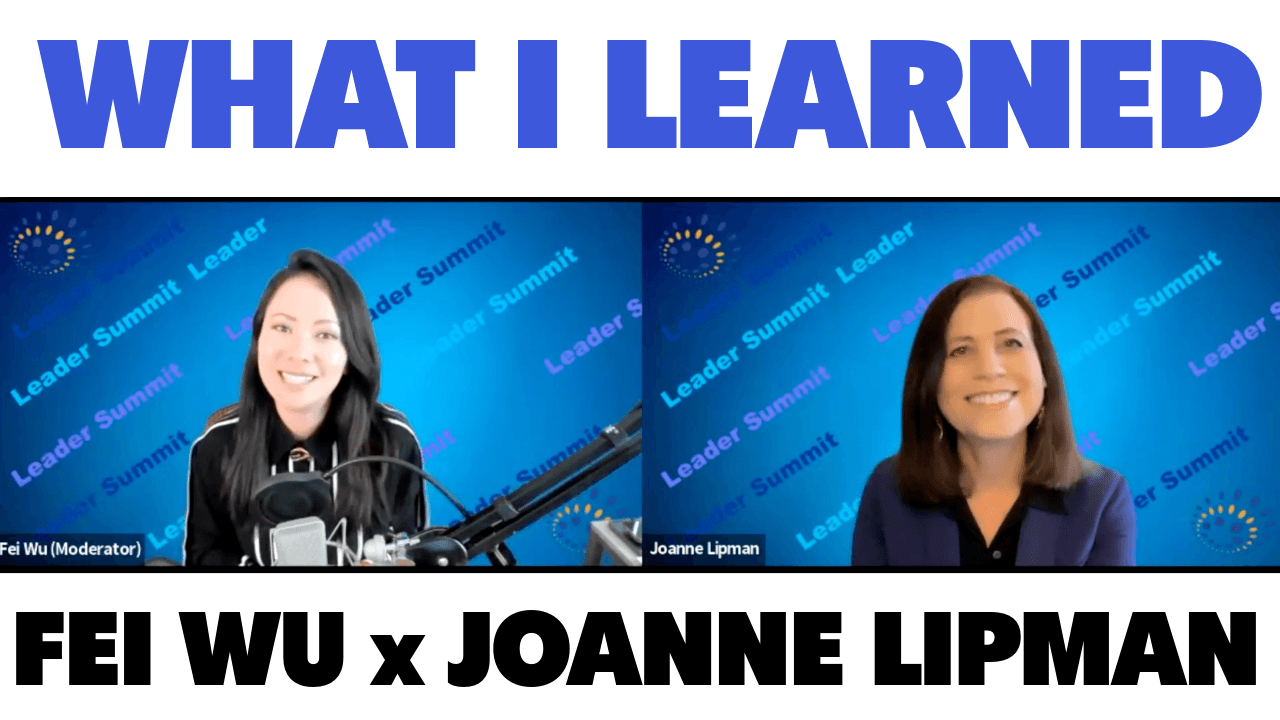
When I introduced Joanne Lipman at the Women Leaders Association quarterly summit, I had to take a breath.
She has led some of the most respected newsrooms in the world
- USA Today
- USA Today Network
- Condé Nast Portfolio
- The Wall Street Journal’s Weekend Journal
Under her leadership, those organizations earned six Pulitzer Prizes.
She is also the author of the number one bestseller That’s What She Said, a powerful book on closing the gender gap that Mark Cuban referenced multiple times earlier in the summit. Joanne is now an on air contributor at CNBC and a journalism lecturer at Yale.
But what impressed me most in our conversation was not just her resume. It was how honest she was about doubt, guilt and the messy reality of building a career while raising children and trying to fix a system that was not designed for women in the first place.
This post is my reflection on our conversation, Feisworld style. 🙂
The Power of Mentors Who Keep You on the List
Joanne started with something deceptively simple. Her “success” is a team effort. But that team did not magically appear.
Right out of college, she joined The Wall Street Journal as an intern, then as a reporter. From the very beginning she had mentors who did something many leaders still fail to do. When she became a young mother, they did not quietly remove her from the list of opportunities.
For about five years, while her kids were babies, she declined promotions and chances to throw her hat in the ring. Many women know this season very well. You still want a career, but your life is full of diapers, daycare, maybe aging parents, and constant fatigue.
Her bosses did something remarkable. They kept asking.
They did not punish her for saying no. They did not decide she was “less ambitious” or “not committed”. By the time her youngest went to kindergarten and Joanne was ready to sprint again, she was still at the top of their list.
That one leadership choice changed the trajectory of her whole career.
Listening to this, I thought about how many talented women never get that second chance. Not because they are less capable, but because a manager made a quiet decision to stop inviting them.
Diversity Was the Outcome, Not the Input
When Joanne first became a news leader and was finally able to build her own team, she did not set out to “create a diverse team”. She simply looked for the best people.
The result?
A team that was roughly half men and half women. Diversity across race, ethnicity and sexuality
It happened because she removed the mental shortcuts and familiar patterns like “people who look like me” or “people who talk like me”. She looked for talent and potential.
Her early mentors had told her to surround herself with people who were smarter than she was. It sounds like a leadership cliché, but you can feel how seriously she took it.
Mentorship Is Not “Will You Be My Mentor?”
I asked Joanne about mentorship because we often talk about it like a structured program. Someone is “assigned” to you. There is a kickoff, a calendar invite, a form.
She flipped that thinking.
It usually does not work to go up to someone and say “will you be my mentor”. True mentorship is a relationship that grows over time. But she also put the responsibility on senior leaders, not just on junior people who are already juggling everything.
We all tend to gravitate toward people who remind us of ourselves. That is human. It also means that in a world where most senior roles are still held by men, men are more likely to mentor other men. Women, people of color and anyone who falls into an “out group” get fewer stretch assignments and fewer second chances.
Joanne shared how her male mentors found ways to build relationships without awkwardness or risk. No golf outings that she would hate. Instead they invited her and her boyfriend to dinner, or later brought their families together for barbecues when their kids were similar ages.
It was personal without crossing lines. It built trust that carried over into work.
For leaders today, especially men, this is a practical model. Mentorship does not have to mean late night drinks or closed door meetings. It can look like family events, group coffees, project based support and intentional sponsorship.
Gender Equity Is Not a “Women’s Issue”
The story behind That’s What She Said began with an aha moment.
Joanne kept getting invited to women’s leadership conferences. They felt great. Women sharing with women is powerful. But she realized something important.
Women talking to women is only half a conversation.
Gender is not a “women’s issue”. It is an everybody issue. If only women are in the room, the system does not change.
She wrote an article for The Wall Street Journal called “Women at Work. A Guide for Men.” That piece and the feedback that followed became the seed for her book.
What surprised her most when researching the book was not the stories themselves. It was how many of the issues women deal with every day are invisible to men. Not because men are evil, but because they do not personally experience them.
- Women interrupted three times more often than men, including female Supreme Court justices.
- Ideas ignored when first raised by a woman, then celebrated when repeated by a man.
- Women blaming themselves for patterns that almost every other woman in the room has lived through.
When she asks a live audience of women how many have had the “Bob’s great idea” experience, nearly every hand goes up.
The painful part is that many women think it is just them.
Why “Women Leave for Kids” Is Not the Real Story
One of the strongest moments in our conversation came from a question in the chat.
HR keeps saying the gender wage gap exists because women take time off to have or raise children.
What did she think?
Joanne did not hedge. She said there is a technical term for that assertion. It is “not true”.
Research shows:
Women’s careers often stall in their 30s whether or not they are married, whether or not they have children.
The gap starts even earlier. From the very first promotion, for every 100 men promoted, only around 85 women are promoted and even fewer women of color. That is before babies, before elder care, before any “family excuse”.
Women are given fewer stretch assignments, less access to big clients and high impact projects, fewer mentors. Then companies turn around and say “they are not performing as well”.
She also introduced a phrase I have not stopped thinking about:
Belonging uncertainty
The guys go out to lunch.
There is a “meeting before the meeting”.
People talk about last night’s game and you are not in that loop.
No one tells you “we don’t want women here”. The signals are subtle. They accumulate. You do not feel a strong connection to your organization, especially compared to the connection you feel to your family.
So when companies say “women leave because of kids”, they are missing the truth. Women leave because they do not feel seen, supported or valued.
Returnships and the Untapped Talent of Parents
Joanne calls parents who step out of the workforce one of America’s greatest untapped resources.
She loves the idea of “returnships”. If your company already has internships, you have the structure you need. A returnship does the same thing for people with gaps in their resume.
That includes:
- Women who stepped back while their children were young
- People returning from the military
- People who were out for illness or family responsibilities
It refreshes their skills, creates a current reference and removes the automatic rejection that happens when resume filters kill anything with a gap.
Beyond formal programs, she reminded us that women’s careers often move in three phases
- All in
- Stuck or stalled
- Reinvention
Many women reinvent outside their original field because they are pushed out and boxed in. Imagine the possibilities if companies designed for those phases instead of punishing them.
Everyday Moves That Change Meetings for Women
Some of my favorite parts of That’s What She Said and of our conversation are the practical moves anyone can use in a meeting. She shared several.
Interrupt the interrupters
If Lisa is being cut off, anyone can say “Lisa was speaking, I would love to hear her finish”.
Brag buddies
You and a colleague share your achievements with each other, then you talk each other up. It works especially well because research shows men are liked more when they brag, women are often liked less. Having someone else advocate for you changes that dynamic.
Amplification
Repeat and credit women by name. “I want to go back to what Lisa said earlier. That idea about X is important because…” This makes it harder for the idea to be quietly reassigned to someone else later.
None of these require a new policy. They require awareness, intention and a bit of courage.
Remote Work, Hybrid Teams and Proximity Bias
We also talked about motivation and engagement in a digital and hybrid world.
Joanne is clear: Everyone on a team, no matter how junior, should feel invited to contribute ideas. This is not just “nice”. It drives innovation and better decisions.
She shared a story from BASF where a simple accident with insulating foam and spilled coffee later became a joint venture with Procter and Gamble and led to the product many of us know as Mr Clean Magic Eraser. That idea was born deep inside the organization. It only became reality because there was a pathway for ideas from “the bowels of the company” to decision makers.
In hybrid work, there is a new risk
Proximity bias
The people who are physically closer to leaders get more attention and opportunities. Those who are remote turn into second class citizens. Research suggests that those preferring the office are more likely to be men with more support at home, while women and people of color often prefer remote work to avoid constant code switching and extra emotional labor.
If leaders ignore this, hybrid work can deepen inequities instead of solving them.
Joanne is hopeful, but clear that we have not cracked this yet. The first step is awareness. Then we need better facilitation, better tech, and better habits, like intentionally engaging remote participants instead of treating them as silent tiles on a screen.
Digital Harassment and Why Women Think Twice About Going Public
I could not resist bringing up digital media. As a YouTuber and creator in the AI and tech space, I see how often women hesitate to show up online.
Joanne was one of the early leaders to embrace digital media inside legacy news organizations. She is excited about the possibilities, but also deeply concerned about harassment and abuse of women online.
She noted one study from The Guardian which analyzed millions of comments on its site. Of the ten writers who received the most vicious and frightening abuse:
- Eight were women
- Two were Black men
Of the ten who received the least abuse
- All were men
Tech platforms are now very aware of political misinformation. We talk a lot about which politicians to ban or reinstate. What has not received equal attention is the daily harassment that pushes women, especially women of color, out of public spaces.
I felt that in my bones. I have female friends who refuse to start channels or newsletters because they simply do not want to deal with the comments.
Joanne admits that in the early days she read every comment and took attacks personally. Over time she learned to separate useful critique from trolling, but she is clear:
Platforms need to take far more responsibility. This cannot rest only on the resilience of individual women.
Saying “Yes” Before You Feel Ready
One story I keep replaying is the conversation she had with a major media CEO while she was in transition.
He asked whether she could run an organization with several thousand people. Manage a huge team. Handle responsibilities she had not held before.
She proudly answered, “I think I could do that.”
He looked at her and said, “Wrong answer. The right answer is yes.”
He went on to become the CEO of one of the largest media companies. He had clearly been saying “yes” his whole life.
Meanwhile many women, including Joanne at that moment and definitely me in many moments, feel we have to be one hundred percent ready before we raise a hand.
His feedback stung, but it revealed something. Men often assume they can learn on the job. Women often try to prove they are already perfect before they even start.
My Feisworld Takeaways
Here is what I am carrying forward from Joanne Lipman
- Mentors who keep you on the list even when you say no for a season can change your life
- Diversity can be the natural outcome of a sincere search for the best people, as long as you do not default to “people like me”
- Belonging is not fluffy and soft. It is a business issue. When women do not feel they belong, they leave
- Parents who stepped away from work are not a liability. They are one of the greatest untapped talent pools in the economy
- Small moves in meetings interrupting interrupters, brag buddies, amplification can quietly but powerfully shift who gets heard and who gets credit
- Hybrid work needs new habits and new awareness, or it will deepen inequality
Women in digital media are doing emotional labor that the platforms still do not fully see
Most of all, Joanne reminded me that guilt is universal among working mothers, even icons like Barbara Walters. That alone feels strangely healing.
If you are a leader, especially a man in a senior role, I hope this conversation nudges you into action. Keeping someone on the list, backing a returnship, amplifying a quieter voice in a meeting, or sending that “nudge note” before promotion season might feel small.
For the woman on the other end, it might be the difference between stalling out and stepping into the work she was meant to do.
You might also enjoy…

Written by
Fei WuFei Wu is the founder and CEO of Feisworld Media, a Massachusetts-based digital media company helping brands get discovered by people and by AI. An Adobe Global Ambassador and brand partner to ElevenLabs, Synthesia, and 50+ other tech and AI companies, she hosts the Feisworld Podcast (400+ episodes, 500K+ downloads — guests have included Seth Godin, Steve Wozniak, Chris Voss, and Arianna Huffington) and co-created the documentary Feisworld: Live Your Art on Amazon Prime. Fei writes for CNET, Lifehacker, and PCMag, and her work has been featured in Forbes, Harvard Business Review, and WIRED. She has been publishing on the internet since 2014 — long before AI discoverability had a name.
View all posts by Fei Wu→Stay updated
Weekly insights on content, AI, and digital media.
Keep Reading
Related Articles

Focal Alpha 50 Evo Review: My 2026 Pick for Creator Studio Monitors
Marc Randolph on Curiosity, Messy Starts and Why “Nobody Knows Anything”