Matan Cohen Grumi: Founding Creative Director at Pika Labs on AI, Creativity and Music (#350)
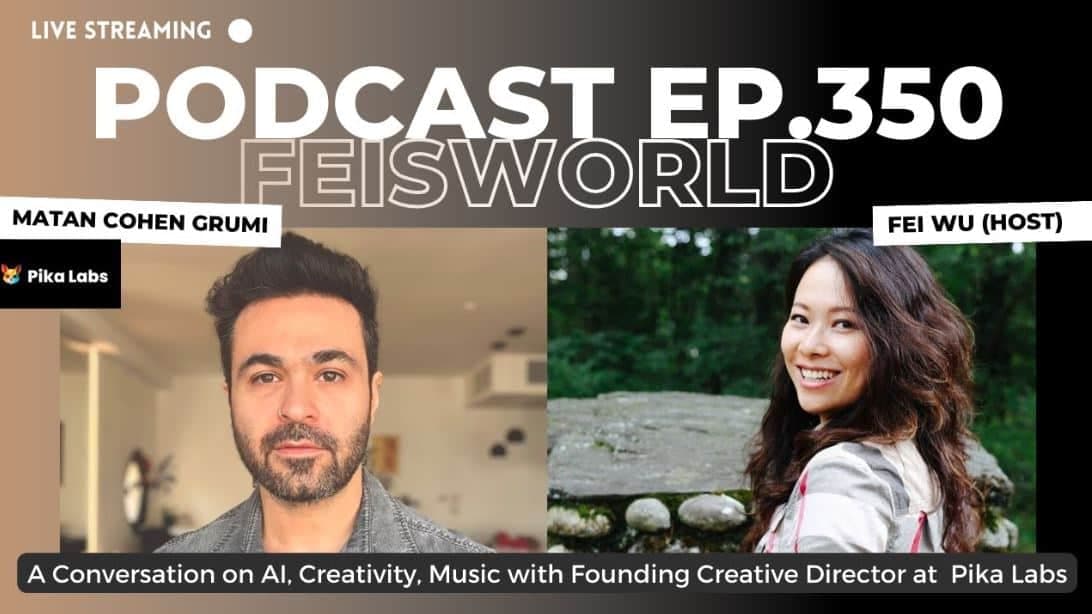
Our guest today: Matan Cohen Grumi
This is a pre-recorded conversation with Matan Cohen Grumi (@matancohengrumi): Founding Creative Director at @Pika_Labs
Together we explore a conversation on AI, creativity and music, and how it transformed Matan’s career from an ex-rock star to becoming a creative director at one of the most talked about AI companies in the world.
Matan’s original story in his words:
“I’m an ex-rock star who played a rock/metal band called ‘Betzefer’ that were signed to a major label in 2004, I’ve been in the advertising industry for 20 years, for the past ten years as a TV Commercial Director for international brands such as Adidas, P&G, Sabon, Columbia, etc. I also own a TVC Production company that became one of the ten largest production companies in Israel.”
Watch Our Interview
Transcript
Transcript
Fei Wu: Looking forward to this conversation for a few days, but the intensity is really high, given how much we love Pika, and the world is talking about this application right now, this AI tool. And I'm here with, I would say, a founding creative director. His name is Matan Cohen Grumi. Welcome, Matan. It's so good to have you here. Hey Fei, how are you? Doing really well. I complimented on your hairstyle and you're currently at the Bay Area and Yeah, welcome. And for the past two months I feel like you have seen some tremendous progress for pika, so we really look forward to hearing all about that. And for people who are not as familiar with your work, I'm just gonna do a brief introduction and we'll dive into today's questions. Okay, so looks like Matan was an ex rockstar who played in a rock metal band called I'm Gonna Try My Best Bet-ze-fer, and that was signed to a major label in 2004. So he's been in advertising industry for the past 20 years. That's something I also, we have shared interests and experiences and for the past 10 years, he was a TV commercial director for international brands such as Adidas, PNG, Saban, orone, Columbia. Which is the right way? Sason. Matan Cohen Grumi: Sason. Oh, correct. So that means like soap in the people.
Fei Wu: Oh, Sason. Perfect. And I, you also own a TVC production company and became one of the 10 largest production companies in Israel. Around last August you got into AI video, so not too long ago and got started with a lot of media attention with your AI video commercials. And two months ago you officially started your new and exciting role as the founding creative director at pika. And for those people who haven't tried out PIKA yet, it is at pika. Art, and if you wanna learn more about Matan, his website is matan cohen groomy.com. I'm gonna list some descriptions and including some of the resources as well. Yeah, welcome. I was so shocked to see your experience as a X rockstar. I don't know what instrument you played or why your band is named that way. What's the connection here? Matan Cohen Grumi: Oh, so it's, I play guitars for as far as I can remember myself, which is 30 years. Yeah, that's my guitar right there. So we started this high school band, and this is just gonna throw us off to this amazing rollercoaster where we signed some record deals. We, we started touring, playing with our favorite bands, and it's was pretty hard maintaining a career, playing in a Israeli rock band. Wow. So each one of us just also got like this side career. In the beginning I went into advertising. I started from the, pretty much from the bottom as a graphic designer, but quickly I became a freelance and started doing art direction, creative directing. And eventually I left the industry as a, as as art director and started my own thing as a TV commercial director. Wow. So, along the way, I learned a lot about cinema, about editing. All aspects of how to make a video. So this was my route for 20 years. Mm-Hmm. Like slowly learning everything about like how to make an ad, how to make videos, and I think all of this experience in all those different aspects of advertising and editing and directing really helped me, helped me being a pretty good AI creator. 'cause a creating video with AI is all about doing it yourself right now. About four months, four months ago, I. My, my band, which, which was just celebrating like 25 years, we decided to like call it quits and just do this one last show, Intel Aviv, which was amazing, and also record this one last song. So we recorded that one last song and we needed to have a video. Music video for it. We didn't want to go into production 'cause we didn't have a lot of time and we didn't have budget 'cause we're Melbourne from Israel. Someone just said, Hey, maybe we'll do the, one of those AI videos. And I was like, yeah, really? And then I kinda, I was, by that time I was already like following AI closely, like from the sidelines. I, like, I was playing with Mid Journey when it came out. I was, I tried it for the first time when it just came out, like the concept blew my mind. You just type something and you can visualize it in a second and it, that really blew my mind. But when I played around with it, it like I, the results were creepy. That's first version of major and like a year and a half ago it was creepy and the concept was amazing, but the result wasn't us so good. So I put it side and then a year later, when. One of my band mates said maybe we should do one of those. I went online just to see what's up and, and I saw this amazing AI video, like this trailer sci-fi trailer, which now there's millions of them. But there was this, I think there was one of the first one I watched it and I was like, oh wow. This came a long way. So I right dived into it. So my first AI project was doing a three minute. Uh, AI video with this cinematic look. Some something kind of hollywoodish, but not exactly. And let me first, lemme say that never do a three minute video as your first project. That was so hard. Too long. Yeah. But at the same time it got me really excited. Like I was really excited about the way that creating like this, 'cause everything. I say, I said it was a lot of work, but when you put it in comparison to what would take, before we had this ability and this technology like this is nothing, and just playing around with it. Just generating more clips, more images that you then turn to clips that this whole process was so new and exciting for me. And a year ago I was pretty much, I stopped editing a few years back 'cause I was just doing directing. But this kind of got me back the passion to editing again. I just, I just love this process and just being this one-man show, we can do everything just from thinking of a vague concept and then really fast just trying it out, editing it, sing out, it feels like. So I, I fell in love. I fell in love with the process again after a long time that I didn't do, uh, like video editing and all. And that video did well. Like I, I was pretty new on Twitter, like I had 12 followers. I just got on Twitter out there and it got some attention. When I saw how people react to that, I said, maybe I should do another one, and maybe the next one shouldn't be this dark like video with music that it's not that easy to digest for everyone, maybe do the exact opposite. Barbie was pretty much on everyone's mind back at the time, so I did this very bright, funny hip hop cats video, which got more attention.
Fei Wu: What were you using by the way? Sorry to interrupt. You're giving so much information. What tools do you remember you were using at the time before PIKA was born? Yeah. Matan Cohen Grumi: In the beginning when I just started out, I always used Midjourney and then I used PIKA Labs. Mm-Hmm. And some runway. When I was started to create, I was using both, but I gradually transformed only using pika. I really liked it. I had the instant connection to what they were doing. It's. I think for me, the thing that really got me connected to that is I always felt that the clips had some life to it. Mm. Like they were breathing, they were alive. They weren't just like very pl aesthetically pleasing. They had this soul. So I always felt like the characters as had some life to it. And that's got me like using Peak exclusively. And that's also what got me falling in love with their product. 'cause I always say that when you do videos, the way I try to approach it is when I see like a shot or a take or a clip or whatever, I try to just look at it and justand, how does this makes me feel? Mm-Hmm. Like, this makes me feel sad. This is making me feel happy, excited. As long as I'm feeling something, I know that it's good in its core. And then I look at everything else, like also aesthetics, composition. If it's, if it's the, if it's aesthetically pleasing, try to look at this at a whole, but the core of it is always like, how does this make me feel?
Fei Wu: That's really interesting. I think your connection when it comes to music, your musical background and rock band and. In an advertising design, I feel like this is a perfect role for you because it's bringing everything together. I have been, there are many musicians in my life, and my mom sisters are all musicians playing for the Beijing Orchestra and all that, so I. I feel like even though I only play casually, there is that sense of belonging. There's a sense of connection, and I've learned that there's nothing more you can learn by putting on YouTube as one thing, but to perform live is a completely different experience. So I was thinking about your live performances as well and how that connects to. Creating a real VER 360 experience for people involved. That's what's Matan Cohen Grumi: echoing my head. Yeah, I can totally understand that. Because art, right? Mm-hmm. Performing arts is also like an expansion of arts and I think, I think. It's it. Once you have this artistic passion, then it can manifest in itself in many ways. And it can be music, it could be videos, it could be advertising. And for me, I rediscovered that passion in ai. And so I talk about it like this was years ago, but when I think about it, it was like four months ago. It blows my mind 'cause I. So much has happened back since then.
Fei Wu: It's crazy. People who are, if you anybody search for PIKA right now during the release of, I'm sure even months after we released the episode, it is so groundbreaking, right? This is something Pika made. People just stop and really pause what they're doing in that given moment to say. I have to check it out. It especially true for content creators like myself who's constantly publishing on YouTube, engaging with people on LinkedIn, and I'm also teaching people all about ai, particularly through generative AI or MarTech or marketing tech. So meeting you and discovering pika, it's really been the highlight of my week, and to be sitting here with you. To hear that firsthand. So I'm really curious. A lot of people may be wondering, I'm only a designer, I'm a creative director. I don't really see a career path to really connect to technology. Do I have to be a data scientist? Do I have to be a prom engineer? Right now, you are the living example of someone coming from a music and an art background who's so deeply involved and contributing significantly to ai. So could you maybe talk about how you were discovered and by the founders and or how did you find your way to becoming a founding creative director? Matan Cohen Grumi: Yeah, it's right where we stop, right? So I started doing those videos and for me as a, as an as a creator, I was always looking to see kind of what hasn't been done yet. And I think this is for me, one of the most exciting times. 'cause being in advertising for so long and having the indu, the, the advertising industry, just doing so much things for the past, um, decade, it's hard to be original. 'cause every, there are so many talented people and. The field is just, everything is, there's a mass amount of commercial that's being like, you know how it is? Like media? How do you create something new? You get inspired by something and then you create something new. We've been doing it for the same way for a long time, so there is a lot of it. And AI is like uncharted territory 'cause everything is new right now. So someone did a sci-fi trailer and then everyone's doing the sci-fi trailer. And so when I tried to approach it, I thought, I thought, wow, this is such an amazing opportunity. 'cause not a lot has been done yet. So before I approached any kind of, okay, so I was thinking what is my next, what is, what is the next video I wanna do? I did a dark male video. I did a pink cat video. What's next? So what's next? I thought wouldn't be cool to try and make like a food commercial with this really food appealing. Something that's supposed to make you feel like, I wanna taste this. Yeah. But it wasn't even filmed. It's created by a computer. So I did this burger commercial and it also got a lot of attention and this was like my, my method of just how to stand out in that space, this new space that had all those opportunities. That's the way I saw it. So I kept doing those, like keeping this in mind, like what hasn't been done yet? And, um, my Twitter account just grew from 12 followers to 1000, 2000, 3000. And I was actually approached by, uh, by some of the guys. It's pika and I was such a big fan at the time. I was like, oh yeah, let's talk. And I started just doing the videos for PIKA at first, like, just 'cause I was doing videos. Anyway. Okay, what haven't I done yet? I haven't done a video for people. Let's do that. And we just got a good connection. We just started talking and yeah, I, I got the offer. I was super excited to join the team and, and this is a very exciting time for me right now.
Fei Wu: Congrats. Oh, no, this was fantastic. You're basically like a content creator, turned creative director. Clearly you've had extensive experience working in advertising in the creative field that this is not too mistaken by somebody who just decided to become a YouTuber like yesterday, and there's a long trajectory. Yeah. All that work that you Matan Cohen Grumi: put in. Yeah. 'cause I've been a creative director, but not in this field. I've been a creative director in the advertising agents industry. I also am my own company doing commercial. So there I was acting mostly as a creative director. So I feel like this, this is the perfect role for me. And I al I always had a passion for like technology. I, I wasn't working in tech, never like I. Back when I was really young, when I was 18, I started go, I went to the university for a while to, to learn computer science, but I left it at the very early stage. So I got back to this right now, like 23 years later and just feel so, so honored to be with, with those team of extremely talented people. And so smart and just handling the artistic side of it is just, it's been so much fun. It's hard work, but it's so much fun and I really think I found my place right now. This is what, this is the perfect place for me right now.
Fei Wu: Wow. I gotta say, it warms my heart to hear that. It's crazy because I think about our overlapping interests, even though we come from very different places. But you mentioned computer science, so I studied computer science and math in college. Undergrad. I really wanted to leave because the way it was taught wasn't so pleasant to be part of, I think we're What did you like about it? What did I like or didn't I like About Matan Cohen Grumi: what? What didn't you like about it?
Fei Wu: Ooh, so I think we're very similar in age. So I went to college 2001 and I graduated 2006 because we had this co-op program and at that time, and it's still partially for the next four or five years, programming tests and learnings happen on paper. So yes, you have these assignments and we have programming assignments, but they're oftentimes, they're like in-classroom tests that were written on paper and. This is, I think our professors are very talented. However, the way that they're explaining some of these problems that I found completely irrelevant from real life, unlike precisely what you described, like it did not connect with me emotionally. I didn't know any of the problems had any value to being solved. I. And also I found the assignments to be completely unclear. Quick tangent, because I was really, I feel like I was really suffering and I wanted to study business and this and that, but I was thinking like for my family, I wanna graduate and get a job, which I did in consulting and advertising because of my degree. I just stuck with it and I was thinking one day that knowledge is gonna come in handy, which it has been for the AI strategy development, all the work I'm doing today. So I don't regret it. Matan Cohen Grumi: I can totally relate to so many other things you just said. Yeah, I felt the same. Like, why am I learning all of this? For me, it was the math, 'cause I loved computers, I always loved computers, but like four out of five of the courses with like math, algebra, linear math, all that stuff,
Fei Wu: calculus five, I was double major as a Matan Cohen Grumi: result and I was good at math, but I was like, this is not why I am here for, I just wanna learn the the geeky stuff. So, yeah.
Fei Wu: But this is so funny. I gotta say, for anybody who's listening to this once studied or pursued a degree and really struggled at the time, there's a gentleman named Krupa, so KI. RUPA. He was like such a hero of my, I didn't realize he was just a kid, like a teenager. When I was reading his website, he was one of the first flash guys and he ended up going to MIT to study computer science. So even though we never knew each other back then, I remember like I wish I could meet Carpa, who must be having a wonderful time at MIT and understand everything about computer science and then. Literally months ago he reached out to me and SF, Hey, I really like your content. Let's have a chat. I was totally giggling out control and finding out very quickly that he also struggled studying computer science at MIT, and I realized all that time we feel alone that we're really not, and not to loop back to pika. I think what's going on with AI world in particular with. Pika, this is what gets me excited is that for people we're still like, wait, what's pika? It's going from idea to video, from text to video without you, yeah. Having to do the learning math, video, editing, how to, how to upload all these things, how to manage the team, which. Small business owners don't have the time to do that. So I think Pika really leveled the playing field. Yeah. Like without, like, you need an idea, but you need to have a better idea. You need to have more meaningful prompts and, but it's like people are so excited to realize, okay, the saying of, I'm not creative now anybody can be creative. So that's, yeah, that's how I feel. Matan Cohen Grumi: Yes. I think this is like the most exciting thing that's happening right now. Mm-Hmm. For me and for a lot of us, a lot of people that are into it and a lot of people that are just discovering this for the first time. So I think PIKA opened that door for so many people who, 'cause it wasn't accessible, that accessible, uh, until now and we. I guess by now, by the time this is aired, like it's already public and just, it's so easy to work it with the new web UI that we have, so everyone basically can just come on, come to the site. Mm-Hmm. Just think of an idea. Type it in the most like common language that, that you can talk at and, and it'll visualize it for you. So. Like this was the PIKA mission statement, right? It was like to put, to give people, like everyone, not just professionals, also professionals, but every, everyone just give that power in their hands to just, you know, think of an idea and have it visualized so everyone could do, can create those visual visuals right now. And I think that's such a strong mission statement and it's such a strong tool and I'm really proud just to being a part of this.
Fei Wu: Yeah, it's so interesting. So I wanna give people a flavor of what they can potentially create. I've had the pleasure of testing things out, so I was initially playing on Discord. I know that it may not be everybody's cup of tea. So there is currently a wait list. Do you know, you don't have to commit to this, obviously, like around what time would it be a public application where people can interact through a web browser. It's like, Matan Cohen Grumi: woo. What do you mean? Like a mobile
Fei Wu: or a mobile or desktop experience? I know there's a, a wait list right Matan Cohen Grumi: now, so Yeah. So the wait list is exactly for that. Yeah. But we're, we started giving access like to, to a small group of super collaborators. These people were like. Our supporters and part of our community and has been supporting us for so long and they're, we're testing everything out just before we release it. Like publicly. Publicly, yeah. And we will gradually open this, so it's like very soon we, I think every day we're opening this cycle, this circle a little bit wider. Yeah. Just to make sure that everything is really perfect once it's public. And Yeah. So I don't have an exact answer for that, but it's like very soon. And I've been asked that a lot, so I'm just, I just wanna say it's. Right around the corner. This is the best answer I can give.
Fei Wu: For people who are watching this, listening to this, if you wanna check it out, you can go to pika, aka Art to sign up for the wait list, and you can immediately test things out using Discord. I'm not an expert in Discord, but I wrote an article, which I'm gonna link in the description below for you to check out exactly how to use very simple prompts to test. With imageries, with just the prompt, just on the idea to generate videos. Someone tan. I was thinking about, my next question is I realized when I test things out, I totally get that short form videos, right? Like having an idea, have something animated. I don't know exactly how long, 5, 10, 15 seconds is the way to go right now. What is your vision or what is the next step if somebody wants to design like an episode of animation where like a slightly longer storyboard, how can we possibly use PIKA like in the future to achieve that? Matan Cohen Grumi: I, I think right now what all the, what what we're doing right now is basically you make clips, right? So right now we're making three second clip that you can extend on the website to make them longer and making me even lot longer. But the thing is, when you want a clip can tell just a little part of the story. So you need to have all those clips and then stitch them together to, to make an idea, to, to, sorry. Yeah. So I think in the future. Like right now we're building the foundations. We're just making sure those clips are the best that you can have, that they will communicate exactly what your idea was and just to make them like really look amazing. But I think in the future it's, I think it's just a natural progression of things. I think all of those, all of those industry, I guess right now it's just those short clips. We have to edit them together. Just when I think about it personally, like what could be nice is. We, if I try to imagine where it will go, it's like you, you just write an idea and it manifests itself. So I don't know how far that in the future is, but you just think of a, of an idea and it doesn't make this one clip. It just make the whole thing
Fei Wu: interesting. We're asking you questions and continue to build out stories on someone. I we're ideating right now, obviously. Yeah. This idea, this platform, so many legs. Matan Cohen Grumi: Yeah, the way this technology is going is just so fast, so you, you can't really tell like when this will happen, but, but yeah, I, I guess this is maybe next stage, maybe this is the next stage.
Fei Wu: Yeah. Wonderful. So I, when it comes to DES Designs and AI platforms and tools, I've had the pleasure and the privilege to interact and talk to so many different companies and growth marketers and designers. What are some of the things you think PIKA really stands out from the crowd, from its competition, from what we have seen so far? Matan Cohen Grumi: So I think there's a few things. First of all. Like I, I said this before, like for me personally, I always felt like the clips are alive. So they convey some kind of feeling and the characters they breathe and that's what got me falling in love with everything that they're doing, like with the results. And that's first thing. And I think that's the second thing that the most important one is. The, the goal, like the goal of the, of PIKA is to give that power to everyone. So ev everyday users, people that have maybe have a zero experience with video editing. Just giving that power of, 'cause a lot, like everyone is a storyteller, right? Everyone is an idea. Everyone can think of a cool thing to, that you would like to manifest as a video, but. A lot of them doesn't have the right tools, the right experience video production is was very pricey, expensive. So if you wanted to, to make a video, you would either add to make some kind of production or to go shoot it with one, or if you went to animations, that's also very lengthy and pricey. Process. So what PIKA is doing is democratizing that and making everyone, giving everyone the ability to visualize their ideas, and I think this is so strong and it's just exciting. I think it's very exciting. Yeah, and I think a lot, if I have to just look around, I think a lot of people, maybe I, I feel this is what separates us, those two things. So clips are very alive. I have a lot of feelings. And second is just the mission goal and this to appeal to everyone and not just, not just the AI enthusiasts, not just the professionals, but really to everyone. So everyone who has an idea or everyone who is, who wants to create a video, basically everyone, I think that separates us.
Fei Wu: Yeah, that's super cool. And I can imagine like people started to really experiment and didn't even think that one of our ideas is even interesting. But now they can visualize it. It may helps them change their mind. I also think as a creator for us to ideate, break the ISIS really hard sometimes. So with PIKA it just makes that process easier, more interactive. Like you'll feel like you have these partners, not one person, but like a team of people to help you put this together. And just incredible because I think we grew up with, I would say, Pixar, Disney, and whenever at the end of the credit for each one of those films, we all know it calls like multiple hundreds of millions of dollars and you can see all the credits, hundreds and thousands of people working on it. Now you feel like you have a, you share a slice of that pie that you can visualize your idea. But I do wanna pivot a little bit to the fact that professionals and companies and agencies truly can use it too and make money. So as part of our audience, people are watching this, people are thinking about like monetization and small business ideas. We're big or medium enterprise business ideas. I first of all recommend people follow me on LinkedIn because you have a lot of updates, like daily updates and that are so relevant to the world that we're talking about. And I saw one of the videos probably published a month ago where I believe like. Pink roses, petals like flowers, and you explain the power of pika. And in the end, at the end of that video, you shared a split screen of the original video shot with the six K camera, expensive crew versus the right one. A hundred percent generated by pika. Frankly, I was blown away. I was sharing with my family and friends that are like, they don't know which one to pick, which is better. And then the idea is a split, right? Like some people's, oh, gimme the original. I can see. But some people say, I actually like the AI version even better. Yeah, could. It's crazy. So could you maybe talk about like how companies can think about using PIKA to create commercials, their storytelling, their client work? Let's explore. Uh, basically Matan Cohen Grumi: the reason I did this comparison is just to show. Like how much of the original world can stay exactly the same. So the same editing, same concept, same visual world, same sound effect, same titles, just the footage replaced and the footage is the thing that takes the most of the time. So to produce that footage, a lot of money, a lot of time, a lot of preparation, a lot of like. Making a bank of shots in one shooting day and then picking just the best one. So it's a very lengthy process, very expensive process. But at the same time, that video wouldn't be the new one. The AI wouldn't be impressive without all the skill and expertise that went into it. 'cause it's not just generating a clip, it's also what you do. We do with it. So I think the process, what I wanted to demonstrate is the process stays the same. But instead of going out for a shoot, you can maybe start also, you can maybe just visualize it using pika and this is so strong. 'cause the, like, when you put them side to side, like you said, they're very similar, but the, the, the process just got so much shorter. I. And so much less expensive, like the gaps are, it's hard to perceive.
Fei Wu: Yeah, it's hard to even imagine. So what is the process like we're talking about in the future when people are truly using PIKA to create these lengthier, like more commercial like production quality output? So I'm thinking, given my limited experience producing one docuseries on Amazon. Is I, I was the producer, executive producer, so I witnessed the process, but I had a team to support me. So I remember we're running around like having these shot lists. And so is that also like how you created that commercial? You still have the detailed shot list, the, exactly the idea what is being shared. Like what, what, how did you, how were you able to replicate that? Matan Cohen Grumi: If you notice when you put it side to side, they're like the, everything is the same. Mm-Hmm. Except the underlying shot. Yeah. So I actually took the old one, put it like, if you like, if you know a little bit of anything, put it on the timeline. Yeah. And then started replacing those shots one by one. Oh. So if the fir in the first shot? Mm-Hmm. If I had, I would look at it and I would say, okay, this is a very extreme closeup. Mm-hmm. Of the mask rose. Probably been shot with a Mac with a macro lens. So it's a macro shot and maybe we add a do slow do in. I just reverse engineer it. Yeah. So I saw, I looked at it, I saw, okay, this shot is, let's write it down. Write it. Mm-hmm. Press generate. I get the shot back and maybe that's not the perfect shot, so maybe I have to refine it a little bit. I refine it, I get it back. Still so much easier. So much faster than going and doing it the way that it was originally done. 'cause originally it was a very lengthy process of just picking the right flour and making sure everything is perfect. And they're very expensive studio, very expensive camera equipment. Shooting takes a lot of time, like a lot of time. Then going back to the editing room and picking just that one second out of a, out a day of shooting. Yeah, so everything is more efficient. Every, everything is shorter. Everything is like also I think, very exciting. Yeah.
Fei Wu: It's so funny that a lot of us who are using, even I edit a lot in Final Cut Pro mostly, and I look at like short form content. I play with ai. But one thing I realized, especially within the Discord community, is I learned from other people's prompts, which is really interesting that I. I know personally I never really used to describe things like this is, imagine this a shot on the camera with this like ISO and then with this lens I'm like, whoa, I don't even have this vocabulary and training to like to get down that level. But you just mentioned it very casually. So that's something that I feel like I wanna write a post about. These are the things that you can example what it looks like, and that gives people just incredible leverage to create something so, so unique with pika. Matan Cohen Grumi: I. Yes, I think, but uh, also the way that you, if we really wanna make it available for everyone, I think what part of what we will do is, what we're doing is not, you don't have to speak that high language. You just write what you wanna see and the AI will rewrite it. So you can, you get, you will always get a professional result. You don't have to be a professional to get a professional result. Love
Fei Wu: it. Love it. And same thing. I totally agree. I've been training and doing a lot of webinars on AI and I was really surprised. A lot of people are still very new to ai. Were like, the only thing they barely interacted with is Chacha bt. That just blows my mind. I was like, what? You haven't tried off 30 different tools and fell in love with half of them? And one thing I realized also since in the past year chat, GPT has. Made it really easy for people not have to write these perfect prompts. Yes, but you can, you even feed in article to say, this is how I write and it's okay. I just study how, how you write and now could you write another article That sounds like me. So I feel like PIKA is definitely gonna make it really prime for people to be able to create professional footage without speaking the nerdy language. So this Matan Cohen Grumi: is exactly what we want to achieve. Like we don't want. You to have to be a professional, respect this professional language. We want our, our product to just understand what you want, even if you give a very simple, a simple prompt and still deliver the most professional result that you can have. Mm-Hmm. So this is when we were try talking earlier, like about what this is, what is, what do we want this to be? We want this to always deliver professional results, but not just for professionals, which are basically for everyone.
Fei Wu: Yeah. Oh, this is super cool. So, to summarize, I know that I derailed it a little bit. There's so many different use cases. You can use it for personal projects, you can use it for your personal YouTube channel. I can think about quick three, five seconds, intro, outro. That's gonna look uniquely you and very captivating. Very candy like if you want it to be, but as well as commercials, which you have given a great example of somebody be curious enough to say, this is the original footage, this is what the finished product and now we're gonna recreate it using pika. So those are like two main use cases I can think of right off the bat. And what are some of the other things you're excited to see people experimented with Matan Cohen Grumi: before? Well, we released two features that currently. Are really mind blowing, like I've been playing them or playing around with them for a month, and every time I keep using it, I, my mind is blown. And the first one is called expand canvas. And basically what that does, you can take a video and then have the FD ai visualize what's, what it will look like if you'll take, wanna make it bigger? Yeah. Not bigger in size. If you want to expand your canvas. Yeah. So the AI kind of visualize everything that's. That's not in the frame. That's pretty mind blowing. So let's say the frame that we are seeing right now, it's like this close up, medium shot of me and you. Yeah. So if I took this recording of the podcast and run it through our system, maybe feel that painting on top of your, like behind you. Yeah. Complete the painting. And I could see maybe the table you're sitting at and maybe I could see a little bit more of your body. And then just the room. So the AI are like, this is one of our strongest features that, that we just released. So just think about the use cases for that content creators that they always have this problem if they're doing like, let's say, YouTube and TikTok. mm-hmm. Because YouTube is like a horizontal aspect ratio, and TikTok is vertical. So you always have to settle. You either shoot it like this and then it will crop it like this, or the other way around. At the way around. And right now you can always shoot, let's say at the 16 by nine mm-Hmm. And then kind of expand it if you do it right. So this is. I think very powerful feature that can also for cinema, for, for commercials, for any everyday creators, for content creators, for influencers. I think this is such a strong feature for anyone who's using video at some way. Yeah. And, and the second feature, which is even more exciting, is modified. Yeah. So. Modify is basically you have a selection of any object, anything in the background. Let's say I want to add a poster on that wall. I can just make a selection type poster and it'll add that to the video. Yeah. And let's say I want to just color my streak being red or something. Be red. Yeah. Let's say I want the whole head to my whole hair to be red. I just collect this. Area, say red hair. And it will not just change it, it will also composite it. So if I move, it'll move me with me in a natural way. It, it will get the lighting that is currently being in, in the room, the backlight. It'll all, it'll manifest it into that. And this is such a strong tool and the possibilities I think are endless. Mm-Hmm. And because this's so new, we are only now starting to see the use cases for it 'cause. You know how it is, like you make the technology and then you need the creative people to show you how it can be used. We're, we're just starting to see the many use cases for this, and it's mind blowing. Every day we see something new and I'm like, oh, I didn't even think about this. You can do that and you can do that. Yeah. The main, one of the main problems in like AI that has been up until today is, uh. You generated the video. Right. And sometimes that clip that the system spit out, it's perfect, but one thing is wrong. Yeah. So what we would do is we go back and we fix our prompt, but there's always some kind of random to to it. So you'll get totally different clip and maybe you, you solve that one problem, but something else is messed up. Yeah. So for the first time ever, you can now edit those. You can iterate. On top of an existing generation, and this gives you such an amazing amount of control of how you create videos. And this wasn't available up until now. Yeah. So this is, I think, one of our strongest features and it's just now being started, start to, to being used. So I think we will be seeing some amazing result with this like. The next few days, weeks,
Fei Wu: month of year. I'm so excited because I even though full transparency, even though Canva released a lot of these like magic edits, but it's not video based so it's not video based. Yeah, exactly. So I'm so excited to see like how you can incorporate new elements like expand as well as change or edit to based on a video content. In fact, I was thinking like a lot, I'm privileged enough to live in a pretty big home. I have my dedicated studio. But remember my producer Hermon always says, Faye, clean your background with this. Move the wire, move that fan away. So now you know every, we take so much time as creators to have to maintain a certain spot, and most of us, frankly, won't have a dedicated spot somebody is in their basement. Can you imagine using PIKA to say, instead of spending 45 minutes cleaning up your space. You can leave everything as is and then post-production, you can just make it look serene and clean and it's Matan Cohen Grumi: just, you can change it to a palace if you want. You know? That's that. That's the thing that, that you want to have perfect control of everything around you. Every object. So if you want your whole background to look like something else, you can do
Fei Wu: that. Yeah. So I could be recording this in front of Disney World right now, little table and the Disney World behind me. I can do whatever I want. It's incredible. I think commercially, it's also very incredible. I see a lot of these commercials of. With the same woman doing chores. She's like multitasking. She's at work, she's with babies, she's, and they have to, in, in the old advertising world, you have to shoot that for weeks, millions of dollars to change the setting, and now it could just literally be having a green screen and everything else can be replaced. Yeah, Matan Cohen Grumi: that's, it's a, that's just another idea when we're just starting to discover like all those creative ideas that you can do with this. So it's very exciting to see where this will go and what will people do with this new ability that, that PIKA has. Just put it out there. I'm cant wait to see what, where this will go. Yeah.
Fei Wu: No, this is super cool. I can't believe the time flies by so quickly. So I would, I'm looking at my list of questions. I feel like we talked. A lot about them already, but what are some of the things that I haven't asked that you wish to share with our audience and any ideas that you've had since the beginning of the conversation? Matan Cohen Grumi: I can maybe elaborate on The last thing you that I said is I said that the, we make the technology and then we need the artists to show us what can be done with it. So right now is, for me, the most exciting, exciting time because. We worked on this so hard for so long and just now releasing it. The most exciting part starts now just seeing all the artists, everyone in the AI art community, people who are exploring this for the first time and maybe have a fresh idea about this, people will now start to show us what can be done with this. Yeah, and this is the most exciting part for me, just to watch, follow the space. Follow following YouTube, following new creators. And there are a lot of new creators every day. And just follow that and see what people are doing. 'cause it's always, oh, you can do that. I didn't even realize it. And even like this front row and playing with it and testing it and trying this. Mm-Hmm. There's so much you can think about when you have your method of think of thinking, right? Mm-Hmm. So just think, just seeing what people do with this is so amazing and I can't wait to see like what everyone will be doing with this.
Fei Wu: Oh, I'm so excited to hear that. Do you think Aika will consider working with influencers and creators at one point as well in 2024? I Matan Cohen Grumi: don't know yet. I, I don't have very, a really good answer for that. I hope. I hope so. 'cause I think it's a natural 'cause this is a tool for everyone. Yeah. And I think it's natural. Yeah. I hope so.
Fei Wu: Sounds great. I so appreciate your time and I know you are. Busier than ever before. I wanna remind people to check out PIKA Art, which is PIK dot a RT, and sign up and definitely give it a test to run. Please let us know. Let me know in the comments below your experiments. I really would like to hear from this community as well. If you wanna check out mats, personal work, go to his website, which is matan cohen groomy.com, and I've listed links in a description below. With that said, I am gonna take us offline and welcome back to this show. Whenever you feel like in Atan, I would love to just follow your work and I would love to see where PIKA goes Matan Cohen Grumi: next. Oh, thank you so much. And yeah, please just check out PIKA and yeah, I think I will have whatever you do we'll, you will have fun with
Connect with Matan Cohen Grumi
www.matancohengrumi.com
www.pika.art
Connect with Matan Cohen Grumi on Social Media
Twitter
Instagram
Youtube
LinkedIn
You might also enjoy…

Written by
Fei WuFei Wu is the founder and CEO of Feisworld Media, a Massachusetts-based digital media company helping brands get discovered by people and by AI. An Adobe Global Ambassador and brand partner to ElevenLabs, Synthesia, and 50+ other tech and AI companies, she hosts the Feisworld Podcast (400+ episodes, 500K+ downloads — guests have included Seth Godin, Steve Wozniak, Chris Voss, and Arianna Huffington) and co-created the documentary Feisworld: Live Your Art on Amazon Prime. Fei writes for CNET, Lifehacker, and PCMag, and her work has been featured in Forbes, Harvard Business Review, and WIRED. She has been publishing on the internet since 2014 — long before AI discoverability had a name.
View all posts by Fei Wu→Stay updated
Weekly insights on content, AI, and digital media.
Keep Reading
Related Articles
Focal Alpha 50 Evo Review: My 2026 Pick for Creator Studio Monitors

Joanne Lipman on Mentors, Untapped Talent and Why Women Should Stop Waiting to Be Perfect