Kevin Fernando: How to Create Businesses that Run On Autopilot (#347)
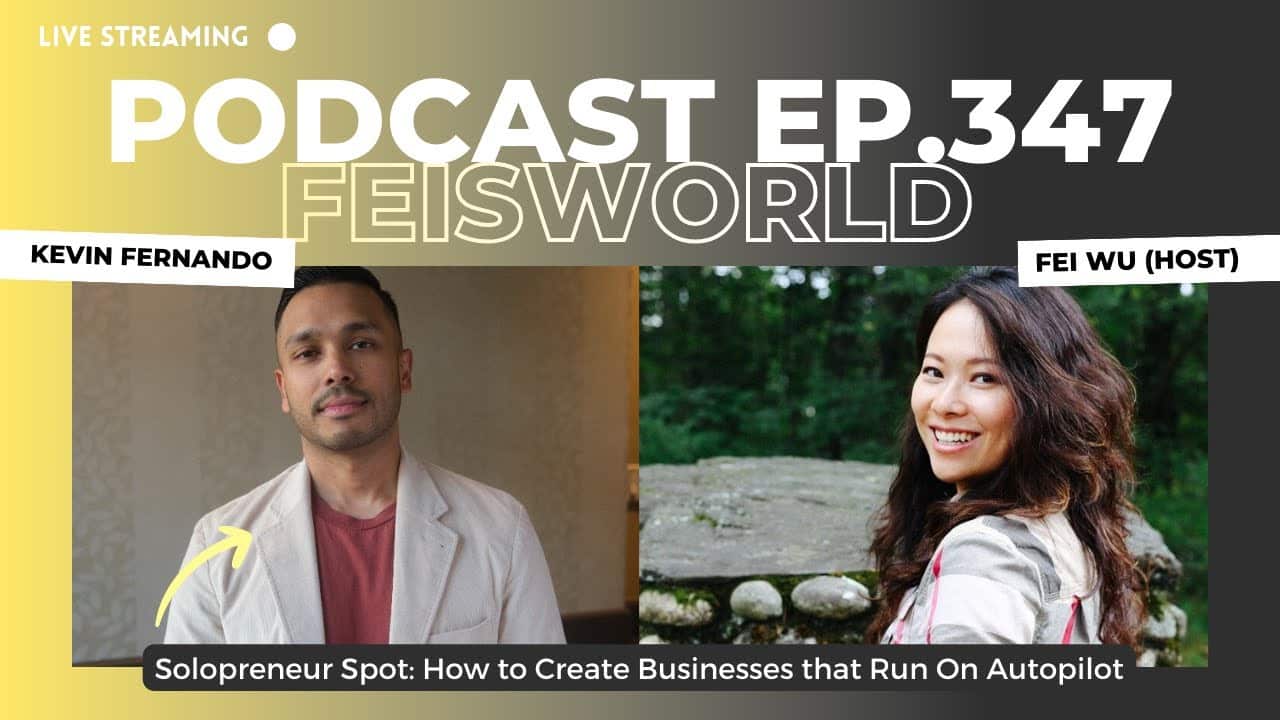
Our guest today: Kevin Fernando
Kevin Fernando @Solopreneur helps everyday people create online businesses while working part-time. He has been a serial entrepreneur and digital marketer and over the last 12+ years. From a 6-figure annual e-learning agency to building and selling eComm stores, Kevin is here to share his experience as an entrepreneur, and a content creator in a time where building a personal brand is no longer optional.
This episode is particularly helpful to those of you who are interested in both working full-time or part-time, as well as starting your own content or affiliate marketing business on the side.
Watch Our Interview
Transcript
Transcript
Fei Wu: Thanks for waiting by a few minutes. And I hope those of you who are watching on YouTube and social media can see us just okay. YouTube has been really reliable. I don't know what's going on with a LinkedIn, but hopefully you're able to find this. Let me know. I'm here sitting with my new friend, Kevin Fernando and Kevin. I met through YouTube, believe it or not, as I was searching for content, repurposing videos, and I found his and immediately. Just felt really resonated to his brand, the way that he creates content. So I really want this opportunity for us to have a casual chat. Please welcome lists, your comments and questions, your face, not going to show up, uh, on our live stream. So don't feel nervous at all. Ask your questions. And before we get started, I want to briefly introduce. Kevin, welcome, Kevin. Hello.
Kevin Fernando: Thanks for having me, Fei. Excited to be here today and chat with everybody. Glad we, uh, got connected. Totally
Fei Wu: agree. I'm so thrilled. And we have your audience here joining with us as well. And it's a great opportunity for us to really get to know each other. And if you're new to Kevin's work, well, he helps everyday people create online businesses while working part time. We're full time. So especially if you still have a full time job, I really want you to know that this is not just for full time content creators only, he has been a serial entrepreneur and digital marketer for the past 12 plus years from a six figure annual e learning agency to building and selling, uh, e comm stores. Kevin is here to share his experience with no reservation as an entrepreneur, as a content creator, uh, in the time we're building a personal brand. I agree is no longer optional. This episode is particularly helpful. As I mentioned, if you're interested in working both full time or part time, well building your personal brand, we want to talk about why it's absolutely possible. I think we're going to dive into corners such as affiliate marketing, um, you know, content marketing, full stack content marketing for those of you who think, well, I don't know how to like niche. Down so far where I'm really interested in, you know, webinar and podcasts and YouTube and kind of all the above. Um, can I really choose all of them so we can really like play around. So welcome Kevin. I'm just so thrilled that I'm sitting here with another content creator and we're here to help others answer their questions.
Kevin Fernando: Yeah, totally. I, I feel like Fay, you know, we've, we've chatted a few times now and I'm, and I'm so glad you put this together. I'm like, yeah, I think just riffing off of each other. We can really bring the audience a lot of value in this session. I'm feeling.
Fei Wu: I totally agree because I mean, look at the tutorials and content we create on YouTube. We have to be so fast paced with the intro, the hook, a content and call to action and done. And people don't really get to know you like as a real person. And I. Just found you very authentic even during our first conversation be so transparent. So I know you're currently working on something really exciting and it's going to be launching in one to two weeks. If people watching this a little bit later, they can get to know that, but may I invite you to maybe chat about a thinking behind and what you're putting together and why you're putting together something like that.
Kevin Fernando: For sure. And, and, you know, firstly, thank you for the great introduction and, um, I'll just pick it up right where you left off. So, so quickly, I do run, as Faye mentioned, I run a YouTube channel and I've been doing that for a long, long time, but I took many, many years off and it's interesting and I'll come back to it. But basically I used to run, I've done, I've wanted to kind of be free and work for myself since I was about 21. And I've built a bunch of businesses. I built an e learning agency and ran that for six years. That's way before e learning was easy and that all these cool tools that could do it. This was when you had to hard code everything, e commerce stores and all kinds of things. And the challenge is that these were really hard to run, uh, with limited time. Sometimes a lot of the time when I was doing this, I still had full time jobs. And so, you know, the transactional nature of it all was really kind of burning me out. And then. Uh, since then, I've put to put it shortly. I've really gotten fallen in love with subscription based models. And so I ran a subscription box business. I even tried my hand at like, uh, you know, at an app that was a recurring software business, and then I fell into sort of affiliate marketing in a recurring way. And so. The training I'm coming up, you know, that's the short version. I can talk about it for an hour here, but the training I have coming up is really just going to talk about how you can build, uh, automated income streams with a subscription based products.
Fei Wu: So what are some of the subscription based products, uh, would you recommend people kind of look into, I know there are a really big variety here and perhaps a, what is like that one on one version for people who are very new to a subscription model business? Perfect.
Kevin Fernando: Yeah. So, so, I mean, I can just say like, I'll just like, everyone's familiar with content subscriptions, whether that's Disney, Netflix, uh, then you, then you're probably familiar with like a software based ones. Like if you know this, Microsoft has moved from having office as a, like a one time thing to now it's a subscription. Adobe is a subscription. So much software is instead of like a one time thing, now a subscription, you see like Amazon prime and Walmart plus and Uber eats, then they're the kind of memberships. Um, and then even like you see anything, everything is subscriptions consumables. Like you hear about razor subscriptions, you know, uh, I have a Peloton. So if you're familiar, it's like, uh, you know, I have a Peloton. So, um, if, if you have, uh, it's, it's a, basically a bike and it's got a screen and it's got a subscription and you can, you know, you pay for the bike, but you still got to pay for the content every month. So everything is kind of moving in the subscription direction and, you know, companies love it because it's like. Predictable income, it's increased customer loyalty and you get lower acquisition costs because people renew every, every month. So those are kind of the ones that everyone kind of knows about, but as an entrepreneur, you know, you can't go build off, build a fancy software. And yeah, that's really, really hard. I trust me. I tried. I failed, but I didn't fail, but it was extremely, extremely difficult. It was a long road, but, uh, you know, it didn't give me the returns. I want. And then the other part of it is, um, you can't build a Netflix. That's not realistic, right? So the, so, you know, what, what I, what I share with everyone is, um, how to do two things, right? So a recurring group revenue, affiliate marketing. And so those are affiliate products that pay you on a monthly basis and, uh, membership sites, how you can kind of make a membership site and the real trick to it is how do you sell that in a sustainable way that's not, you know, spending all day posting in that membership site. So those are kind of the two vehicles, if you will, that. And I have a whole model around how to incorporate those two together. But that's, that's kind of the, that's in both of it.
Fei Wu: Yeah. I mean, it's, uh, definitely it's very intriguing to me. I was just having a conversation, uh, around with a colleague of mine on a, uh, talking about building a community and the challenges that comes with, uh, building a community, as you know, um, as well as, uh, as some of my followers may know that I have an Academy on Podia and literally, like you mentioned within the past, I think, few months, I considered Instead of selling individual courses, of course, there are a lot of free resources, but instead of selling a course for 97, 197 or whatever, I decided that I should switch the whole thing to a subscription, like for 97. Anybody can consume anything that is there now and what I'm, what I'm going to create in the future. So I don't know why I did that, but I just wanted the content to be more accessible. So could you maybe talk about. Maybe even the pros and cons or even some of the challenges like you mentioned about how to make selling a membership site a subscription sustainable.
Kevin Fernando: Yeah, it's it's it's it's a great question, right? I think one of the advantages so. One of the advantages when it comes to a subscription and what makes it sustainable is often with a thousand dollar online course, a lot of the time we have that apprehension. Am I an expert? Can I sell the 997 or 497 online course? Am I good enough? Right? But with, as you mentioned, Faye, like a 99 or 49 dollar subscription, the The, uh, the barrier is a lot lower for the person who's, who's subscribing, but at the same time, it's also, you know, you don't have to, it's the expectation isn't that you're going to teach them everything in, you know, in one month of the subscription. So, one thing I'll just say right off the bat is one of the advantages there is that. It is, it's something that it has a, you can start sooner. You only have to have 1 month of content and you can just build it month after month. And so, so I would say that, you know, that's really 1 of the advantages. Uh, another thing is, you know, there's this idea that. You got to create like countless amounts of content, but you really don't have to. You know, I, you know, uh, there's a lot of research done in this space. And one of the things is ironically, the number one reason that people leave services like Netflix, anything is content overload. And so having too much content can, can actually be pretty harmful for you. So, I mean, to, to, to touch on your question, you know, how do you, what was it, were you asking Faye how to de risk kind of, or how do you, how do you, what would, can you rephrase the question? I want to make sure I covered it. Yeah,
Fei Wu: sure. You know, any pros, I think we talk about pros of consistency, expected, uh, measurable income. Um, but perhaps what are some of the cons or challenges associated?
Kevin Fernando: Yeah, absolutely. So yeah, it's absolute. I think one of the things is that it's not no business is passive income in the sense that you were sleeping on a beach and you're just getting paid. Right? I think what we what people mean by that is you're not trading your time for money. You're always still working, but you're not trading your time for money. Right? So all things being equal, of course, with a subscription based business. Uh, there's very smart ways to do this where you're only working maybe, maybe three hours a week when you're engaging with the community, the kind of content you create all of those kinds of things, but there is still a maintenance factor to it. That's rather than something that you create 1 time. So, again, the advantage was that you're not spending 6 months creating an online course, which is your flagship course, but the disadvantage, of course, is that. To a degree, there is some work, but in a way, I actually think this is one of the biggest advantages because this is something, uh, I learned in my in the software world and it's called customer discovery, where oftentimes, you know, where people are not in touch with your customer. You're not in touch with their needs. And so when you run a membership, you get to have a deep understanding, Faye, like, you know, you run one, right? Like, you get a much deeper, I'm sure you might say, you get a deeper understanding of what's actually resonating. It's more timely. It's more up to date. You're actually, and most importantly, you're actually helping people, right? I mean, because it's so easy to sell a thousand, not so easy, but it's. You know, you can sell a thousand dollar online course and that the only transaction you ever have with that person. And even if you don't end up helping them, well, you still got your money, right? Whereas here with the membership, I think if they're showing up and they're and they're coming back month after month, uh, you know, it's, it's really an opportunity to. Uh, make sure that you're, you know, you build confidence in yourself that you're actually helping people. And the one final thing I can say that it's a huge advantage if we're just talking funnels and mechanics and whatnot. And there's more to it. I talk about in my program, but, um, with a, with a membership, you can offer a free trial. An online course, you can't, there's no trial of the course, whether the membership you can offer a free trial, just like everyone else does. And if you can pull them away in that 1st month or whatever period you want, then there's an opportunity there to keep serving them.
Fei Wu: Yeah, it's interesting because I think about the fact that once you have a membership model, you are closer to your customers. And it's interesting that for me, I never, I don't feel like it's a skill I really hone in on. It's more like they're showing up, they're buying this annual subscription at any given time. They may have seen the video three weeks ago or, you know, or a week ago and they're kind of All coming in at different times, which is perhaps a challenge with my community that I'm not really moving people towards the same goals at the same time. Whereas an example I've seen that's quite successful is with a colleague of mine called Carly Agar, who's running these, uh, you know, helping people transition in customer success jobs. And she's, I misquoting a little bit, but her membership. Runs, you know, up to six months and people have full access to her online courses and getting support directly from coaches. And the fact that there are things, uh, you know, when you move from people from A to B, it just takes time. And I think having a community there to really be there to support them is quite. Essential. So like, Kevin, do you feel like, you know, you need a certain number of followers, community, you know, sort of, uh, fans followers that you, that it's already there before people can actually consider building a community. If you're watching this, please ask any
Kevin Fernando: questions too. Yeah, and first of all, it's a fantastic point, Faye, you touched on there. And I want to say that that's, you know, I, I, I reflecting on it. And, you know, it's something sometimes, you know, you don't always think about, but that's a, that's one of the most challenging parts with a membership site is how do you add value early? Because with, with the online course. Whether, you know, you're going to learn soup to nuts, how to do some one specific thing, usually, right? Lose 20 pounds in six weeks. How to start a Shopify store or whatever it is. But with a membership site, if you only have a month's worth of content, is that person going to be, if they're a true beginner? Are they going to get to that point where they're like feeling that they got an outcome yet, right? And so I think there's a, there's an element there with the membership site. That's, that's a little bit trickier to get people to the value initially if you don't have a lot of content in the start. So that, that, that to say, right. And so there's a, there's a balance there, but yeah, you know, I think, I think it's a, it's an interesting question. You know, if you, if you don't have an audience, can you start one? Well, I would actually say that it's probably. Easier to start one than an online course, because if you do a free trial, what does the person have to lose? Right? Someone is much more willing to say, Hey, I don't really know about this person. They don't have 40 testimonials on their website, but I'm not going to give them a thousand dollars. Right? I think now it comes down to traffic, right? Of course, if you don't have an email list, then you got to earn it or pay for it. That's just. Those are the, that's the reality, right? So I think, um, then, you know, if you have a budget to, to, and you, and you have a smart funnel that can, you know, educate people about the program and get them into the membership and your numbers work out, I think you can absolutely do it with a zero audience. But, um, you know, what I would recommend though, is, you know, you actually start to help a few people for free before you build your membership. Right? Maybe start doing some content, maybe try out your method on on a few people, see if you can create some success there and then and that will just give you the confidence to know the kind of content you're doing. But I would argue that it's actually easier to go with that than say, the alternative, which is often an online course.
Fei Wu: Yeah, and also I think we touched upon a variation of seeing ourselves as experts have trained people to go from A to B, but I also realized, like, when I first started a community online in 2017, I remember, I mean, I was a podcaster with about 3 years of experience at the time. There are also other podcasters thinking about starting I did not feel like I could claim expertise in the area yet I was more like an organizer as a facilitator, who basically gathered people who share the same interest to say, Hey, I don't, I'm not here to promise anything is more like on a weekly basis. And later on, it was bi weekly, that we invite experts, we invite each other to share our experiences. So in a way that I really had, you know, not a lot of following and not a ton of Expertise, but the community was really still growing and it was going really well, a lot of the relationships, you know, lasted for a long time. You know, part of that group continued. We kind of evolved into interesting enough podcasters into now creative entrepreneurs we meet once a month right now. And people from like all over the U S and the world. Um, I just think. Yeah. I think developing long term relationships and allowing people, allowing ourselves to grow and for the group to evolve, that's really interesting. If we didn't have that community or membership at the beginning, I think we would probably have lost in touch very quickly and not really have that shared vision or ongoing communication.
Kevin Fernando: Yeah. Fair. I would, I, you know, I've looked at, you know, we are on, I believe this is episode 347, which is. Just amazing for what and I think, you know, from, you know, candidly, like, you know, for the audience, you know, fave and I've only, uh, got connected just a few months back, but I think that's your superpower, Faye. I think it's your relationship building your, your ability to kind of authentically connect with people and bring out, uh, bring things out of them. Right. And, and, and just be able to be very, uh, present with them. I think it's your superpower. And I think that's why, uh, as a content creator, I think you've been so successful.
Fei Wu: Oh, thank you. Well, speaking of which I, you know, we connected and I wanted to paint a picture for people who are thinking about building their personal brand because they feel like I need a superpower. I need an insane, you know, amount of skill sets. I use the metaphor of like being a triple threat in acting. You can. Dance and sing. Whereas I realized being a YouTuber, being a podcaster, a lot of people don't realize you're not just doing audio. You're not just interviewing another human being. Instead, you're really running a business, believe it or not, especially when you have that vision, that mindset earlier on, it actually helps you. So I would love to hear your origin story. You mentioned, I didn't realize that you were running your YouTube channel for a long time. You took years off and now your channel is monetized. Like, could you maybe talk about. The beginning, because a lot of people listening to be like, well, I, I've been thinking about doing this for years. I just don't think I have what it takes to start.
Kevin Fernando: Yeah. It's so interesting. So yeah, it's a great question. So, um, you know, I always share my failures and, and, and my, and, and my. Successes. So basically, uh, back in 2015, uh, a buddy of mine, he showed me his YouTube channel. Mm-hmm. . And what was so awesome about it is, uh, you know, I won't get too much into the algorithm, but it, I was just amazed by how his videos were just working for him 24 7. Like you shoot a YouTube video if it's a evergreen or you know, a search focus video. You're just going to keep getting content. And so then I actually ended up making my own YouTube channel and I ran it for about six months, but then I stopped doing that. And I went off to build this sales app and that was a long journey. And I talked about it earlier, but, uh, then just. Back in maybe just three or three or maybe three years ago. Now, one day I was curious and I decided to check in on my YouTube channel and it was crazy. I had videos from 2015 that were still bringing me traffic and I was sitting there like, wow. Okay, this is, I, I think I should have, if only I would have been focusing on this for the last seven years. Right. So you had kind of like that kick me moment, but yeah. So that's when I, you know, I, I went through, I learned a lot of things and then I realized that, um, evergreen content, you know, we talked about Faye, like, um, how, how do you do this in a sustainable way, evergreen content, in my opinion, that's why I love YouTube so much is, you know, it's the best way to not have to post. You know, you hear. Things like Instagram and whatnot. Like, Hey, you got to post three times a day or six times a day. Every 20 minutes, you hear all these things like even sometimes TikTok, even though TikTok is now like the Gen Z search engine, which is a really interesting trend, but, um, uh, so that's, that's kind of how I got back into, into YouTube. And I started to dabble and kind of find my lane. But it's an interesting story. So it's like, yes, I've been doing this since 2015. But I took about six years off,
Fei Wu: six years off. Hey, you know, sometimes I gotta say I was just telling talking to a friend of mine earlier about like, almost like a related to relationship, you break up with someone, your friend, someone you may date for a short period of time. And later on, you reunite and decided that You are better off together. You know, it's really necessary. Otherwise, sometimes I feel like for me, I've been pretty consistent on YouTube since 2019. And there are moments where like, Oh, is my, is this effort well spent? Are there better channels and things like that? You do question it, but I agree with you. Once you see the results, especially you have a business mindset, creating your content, you go. Wow. In comparison as because we also love analytics and we measure you look at YouTube versus, and like you said, anywhere else, wow, the evergreen power of the content and, and even affiliates. I haven't, for instance, haven't, um, really done any content videos for a restream, which is the app we're using right now. Every single month in the past six months, I was seeing like so many leads are coming in from articles and videos created from 2021. It's just crazy to me, given all the new features, AI, this and that. Yeah,
Kevin Fernando: yeah, you're, you're, you're so right. I mean, it's, it's. It's there's that you have to experience it, but I think a lot of people, I think the part where, you know, we're painting the idea that like, Hey, it's that the end state is worth it. But I think a lot of people fall off in that early grind, right? Because YouTube makes you really show them that you're consistent before they start giving anything. Yeah. It's
Fei Wu: just like, Oh, heart heartache and heartbreak with YouTube.
Kevin Fernando: And then Faye, you touched on it. I mean, the number of skills you have to learn. Listen, I still think it's the best use of your time if you're doing organic, but the number of skills that you have to learn. I think that's where it has a big learning curve, right? I think like that's where I think the biggest challenge when I think about the apprehension people have with YouTube.
Fei Wu: Yeah, we got to dive in a little deep and we see I've been seeing different people hopping on. So feel free to drop your questions. You're not going to go live. You're not live streaming with us. So no worries. And I just want to really kind of dive a little deeper with YouTube because, you know, there are a lot of Misconceptions like over the years, and frankly, there's just so many changes in terms of the strategy direction, even from world famous marketing experts, things literally switched and completely swapped as of the beginning of this year, which is you need a niche down, niche down even further to all of a sudden, there are Numerous videos coming out to say, you know what, you should really broaden your reach. You shouldn't, you're niching down too much. You really should focus on your interests. You're like, all of a sudden people are like, what, you know, um, I was really surprised to kind of hear that because it's something I really believe in. And I want to, uh, really talk about the idea of full stack content marketing that I've seen, I've been seeing so many different, you know, positive results for us to really understand SEO. Do the research blog, create videos, embed our videos in our blog posts and, you know, running a couple of webinars and creating, you know, YouTube videos as well as podcasts. And this is a video podcast or somebody called a live stream. And together, you know, our traffic is up like four or five X on face world, which is rising tides, you know, lifting old boats. And I wish more people could really. Understand the power of, uh, full stack and just wondering what your thoughts on that is, Kevin.
Kevin Fernando: Yeah, I mean, it's, you know, maybe we should just unpack just to make sure that, you know, I'm following and everyone. What would you like? How would you define full stack? Do you mean kind of being kind of omnipresent being being everywhere on social or how would you define it?
Fei Wu: Great question, because first of all, I come from a development kind of a computer science background. And this is a full stack as a term is very focused on tech and development. It means someone who knows the front end development back end. And for people who are listening to this, watching this means, you know, on your iPhone, you love this app. It's not just The visual and, you know, the look and feel of the app, but also what's going on in the backend, the calculation, the analytics that are going on. Uh, it's at the time, you know, not a lot of people, not a lot of developers who can do both. And when they can, they're superstars at a company. So I kind of, we kind of borrow my producer, Haman and I. Just borrow this term and move that into marketing. So we really means a number of things. So number one to define it. It is the ability to be able to do audio video, you know, webinar to be able to facilitate moderate. So, and to be able to write, to be able to design. Sure. If you use Canva, no faults to you, right? Like you use the tools that is available. Um, so that's one area. The other is actually like end to end. Do you know how to strategize your content, really plan your content, staying organized, communicating with teams and understand the analytics. Some people are like, Oh, I hate numbers. I can't work with Excel's can't do that. And last but not least, uh, multi or omni channel, uh, you know, what you said, Kevin is, do you have the ability, what are the understanding of different platforms, not just trying to be everywhere all at once for the sake of it? Oh, I'm on YouTube. I'm on Instagram. You know, I'm full stack. It doesn't mean that way. You have to know how to measure and how to go about your efforts. So that is consistent, uh, and sustainable. So it's a lot of
Kevin Fernando: things. Yeah, no, definitely. I, and I come from the SAS world too. And, and we could talk about that. I totally get you with the whole full stack analogy. I like you applying it to. Uh, to to kind of the content creator world to, um, you know, I think it's, it's interesting, right? I think, I think video is a little different in that sense than say, writing, because I think the one differentiator with video, at least when you start is that, you know, I like to, you know, I'd like to, you know, I simplified in a way and say, you know, there's kind of the performer and the operator. Right. You got to be both the strategist, the performer and the operator, right? Like you got to be the person on camera, and that is a very particular skill set. And then, of course, you need to know how to how to deploy that in a strategic way and all that. So, yeah, I do think that it is such a tremendous skill set to learn and. It's not as difficult as, as many people think. And I think that, I think that's, that's the thing to get across. Right. Because I think some people always want, it's not like blogging where you can just outsource stuff. Right. I think there's a real, real, uh, uh, deep, there's a deep level of expertise and sort of personalization you can take. When you are the one talking about the subject matter and when you're researching the content and you're planning it and it ties into your message and then there's a strategic initiative that you can follow off. So, you know, all that to say, I, I think being, being a full stack creator is so important when you're first starting out because you don't have the budget and all of these things to hire an editor. And keep in mind, I mean, I want to say that you can at some point, right? There are some jobs. That you can start outsourcing your editing, maybe a little bit, maybe, you know what I like to talk about content syndication, maybe you make a long form video and then you outsource cutting it up into the, into the vertical slices. There's things you can definitely outsource, but I think it's such a tremendous, uh, skill set to even just understand the end to end before you start to say, Hey, which pieces can I take off my plate?
Fei Wu: Yeah, really interesting, right? Like you mentioned that, like getting help true, that's the biggest struggle. It's a lot of people realize I don't have the skillset. I'm interesting. These all these things, it's just not possible. Or I either do nothing or hire an agency, which is. Uh, you know, I don't really have the budget for that, but there's actually a lot of in between state and, and these days, I think with Upwork with Fiverr, you could, I didn't realize this before that you could hire an expert, someone at a very reasonable rate to say, you know what, I really want to be able to learn and do a lot of things on my own, but I just need a partner, someone I can learn from, uh, You know, cheaply, you know, with a hourly rate and you can actually learn a lot from that person, believe it or not. And you're not alone having a partner, having someone send you an email, tweak something for you to show you the way or, or do some loom videos is actually goes a long way. I think the loneliness as a creator is, is real. Like as much as I enjoyed, I think I enjoy it more than a lot of other people, but I do hear the, the, the thrill being a creator, but the fear of loneliness.
Kevin Fernando: Yeah, that's, that's, you know, I think COVID probably accelerated that and amplified that feeling for a lot of people. But yeah, you know, I mean, sometimes I find as a creator, you're looking to connect with people like, like each other, like us right here. That's why I'm glad we're connected. But you try and go to these conferences, maybe once in a few months or something. But yeah, I think I'd love to hear your opinion, Faye. I mean, I think you've been doing this longer than me as, as a, you know, uh, as a solo creator, how, what are your tips for, I guess, dealing with that loneliness?
Fei Wu: Yeah, the loneliness, uh, first of all is I think it builds stamina of what it means to be a creator. So, uh, connecting with other people is one thing, but I also think the idea of that nature is always around us. Like we forget that sometimes you could be living in a beautiful place or we're a busy city streets, uh, get out there actually, you know, because. When it comes to when you get stuck with design or thinking about thumbnail or like keywords, that feeling of getting stuck is not always comfortable. And by staring into the screen and just like train yourself, that was actually not always effective. So I just take a walk outside, listen to podcasts, music, or sometimes nothing at all. And the other, like I mentioned before, is having partnerships, uh, Hermon, you know, Anna Rose, my partner, Adam, they've. been there, some of them since the very beginning, some of them like, you know, caught me halfway through having that little community. And by the way, I really believe in having like just even the single accountability partner guys, like don't think of community as like 180 people there to like roof for you. You don't actually need that. Sometimes that's like less effective. You know, people are not really as invested in, in, uh, what you're doing anyway, thirdly, reaching out for collaborations, reaching out to other creators, like what I'm doing with you, Kevin, because I know that we're not alone. And you won't believe me until you actually reach out to people. And it immediately got on the zoom call. 30 minutes would be like, Oh my God, we can talk about this forever. That's why I said, let's go live stream. So I think there's so many ways to connect with nature, connect with other creators and people and do not feel alone. Yeah, that
Kevin Fernando: that's Yeah, that's I think that's, you know, fantastic advice, Faye. And, and, you know, I guess, what could you, what could you tell someone where, again, going back to your podcast, if you have, you've had hundreds of guests, right, even named like Seth Godin on there. And, um, And I mean, how do you, what would you say is, is how would someone start something like that? So what is your, I guess, what would be your advice to say, Hey, how do I, you know, when you're reaching out to people? Cause I often hear people say, well, why would anyone want to collab with me? Or why would they want to come on my show? I don't even have a following or anything like that. Right. Can you kind of talk a bit about your journey, how you got started there and, you know, how you built something? Uh, with so many episodes and so many guests and you're so, the most important part, you're so consistent with, with, with your guests. Right. And so, yeah, I'd love to hear a bit about, and I'm sure people would too, how, how you sort of do that.
Fei Wu: Yeah. So in 2014, I had the urge, I think we look for pockets of inspirations, right? Like sometimes we all wait for all the shiny moment. And then I feel like this calling, it doesn't really work that way for me. It, the funny thing is like, I. I'm proud to be, uh, proud to be Chinese. I'm proud of my culture. That's why I don't even want to blur my background. So people can actually see during live stream, the beautiful artworks done by my mom. And, uh, I realized as a result, you know, what's funny, Kevin is the marketing agency I was working at, at the time, even before, you know, for years, people walk up to my desk and they say, Hey, you know, we're in downtown Boston. Could you take me to have some dim sum? And I love that because I love food. I love showing. Other people like our culture and, you know, dim sum, just like, you know, tapas, it's like so cool. So cute. And we then just launch into these conversations, you know, it's so crazy was I've taken people that I don't think I would naturally connect or even agree with out to dim sum, just because they really wanted to eat and. And by the time they start tasting the food, whether they like it or they don't, like crazy things come out just in those moments. And at times I was like, wow, that's so cool to be able to film this, to be able to record this. Uh, and then I realized that when people feel like when they can be vulnerable in front of you, that when they can be authentic, those are the stories that should be shared with the world. And frankly, I didn't really have a strategy monetization strategy, the business I'll build from like, I didn't think about, I just didn't know how I could possibly build a business out of that. So that was really the beginning of my podcast. And trust me, Kevin, a lot of people criticized on the trajectory of face where it'd be like, you know, you should really prerecord seven episodes and it's not about having fun, you know, but. Frankly, it got me started if I had to think about analytics and measure everything and then redirect the conversation in ways that could generate me money and revenue, it would have been a very different project. So that's how I got started. So I tell people, frankly, choose something that you are passionate. You really actually love doing. Don't worry about the audience. Reach out to other smaller creators. Go on YouTube today, you can actually follow people who have a few hundred subscribers instead of a few hundred thousand subscribers, you can start there and just connect with people want to share their stories. People, most people have never had the opportunity to talk in this way to make eye contact, to gaze into each other's eyes, right? Even we're actually gazing into the virtual cam right now, um, yeah, it's very powerful. Then you think there are way more people would say yes to you than you
Kevin Fernando: think. Yeah. So, so what I got was this amazing. And so the, the, the, the, the super secret also is dim sum
Fei Wu: culture connection chocolate. It doesn't matter. Right.
Kevin Fernando: It's, it's a, I, I, I joke, but no, that you're, you're absolutely right. Fain. I, and, and it's, it, I think what's so powerful there is, you know, there's no perfect time. You don't have to have it all figured out from day one that you will figure out more. And I think along the journey, you're Then sitting in a room for months, trying to figure it out before you start. Oh,
Fei Wu: right. Yeah. You know, one thing I really want to kind of get into a, one thing, Kevin, that comes up all the time is I really want to do this. I really don't have the time and I'm not a parent, so I'm, I cannot judge. I really don't any better, but I have many friends, my cousins who, you know, my, one of my cousins has like a. newborn baby and they're sleeping very little and we're all like so soaked up in love, frankly, as a content creator in that environment, I go, wow, I really, it is tough, man. I don't know how this could be possible. Uh, and could you maybe talk about your experience and you believe your belief that people with a part time full time job can actually start something and can actually. Sustain it and run. And I won't give people hope that they can do that, too.
Kevin Fernando: Yeah, 100%. I think, you know, I think the first thing is to set the right expectations, right? Like, I think. You need to understand that obviously, if you were doing this full time versus if you were doing this part time and or you had more obligations in your life, like, like children or whatnot, or any other extracurriculars that, of course, it's going to take you longer than if you weren't doing. I think that's, I think that's fair to say. And so I find that sometimes people's biggest point of failure is just not having that expectation upfront that, you know, the goal is not there. The end state, the goal, sometimes I always like to say is like, maybe you should set incremental goals. Like, Hey, my goal is I'm going to make 10 pieces of content. That is my goal. And I'm going to learn a lot in that process. And then another incremental goal, right? So I think that's one thing, right? It's like, do you have the right perspective even before you start doing this part time? So that's number one. But then from a logistical standpoint, the, you know, the, the, the truth of the matter is, you know, I, I have, you know, I, I, yeah. I built my channel completely part time when I was doing that. Right. And when I, when I had a job and when, uh, and, uh, and, you know, I've in my, I, I'm, I have my first, uh, first child and he's three and a half years old and yeah, it, it definitely is a challenge. So I would say 2 things, right? My, my 2 biggest tips are Pareto principle, right? 80, 20, you, you cannot do everything. You want, you can't do everything perfectly, right? So I think there's a need to understand. Hey, what, what are the things that are going to give me the most impact? And then how do I get to a point where there's it's a quality? It's quality output, but it's not perfect output. So I think over to, you know, to two things to keep in mind. And then I think the other point is, and you talked about strategy. I think you have to be very meticulous about the kinds of content you're producing, right? When, when, um, Sometimes people are just doing a lot of different random things. One day they're blogging about their picnic and next time they're talking about their iPhone they bought. And then it's about their business or whatever it is, right? And it's the algorithm gets confused. People get confused. And most people probably know this by now that there's a level of. Specificity need to get to, but I do think that just taking the time to say, Hey, I'm going to produce one video a week. I'm going to film it on Monday. I'm an editor, you know, on Tuesday. I'm going to do this on Wednesday. And then you just get into systemize. You got to get really, really systemized and you have to find that pocket. And when it comes to your family, I'll just say, I think you need to Get the support with, um, you know, potentially, you know, if, if you have a spouse or whatnot to say, I'm really want to build this and I'm going to, I'm going to, this is my work schedule. This is what I want to do on the side. And I'd really, you know, if you could help me out and, you know, if you could watch, uh, you know, the dependents, if you have children and whatnot, take, can you watch them these days? And I'm going to work on these days, but then those days, if you need to do things, so it just takes a lot more. Planning and, and, and, uh, and whatnot, you know, like I often don't mind. My brother just had a kid, right? And, uh, he had his, his son and, and he's only three weeks old. And like the people who are not yet parents, the joke I always make is I go to them and I say, Hey, you know, those Sundays where you wake up in the morning and you're like, Hey, what do you want to do? What do you want to do? You're never going to have that again. It's just the look of horror on their face. Having children is amazing. And, and I would just say, you know, just jokes aside that it's, you, you do just need just a little bit more into, you gotta be really intentional. And kind of just go at that pace. You were when you had a lot of time, which is a few really,
Fei Wu: it's, it's a great point. And I know that this could make some, you know, couples relationships stronger or, or weaker. Uh, right. And I think if you are. In the right relationships, frankly, uh, I think it's really exciting for your partner to hear about your endeavor and actually putting work into it and set schedule. Like you said, and a lot of the parents I know who have worked with said literally Faye, I'm maximum I can set aside, you know, maybe two nights a week, you know, two hours. And then later on, they always tell me I was being too ambitious because I really truly had one hour or I wake up. Like super early in the morning, I've worked with nurses who literally would manage their social media, like from four, like five to 6am before they have to get ready for work. So these struggles are real, but once you're able to build a personal brand, going back to the beginning. I cannot begin to tell you how worth it that is. It's not just for the fame all getting on, you know, HBR or like being mentioned in Forbes, none of that really matters. Those are like temporary validations and people might like, Oh, that's, that's great. But I think the, the real change is like the value you're able to bring the different angles that you'll have. And it is nearly impossible to be original these days. You're going to look up. So you have an idea, you. Look up on Google. They're probably like 3 million pages, but I, right. I like what Sarah Cooper has taught me. And it's so important to really stuck with me for all these years. So you have to remember it. It hasn't been done by you. And that is so, so powerful. And I think looking at our background, you know, Kevin, I don't know exactly, you know, where you grew up with your parents are like you're in Toronto. I'm in Boston. Originally I'm, I'm a girl, you know, growing up in a big city in Beijing. Our unique backgrounds are so. Interesting. If we can distill that in our content,
Kevin Fernando: yeah, I couldn't agree more. I think, you know, I always talk about this kind of concept. I have it where I can it to like a map, you know, often if you're on any social media platform, you're going to see people telling you that, you know, You need their three step process and I, and I, and I think it's what makes things, Hey, just do these three steps and you can succeed. And I think that's what makes people feel like, well, how am I going to stand out? Because, you know, you're just being taught that everyone should just do the same thing or, but to your point, it's a thousand percent. I couldn't agree more. It's about discovering what's unique to you. What? You know, maybe, maybe you have, uh, how do you combine? Like, for example, like you just talked about, say, like you bring your experience from the tech world into what you do now. And there are concepts and things that you've learned and principles that someone else teaching what you teach might not might not be able to share. And likewise, I think those same learnings and people I've I've I've I've worked with, you know, I've worked with someone and, um, She was, uh, she was actually a chef in the army and yeah, and so, and you know, and she had a lot of discipline and basically the short version is she had learned a lot of discipline and organization and, and she runs a program now where, um, she's like, Hey, you don't, you know, the reason you're not losing weight is because of meal prepping. And she kind of the more disciplined rigorous method to, to kind of do this and that will work. But I mean, sorry, any workout plan will work, but the reality is diet is where 99 percent of people fall off. You can, if you're working out every day, it doesn't matter what you're doing. It's going to work. Right. And so basically, you know, she, she thought about her unique background, you know, as a soldier in the army and, and the experiences she had, and she's bringing it into something like the nutrition world, which might be. One of the most saturated kind of, uh, you know, fields you could be in. So I a hundred percent agree that you have to really reflect on your unique, um, experiences.
Fei Wu: So true. I mean, I'm going to like do a quick, uh, shout out to Melissa Kwan. Uh, I did a recorded interview with her yesterday and, uh, her last name is KH, uh, Kwan. Let me see. Wow. K. W. A. N. I think, and she is a master at crafting stories and messages. She's the founder of e webinar and I couldn't believe it. Kevin, if you haven't followed her on LinkedIn, I highly recommended she's been writing, uh, was daily and then down to weekly with these stories, but with her unique background as a bootstrapped CEO founder for three different companies. And she's now, Kwan. You know, living in Amsterdam with her husband, they're going to be living more permanently in Bangkok, making a second home. And she talks about entrepreneurship, but it's all about stories. And, and it's something that just, I feel so hooked every time she publishes something. I read from beginning to end, no matter, it really catches me, uh, instead of me wanting to move on to my, whatever the next to do, uh, is on my checklist. And that, that is such an art and yet in all her posts on LinkedIn, she does not mention eWebinar, her business. There's no call to action to work with me or anything like that. It's her life story. And yet it's, we don't, I know precisely how much her revenue is increasing as a result of it. Because as soon as she posts something, The number of comments, Kevin, it's like 60 comments, a hundred comments. It's mind blowing. It's so masterful.
Kevin Fernando: It's it's so it's, I think you raise a fantastic point. If I had to find like the humanity in digital marketing has been. Like, it's, it's so devoid. Everything is just like templates and, and just automations. And I love automations and, and, and ai and I wanna talk about it if we get there. Oh, yeah, yeah, of course. . Yeah. But, but I, but I do think that there's still, you know, stories are the, like, have been around since the dawn of humanity and it's, it's one of the most compelling ways to connect with people. And if you're a great storyteller, I think it's probably one of the hardest skills to master, but, It's, it's so powerful. And, and I find like the shortcut sometimes is just to be authentic.
Fei Wu: True. Yeah, absolutely. So, um, you know, our stories are a storytelling skills is what make our content unique. And I do want to take a moment to talk about AI automation, because I think throughout the theme here, we are very being transparent and honest about the fact that. No business actually runs completely on its own with no work. Uh, so, you know, we create business that run on autopilot or different ways, you know, membership, parts of membership and, you know, affiliate marketing. But I want to invite Kevin, you to talk about, you know, autopiloting or maybe using AI to assist with content creation, ideation strategy, whatever comes to mind. Yeah.
Kevin Fernando: Yeah, absolutely. So, you know, we're talking about YouTube, right? And, um, and one of the things you can do, and again, everyone's going to come. I noticed with AI, everyone's going to come at this with a different level of experience. There are people who are like, Hey, what is chat GPT? And then there are people who, you know, pay for the premium version and they're up on every single AI tool, right? So I'm just going to talk about it at a level where, you know, maybe at a beginner level, whereas there. You know, you could use something like chat GPT, which is free. It's a AI chat bot, and you could literally say, write me the script for a YouTube video about X and that will give. Now, should you use that exactly? No, I think you need to personalize it, but it would literally write you the script. And then you could say, make me a 60 second TikTok video about this. So just right off the bat, I think, you know, if you would be amazed. To see the amount of content and things you can do, you can do everything from write me an email, write me a contract, write me a this. So all the tasks in your business, um, you can, you know, you can kind of accelerate them using AI. So I think that's the most obvious use case that I think, you know, it just considering chat GPT only got popularized. What like last basically. Yeah. And now everyone is using it. So I think If you're not using it, you're doing yourself a disservice and you know, when, and, and I bring this up to say, I think, you know, pure automation, like this happens. And then this triggers like, you know, like email sequences and, and, uh, and, and funnels and things of that nature. Like, I think that's been around for a while and I think those are the things you should always build it, right? If someone buys a product, of course you should send them a sequence of emails or to get your lead magnet. I think those are those automations that can really help your business. Um, and we talked about. Uh, but then I think there are, which I call, uh, which, which I like to say are like almost semi passive or you're, they're systemized rather than automate my dad. I like to separate, like systemize rather than automate. And I think systemize things are like YouTube where, yes, you got to. You got to create that video for the first time, but then after you've created it, as you've talked about with your videos in mind, you can, you're getting traffic now on autopilot. Yes, you had to do the initial work, of course, but, um, and, and so things like, uh, chat GPT can help you. I have, you know, Faye, you and I are both familiar with the tool repurpose. io. I know you're actually You know, a different but similar tool that that's pretty awesome, which is actually funny enough. I don't know if you're gonna, I don't know where you are in the journey, so I won't say too much about it. But, um,
Fei Wu: all good. No, we could talk about anything that comes to mind. I'll leave pot intelligence in the in the comments here for anybody who's interested in learning more.
Kevin Fernando: Awesome. Yeah. So, so like that would be, you know, that, that tool right there, from what I understand, like this conversation we've gone, you know, we've gone so wide on all of these different topics and with phase tool, you'd be able to figure out the exact segments and the different, and it'll separate out all those topics for you by keyword. And you'd be able to take those individual snippets, which is amazing, right? Just think about the work that would go into doing that. Right. And so while it's not 100 percent automated, like, I think it's that acceleration and amplification I find, you know, pure automation is you should do it when, when you can, but I think also another, you know, almost like, uh, you know, aside to that is how do I use smart tools that can accelerate things like AI writers, like, um, you know, like There's other tools that can syndicate content for you and distribute it for you. You post on TikTok, it'll post five different places instantly. Um, you know, Repurpose. io is one where I was good. I'm, you know, uh, good friends with the CEO there. So I'll give a shout out, uh, to him as well. So there are, yeah, tons of great tools that can do so many things. I think in it, it's like the wild, wild West in the sense that every month, there's like a handful of new tools and you're like, why? Like, I'll just say literally, literally this week. I asked ChatGPT to create me a calculator and that would have been a task that I would have had a programmer do and I'd have to find someone on Fiverr. But not only did it save me money, but it saved me time. My, you know, I fiddle with it maybe 30 minutes, but I got a complete coded calculator for me in 30 minutes. And it's just, you know, your imagination is, it is the limitation sometimes with some of these AI tools. Yeah,
Fei Wu: absolutely. The discipline it takes to learn something new, you know, how much time, let me turn that into a question, Kevin, like how much time do you find yourself as a parent to set aside time for purely learning discovery, new tools, like a little uncomfortable, like that could include a new prompts as well, versus kind of, and really then how do you eliminate kind of filter out the tools that you really like, even the Particular function within a, or feature within the tool that you really like to integrate that into your existing workflow. I'm really interested in how you think about
Kevin Fernando: that. Yeah, I think there's two ways. Right, right. I think, um, I think there's always, you know, you don't know what you don't know. So that's kind of like the discovery. So, so, but, but I'll start with like problem centric, right. I might be doing some sort of task and I'm like, shoot, there's gotta be an easier way to do X, right? And I think that might take me down the journey of, Hey, how do I do X? And I find, Oh, there's a tool that'll help me do X. And then you kind of learn that tool. And often those, those are the exact content that I put in my channel where I'm doing my tool tutorials and whatnot, um, to share those learnings. So I think there there's one where it's very much, um, you know, kind of. Uh, as a result of something I need to get done. Mm-hmm. And then I always try and, and, and it is harder to do this one. I'll be, I'll be honest you, the, the, you don't know what you don't know. Mm-hmm. And, you know, there, there might be some blogs I read and I try and stay up, you know, check out some forms and stuff, but, It's, it's, it's, it's, it's that it's, you know, and, and sometimes I'm like, I wonder what I'm not using. That's awesome. Like the other day, the other day I heard about now, not the other day, rather it was last month I was on, uh, you know, I was on a business trip and is with a bunch of different creators. And one of them were talking about a walkie talkie app. And so, yeah, and, and, and so, you know, unlike, unlike, you know, WhatsApp basically picture this, it's a walkie talkie app where it's like you can send quick messages and they use it to support their customers. And so it's like, and so I'm like, I didn't even know that was a thing, but it's so awesome. There's so there's, I think there's a graphic, you can find it like marketing tools and it shows you every year, how many more, I don't even think they can update the graphic anymore because there's probably like 10, now. So yeah, yeah, I think it's, I think the best way is to kind of just focus on the. The problems you have and think about, can I do them more efficiently? And then that way I find you're motivated to want to learn because you're like, I need to solve this problem now. So, but you know, I think it takes a higher level if you can also then be like, no, but I also need to find out. What I, I don't know what I don't know is so
Fei Wu: true, you know, these days I agree like looking at all these fancy AI tools. It is so easily blinding be like, Oh God, I can't take this anymore. Or okay. It generates a great picture. So what is the question? Like, Oh, it's cute. Like really cute puppy is generated by AI. All right, what am I going to do with that? Um, but for creators, especially for people who are getting started, uh, once you build your experience, you can batch your work together. But I got to say, like, I'm just as lazy as everybody else. Like something worked out great and dinner's ready. I'm not going to sit here and like capture it. I'm like, you're documented. No, but it actually, that extra discipline noting yourself after dinner, I'm actually going to write down capture somewhere, you know, years ago it was like ever note nowadays I just use Google doc, whatever to capture what's. Really worked and having that internal dialogue, but something like really visibly captured, uh, is super helpful. I was finally disciplined to do this because I, you know, run a team of like three, four people and then people are doing different types of works and, uh, you have virtual assistants as well. Like you can't just like give it to somebody to say, you should just be able to read my mind and do it efficiently, accurately each time. You have to document it. So as a result, I, I can see, Oh, that's an AI tool. Here's a feature. And here's how we include it in this process that we currently have. My VM. I also asked me why this didn't work and you go, it's a collaborative process, but as much as we want, we don't want to think about it. I think that's how we actually grow as individuals and as a group. So I just want to share that before time is running out. Kevin, sorry.
Kevin Fernando: Yeah, I'll just quickly say one quick thing. That's yeah, that's fantastic. And I think. You know, to your point about if you want to start to systematically remove yourself, uh, or, or focus on higher, uh, higher value things in your business, then of course, documentation, like you said, is great. And I find another, another, uh, side benefit of doing that is often those templates you create for yourself. You can use them as lead magnets and as extra offers in your content for other people to use. So the use that, you know, it's definitely worth the time. And I'm impressed that, you know, you discipline yourself to try and do it after dinner sometimes.
Fei Wu: It's so, no, absolutely. So true. Those are, can be lead magnets. You could be resources for your community, for your subscription model. And, uh, they're so powerful. And, you know, again, Kevin, I'm just so thrilled that you're here. And before we conclude, is there anything, any takeaways, any, anything you'd like to share with our audience?
Kevin Fernando: Yeah. You know, I, I think it's, I think I want to, you know, I had thought about some things, but I really want to just stress on what one thing you said. I think it's just about getting started. I think there's always, you know, there's a saying like there's like a hundred reasons why you can't do something. Right. You only need one reason why you can. And I find that when there's so much to learn in this, in this online business world, and I don't want to minimize that, but I find that once you get the momentum going, you kind of fall into it. You start figuring it out. But I find like the biggest thing is, is, is that apprehension to get started. So, uh, I, whatever your passion is, I, you know, I, uh, Think that it's more possible than ever to get started. It's easier than ever. There's, there's, there's less risk than ever. There's, it's usually just a computer, maybe a couple of 100 bucks to register a domain and do other small things to get a couple of tools. But yeah, I think. Um, there's, you know, there's, uh, it sounds like that's a, a, a struggle for sometimes for your audience face. So I just wanted to say that, that believe me, I've done it part time, you know, I have a child and, and it is possible to have the right expectations and just get started, have fun with it.
Fei Wu: Yeah, have fun with it. You're not going to regret it. Um, so thank you so much. What a great final message. And for those of you, those of you want to learn more about Kevin's work, I've listed a lot of resources and links in the description below, wherever you're watching this. So please connect with Kevin, um, everywhere. If you could learn more about what he does and if you'll learn more about full stack content marketing, there is a link there as well. If you're so intrigued until next time guys. And, um, thank you. We're going to conclude today's live stream. Bye.
Kevin Fernando: Thanks Faye. Thanks.
Connect with Kevin Fernando
Kevin’s YouTube channel
Kevin on LinkedIn
You might also enjoy…

Written by
Fei WuFei Wu is the founder and CEO of Feisworld Media, a Massachusetts-based digital media company helping brands get discovered by people and by AI. An Adobe Global Ambassador and brand partner to ElevenLabs, Synthesia, and 50+ other tech and AI companies, she hosts the Feisworld Podcast (400+ episodes, 500K+ downloads — guests have included Seth Godin, Steve Wozniak, Chris Voss, and Arianna Huffington) and co-created the documentary Feisworld: Live Your Art on Amazon Prime. Fei writes for CNET, Lifehacker, and PCMag, and her work has been featured in Forbes, Harvard Business Review, and WIRED. She has been publishing on the internet since 2014 — long before AI discoverability had a name.
View all posts by Fei Wu→Stay updated
Weekly insights on content, AI, and digital media.
Keep Reading
Related Articles

Focal Alpha 50 Evo Review: My 2026 Pick for Creator Studio Monitors
Joanne Lipman on Mentors, Untapped Talent and Why Women Should Stop Waiting to Be Perfect