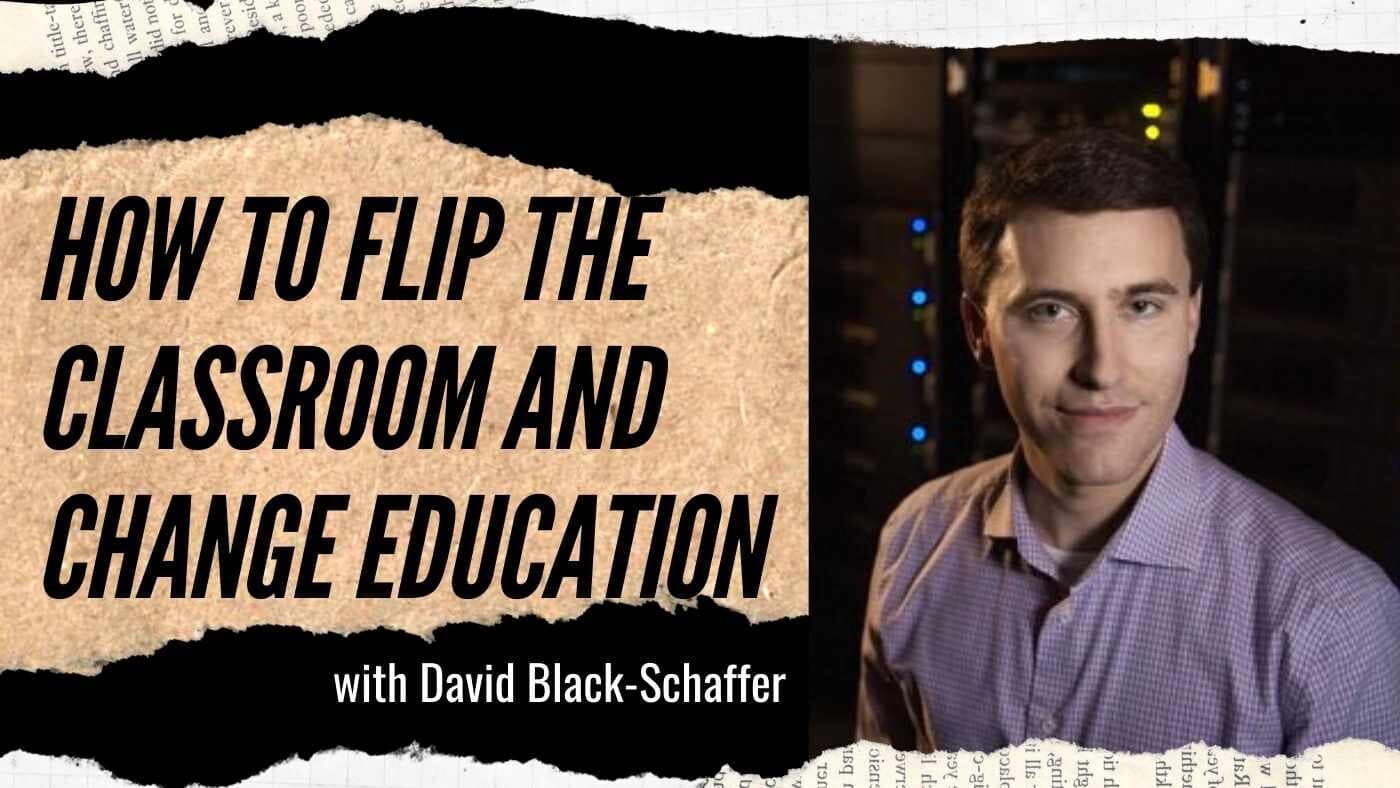
Our Guest Today: David Black-Schaffer
David Schaffer is a world-class researcher in Computer Architecture. He was introduced to me by my audio producer Germán who has been studying with David at Uppsala University in Sweden for the past three years.
David is a Winchester, Massachusetts native, who received his Ph.D. from Stanford and then moved to Sweden with his family. He is currently a senior researcher in the Uppsala Architecture Research Team working among a group of curious minds from around the world.
Recently, David started the Scalable Learning Project, a platform to “flip the classroom”, making teaching and learning interactive. Students not only love it, they also perform much better. As a professor in Computer Science, David believes that these interactive video lectures could also help subjects such as economics, art and history.
“When I go into my classroom, I know exactly what questions students have. I’ve chosen the most interesting ones right up on the board, along with the exact point in the videos when they asked the questions.”
David sees having the lectures online lets him be “in the classroom” with the students. And that is fun and rewarding for a teacher.
Another technical area we delved into was David’s research “Energy efficient computation for future challenges”. How does energy efficiency impact your life? Well, if you have a smartphone and ever felt frustrated with its limited battery life, you’ll want to know why this research project is crucial. Turns out, energy efficiency is an even bigger problem to tackle in the fields such as medicine and computer science.
Besides teaching, research, David is a father to two young children who are being raised in Sweden. David tells me about parenthood and a life as an American family living abroad. What are the important reasons David decided to move his family to Europe? How has it impacted his work and relationship with his children?
David Black-Schaffer – Show Notes
- [06:30] Fei and David sharing thoughts about life as a whole, and work-life balance.
- [08:00] Boston is where your roots are, can you tell us a little bit more about that?
- [10:00] You parents are both doctors at Mass General Hospital (MGH). What was it like growing up in a household of doctors?
- [17:30] Why did you decided to move to Sweden, and what was that decision like?
- [20:00] David compares working in the US vs. Sweden
- [22:00] How is the success as a researcher being measured today? What are the role of bibliometrics?
- [25:00] What is Scalable-Learning and how did that project started? How did that change your way of teaching?
- [31:00] The Scalable-Learning platform sounds radically different, but very practical from a teaching standpoint. However, it is also more work for the teachers, how do you deal with that?
- [37:00] What are some of the solutions to approach teachers that are more traditional or not properly motivated to change their teaching style?
- [42:00] What is your area of research? What are you currently investigating?
- [48:00] How can people learn more about your research and group?[50:00] David and Fei discussing about the challenges behind making knowledge available to different communities and people, and common points in research and advertising.
Favorite Quotes
- [07:00] ‘A mentor of mine is fond of saying that life is a package deal. This concept that you can have a work-life balance. […] Everything is a package, so it’s no more one or the other, it’s deciding what is important to you and figuring out how to do it, because you do it once. It is life, and it all comes together…’
- [11:00] ‘A career is not something that you get to a point and stay there, but it is something that you are constantly evolving as you go through it. I found that to be a very comforting thought for what is the future, you are not stuck somewhere, you can keep pushing yourself in new directions.
- [13:00] It’s OK to be yourself and to have things that are important to you, but you also need to make sure that you are taking care of the people around you in those relationships as well. And I feel that’s both an important and an inspiring message to give to kids.
- [17:00] There are parents who are really committed to their careers, and they will be better parents if they are able to be successful in their career as well. Getting a balance is important, but it is also interesting to see how society judges those different balances.
- [26:30] ‘I fundamentally believe that teaching is the most important thing we do at the university. […] I love teaching, I really enjoy being in the classroom, I enjoy helping people and seeing them succeed.’
- [27:30] ‘When I go into my classroom, I know exactly what questions students had on the material the night before, I’ve chosen the most interesting ones right up on the board, along with the exact point in the videos when they asked the questions.’
- [29:00] ‘For me this has lead to an enormously more satisfying teaching experience, because I spend my time in the classroom, walking around and talking to the students while they are working on problems, while they are solving things, while they are trying to get stuff done. […] This has been a lot of fun.’
Transcript
Transcript
Fei Wu: Welcome to the Feisworld Podcast, engaging conversations that cross the boundaries between business, art and the digital world. David Black-Schaffer: A career is not something that you get to a point and you stay there, but it, it's something that you are constantly evolving and making as you go through it. And I find this to be a very comforting thought for, you know, what is the future? You're not stuck somewhere. You can keep pushing yourself in new direct. It's okay to be yourself and to have things that are important to you, but that you also need to make sure that you are taking care of the people around you and those relationships as well. And I feel that's both an important and an inspiring message to give to kids. I fundamentally believe that teaching is the most important thing we do at the university. I spend my time in the classroom. Walking around and talking to the students while they're working on problems, while they're solving things, while they're trying to get stuff done. For me as a teacher, that is. Enormously satisfying. A mentor of mine is fond of saying that life is a package deal and, um, this, uh, concept that you can have a work life balance. Everything is a package, so it's not more one or the other. It. You know, deciding what is important to you and figuring out how to do it because you do it once. Hey everybody, this is Faye W and I am your host for the Phase Roll podcast. I'm really excited today because I have a very special guest named David Black Shaffer, who is a world class researcher in computer Arch. He was introduced to me by my fantastic audio producer named German, behind the scenes on phase world. German has been studying with David at Sala University in Sweden for the past three years as a Winchester, Massachusetts native. David is quite familiar with where I'm currently living and working, which is Boston. David received his PhD from Stanford and then moved to Sweden with his family. He is currently a senior researcher in the ZA architecture research team. The work environment is quite international. German being one of them, was raised in Argentina. David has been incredibly successful in leading a diverse group of curious minds. After spending years as a student in both China and the United States, I find David a rather unusual teacher in many. Recently he started the Scalable Learning Project, a platform to flip the classroom, making, teaching and learning interactive, not a one-way lecture. Students not only love it, they also perform much better. The experiment David designed is rather sophisticated and he does an incredible job describing and explaining it. In this episode, here are just a few examples David created at home Interactive video lectures where there are self-assessment quizzes integrated and students receive real time feedback, correct or incorrect. They can even go as far as clicking a button to indicate that they were confused. These results help David modify his in-class lecture to directly address what the students are struggling with. And as a professor in computer science, David further elaborated on how these interactive video lectures could help subjects such as economics, arts, and history. David sees having the lectures online lets him be in the classroom with the students, and that is fun and rewarding for a teacher. Another technical area we delved into was David's research called energy efficient computation for future challenges. How does energy efficiency impact your life? Well, if you have a smartphone and ever felt so frustrated with its limited battery life, you will want to know why this research project is crucial. Turns out energy efficiency is an even bigger problem to tackle in the field, such as medicine and computer science. Besides teaching research, David is a father to two young children who are being raised in Sweden. David tells me about parenthood and a life as an American family living in Sweden. What were some of the important reasons for David to move his family to Europe? How has it impacted his work and relationship with his. I hope you enjoy this conversation. It's a rare opportunity and I love how my path crossed with David's. This experience reminds me once again, the purpose of Face World Podcast as a home to celebrate the stories you may never hear of otherwise. Don't forget show notes, tools and resources, including videos of David explaining the setup and impact behind flipping the classroom, as well as his research subject on phase world.com. We hope you share the story with others. Perhaps you might want to refer similar stories guests to us to consider in 2017. Without further ado, please welcome David Black shaer to the Phase World Podcast. Thank you so much for joining me. I really look forward to this. I you, you're most welcome. Um, I, I have to say, I'm looking forward to this too. I think this will be fascinating for, uh, my kids to look. Or listen to 10 years from now and get a feeling for what their father was thinking about when they were small. So, um, wow. I need a little bit selfish in this as well. I, I love,
Fei Wu: and thanks so much for bringing it up, because I think parenthood is such an interesting topic. I love children. I, I currently don't have children. I do plan. To have them. And, uh, I, I, hopefully I will become a great mom. But, you know, surprisingly, this journey of being a podcaster has, you know, basically led me to talk to so many interesting people and different ways of parenting, but the underlying theme has always been the same, and I've just tremendous respect of, you know, people sometime have to make. Difficult decisions and have to make their life decisions around their children and still, you know, be able to achieve, um, what they need to do. It's just so fascinating to David Black-Schaffer: me. It is. And, um, a mentor of mine is fond of saying that life is a package deal and, um, this, uh, concept that you can have a work life balance, , um, no, everything is a package, so it's not more one or the other. It's, you know, deciding what is important to you and figuring out how to do it because you do it once. It is life. and, um, it all comes together and it is the, the big thing that people deal with. And so it's not at all surprising that, um, this is a, a overriding theme, particularly if you're interviewing people in sort of the age group that I'm in where small children or a, uh, large part of their lives
Fei Wu: mm-hmm. you know, I notice, you know, I have so many questions. I'm gonna trying to like package them a little bit more, but I can't ignore the fact that David, you are somehow, I'm currently in Boston and. Where your roots are, uh, somewhat, or this is kind of where your beginning was, so tell me a little bit more about that. No, David Black-Schaffer: I, I grew up in Winchester, um, and so I grew up there all through middle school. And then in high school I started going to Phillips Academy, Andover in Andover. And then after that I went to college at Dartmouth, up in New Hampshire. So I have the interesting position of having. In the Boston area right up until the time when I would've been old enough to sort of explore Boston on my own. And then at that point I went off to school at Andover. So while I grew up in the Boston area, I never really explored Boston as a kid. And all of my experiences in Boston have been afterwards as an adult, and except when I say Boston. Where I do think you can detect a slight accent, I don't, people when they, when they hear me, are very surprised that I grew up in the Boston area and then I don't have a strong accent from that.
Fei Wu: That's fascinating because I, I certainly heard about this. I'm not originally from here, but the people I work with tend not to have an accent, uh, in advertising in agencies. Um, but the moment, again, to some of those, um, suburban areas, I immediately, you know, Marlborough and Braintree, I start hearing these accent left and right. David Black-Schaffer: I had a friend of mine in college who had a very strong Boston accent. And I think he was one of the first people in his family to go to college, and he came from, you know, sort of a, a working class suburb. And if you move to the suburbs where everybody's moving into the Boston area from somewhere else, I don't think you see the accent as much.
Fei Wu: Yeah, I, I certainly notice that, and especially as an immigrant myself. And that, uh, sort of observation here in Boston is quite intriguing. Um, you mentioned Mass General Hospital. Uh, that's. Incredible because it's a place that I find myself traveling through over and over again. So in this case, I assume your parents were or perhaps still are doctors? David Black-Schaffer: Yes, both my parents were doctors. My father's parents were both doctors, including my grandmother and my mother's parents. Her father was a doctor and her mother was a nurse. So I come from a long line of physicians and uh, as a result had no interest whatsoever myself in going into medicine. The other thing that has, Quite interesting to me and has influenced me a lot, is that I grew up in a household where both parents had serious careers and it was very regular for one or the other of them to be off. You know, they weren't coming home for dinners tonight because they had a meeting at work. This was just the way parents were. And as I got older, I saw also how my parents managed to evolve their careers over time. They went from change specialties or moved from doing prac, purely practicing medicine to being involved in medicine policy at the local level or the national level, or being involved in working on their organization and things like that. And that has really. Shown me that a career is not something that you get to a point and you stay there, but it, it's something that you are constantly evolving and making as you go through it. And I find this to be a very comforting thought for, you know, what is the future? You're not stuck somewhere. You can keep pushing yourself in new directions. Mm-hmm. ,
Fei Wu: I am taking notes as I'm thinking, how many people are absolutely going to enjoy this episode? Because I know several people whose parents are also doctors. I guess it's not too big of a surprise living in the Boston area, having MGH and all the. On Longwood Avenue, and I know precisely that none of those children decided to pursue even a degree in medicine. Uh, needless to say that they were thinking about medicine as a career, much due to the fact that of the, their childhood and, uh, how that was perceived. And, and David Black-Schaffer: I, I think Harvard hospitals are particularly vicious in this regard and, and Harvard in general that, um, there is just this assumption that your, your career is your. And that they want the best, most dedicated people possible. And that that takes a certain sort of person with a certain commitment. And if you're growing up as a child and you see that, yeah, you see that there's a lot of time put into that. And I actually find this to be in some sense very comforting because I consider that I had a fantastic childhood. And when I see my wife and I regularly being out traveling or out for dinners and things like that, and I see my children experiencing this, oh yeah, mommy's not home for dinner tonight. She has a meeting. Daddy's off on a trip. He has a meeting, he's not home. Sending this message to them that their parents have their own lives, have their careers, that these are important to them and that, you know, as I said before, that life is a package deal. That their parents are not going to give up everything because they have kids. That the kids are important, but the parents also have other things outside of the family. That's important. And I feel that's both an important and an inspiring message to give to. That it's okay to be yourself and to have things that are important to you, but that you also need to make sure that you are taking care of the people around you and those relationships as well.
Fei Wu: Yes. Uh, you know, this message, Resonated with me on a new level, just watching my own mom. You know, at this point in my life, and it has been for the past, really 15 years, I did not need, I did not have an adult in my life traveling here to kind of be an independent student and really, uh, like a boarding student at the age of 16 until now in my early thirties. And all of a sudden, you know, I saw my mom trying to reintegrate her life back into mind, trying to take care of me. I put my foot down and just said, mom, you don't need to retire right now. In fact, you can, you know, as an artist, you can go chase after your dreams. And, and to be honest, just based on what you told me, our relationship, my relationship with my mom has significantly improved it as a result of her decision, continue to pursue what she loves to do instead of kind of just hovering over my life. So I love the fact that you're able to. Well, there's David Black-Schaffer: an enormous pressure in society to have a career and have a family. This is where this whole concept of work life balance comes from that. And historically, this has been solved by the man having the career and the woman having the family. And that's not good, in my opinion. I mean, I think that it's very good to see that both parents can do things, but as a society, we haven't really adjusted to this idea. It's not one or the other anymore that you have to sacrifice both. And it is politically incorrect to say, oh, I'm going to sacrifice how much time I spend with my kids because I wanna work on my career. That is, you know, something people react to very negatively. And I have noticed a, a significant difference in this regard between the United States and living here in Sweden. And the most obvious form of this was that when we lived in the US there was sort of a competition among parents to see who could pick up their kid as late at possible as daycare without being past closing time And, you know, that that was really the goal to get in every last minute of work. And here in Sweden, it's exactly the. Here everybody's competing to see who can pick up their kid. Earliest, can I, you know, get my kid two hours before daycare closes or can I have, you know, grandma come and pick up the kid a few days a week. So they're there only until lunch. And this idea of using the daycare until it close is not frowned upon. But there is a feeling that, you know, if, if you really have to work that much of course day care's there for you. But it says something about your. Quite regularly. My son is the last one at daycare when we pick him. And, um, I, you know, think this is fantastic because it means that for, you know, the last 15 minutes of the day, his, uh, student to teacher ratio is one to one . You know, this is great. He gets some time to relax and quiet, calm down before we bring him home. But the fact that the daycare's open until five 15 and there's one kid left at five o'clock when we pick him up. Says something about the expected balance between careers and kids that they have here. The fact that you can continue to use parental leave until the child graduates from, uh, the end of first grade. Says something about that too. And many parents are just on 20% parental leave for several years, so they can pick up their kids early and do things like that. And that is, um, fantastic in some ways, but it puts a large pressure on people to say you have to sacrifice your career for small children. I'm of the belief that if the parents are less happy because they do that, that's going to affect the. And that there are parents who are happy to do that and there are parents who are really committed to their careers and they will be better parents if they're able to be successful at their careers as well. Getting a balance there is important, but it's interesting to see how the society judges the different balances here. Wow. We
Fei Wu: are onto Sweden quickly, and I am just so fascinated by even just that for me right now, just peeking into this society. So I would love to maybe take a couple of step back and just find out what was that decision like and, and why was the decision to move to Sweden. If you could tell me a bit. David Black-Schaffer: Oh, uh, the decision was a very simple one. I had started in graduate school the year that my wife did an exchange program from her Swedish University to the same graduate school. That's where we met. Then we both continued on to do PhDs in graduate school in California, and well, we both ended up being there for seven or eight years after that. We had one kid at that point and we decided, all right, we've tried the US thing. Let's try the Swedish. And so it was a question mostly of finding appropriate jobs for us in Sweden and then moving here. And since doing that, we've both been very successful in this environment and we found that the lifestyle here works very well for us. The ability to work 45 hours a week and be considered really working a lot. Instead of in the US where you're working 45 hours. Okay. I, I guess you're, you're doing the minimum here, you know, 45 hours and Okay. You're really, you're really putting in your time . And that puts us in a comfortable position in the sense that we don't feel a pressure that we have to be working more, but it also gives us the ability to really spend time at home. I mean, we really try to not work at all over the weekends. I go and pick up my daughter early from school every Wednesday so we can spend some time in the afternoons together. And the flexibility to do that without feeling as though we are hurting our careers here or we're not living up to our employers expectations is, is a very nice. Position to be in.
Fei Wu: Mm. You know, what you just said reminded me so much of the friends I had, um, a number of years ago who were postoc at Harvard and mit, and I must tell you they were working. 80, a hundred, 120 hours every week and seeing them was nearly impossible. And arranging social events with these folks would take weeks and weeks, and we're all, you know, we're all feeling bad for even just like pulling of them away from work. So, I'm so glad you're talking about this. The fact that you don't wanna be a workaholic, the family is very important to you. That's refreshing to me. David Black-Schaffer: It's not just the family being important to me, it's um, for my own San. I mean, there have been times in my life when I have had to push myself to work really hard for an extended period of time and I just get burned out. Mm-hmm. . And it is, you know, physically and psychologically unpleasant. And if I can reach a balance where I am mentally have the energy to do things and I'm feeling good about stuff, and that's working at a level which is appropriate for my position and where I'm trying to go, then that's a good match. And then I think I found that here. But you do bring up an interesting. If you have postdocs and researchers at Harvard that are working truly 50 or 60 hours a week, they're going to be at a minimum 50% more productive than the researchers that we have working here in Sweden who are working 40, maybe 45 hours a week. And when you think of research as being an internationally competitive endeavor, we need to take that into account when we set our expectations for what it is we expect to be able to achieve, and how competitive we expect. And this is a real challenge for an international field that is still practiced in local places. Another example of this is within Europe. How do you compare a three year PhD program in France to a seven year PhD program in the United States? That's a huge difference in the amount of time people put into things, and since research is such an internationally competitive endeavor with everything being reviewed internationally, it becomes a real challenge to make sure that your productivity is high enough when you're living in a culture which expects people to have a different balance, that you can continue to be competitive and that that is not so. That people are comfortable acknowledging and it's not something that we have a clear solution for. How do we address it?
Fei Wu: There was this measurement. I, I actually looked it up, um, which is, I believe Google actually calculates based on the citation and, and the papers that you produce, I believe is something around, in anywhere between zero, I believe, the score of 20. I was reading this book by, uh, Cal Newport. The book called Deep Work. So he was talking about that precisely. And you know how much work and paper you need to publish in order for that score to go up, which is oftentimes used to measure how successful you are as a researcher. So does that ring the bell? Is there such measurement in Sweden or some you feel like some sort of system? David Black-Schaffer: There's an interesting, uh, issue. People measure what they can measure and bibliometrics this idea that we're going to evaluate people based on how they're doing in the library, how they're doing in publish. Is a very common thing because it's so easy to measure compared to what is the actual quality of your research. Now these statistics have historically been very crude, just the total number of publications, and that encouraged people to publish in really lousy places because it was easier to get publications. And then people started including some sort of, uh, quality metric. How, how much impact does a publication have? And we'll wait your publications by the impact. So now there's more incentive to publish in good places, but still the incentive is to publish a lot. And we haven't yet gotten to the point where we can actually infer what the quality of publications is, and I'm sure we'll get there. I mean, there's no reason to believe that with Google having all this information, they won't be able to go through and determine which publications it were that led to, which new fields being develop. And then mark those publications and those people as being more impressive. And when we do that, then we'll be able to truly use Bibliometrics to do a good measurement. But right now there's a huge amount of emphasis on that because that's what we can measure and it's very hard to evaluate things otherwise. Uh, where this becomes most apparent to me is actually not in research, because in research we sort of know how the game is played. We know what the metrics are that people use and what they're looking for. It's, if you look at the university's role of doing research and. We don't have any metrics for teaching. There's nothing that's obvious to measure, and so as a result, we don't really measure anything, and the fact that we have something we can measure in research means that people kind of know what they're supposed to do to get ahead and research, but the fact that we don't have anything to measure in teaching, well, there's not much incentive for people to try new things or work harder if there's no measurement. That's going to show they're doing a better job. And so we have a real challenge here that because we measure these things in research, we put a lot of incentive on people to get ahead with research. And because we don't measure anything in teaching, there's no feeling that improving teaching will count somewhere. Whereas I know that every publication I do that will count.
Fei Wu: This is very thought-provoking. David must say, I'm so glad you're bringing this up because there's so many people I interview, including two doctors from MGH and one of them being a woman who loves mentoring, other basically students or um, future doctors. But then oftentimes she's not given any credit, even time or support or resources to do that, but she feels obligated because those doctors. Client facing were patient facing and they must hone in on the skills that she thought it was crucial. And right here as I'm studying more about you in the, the past few days, the area and actually what you called flipping the classroom, it just a wonderful approach for any. For any teachers, you know, classrooms and subject. And I really wanna kind of chat a bit more about that. And I must say that the fact that you're giving yourself a standard, uh, and therefore something that in many cases measured against, I think that's a, that's a lot of courage David Black-Schaffer: too. What I can say that's really good about, I think, humanity in general is we, we have lots of people who do really. And our, our world works not because we have all the right incentives in place, but because most people are decent people who care. And if you look at the university level in teaching, there are a lot of really good teachers who put in the time to do it just as this person who mentors you, you mentioned not because they get any credit for it officially, but because they feel it's an important thing to do. And there are people trying all sorts of neat things. Uh, the work that I've been doing with the flipped classroom falls into that category, and this isn't because there's any official credit for it. It's because I fundamentally believe that teaching is the most important thing we do at the university. And this is difficult for me because I also understand that research is the most important thing for my career at the university level. Teaching is important, but once you've done enough teaching, you've check that box. But research is something that continually, the more you do, the more grants you can get, the more research you can do. It's something that throughout your career, you need to be constantly improving. And I also have to say from a purely selfish point of view, I love teaching. I really enjoy being in the classroom. I enjoy helping people and seeing them succeed. And my own journey through different teaching approaches began basically when I started teaching and I got all the positive feedback you could imagine. Course reviews, students being enthusiastic in class, and then everybody did really badly on the. And I, I wondered what was going on here because I was getting all the positive feedback that I was doing a great job, but people just weren't learning the material. And I ran into some research which basically said in a, um, disturbingly authoritative sense that lecturing doesn't teach. And that people learn things by working on them, by being active, by struggling through the material. And, and since then there have been a bunch of studies which have made it abundantly clear that if we actually want people to learn things, we can't lecture to them. We have to get them involved. And working with the materials or active teaching is, is the essence of this. And so I wanted to switch to doing that myself in my classroom. And I wanted to take the approach of taking my lectures and putting them online as videos, but I knew that. Asking people to watch lectures on YouTube is, um, difficult. It's incredibly boring. Just watching a lecture on YouTube and if you have a lot of them trying to make sure everybody watches them is difficult and there, there just wasn't a good way to make this work at this point. And so I got together with some colleagues of mine and we built a system that allows us to make interactive videos. So we can basically put quizzes into the videos so students can interact with the material and we can check their progress and they can ask questions and we can give them feedback. And this has allowed us to build up a system which really helps integrate students preparing before C class with what you do in the classroom. So if students ask a question online while they're watching the video, the teacher can then go through and review all of those questions before class, send answers to the students, and also select questions to bring up in the classroom. And so when I go into my classroom, I know exactly what the questions were that students had on the material the night before, and I've chosen the most interesting of those questions. And when I start off my. I show the questions right up on the board, along with the exact point in the video where they ask the questions, and that makes it very easy for me as a teacher to jump into those questions and to connect to the issues that they ran into. And it's also a lot of fun because I know there's a student in the classroom there who asks the question. These are all anonymous, so I don't know who the student was. And for that student, having the teacher choose their question and say in front of the whole class, this is a great question, let's spend some time talking about it, is also gives a very positive sense of feedback to the students that I care about what they're doing and I'm interested. For me, this has led to, um, An enormously more satisfying teaching experience because I spend my time in the classroom walking around and talking to the students while they're working on problems, while they're solving things, while they're trying to get stuff done. And then once they've all worked on the problems, I know that every student in the classroom has now solved this problem. So when I want to discuss it and go through the answer, I can call on anyone I want. So I don't usually ask people who wants to answer a question, I just pick. And I just walk through the classroom from the front to the back, picking on the next group for every question because I know everybody's been working on it. And that is something which, if you try to do it in a regular classroom, would be, uh, somewhat difficult. But in a classroom where I know all of the students just spent the last 10 minutes working on solving that problem, I have this confidence that I can just ask whoever I want and I know that everybody has something to say about it because they just spent time working on it. For me, as a teacher, that is. Enormously satisfying and for the students, well, it's, frankly, it's uncomfortable and it's a lot more work, but they also very much appreciate that it's a much more effective way to learn the material. So for me, this has been, um, a lot of fun.
Fei Wu: Yeah, I, the fun was the word that you used and I believe, uh, quoting you slightly incorrectly is about how you know this is the most fun you've had teaching in a very long time and or ever. And at the end of a video I was watching, and I must say though, it's not just what worked for the students. I'm a technology geek myself and I'm in digital marketing. So I was really intrigued by when you said, putting together these video. That are interactive. I mean, that's a lot more work for you. Could you tell me a bit more about that ? David Black-Schaffer: It absolutely is, and this is the limiting factor. Uh, we've had thousands of teachers and over 25,000 students use this system that we developed since we put it out. And the problem is that the people who use this, they are the highly motivated teachers who are gonna spend the time to develop this material. It takes. A lot of practice to put together interactive videos. It takes a lot of practice to develop interactive material for people to use in the classroom that's at the right level, and people can work on on their own with some help and work on with a partner. And these are things that none of us have experience with because we were never taught this way when we ourselves were students. So it's not just the question of developing the material, it's also a question of developing the skills needed to. And this is the limiting factor in, in getting these sorts of methods adopted more. It takes a huge amount of time and it takes skills that we don't have. And as we were discussing earlier about the incentives in the system, there are no strong incentives for people to invest that time or develop those skills. If I look at this from sort of a broader perspective, What we need to do to enable this is we need to move away from this idea that individual teachers put together their own classes and teach them in their own unique way. We need to enable teachers to work together and share material and develop courses together so that each teacher can develop perhaps a third of a course, but they can work together with others to produce the whole course. And I think if we could do. We could amortize the time it takes to produce this material, and that would be much more effective. But we're up against a teaching culture, which is very individualistic. Teachers really want to teach their own stuff and put it together their own specific way and put their own spin on it, and moving away from that to the point where you are going to develop good material for part of the course, but you're gonna use other people's good material for another part of the course. That's uncomfortable for a lot of teacher. And it's going to take some time before we get to the point where teachers are comfortable saying, right, this part of the course, you are going to be using material that somebody else developed and we're gonna use it because I know it's good material. Because as you do say, it takes an enormous amount of time and effort to develop this sort of material. There's a lot of value in it from the teaching point of view. But unless we have the incentives to do that, it's very hard for most teachers to spend that time. Mm.
Fei Wu: I really like where you're going with this because I think it's much easier to say than done and in some areas, uh, not to generalize, a collaboration may be challenging, let's just say, but I think in most cases, collaboration is beautiful. I think that the fact that what you mentioned about teachers and collaboration and I think about working in marketing and advertising, then there's just so much. There's so much insecurities and that surface, you know, I'm on people and that's just really unfortunate. I think that what you're describing, if we can take a few steps towards that direction, this world would be a better place. David Black-Schaffer: I, I agree with you that all of that is there. From the academic point of view, the biggest thing I see is not even that, it's just the overhead of collabo. To have a productive collaboration requires a significant amount of overhead in organization. It requires developing a significant amount of trust, which takes time and experience, and all of those things are a significant investment. And if you can produce a course, which is eh, fine, without making that investment, there has to be a pretty strong incentive in place for you to invest in that level of teamwork before you can get the benefits. You're absolutely right that, you know, getting credit and people wanting to, you know, be the one listed on there is part of the issue. But my impression is that when it comes to developing teaching material, we are so far from running into that problem that I'm far more concerned about the how do we incentivize people to invest in working together first. We get to the point where so many people are working together, that they're fighting over who gets credit. Um, I'll be happy with that outcome. ?
Fei Wu: Yeah, absolutely. I, I think this, uh, we're kind of tapping into organizational behavior as well, and for me, this is very helpful. Information because I tend to be the person who says, okay, that this part of the system is broken. But then I don't really take a step back and, and say that why aren't people participating? Or maybe there's a different set of issues involved and. A recent example would be the collaboration even among producers like myself and marketing and advertising was simply missing that we were all out there, even on different projects, but we typically face the same problems, and we come from a very different backgrounds. Ages. In some cases I have, uh, more experience than my peers, so why don't we just come together? But that's actually right there. Sometimes that stops people from coming because they feel like they could use that hour or two to be more productive, kind of solving problems independently. But I'm pulling them away from that to say, let the eight or nine of us come together, because some of the problems in terms of themes might repeat themselves. Um, David Black-Schaffer: but there's also a question of incentives here. If you look. The academic world, those incentives exist with research. You know, you're gonna be evaluated by international peers. If you're not using the most recent methods and techniques and working on the right problems, they're not going to evaluate you positively. But when you look at teaching, teaching is a relatively protected endeavor in the university. You are not going to be evaluated by other people in any significant way, and your benefits from improving and the incentives are really not there. And getting people without those incentives to go and do things is extremely hard. It's the benefits over a sort of normal level of teaching aren't there. So they have to commit that time because they believe in this personally and they're willing to invest in it because they are good people rather than because the system is pushing them in that direction.
Fei Wu: Mm. What are some of the hypothetical solutions or sort of measurements or incentives that could benefit both teachers and students? In that case? David Black-Schaffer: The, the most important thing is to not let the best be the enemy of the good. There is no perfect measurement of teaching. and to worry about using something because it's not perfect is a very common excuse for using nothing. There are plenty of things which are known to work poorly. For example, there was a very neat study which looked at the question, how was your course overall And they found a strong correlation between that and what your students were in, what grade they were getting, and what the weather was the day they were asked. So that's not a very good question to use. Judge teaching by, but there have been a whole range of questions, which have been found to be fairly indicative of whether teaching is good. There are other simple things to ask, like what sort of teaching techniques are used if you find that teachers are using a range of techniques which will activate students and get them involved in working with the material, that's a very good sign. If you find teachers are primarily using passive techniques such as reading and lecturing, that's an indication that the education isn't being very good. And these things are very simple to measure, but the problem is you don't just need to measure them. You need to make this data available to everyone who's involved. Teachers need to know that students are gonna be looking at their data so they feel some pressure to do a good job. So it looks good. Students need to be able to go look at the data for courses to decide if it's worth their time taking courses and administrators need to be able to look across the university to figure out where are the areas that we can improve and where are the areas that are doing well that we can learn from. Switching to an idea where we should collect this data and we should make it available is a very uncomfortable. I think this is particularly uncomfortable in Sweden where we don't like to point out people who are better or worse. Everybody should be good. Nobody should be really excellent and nobody should be really bad, and it's very uncomfortable if we do collect that data. And it turns out that some people are far better. Or some people are far worse, that that is a very difficult thing to deal with. Um, in the culture that I'm in at the moment, and this isn't hard to do, it's just, again, it's a cultural question.
Fei Wu: I, as a freelancer since the beginning of the year, I realized that you basically pinpointed one of the reasons why I decided to leave the corporate culture, which I, I must say that, you know, I know plenty of people in medicine, in education that it's not something that you can operate alone. So it's not so easy to be a freelance professor or you know, a freelance doctor. I think it's such a different world that I'm living in and how competitive that. And for people to send me a note, but they're sending the same note to so many other people. So you must be the absolute best producer or designer, whatever you do in order to be selected. And people are so transparent about that feedback with you that I, I'm able to learn and really kind of walk the walk and through a different journey this year. To, to understand that data of me, like for myself. So this is, this is fascinating. Sorry David, I kind of like took you on to so many different tangents here and one area we haven't had a chance to talk about is actually your research, which is to me equally as fascinating. So I'd love to kind of have you introduce to my audience a bit about that as David Black-Schaffer: well. Sure. So the area I do research in is computer architecture. That's the design of computer systems. And the particular problem that is in vogue at the moment that, um, is the most pressing problem at the moment is how to make computer systems more energy efficient. And from a practical point of view, if you look at a cell phone today or an iPad, it's basically a, a big box to hold a battery with a teeny little computer and a screen attached to it. Um, and the reason for that is simply that to get acceptable battery life, you have to have a really big battery because the parts of the computer inside there eat up a lot of. And at the same time, we want to have faster and faster computers. And so we've gotta figure out how to make them more energy efficient. And we've had two trends over the history of computer design, which have really helped us. The first one, which many people are familiar with is called Moore's Law, and it basically says that we can get more and more transistors in a computer processor for the same. And that allows us to do more and more stuff, build in more complexity and the like. At the same time, there was a trend called Denis Law, which basically said that at the same time, they're getting smaller. We can make them faster, but we can also reduce the voltage we use to power them. And if we can reduce the voltage, then we can make them faster and smaller and not use more energy. So basically for the same size battery every year, you just got things faster and. Or for the same size box on your desktop or the same size server in a server room, you could get faster and faster without needing more energy, more heat, or more cooling. Unfortunately, in about 2003, 2004, the transistors got small enough where that stopped being the case. We could make them smaller, we could run them faster, but if we reduce the voltage, they stopped. And this was known as the end of dinner scaling. And it basically said that, yeah, you can have faster computers every year, but they're gonna use more and more energy and generate more and more heat. And the problem with that is that most of us aren't happy having larger and larger batteries on our phones every year. So what this meant is that we've had a transition in the design of computer systems to focusing not on raw performance, but focusing on how efficiently you can do comput. And the first part of this trend was the switch from faster and faster processors to having more and more of them. So everybody buys a laptop with two cores in it, or four cores in it because they couldn't make one core that was twice as fast. So the Intel's brilliant marketing department decided they'd sell you two cores. They were the same speed as before, and of course while two was better than one, so everybody would buy it, and that doesn't really work out because it's very hard to make programs that use more than one quarter at a time. So it was never really twice as fast. So this trend has continued, the excitement in computer design these days is how can we design systems that are more power efficient so that we can do a better job of using the limited energy we have to deliver more performance? And I work on this at two levels. First level is with software. Right now we have computer systems which have a range of different types of processors in them. So the most typical ones is you'll have a main processor for doing general purpose computations, and you'll have a graphics processor, which mostly does graphics, but all graphics is is it's thousands and thousands of nearly identical computations at the same time. And if you have another problem that also does thousands and thousands of merely identical computations at the same time, you can run it on the graphics processor and have it run more efficient. Examples are the sort of problems that can do that. Uh, machine learning is a good one. Uh, there are big parts of genetics that can be done that way as well, and so lots of people are using graphics processors for other types of processing. The problem is that now if you're gonna write a program, you have to figure out how to divide your program between your regular processor and your graphics process. You have to figure out which parts are very parallel, have thousands of different things, which parts don't have many things. Figure out how to get their communication synchronized and how to optimize moving data back and forth between them. And all of this is sufficiently complicated that it's really only the most advanced programmers who can take advantage of this. And if we continue that way, it's going to mean that only the most advanced programmers can get these benefits. So part of the work I'm doing is on how can we understand and optimize this sort of behavior. So can we look at a program and learn which device it runs best on? How to move the data back and forth, how to balance the computation between different devices so that the programmers don't have to deal with those optimizations. At the same time, I'm also looking at how to improve the computer processor itself. If you think about a computer processor, it's sitting there and it's doing calculations. It's adding things and checking numbers and counting stuff. That's basically what a processor does, but half of the energy that's used in that processor goes to actually doing the work. The other half goes to just moving the data around. So if you want to take a picture on your screen and you wanna make it lighter, you have to move every piece of data from that picture into the process. Do one math operation on it to make it lighter and then send the data all the way back to the main memory. And so for that operation, you spend all your energy moving the data and very little energy actually doing work. And what we've been working at is how can we do a better job of moving the data so that we're more intelligent about it. Can we move the data to the right place at the right time? Can we avoid having to search for the data as much? And if we can do that, we can access the data with much lower energy, therefore make it more energy efficient. And if we're more energy efficient in how we move data, that means we have energy left over to do computations faster so we can improve the overall performance of the system without increasing the amount of energy. So those are the two areas that I'm working on for improving energy efficiency. They're how to make the software take advantage of different processors better and how to design the hardware so that it can more efficiently move data around.
Fei Wu: Wow. I love the word choices that you had, and then thank you so much for sort of targeting that message and so that. I found it really easy to understand and to be able to relate to, uh, at a personal level that I notice is as a, you know, smartphone user for the past 10 years. And like you said, the device is getting bigger and the battery life is none existing and it's, it's just been honestly introduced tremendous amount of stress when I travel, when I'm at work, using my phone for client calls, uh, and just watch the battery dying down. It's like there's nothing I can do about it. I'm so thrilled that in your field that you've decided to, to focus on this David Black-Schaffer: and, but just, this is a, a very common issue when we go and talk to companies about this, everyone is excited about the idea of saving energy. Because everybody is trying to balance how much performance, for how much energy so that we can deliver better features in the future, but not hurt the battery life or improve the battery life. So this is the big challenge in computer systems these days and it's by no means just me working on it. I mean, this is really what everybody is looking at. It's a great opportunity to really rethink things from a different perspective and uh, I'm quite excited about that. And what's
Fei Wu: the name of the startup or how can people learn more about this research topic of. David Black-Schaffer: Oh, that's an excellent question. Um, the research that we've done is of course, all available on our website. Uh, one of the projects I have has a little, um, informational video produced about it, which is on my website. That's the software one, which you can go and look at that and learn something about it. There is a sort of, uh, popular science type article coming out about the other project. It is always a challenge to explain these things in a way that gets away from all of those details. Um, I had a lot of fun a few years ago explaining this to my daughter's kindergarten class and, um, this was, you know, exactly what I explained to them and I explained it to them with pictures of what's inside an iPad and how big is the battery and how fast do things go, and how much battery do they use, and tried to explain to them what it was we were trying to do. A very straightforward problem and everybody can relate to it, but the solutions that we're doing have to deal with the specifics of how machines have been designed in the past and the inefficiencies that we're sort of left with, and how can we redesign them and get away from those inefficiencies.
Fei Wu: I love that an explanation in kindergarten class and oftentimes through, you know, testing and what I have observed through effective marketing and advertising is about relating to people and then so that you don't leave anybody behind and kind of have the most raw materials. And the things that they can see and touch. Uh, as part of the explanation last night, I was even thinking how this can, by solving or even approaching this issue, helping people be exposed to this information, even though they may or may not fully understand it, is, is critical path. And I think it's going back to the teaching, uh, measurement as well. If people are unaware of how this could potentially be measured, how you could, you know, improve upon David Black-Schaffer: it, well, Part of the reason we're having this problem is related to the fact that we have been so successful. If you look at what it takes to build a popular app these days, you know, somebody's gonna write an application that's gonna run on a phone. It's not written with efficiency in mind. It's designed in a way which makes it quick for the people to write the applications to write it, and then it's gonna communicate with a server at Amazon or Google. And the code running on that server is not written in a way that's designed to be efficient. It's written in a way that's designed to be quick to write the code so that they can quickly put the stuff together and get it working. And so we have paid an enormous overhead in terms of raw computational efficiency in order to get developer efficiency, and that's definitely the right trade off to make in terms of getting things to market quickly. But now that we've done this, if we also want better battery life on our phone, well now we gotta go back to the people who made those apps and say, Hey, you guys need to rewrite these using different tools in order to make them more efficient. Or we have to come up with sort of meta tools, which can take the stuff that they're writing and make it more efficient. And there has been an enormous amount of work on this. Uh, my favorite example is, uh, if you look at an iPhone, an Apple's web. When you load a page on the web browser, the first thing it does is it starts running the page in a very slow but quick to start way, and it runs it for a little while and then it finds out which parts of the page you're spending all the time are taking all the energy and it doesn't optimization on those parts. So now it can run them more quickly, then it runs it for a little while longer and collect some more data, and then it uses another optimization to reoptimize those. And so they've gone and built in three completely separate ways to run the webpage so that they can get the right balance between getting it to load quickly and run efficiently. And the result of this is the people who write webpages don't have to figure out how to make it efficient, because in the back end it's being smart and already trying to do this for you. And I think that there's a lot of room for that sort of improvement because if we give up the developer productivity, That kills time to market and then nobody's gonna do it because they won't be able to make a business case for it. So there's a lot of pressure that we've been so successful in performance that we can now afford these very inefficient ways to do things. But now when we look at battery life, it comes back and bites us and then we've gotta figure out how to fix that part too. Mm.
Fei Wu: I think that should, the raw computational efficiency should be built in as a measurement, you know, perhaps submitting an app. Well, it is David Black-Schaffer: or it is. So if, if you have a Mac laptop and you click on the battery icon in your menu bar, you'll get a list of programs running on your computer that are using a lot of. And this is exactly there to sort of shame developers into fixing their problems. I mean, if you run it and you say, Hey, you know, word is using a lot of energy, you're gonna think twice about the next time you go and buy a product from Microsoft. And of course there's a balance here. If you do it too aggressively, then developers will stop caring. But, so there is some incentive to do that. And you can also look, um, on phones, which applications have been using the most. The problem is that there's no easy way for people to fix this. Some things just take energy. If you're playing a game, you're using that energy to render the screen, so of course you want it to use energy, so you don't wanna be too mean to people. It would be really nice if there was some way to say how much energy they were wasting, sort of how efficient they were, not just how much energy they use, but that's a very hard metric to figure out.
Fei Wu: Wow. David, this is such a phenomenal conversation. I feel like I was able to learn such a tremendous amount of information. Our conversation just now would've taken several books, weeks of reading, but somehow you're able to like break it down for me and maybe really think. One is held to think, but really think about the things that are that really important, uh, in the realm of our topics, uh, in this hour. So thank you so much for this. It was such a surprise. You David Black-Schaffer: know, you're most welcome and, and it is, it is very generous of you to say that about this. But, um, you should keep in mind that this is my career and what I've been doing for the past decade or more. I'm always quite impressed by journalists that they were able to go into completely different sets of situations and distill out of. What is the interesting part? What is the essence of things that are there, uh, for you to be able to do this across a wide range of topics is very impressive.
Fei Wu: Oh, wow. Thank you. David. I, I love the word journalism. You know, it's an area that I've always been interested in, but I've never really pursued as profession, but, You know, I gain selfishly, I, I have such tremendous joy in speaking with my guests and learning more about what they do and, and really trying to build awareness around that because I, when I interview Chris ti, which I absolutely adore so dearly from npr, and now she said that we have to, we're obligated to do this cuz we have a platform and people like yourself, David, that you've devoted, you know, so much of your time, your career into building this. You're really busy doing that. You don't have time to do what I do. So I'm so glad I'm able to offer this to you. David Black-Schaffer: Oh, thank you very much. Um, this was a pleasure to discuss and I, I think these issues are exciting and important and I'm glad to, uh, discuss them. Awesome.
Fei Wu: Thank you, David. All David Black-Schaffer: right. Thank you very much. Hey, it's.
Fei Wu: I'm back for a few words at the end of the show. I hope you enjoy what you heard. You can visit us online@phaseworld.com to find out other episodes from this category or topic, or you could explore other awesome people who are artists and designers, digital marketers, performing artists, authors and speakers, entrepreneurs, students, educators, and. For this reason, we've taken your feedback and created a landing page to most easily navigate by categories and topics. Simply visit podcast dot face world.com to learn more. Sincerely, I want to thank you for your support. Bye for now.
Links, Tools and Resources Mentioned
- Scalable-Learning website www.scalable-learning.com
- David’s website http://www.it.uu.se/katalog/davbl791
- UART Website http://www.it.uu.se/research/group/uart
Music by Olexandr IgnatovLicense this song for personal or commercial use SoundCloud

Written by
Fei WuFei Wu is the founder and CEO of Feisworld Media, a Massachusetts-based digital media company helping brands get discovered by people and by AI. An Adobe Global Ambassador and brand partner to ElevenLabs, Synthesia, and 50+ other tech and AI companies, she hosts the Feisworld Podcast (400+ episodes, 500K+ downloads — guests have included Seth Godin, Steve Wozniak, Chris Voss, and Arianna Huffington) and co-created the documentary Feisworld: Live Your Art on Amazon Prime. Fei writes for CNET, Lifehacker, and PCMag, and her work has been featured in Forbes, Harvard Business Review, and WIRED. She has been publishing on the internet since 2014 — long before AI discoverability had a name.
View all posts by Fei Wu→Stay updated
Weekly insights on content, AI, and digital media.
Keep Reading
Related Articles

Joanne Lipman on Mentors, Untapped Talent and Why Women Should Stop Waiting to Be Perfect

Marc Randolph on Curiosity, Messy Starts and Why “Nobody Knows Anything”