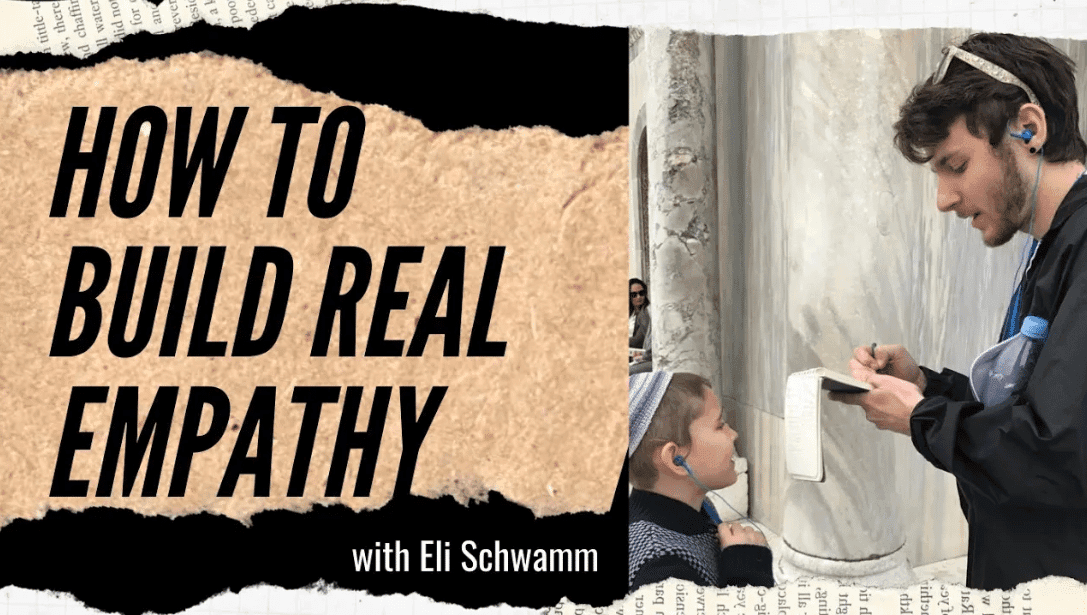
Our Guest Today: Eli Schwamm
Meet today’s superhero, Eli Schwamm, who has appeared on an earlier episode of Feisworld in Episode 27 (nearly 3 years ago), where he introduced himself with a rap song he had written. That episode remains to be one of the most popular, most downloaded of all time.
While in high school, Eli learned to produce music, had a near 4.0 GPA, and volunteered at Samaritans in Boston for a few years. He even went back there to continue his work during the summer when he’s in college.
So where has he been? Where is he now?
Eli and I talked about giving and receiving feedback, a more authentic understanding of empathy, his relentless curiosity towards the healthcare system.
He interned at Mass General Hospital, Boston Medical Center, and received his EMT certification.
Eli believes that there is a special connection between people that is “only uniquely possible in a healthcare setting”.
Now as a Junior at Vassar college, Eli spends his “off hours” working at a transitional community helping previously incarcerated young adults.
This conversation intrigued me to rethink the possibilities for millennials. What can they do to make the world a better place, for themselves?
If you enjoy this episode, please consider sharing it with ONE MORE PERSON.
Show Notes
- [06:00] Last time we talked about joining the Samaritans. Can you update us what you’ve
- been since then?
- [10:00] You have empathy beyond average in your age. Are you aware of this and how do you see yourself with it?
- [13:00] Fei and Eli discussing being a good listener
- [16:00] Fei and Eli chatting on how to give and receive feedback, and one particular experience with Eli.
- [22:00] When you pick up these activities, this maturity towards helping others while learning and becoming a better person, were you inspired by your parents?
- [23:00] Fei sharing differences between family life, work-life balance
- and Eli’s experience when he was a kid and his parents were working.
- [25:00] How was your experience being an assistant/ambulance driver? How did this come about?
- [29:00] What was your role in this experience? How were you assisting them?
- [31:00] You mentioned that you need to be extra careful when asking the questions to your patients, because of how they can interpret them and feel. What kind of tricks did you learn from this?
- [34:00] Fei sharing her experience when she served as a translator for her mom while she was at the hospital, and relating to Eli’s experience.
- [38:00] How do you find these opportunities and experiences?
- [41:00] From your experience surveying patients with an iPad, what have you learned as surprising findings?
- [43:00] What are your thoughts regarding palliative care vs hospice care? Is there any other are you are interested?
- [46:00] What are your thoughts with regards to picking up one of these activities during the school year versus during the summer, what do you prefer?
Favorite Quotes
[11:00] Everyone comes into this world as their own person and there’s no way I can fully encapsulate somebody else’s experience. And that becomes really important because often I see people using this concept of empathy as a way to justify making decisions for other people. For example in humanitarian aid, where people in a position of power use empathy as a way to justify telling people what are suffering what they need, as opposed to listening to people that are suffering…
[15:00] I think I will never be able to say ‘I’m a good listener’ because I feel that as soon as I say that I become complacent and I stop listening. Especially when it comes to things like criticism, as soon as I think I’m good at receiving feedback, that’s the time I think I’ll close myself off and become complacent.
[27:00] It’s really important in those interactions to approach the person at their level, not at this level of ‘I know what’s best’, but rather at this level of ‘tell me what’s bothering you and I’ll do my best’.
[49:00] The world is filled with people who are passionate about things. I think it’s important to be consistent and to not spend a bunch of money into some hobby and then drop the hobby sometime in the future, but I think it’s also really OK for me to experience different things. And I hope to continue for the rest of my life to have things that I’m committed to, like my career, my family, and then to also leave myself the space to explore and to try to find other things.
Transcript
Transcript
Fei Wu: Hey. Hello. How are you? This is a show for everyone else instead of going after top 1% of the world, we dedicate this podcast to celebrate the lives of the unsung heroes and self-made artists.
Eli Schwamm: People in a position of power use quote unquote empathy as a way to justify telling people who are suffering what they need. Yeah. Um, as opposed to actually listening to the people who are suffer. Uh, and hearing from them firsthand what they need and trying to work with them to figure out how to provide it. I've learned that I need to always hold the distance between me and other people and always hold this idea that I can't possibly understand what somebody else is experiencing and that the only. To take a stab at understanding is to really listen with an open mind and an open heart to what they're saying. It's really important, I think, in those interactions to approach the person at their level. Tell me what's, what's bothering you? Tell me what's going on, and I'll do my best to sort of bring you to the hospital, if that's what you need, or to, to provide the little amount of care that EMTs can provide on scene. Uh, the world is filled with people who are doing, who are passionate about things. For me at least, it's important for me to be consistent and to not, like, spend a bunch of money getting into some hobby and then drop the hobby. Sometime in the future, but I think it's also really okay for me to experience different things and dabble in different things. It's okay for me to get really into audio engineering for a few years and then pull back a little bit. Um, and I, I hope to continue for the rest of my life to have things that I'm committed to, like my career. And my family. Um, and then to also leave myself the space to explore and to try to find new things that I'll be
Fei Wu: committed to. Hi there. This is your host, FA w and you are listening to a brand new episode from Face World Podcast. Today's superhero is Eli Shroom. Okay, just kidding. Eli is also an unsung hero who has appeared on a much earlier episode of Face World episode 27. I actually couldn't believe this when I said it because that was more than a hundred episodes ago. Anyway, Eli opened that episode by introducing himself with a rap song that he wrote. He learned to produce music while he was still in high school and he was only 17 years old. In episode 27. He learned how to rap back then, held a near 4.0 gpa, volunteer at Samaritans in Boston for a few years, and even went back there to continue his work during college. That episode remains to be one of the most popular, most downloaded episodes of all time. Eli and I. Still can't believe that is true. So where has he been? Where is he now? This episode answers all the questions. So if you have been a fan of Eli, this is the episode for you. We talked about giving and receiving feedback, an area where Eli's paying close attention to and hopes to improve upon. At the same time, he is insanely curious about the healthcare system. I mean, who isn't, even if you're not, you feel like you probably should care. Um, so his curiosity has taken him to several internships from Mass General Hospital to Boston Medical Center, and even getting his EMT certification. By the way, Eli's only 20 years. He told me about a special feeling of connecting with someone that is uniquely possible only in a healthcare setting. He talks about a complicated power dynamics and, uh, being an EMT person working often in lower, uh, income neighborhoods and be able to connect with someone where they are, not to pretend that he knows everything or what's best. Eli's now a junior at Vassar College, and he spends a lot of time learning going to classes as you can imagine. But, um, during his rare free time, he chooses to work at a transitional community helping previously incarcerated young adults. So this conversation can easily turn into a love fest. I absolutely adore Eli, which you'll find out in a minute, but intrigued me to think. What can the future generation, in this case, younger millennials do to help themselves and really make the world a better place? What can they contribute and influence today, not 10 or 20 years from now? You know, are they really completely powerless and choiceless? If you enjoy this episode and if you feel like. Another young person, you know, whether it's your friend or your children, your nephews nieces, please help share this episode. I think it really means so much to us, and I think it'll really help, uh, young people rethink the possibilities. Thank you so much for choosing to spend your precious time here with us and, uh, very special, happy Holidays to all of you. This is the last episode, uh, at the end of 2017, and I cannot possibly think of a better person to help me close this chapter of Face World. Without further ado, please welcome the very special unsung hero, Eli Schrom to the Face World Podcast. So I'm here with Eli Schrom, who has appeared on an earlier episode of Face World Podcast. Mm-hmm. , not only that, you were only 17 at the time, and what really intrigued me in terms of what you were passionate about working on was Samaritans of Boston and I've been involved in their. Annual breakfast, learn more about the organization. That was an incredible experience for me. But now you are a junior
Eli Schwamm: at, uh, Vassar College. Vassar College. That's correct. I'm so grateful to be back on the show. I think this is a really special. Place. Um, I'm really interested in hearing people talk about what they're passionate about, even if that thing itself isn't something that I am interested in. I think that the way that people talk when they're really in love with something is, is beautiful to see. And I think that your show really is about that. It's about capturing. People's passions from all walks of life. So I'm so grateful to be able to be here sharing my passions. Yeah, I think the show's a really incredible thing.
Fei Wu: Thank you, Eli. And hearing that from you really means a lot because you are what I like to consider the og, one of the OGs of Face World really. Uh, saw it from inception. Mm-hmm. through some of the ups and downs or mostly ups over the years. A lot of the insights and such as what you just shared with me and I really don't mind hearing more of, as you can imagine, became some, became taglines and really helped me drew clarity to what and why I'm doing, and that's, Powerful to
Eli Schwamm: have that. Um, yeah, so, so you mentioned Samaritans. Um, and I'll, I can, I'm happy to give a little bit of an update. Please do. About that. I've can actually continued to stay in touch with them and to work with them. Uh, over time it's been more difficult now that I'm in school. I'm not in Boston anymore, but when I come back for breaks, occasionally I'll do shifts with them and I still feel really strongly. The work that they do there. I think it's really incredible. It also sheds light on the way that I think mental healthcare is not provided, uh, in this country. So many of the callers that we get are people who have been somehow failed by the mental healthcare system, and I think that's maybe one of the less expected parts. It's not just people who are calling feeling imminently suicidal, it's also people who are calling. Because they need some sort of care and, uh, they can't get it elsewhere, and that's a hard position to be in. There were times, especially this last winter break, uh, when I was back in Boston where I would get a caller who I knew desperately needed help and I knew that I was so far from qualified to help this person. Um, and so, and so powerless to help this person, just from my position, you know, miles away on the. They, and they knew that for the most part, they knew that I couldn't actually help them, but I was the best thing that they, that they had. And it sort of feels sometimes like giving just enough nourishment to a starving person to keep them alive. Mm-hmm. , but constantly suffering and there's, that's something that I really have to continue to reckon with. I obviously was grateful to have been there to begin with, but there's a way in which what I was doing was not nearly. You have
Fei Wu: shown a lot of empathy and just hearing you talk makes me wonder. I mean, one of the reasons we connect is I feel the same way a lot of the times. Mm-hmm. and I'm much older and that sometime I look back to see myself as an absorbing so much of that energy. You know, same thing with podcasting, but it's generally very positive. Mm-hmm. . Um, but sometime when I interview. Oncologists or you know, someone with a disease or mm-hmm. in that moment during production. I mean, my whole body is so involved in that and their journey as if I were them. So are you aware of that? How do you see yourself with the love of empathy that you have possibly beyond your age and your generation?
Eli Schwamm: Um, well, I think empathy is an interesting concept. There's a way in which. I, I would challenge the idea that empathy as experiencing somebody else's experience could even exist because, you know, everyone comes into this world with their own a as their own person, and there's no way that I can ever really fully encapsulate somebody else's experience. Mm-hmm. . And I think that becomes really important because often I see people using. This sort of concept of empathy as a way to justify making decisions for other people. And this comes into play in a lot of spaces. It comes into play in a lot of humanitarian aid, where people in a position of power, uh, use quote unquote empathy as a way to justify telling people who are suffering what they need. Yeah. Um, as opposed to actually listening to the people who are suffer. Uh, and hearing from them firsthand what they need and trying to work with them to figure out how to provide it. Um, and this is something actually that college has really taught me. There are a lot of really important people in my life who I've had really challenging conversations with that have really brought me to this place of understanding that empathy is a complicated concept. So I do try, I do try my hardest to, to understand where people are coming from. I try my hardest to, to experience, to, to experience in myself something that might approximate what other people are experiencing. But I think in large part, because of these really wonderful people that I've met at school, I've learned that I need to always hold. The distance between me and other people and always hold this idea that I can't possibly understand what somebody else is experiencing and that the only way to take a stab at understanding is to really listen with an open mind and an open heart to what they're saying.
Fei Wu: I, I love that. That's, um, one of the, kind of a selfish reason why I started the podcast was because I wanted to be a good listener. And I, before that, I always believed I was one already. So, um, over the years, I think, um, as I was getting older, I noticed it was not a. Skill necessarily that you were born with where you're just naturally good at And sure, some people are about better listeners, but I think to keep an open mind isn't always easy In my cases, and I find it these days when I record a conversation because I have so much love for the people I'm speaking with. Some people are complete strangers, I will probably never meet in person. I really try to put myself in that position just to reimagine the things that they accomplish and the things that they're so passionate about. But sometimes it's outside of the podcasting environment that can be. A struggle sometimes with family members, with people you're particular close with and, and at work when clients being unreasonable. So I try to kind of hone in on that skill. I feel like if I can elevate myself during podcasting, maybe I can disperse some of that skills and reuse it
Eli Schwamm: elsewhere. Absolutely. And I, I think that it's a really, as I said at the beginning of the, of the episode, it's a really wonderful platform to, to think about what it means to really listen to someone and to really hear someone. And I actually think. Not only are you providing an opportunity for. To work on that scale, you're actually probably providing an opportunity to all your listeners to work on that skill as well as they hear people talking about things that they're passionate about. I love,
Fei Wu: it's so, such an interesting, uh, I guess in this almost like tips and tricks in terms of how to even listen to a podcast because I notice the same thing when I listen to, say, digital marketing, because I happen to be a, a digital marketer, I tend to want to answer those questions. Oh, I know a better way to do this, right? I know how to save you more money. And you completely miss the point and miss the answers altogether. So I think podcast is such an interesting platform to give you that chance to, to go back. And I think even that simple action of going back shows something about who you are as a person.
Eli Schwamm: Actually, the last time I appeared on the show, I think that I. I don't remember if this is exactly what I said, but I remember at that time in my life I felt like I had learned how to be a good listener, and I've since sort of reimagined what being a good listener is and that I don't necessarily think that I can ever say. I am a good listener because I feel like as soon as I say that, I become complacent and I stop listening. And I, especially when it be, when it comes to things like criticism mm-hmm. , and it's very hard to listen to criticism. And if as soon as I think I am good at receiving feedback, that's the time when I think I'll close myself off and become complacent. Mm-hmm. . So I'm, I'm working hard now to try to think about how to constantly be challenging. Am I really listening to what this person's saying or am I doing that thing where I try to answer the question before it's out am. Really hearing the feedback that this person is trying to give me or am I getting defensive and trying to, you know, flip the script and make it about them. Mm-hmm. , do you
Fei Wu: challenge us to talk about getting and receiving feedback, which also, I know you're looking at one of the sticky notes I have on my computer. It says Ignore sunk cost. Uh, in that very session, SESCO's, L 10 B earlier this year where I just learned tremendous amount of information. I thought I already knew, but I did not at. Or, you know, some costs, you ignore some costs. You hear that in business school sometimes, and you just imagine that you know it. But when it comes to analyzing your own project, your life to say what is, what does it even mean to you? You don't realize that what, what that actually translates to. But one of the other lessons I, I learned, Precisely what Seth focuses on is giving and receiving feedback, and it's such a challenge. And sometimes you ignore it. You try to ignore it, especially when you're trying to, when you're at work, not alone. In this case, I have the privilege to be alone and to sit with myself, but if you're in a out in the open and people staring at you, you're trying to suppress that. Mm-hmm. and you behave very differently. So I definitely exercise, receiving feedback and try to be a good listener.
Eli Schwamm: I think. The ideal scenario is one where, um, uh, I would receive feedback or you would receive feedback, and then we would immediately be able to kind of suppress that defensive instinct. I think. That is the standard that I will hold myself to, but I also know that I will fall short of that standard. And I think that in those cases it's very easy to sort of cut ties with the whole situation and just, and leave it and be like, I'll do better next time. Mm-hmm. . But I actually think that there's a lot can, that can be done retrospectively to make a situation. More. Okay. So recently I had a, a scenario where a close friend of mine gave me some feedback about the way that I was behaving in a class. And they felt sort of isolated by my behavior in that class. And at the time, I really didn't receive the feedback well, I didn't yell at my friend. I didn't snap at my friend, but I didn't, I sort of dismissed what my friend said. Mm-hmm. . And I think that that was really hurtful for them. And I was able to sort of realize this after the fact and kind of go. And apologize and have another conversation. Reopen that conversation with my friend and I think. That was really important cuz I realized actually after that second conversation that had I not gone back, that probably would've been the last piece of feedback that I got from this friend.
Fei Wu: Mm. I think when it comes to feedback, there's that whole set of opportunities. And things that you might not see on your own. I try to imagine what actually happened in that class. Were you answering or giving an answer too quickly? Were you asking too many questions? What, what was that situation like? Uh, it
Eli Schwamm: was a little bit more, so this is a very group work oriented class, and my friend felt that I was sort of ignoring them, that I wasn't including them in the, in the group work that I was doing, which is, to be perfectly fair, something that I can have a tendency to do. Mm-hmm. , I get very sort of laser focused on producing a. Okay. Um, and I forget about the fact that in group work scenarios, it it is, it's always. About the process as well as the, as the product. I have a lot of work to do, um, in, in terms of making myself a better partner. Mm-hmm. , uh, to work, to work on group work with.
Fei Wu: That's such a mature observation, uh, knowing you for, I wanna say, oh my God, most of your life. I can't believe that's actually true. We, I think we're wired differently and I see you not only as in someone who's interested in medicine, but science in general and figuring things out, problem solving, and the reason for you to be. So there's that balance. The reason for you to be so good at it is because you can tune out a lot of these things, right? So for. Uh, sometimes that's something I struggle, like I would love to dedicate more time just to do one thing, but my emails will pop up. My phones are to ring my mom, right? I get distracted. You know, I'm not saying you're free from distractions, but you are so passionate whenever you talk about an algorithm, a new discovery, things I wouldn't understand. You really go deep. You get really into it. And so how do you balance? Something that makes you good at what you do professionally, academically, versus trying to be a, a group member and collaborator.
Eli Schwamm: Like, to be honest, I don't know that I really do very well, so I might not be the best person to ask about how to balance that. Um, mm-hmm. . So for, I've, since I, we last appeared on the show, I, um, went to school and I declared a math major. So a lot of the work that I do now is in math, problem sets, proofs, um, derivations, things like this. And I think the reason, part of the reason why I'm so passionate about it is that it's the kind of thing I can really lose myself in. Mm-hmm. , I'll start last night as a great example. I was working on a problem set for one of my classes. I had to do this very long, um, derivation. Um, it was a, it was a really complicated problem. It was really interesting, and I really got to like, use all the tools in my algebra toolkit to solve it. Uh, and it was something that I started it, I mean, I've been working on it for a few weeks, but I started it at like maybe 8:00 PM. and I looked up and it was three in the morning and I had Jen. I just finished it, but I hadn't even noticed the time go by. Mm-hmm. . And that's really special. And so I love that. It's interesting. I think many of the things that I'm really passionate about, I, I, I find myself losing myself in those, in those activities. There's, uh, some psychiatrist who calls this like, flow. Mm-hmm. , uh, I'm not familiar with who. Um, I really feel like I get into this, this flow. And that's true. I mean that's true with a lot of my hobby activities too, like even video games, um, or ultimate Frisbee or, um, electronics repair, which is something we can talk about afterwards. But they're the same way that I sort of get laser focused and I ignore everything around me other than the problem. And this is something you alluded to, when someone's trying to get my attention, when someone's trying to ask me a question, I can be very dismissive and I think. It's easy to use this sort of impersonal perspective to describe this, to say like, oh, this is something that happens to me, that I lose myself, and therefore I can't be held responsible for the way that I react. When people try to ask my advice or ask a question and I think that that's the wrong way to approach it, I think I need to take responsibility. Even I need to be able to have that interrupt. Mm-hmm. be able to. Okay, I'm close to a breakthrough on this problem, but my friend is either a step ahead or a step behind and has a question that I might be able to help them with and I might learn, and I probably will learn in the process. I need to be able to have that interrupt. I need to be able to step back, drop what I'm doing, and really with my whole mind, listen to what they're saying. I mean, it really goes back to listening. Yeah, exactly.
Fei Wu: We're talking about kind of, this comes in full circle there and teaching from my experience is sometimes the best way to learn and to dissect, get in even deeper to a place that you might not even see on your own. But I, I do wanna address the fact. My whole entire career as a project manager before I win freelancing, and even now, I still freelance as a project manager. Is about the ability to multitask and there were numerous articles, uh, talking about how that's never possible, whether it's not ideal to create deep work. You know, I thought based on some of my teachers, I consider someone like Dory Clark, people like Dory Clark, they block how their calendars. Tuesdays and Thursdays, for example, they even share like a screenshot of that. We're just uninterrupted work. You know? Because in reality they have to connect with their listeners. With their readers and email lists. Mm-hmm. and other people who wanna interview them, whatever that reason may be. So they can't Right. In reality, block out Monday through Friday, right? Mm-hmm. , I also, um, talk to a lot of parents with the young kids and. A lot of successful entrepreneurs I know love their family life. They really love their kids when they spend more time. But when they're young, you know, they teach their kids if their morning time is very important and everybody has a slightly different routine, right? They put up a sign, you know, in front of their office to say, no interruption for mommy before noon. And the kids learn that as in a result, they're able to accomplish so much more and. Know how to entertain themselves and they grow up to be more independent. Right? And they respect what their parents are passionate about. So, yeah.
Eli Schwamm: And, and I think that's, that's in some ways the way that, uh, my parents operated when we were young. Um, but I never really thought about it that way. And I think one of the really nice side effects of that is that if you set aside time for work versus time for spending time with the family, each of those can take on this. Whole self quality and that if I'm, if, if I'm working and I'm not distracted when I'm working, then I get more work done. And that means that when I'm with my family, I don't have to think about my work. I can think about really being with my family. Mm-hmm. .
Fei Wu: Yeah. Since we recorded the last episode. And the reason for that is I, I couldn't really see myself at then maybe a 30 year old to take on such a endeavor such as, um, Samaritans. And, you know, I was personally going through a, a friend's suicide and it was very difficult, you know, so it was really, daring is not the word, but it's kind of pushing your own personal limit into tapping into a place because. Sometimes maybe a little scary or unsettling is not only the fact that you're helping others, but you're probably discovering so much more about yourself. Um, since then you've taken on, you know, becoming a ambulance driver or, uh, assistance. So tell us about, like, do you recall, do you remember what kind of trigger that interest and. You know, how did that come about?
Eli Schwamm: So I think I've always had an interest in, in, uh, healthcare. Um, I come by it from my family. I mean, both of my, my parents are physicians and my grandfather was a physician, et cetera. And I think that that was really what planted the seed in my head. But I think that what's, there are a couple things that have drawn me back to, uh, anything in the vicinity of healthcare over time. I think I really find the human interaction to be very me. It's the kind of thing when, when I'm working EMT shifts, I often have to leave the house by four in the morning. So waking up at, at four, at three 30 as a 18 year old, right? Yeah. There aren't that many things that can really get me outta bed at that time. Um, and truth be told, human interaction only barely makes the cut, but that, that very special feeling of connecting with someone, which is in some ways uniquely possible, uh, in a healthcare setting. There's also a way in which there's this very complicated power dynamic of being a healthcare provider, and especially, you know, When I work as an emt, I work in some of the more impoverished neighborhoods in Boston, and there's something very complex about me as a, you know, upper middle class white person going into a impoverished community where most of the residents are, are immigrants or, or of minority status in one way or another, providing this sort of care taking role in that space. So one of the things that I've had to think about, Full circle back to the listening. It's really important, I think, in that, in those interactions to approach the person at, at their level, not at this level of, you know, I know what's best, um, but rather at this level of tell me what's, what's bothering you? Tell me what's going on and I'll do my best to sort of, Bring you to the hospital, if that's what you need or to, to provide the little amount of care that EMTs can provide on scene. Mm-hmm. , a large part of that job also was taking people to and from dialysis appointments to and from doctor's appointments, people who, for one reason or another, it was deemed unsafe for them to travel in a cab or, or on foot or driving, and that an ambulance was considered the best transport for them. And those actually, I think, were my favorite. Those are my favorite calls. Those, I think in those spaces, in many ways, that weird power dynamic could dissolve more organically. Mm-hmm. , um, that felt like a very genuine, uh, interaction. It wasn't as if, you know, I was, I had to be in that space because I was being, you know, that was my job. I had to be there with them. No one was forcing me to talk with them, and no one was forcing them to talk with me. So it, it was this very meeting in the middle. Having this conversation because you were both interested in doing it. Wow, that sounds
Fei Wu: amazing. You make me wanna give that a shot too. , just to clarify, your role in the ambulance is not as a driver, but you actually in the back.
Eli Schwamm: So it's actually, we take turns. So in a, in your typical basic life support ambulance, these are the, this ones that look more like a U-Haul van than like the sort of boxy trucks. And those are the kinds that I work in. You have two what are called EMT basics and we are trained in emergency response driving. So we do drive. We're also trained in basic life support, which includes things like cardiac arrest, splinting, broken bones, administering simple drugs like, uh, aspirin, Narcan, epinephrine, things like this, things that people could technically administer themselves. But that, you know, we've been trained on how to administer these in crisis situations.
Fei Wu: What are some of the skills that, that are hard to learn? Because some of the things I heard, I, I imagine, you know, if you sprint something or you know, if you have a broken bone, what, what do you do in that situation?
Eli Schwamm: Yeah, so I think it's interesting. I, there are a lot of skills that I technically quote, unquote, have learned but have never actually performed. So, for example, I, in the state of Massachusetts and New York, I. Registered to deliver children because of my T certification. I've never done it . Um, and I'm sure that I could do it because I was trained to do it, but I wouldn't say that a skill that, that's a skill that I have. But the sort of funny thing about that is that childbirth is kind of, if there are no complications, I mean, people have been giving birth since the beginning of human history. With, I mean, and there, there have been issues, but, but for the most part it's kind of takes care of itself. It means only just a very small amount of, uh, guiding. But yeah, I, I mean, I think the, the skill that I am perhaps the most proud of that took the longest to really develop, and this is something that I would really say is a skill that I've worked on, is the ability to stay calm in a crisis situation. You know, so just the other, just a week or two ago, um, I was with my grandmother and we. Uh, an older woman slip and fall, um, on the sidewalk. Very fortunately, she was totally okay. It was really remarkable actually, cuz it was, you know, a, a fully standing fall. But in that situation, I felt very comfortable approaching her, asking her how she was doing. Little things that, that. I wouldn't, wouldn't have occurred to me, I think to do in a, in sort of a intense emotional situation, like seeing someone
Fei Wu: fall, you are very, you are very careful at picking, choosing your words on language even way before, you know, since you were five, so, Uh, with that said, what I find really astonishing and really interesting is some of these training that teach you to, you know, there's body language involved. Mm-hmm. , there is certain, certain words that you choose over the others that might sound good, but might trigger certain emotional, uh, barriers and such. I'm curious, like, what are, how do you ask your questions and what are the micro expressions and, you know, things that you pay attention to,
Eli Schwamm: what you learned. Um, I would say it really depends on the situation and I think a lot of it, it's hard to teach that kind of thing, and I don't necessarily know if I'm good at it or not. I've just tried to sort of intuit, um, my way around, uh, how to ask questions. Some of the interesting questions that I think are very complicated to ask our questions that often sound judgemental. So for example, as a part of any sort of, he. Screening people are always asked about whether or not they smoke tobacco, whether not they drink alcohol, and whether or not they use any other drugs. And the way to ask those questions is really complex, and that's something that I've paid a lot of attention to. I think if it, if I ask the question with two. Bright a tone. It almost sounds kind of mocking if I ask the question with too much gravitas. It sounds judgemental. So there's this sweet spot. Um, and I actually had a not so wonderful experience being asked one of those questions recently. I was at a doctor's appointment and I was asked about whether or not I drink. And the way that I was asked make me feel all of a sudden very, uh, should be ashamed of it. And, you know, I don't blame this person. You know, I was, I, it was the end of the day. It had been a long day. Um, uh, and I think that it's totally understandable. That being said, I think it was, it was, it was hard to be in a, be receiving healthcare and feel like I was somehow unworthy. I think in the case when somebody's fallen, uh, you know, approaching them and asking like, Hey, how are you doing? , the message is pretty clear that someone's there to help. Mm-hmm. , um, and not there to be judgemental. But I, I, I think in general, that there are some questions that are easier to ask and other questions that are harder to ask. So that's my convoluted answer to.
Fei Wu: You pursued a, an internship training at, um, a local hospital here in Boston where you hold onto an iPad and kind of being able to survey and even greet people where they're in the waiting room to trying to find out what is wrong with them over there, be nothing wrong. Right. Maybe just routine, you know? So what, what was that experience like for you?
Eli Schwamm: Absolutely. I. Interestingly enough, I think in this particular, um, domain, you're probably as if not more qualified to speak about it than I am. I think the memory. Um, you actually serving as a sort of mediator in a lot of the care of, at least, um, your mother when she was ill a little while ago. Mm-hmm. , uh, and she needed everything translated.
Fei Wu: Um, for my experience, I was very under-prepared. I had a full-time job, so I wasn't, never really did this in terms of experience and. Didn't have the time or that emotional, again, training, like you said, to be remain calm. For me, that was interesting. Now, in retrospect, she's doing, uh, very well today. When we received the news that she was actually diabetic, I just remember for me to even hear that word to felt so foreign. And then I have to look at her to think this is going to be a chronic thing possibly for the rest of her life. How and if I should translate that. There's not just that accuracy. It's like I know exactly what's going on. So I remember a couple of things I did instead of that real time translation. I try to, this is maybe advice for a lot of my friends and people out there have to do a lot of translation for their parents or loved ones, and I try to just. Delve in a little bit deeper in terms of understanding what we're dealing with at that time. So asking not too many questions, but the key questions such as how bad is it? What are, what do we expect to do next? How long does she have to stay in the hospital? Where is she gonna stay? Right? Um, so after I felt like I gathered some somewhat sufficient information, I then started the translation. So can slow down that real time back and forth, like a ping pong
Eli Schwamm: ball, you know. And I imagine, I think it's interesting as you're saying that I'm thinking about, um, you know, what I was talking about before about how the tone makes all the difference and that it's almost as if serving as the translator, you're expected to sort of relay the tone of the provider, but in an entirely different language, in entirely different cultural context. So I'm not sur I mean, it makes a lot of sense that you'd need a lot more information to be able to do that. You need to understand, you know, if somebody. Uh, you know, I'm really sorry, but you, I think you're suffering from diabetes like that sounds a lot more serious than if the provider says like, you know, we did a routine test and I think you might have diabetes. Mm-hmm. so. Being able to take that and turn, turn it into a message that's in an entirely different language, literally and metaphorically, is really interesting.
Fei Wu: And the hospital we're staying at gave me such insight into, I know that the American medical system is nowhere near perfection, but coming from where. What I was used to with my dad being sick in China. Yeah. So think about the cancer patients at Dana Farber, but that hospital, imagine that hospital flooded with 20 times the people, with people sitting over nowhere to even sit while having cancer. To, while my mom had staying at. ICU for 10 days. I know that sounds like extraordinary amount of time. They were incredibly patient and just so kind and talking to her, capturing, asking us questions such as where does she walk to? What does she like to do? Yeah. What was her like? You sitting in that, in that ambulance, trying to understand her as a person. Right. And not just an. Subject or a
Eli Schwamm: patient. Yeah. Yeah, that, I mean, I think that's interesting observation. I think that's really beautiful that she was able to be provided that. But going, going
Fei Wu: back to your experience with the iPad and talking to patients, how did you find the opportunity for maybe some listeners who wanna even consider doing that, or you self-initiated a lot of these things? I just wanna put it out there, not because your parents are doctors, Just slotted you in some situation, you found out about these things, that your parents were surprised that they even existed, or you'd be interested in
Eli Schwamm: them? Well, first of all, I very much appreciate that. I think, to be perfectly fair, I definitely have benefited from, you know, connections that my parents have in the, in the medical world. And in one case it was as simple as knowing the right vocabulary to use in a job search. I mean, that's really something that. Get from, from the background that I come from, and that's not something that I've necessarily earned. That being said, I have really worked hard to try to find a variety of opportunities and I, I would say I have not necessarily relied solely on acumen or connections of my, of my folks to try to find different opportunities in the healthcare world. The iPad position that I held, basically I was working on collecting something called patient reported outcomes, which is a new, a relatively new movement in medicine to try to. ask patients structured questions, um, about how they feel they are doing, which is sort of revolutionary. Probably shouldn't be very revolutionary given that, I don't know. I think it's one of the sort of first things that, uh, one would think of doing. That being said, healthcare is a very complicated space, so I don't wanna come in and pretend that I could solve the whole thing or pretend that, you know, this should have been something that was easy to foresee. But yeah, I think it's, it's made a lot of really interesting waves. Um, first of all, patients tend to have a pretty good sense of how they're doing and patient reported outcomes correlate very well with more traditional physician based sort of observational, um, metrics of how patients are doing, which is wonderful for a bunch of reasons. First of all, it's much more efficient to ask somebody how they're doing than it is to devote physician time. Mm-hmm. to evaluating how they're doing. Mm-hmm. , uh, and second of all, Gives patients the opportunity to share components of their health and wellness that might not be externally observable. Pain is a really good example, almost impossible to, to externally observe pain, um, cuz everyone reacts to pain differently. Yeah. So I worked basically facilitating. Large scale collection of patient reported outcomes using an iPad. Mm-hmm. . So I helped build the tool, the survey tool that we used, and I helped manage the data from the back end. And I think the majority of my work was helping to sort of incorporate the iPad into the workflow, help patients who were unfamiliar with how to use the technology, uh, help answer questions and help tweak the design to make it as intuitive and straightforward as possible for the patients and for the front desk staff. What a
Fei Wu: great, fantastic experience. There's so many touch points, right? So it's, it sounded straightforward as a task. I mean, I've been handed the iPad many different situations. Um, never at a hospital setting unfortunately. But bsc, Boston Sports Club recently incorporated that, and there's something kind of surprising about that experience as of, you know, at that setting, I feel like, wow, you're interested in hearing what I have to say or how I'm feeling at this moment in time that will be addressed, you know, once I walk into the. You know, without calling out the hospital name or specific patients, obviously that's not what this is about, but what have you learned as surprising findings in the
Eli Schwamm: end? Um, I think there were a lot of things that were surprising to me in the implementation side of things. So first of all, what was surprising to me is that very few people had trouble using the iPads. Computers are very complicated, but they can be made to be very simple if there exists for a very straightforward, dedicated. So these iPads, you filled out a survey. All you had to do was touch yes or no, or, or zero through five on the screen. There was no free text entry, there was no dropdown selecting lists. These things that tend to be more complicated, we deliberately kept out of the design and found that very few people had trouble regardless of of age and also regardless of impairment from disease. The other thing that was not perhaps surprising but really I think requires a lot of thought is the way. This initiative created tension on the provider end of things. Um, and I think that that's because providers, nurses, nurse practitioners, doctors, the whole sort of suite of providers, even, you know, medical assistants, physicians assistants, there are so many different types, it's hard to name them all are, are expected to be, to devote so much time to so many different things. Mm-hmm. that I think there's a feeling. They're losing the ability to devote time to the patients. That hour and 15 minutes that I may have had driving somebody to a far away doctor's appointment in the ambulance where I could really get to know them, understand, ask them about, you know, what they're passionate about, what, how they feel about their health, these kinds of things. Those are becoming harder and harder to do when you have to satisfy a series of government requirements about collecting information about demographics and, and. Public health concerns, smoking status, things like this when you have to book more and more appointments every day so your appointments get shorter and shorter. Mm-hmm. , and then this was another thing that was added onto their sort of plate. Um, and I think that it was complicated, you know, there was a way in which we were sort of holding providers accountable to make sure that they were asking these questions, reviewing these questions with patients about their self-reported health outcomes. But there was also a way in which. have served as a sort of obstacle for provider. To ask those questions in their own style. It's
Fei Wu: such a complicated system. When I think about the healthcare system, I, it's up there for me compared to things that we have access to where we rely on in this lifetime in a sneaky way. I kind of also wanna transition to another area, which is palliative care, because. Uh, as we know, as you know, of uh, BJ Miller's work mm-hmm. and also, uh, Vicki Jackson, whom I have interviewed twice now on the show. Right. Which is incredible for people who are listening, but it's not the same as hospice care. Um, it is provided and to patients. I mean, even at the first diagnosis of. Cancer, whether it's terminal or not. Yeah. You were allowed to have access to that. Granted, you do need that system or that service to be in place, which it is in the case of many hospitals.
Eli Schwamm: Um, I think palliative care is a space that I'm very interested going forward. I think it's something I've researched some mm-hmm. and what I've found in my research is it appears to me to be a place where a lot of the fundamental assumptions behind. Present day. And I think that it's a place that allows other, for example, other healing traditions to come into play. I personally am a, I'm a, you know, stern believer in the scientific method. I think that double blind studies are really important. They demonstrate that the medicine that we offer is excellent at. at the goals that we sort of attempt to achieve. It's the medicine that we provide is fantastic at extending people's lifespan. It's fantastic at treating particular symptoms. Mm-hmm. it is impossible to take something as complex as a human life and distill it into a series of actionable items. So there's always something that the double blind, randomized, controlled trial cannot. Fully capture. And that doesn't mean that it's a failure, you know, it's still, it's, it is still like the cornerstone of, of science and medicine. Um, and it's not the only thing that should be offered, I think. Mm-hmm. . So that's to say palliative care is a space where there is time to have conversations with somebody and ask what they want. And if the answer is, I would rather have a shorter life with less. And more, you know, meaningful time with my family than a longer life with more pain and more time in the hospital. That's a question, that's a conversation that's very hard to have in a lot of other spaces, or, I mean, one really interesting paradox. At the very end of life, oftentimes there is a direct sort of one to one trade off between consciousness and pain, and that if you're medicated for pain, then you sort of lose touch with the world in some respects. You know, like I said, at the very, very end of life, oftentimes the medicines that we use to treat for pain also cause some sort of delirium that can't be. That doesn't end up getting, you know, processed and, and the, the compounds don't necessarily ever get broken down and, and metabolized. So
Fei Wu: I'm in particular very interested in helping students who are either in school or very new in their career, you know, after graduating to explore that possibility. But as a project manager, what I see oftentimes is that disconnect of. Once you remove school or parents or an organization to say, this is what you're going to do, when and where, and this is all the logistical side of things, right? I guess the question specific to you in then as a junior, which is an interesting year, junior and senior year, you are in. Now qualify for a lot more things that you view a freshman, sophomore, but you also have a very busy schedule at a high level without promising anything. What does it look like to you to pick up something during the school year or versus ideally? Summer really is the only time where you can devote the time that you
Eli Schwamm: prefer, so it's interesting. I mean, I think this semester actually, I'm working an internship. It's somewhere between an internship and a volunteer position. It's something called Field Work that Basar actually offers some academic credit for. And I'm working at a community called Exodus, um, in Poughkeepsie. It's a transitional community. It, it, uh, it's designed to sort of help people who are coming, who are formerly incarcerated, uh, apply to jobs, help them apply to housing benefits, stuff like this. So, yeah, so this is something that I've picked up sort of as a part of the semester. One of the things that college has taught me is that there's sort of, for me at least, there's, I, I'm trying to not listen to the voice in my head that says, now is not the time you should do this later. Um, you know, this is something that I think I have a lot of thoughts and feelings about the way that the prison system works in this country. I think that there's a lot of work that needs to be done to support people on both sides before incarceration and after incarceration. And this is something that I could talk about and read about and think about all. But I would rather have some sort of part in it. And it's not to say for the record that people who are doing the thinking and talking and reading are not contributing something important to the cause. I think they really are. I think for me personally, it's easier for me to feel inspired. It's easier for me to feel like I'm doing the work that should be done if I have my sort of two feet on the. What I
Fei Wu: find fascinating with you is, uh, you people talk about left brain, right brain. There is such a scientific centric part of you that you can deep work into anything. Math work for last night, exactly seven hours, right? But at the same time, there's a polar opposite of something else that you've been doing, which many people still don't know about. You know, as parents might not even know how to recommend their kids to consider that being, having them being such different part of your brain, a different set of skills. But I, we are just hearing you talk and knowing you as a person, that's such a great way to, for a person's general wellbeing, I think, to not over index on certain activities. Mm-hmm. , you know, to get up and not to think about all
Eli Schwamm: that. Yeah. Because, uh, the world is filled with people who. Doing who are passionate about things. And I think that it's important to, for me at least, it's important for me to be consistent and to not, like spend a bunch of money mm-hmm. , getting into some hobby and then drop the hobby sometime in the future. Mm-hmm. . But I think it's also really okay for me to experience different things and dabble in different things. It's okay for me to get really into audio engineering for a few years and then pull back a little bit. Mm-hmm. and I, I hope to continue for the rest of my. To have things that I'm committed to, like my career and my family. Mm-hmm. . Um, and then to also leave myself the space to explore and to try to find new things that I'll be committed to.
Fei Wu: That is a, an absolutely lovely ending to this podcast. Thank you so much for doing this is such a
Eli Schwamm: Yeah, my pleasure. Thank you so much for giving me a platform to talk about the things that I'm passionate
Fei Wu: about. Hey, it's Faye. I'm back for a few words at the end of the show. I hope you enjoy what you heard. You can visit us online@phaseworld.com to find out other episodes from this category or topic, or you could explore other awesome people who are artists and designers, digital marketers, performing artists, authors and speakers, entrepreneurs, students, educators. Some more for this. We've taken your feedback and created a landing page to most easily navigate by categories and topics. Simply visit. Podcast dot phase world.com to learn more. Sincerely, I want to thank you for your support. Bye for now.
Acknowledgements/Music
[No Copyright Music] Acoustic Folk Instrumental – Hyde Free Instrumentals
Sharing = Love
If you find this episode helpful, please share with ONE OTHER PERSON.
Subscribe to Feisworld Podcast with just one click! New episodes are released every Thursday anywhere you get your podcast. Your feedback is always appreciated – please consider leaving a line or two on iTunes. If you include your Twitter handle, we will make sure to thank you personally.

Written by
Fei WuFei Wu is the founder and CEO of Feisworld Media, a Massachusetts-based digital media company helping brands get discovered by people and by AI. An Adobe Global Ambassador and brand partner to ElevenLabs, Synthesia, and 50+ other tech and AI companies, she hosts the Feisworld Podcast (400+ episodes, 500K+ downloads — guests have included Seth Godin, Steve Wozniak, Chris Voss, and Arianna Huffington) and co-created the documentary Feisworld: Live Your Art on Amazon Prime. Fei writes for CNET, Lifehacker, and PCMag, and her work has been featured in Forbes, Harvard Business Review, and WIRED. She has been publishing on the internet since 2014 — long before AI discoverability had a name.
View all posts by Fei Wu→Stay updated
Weekly insights on content, AI, and digital media.
Keep Reading
Related Articles
Joanne Lipman on Mentors, Untapped Talent and Why Women Should Stop Waiting to Be Perfect
Marc Randolph on Curiosity, Messy Starts and Why “Nobody Knows Anything”