Natalie Nixon and Fei Wu: A Conversation to Better Understand Creativity, AI and You (#340)
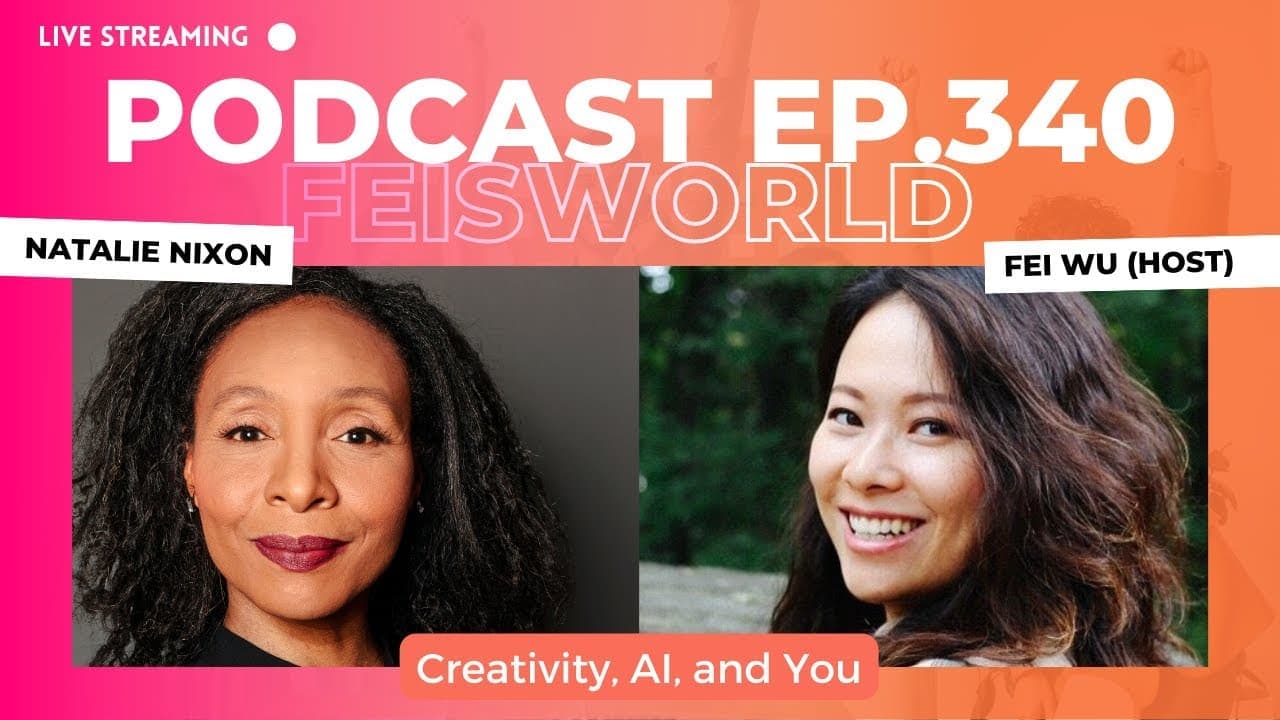
Our guest today: Natalie Nixon
A conversation and exploration with creativity author and expert Natalie Nixon on the topics of human creativity, AI automation, your role and potential in both.
Meet Natalie Nixon:
Creativity strategist Natalie Nixon is the creativity whisperer to the C-Suite. Marketing guru Seth Godin has said that she “can help you get unstuck and unlock the work you were born to do.”
Natalie is the author of the award-winning book
The Creativity Leap: Unleash Curiosity, Improvisation, and Intuition at Work. She has been ranked among the top 50 keynote speakers in the world by Real Leaders, valued for her accessible expertise on creativity, the future of work and innovation. As CEO of Figure 8 Thinking, LLC she advises leaders on transformation- by applying wonder and rigor to amplify growth and business value.
Watch Our Interview
Transcript
Transcript
Fei Wu: From Feisworld Media. I'm so excited to have Natalie Nixon back to join me on the livestream for the second time. And, uh, for those of you who are meeting her for the first time, let me just do a very quick intro and then Natalie and I are gonna dive into all sorts of creative places. Uh, you know, talking a bit more about her book and her big appearance recently on big Think all that jazz. So, With as said, Natalie Nixon. Uh, she is a creativity strategist and she's also the creativity whisper to C-suite marketing brew. Seth Godin, for example, has said that she can help you get unstuck and unlock the work you were born to do. Now you guys know I'm a huge fan of Seth Godin, and that is, uh, That is just incredible. Natalie is the author of the award-winning book, the Creativity Leap. Um, unleashing Curiosity. Improvisation and Intuition at Work has been ranked among the top 50 keynote speakers in the world by, uh, real Leaders, value for her, um, accessible expertise on creativity and the future of work and innovation, which is gonna be the. Core of what we're going to talk about today, but there's more because as you guys can see in the title, I've also included ai, artificial intelligence, how it impacts our life, maybe Natalie's life as well. So last but not least, you should definitely check her out. She is the. CEO of Figure eight thinking L L C, where she advises leaders on transformation by applying wonder and rigor to amplify growth and business value. Her work has been featured in Forbes Fast Company in Inc. And her clients have included meta Google, Deloitte, Salesforce, and Vayner Media. With that said, Natalie, welcome back. I'm so thrill you're here,
Natalie Nixon: Faye. Thank you. Thank you, thank you. You were so instrumental during the launch of the creativity lead to. Interview me on your YouTube channel and you join me for, I think we did like a launch lunch. We either did like coffee, virtual coffee, or virtual lunch. So it's always a pleasure to connect with you. Thanks for having me.
Fei Wu: Oh, thank you. You actually just brought such sweet memories back. I was so touched because you were interviewed by so many people. I remember by Seth Godin himself, and I saw myself on your landing page. I was thinking, oh, It really, really touched me, and I'm a, a firm believer of the book you've written and how timely it was to do that. You know, a year, year and a half before AI kind of just came down on all of us. So I wanna just kind of open it up, Natalie and, and have you maybe talk about your, there's a video, a big think featured due on their channel very recently, three weeks ago, and there's a follow up session on hopin. I saw hundreds of people registered, so maybe could you talk about that experience and what inspired you to talk about AI automation next to creativity?
Natalie Nixon: Yes. Well, it was such a treat to be interviewed with big thing. They're, they are a super professional shop. We actually. I'm part of a series. They, so, so the teaser that's been shared more publicly is about my thoughts on what I call asking divergent questions. But there's an entire series of people subscribe to Big Think where they can learn it even more. But in that particular, Excerpt. I was just talking about the power of asking questions, and I'm sure you and I have talked about something I call question shaming, which is my way of referring to why we don't see more people volunteering to raise their hand and ask a question. A lot of us. I've been, I've been, I've had this experience as well, have been question shamed at some point in their educational experiences or early on in the job where you dared to raise your hand to ask a question, and maybe you got some giggles or strange stares, or even worse, you were ignored. And the problem with that is, obviously it feels horrible when that happens, but you begin to get the message, oh, this must not be the environment where questions, curiosity are welcomed. And the reason that matters is because questions are inputs into a system. And that system could be what's for dinner or what's our next financial model, or what's the next product we should be developing and. The more diverse the questions or the more diverse the inputs, again, questions or inputs into a system, the more diverse and innovative, the output. So in that big think excerpt, I was just sharing why asking questions and learning how to frame and reframe questions is so important. As you've already indicated right now, during this time of all the chatter about AI and chat, G P T, curiosity and asking questions is becoming more important than ever.
Fei Wu: Mm, isn't that true? My goodness. And I've been following your work and I also see sometimes, you know, people don't really know how to interpret the, the freedom, the creativity that they possess, and in a way that I almost don't blame them because I also, you know, came from corporate America and after spending 10 years there, From age, you know, 22 to 32, you don't even realize how conditioned you are to often not speak up and lower your voice and just kind of, uh, you know, just kind of disappear, you know? And so what are some of the things, Natalie, that you have been able to coach other people? Teach them to actually speak up, to ask the right questions. Um, how, how do really process all that? If we're kind of old beginners still, we are
Natalie Nixon: all beginners. Fay and it's really a, a matter of undoing old learning and practicing. One of the ways that I advise leaders and managers is, and I even include this on a LinkedIn course, is we have to model asking questions. So here's what not to do. If you want to spark more curiosity and question ask among your team. Try not to say. Okay guys, I welcome your questions cuz even though that sounds like a totally obvious and warm and welcoming request, you probably will be met with crossed arms or hands on the hips or kind of deer in the headlights because. People aren't used to that and they're not really sure. It's a safe space. So what you could do instead, especially if you're in a managerial or leadership position, is to model the kind of inquiry that you'd like to see from your team. And one of the best ways to model that is it requires some humility, requires lots of transparency, is self-inquiry. So what I mean by that mm-hmm is you begin to share. Questions that you are starting to ask yourself about choices that the team has made, that you've made as a leader. So for example, you may have been rethinking a choice six months ago to severeties with a competitor, um, or maybe it was a former collaborative that's become a competitor. So to even pose the question that you to, that you've started to wonder, About, uh, reconnecting with this co competitor and forming more of a co-option model. You're not sure what might come of it, but you welcome ideas about ways we might start to reconnect with them. And one idea that I have is X, right? So you're modeling your own vulnerability. And humility and asking the question, and that begins to, uh, open the playing field for others to start asking the questions. But it is learned behavior and we all get better at developing curiosity, which helps with our creative capacity the more we try it.
Fei Wu: Yeah. Love it. And for those of you who haven't picked up Natalie's book, the Creativity Leap, I highly recommend it because in particular, I love the exercises, just like what we're talking about. It's just not just like big theories and concepts, but here are the next steps. And one of the things I remember, this is from many months ago, uh, Natalie, you mentioned, when it comes to leadership demonstrating creativity, vulnerabilities actually do it in a public way. So, I would love to welcome you to maybe recommend or advise on how leaders can actually do it in a, in a public, you know, sense or domain. Like how do I actually. Be able to do that.
Natalie Nixon: Um, do you mean publicly just among the team, inside the company, or do you mean even external to the company?
Fei Wu: Oh, interesting. I didn't even think about the external part, but let's maybe talk about both.
Natalie Nixon: Okay. Yeah. Well, I think internally within the company, in that team environment, in a meeting could be a virtual meeting or an in-person meeting, a retreat. Is actually a great place to start exploring this space of question asking and curiosity because it really, in a retreat you are a bit more relaxed and you know that you're showing up in much more of a learning mode, in a reflection mode. So that's one great way to try it in a more publicly facing way. Internally to the company, uh, the more you practice it, the better you realize. There's no shame to your game. There's no shame to asking questions that are our best philosophers and, and leaders in corporate as well as in other areas have asked really. Interesting questions, which led to incredible pivots and developments in their organizations. So using any kind of social media platform, probably in a more corporate environment. It might be LinkedIn, but posing a question, maybe it's a question a week that you, or you invite feedback, and it can be really low stakes questions. It doesn't have to be revealing the top secrets of the business, but questions that really are going to spark engagement. On a social platform like a LinkedIn. If you're on Instagram, that's great too. But these are ways that you begin to see your sparking conversation. And the reason this is relevant is because at the end of the day, we're not in business for ourselves. At the end of the day, we are in business. For others and the best way to stay in business is to fall in love with people's problems and questions, reveal people's problems, their concerns. It's keeping them up at night, and this becomes a really great habit to cultivate asking questions.
Fei Wu: I love that quote. Fall in love with other people's problems and become solution providers. And I think that's how many of us, uh, end up running our own business and become entrepreneurs. And I gotta ask this. We're, this is such a great excuse to catch up with you, Natalie. Know how busy you are. Uh, and for those of you who don't know live dreaming, I just love. Catching up people for the second, third time over the years. And something has changed as we talked about, which is ai. So Natalie, how do you see, uh, maybe yourself leveraging AI for your workflow, your business? And maybe in some ways, how do you, uh, advise companies to take advantage of AI automation as well?
Natalie Nixon: Well, I think the first step I always. Make in this direction as we're having conversations about artificial intelligence is to acknowledge the loss and the fear that people have around certain AI platforms. So the reality is that there will be casualties as we begin to see more companies adopt automation. Artificial intelligence, robotics, et cetera. The second thing to remember is that this is not entirely new. This is kind of what I call version 2.0. Version 1.0 was iot, OT was the internet of things. And if you recall, when Iott and the Internet of Things was really popular in our parlance, the folks who were hit the hardest. Tended to be blue collar workers tended to be people who worked in auto, in, in factory lines, for example, assembly lines where there was great fear for, for real reasons that their jobs will be taken over by robots. Now what's interesting is that AI's biggest threat is to knowledge workers and white collar workers. So let's, let's put out into the open what the challenges are and what the fears are. The opportunity from my perspective is that it's actually an opportunity to boost our creative capacity. And what I mean by that is as follows, when if you've interacted at all with chat G P T, for example, then you know that this is a tool that is only as good. As the questions that you ask, and I actually wrote about this in a recent article for Fast Company. Uh, I think the name of the article is The AI We Didn't See Coming Artificial Imagination, and I first saw the phrase Artificial Imagination in 2017. I was reading an interview with Shelly Palmer. And a Price Waterhouse Cooper's magazine and Shelly Palmer is a musician and a technologist. So I really, first of all, you know me in my work face, so you know that I love that mishmash of music and tech. Mm-hmm. I was like, wow, this is a really interesting person. And he plugged in that word artificial imagination. And to be quite honest with you, I was horrified the idea of an artificial imagination. Right. Because he was, Talking about real examples of where this is. In 2017, the AI technology existed, uh, to mimic jazz improvisation, right? So fast forward now, we have chat, g p t as, as an integral, integral part of our lives, and it's requiring that we still know how to ask better questions from the perspective of the coders. Who are actually developing the code for this ai as well as from the perspective of those of us who are using it for everything to, you know, save for physicians who are using it to save time on kind of more rote work so they can spend more FaceTime with people and I, and at the end of the day, from my PERS perspective, I don't know about you, Fay. I think I know the answer. I think the opportunity of all technology. It's not that it, and looking at ways how, how it replaces us, but looking at ways in how it actually makes space in our brain. Mm-hmm. So that we can spend more time for what makes us uniquely human. So, so an a very basic AI feature that I find myself using all the time, uh, is audio ai. So it helps me to save time when I'm. Messaging with my team on the Voxer app. I use the Otter AI app quite a bit. Um, even on my iPhone, I'm really impressed with how accurate the transcriptions are. Um, and sometimes I don't even try and experiment a bit and practice my Portuguese or my Spanish, and I'm not a native speaker, so it's even picking that up. So those are examples of it. It, it has seconds, minutes into my day, so I actually have space. To put down the technology and do more human interaction or do more meaningful work. And so that's another example of, of one of the benefits down the line of the ai.
Fei Wu: Wow. How interesting this is because I, I love the fact that you're sharing the things that you are using, and I think this could be like a really, Interesting. Get together, like breakout of asking people what they're doing with AI and the definition of ai. Sometimes it feel like, um, public media makes it seem really narrow, scary and dramatic, but in reality is AI has so many different verticals. Uh, for instance, one of the ones that I'm exploring, I'm gonna, if you guys are watching, I'm gonna just like drop it in the link. It's still on like a temporary domain, but this is actually for my mom's artwork. So as you can see, Natalie, the last time we chatted, my mom didn't even complete this one. And now she has, we're just thinking, wow, wouldn't it be great to make these, these are women, female and persist from, from Chinese history? And I said, wouldn't it be great if we can make them. Talk. So the, yeah, so AI feature from, uh, a company called A D I D. So d hyphen id.com allows you to create what's called a speaking portraits. You can use either robotic or AI voices where you can upload your own voice or use something like 11 labs. And to me, I was just so excited about, uh, this opportunity and, um, I
Natalie Nixon: love that. First of all, your mother's art is beautiful. It's gorgeous. It's so vibrant. I love that. It's also a history marker. For really important people of Chinese history who happen to be women. Mm-hmm. And I think the example you gave of d hyphen id, when I explore that further mm-hmm. What it says, what it speaks to me about is that it's a, it's a version of AI that's helping us to be more playful. So I could see you could even, um, I don't know. I, I don't know if kids really play with, I don't think they really play with paper dolls anymore. But you know what, if there was some application of that to create these characters to create, um, you probably know what this means, babe, but, uh, the word larp, it's an acronym. It stands for long La Lark. It stands, what is it? It's, uh, it, it, it's, it's, I'm sorry that I'm forgetting what the acronym No, no. I, I'm
Fei Wu: learning it for the
Natalie Nixon: first time, but it's not, it's not lar it's alar, but, but it's a way to develop, it's a persona development, um, activity, right? Mm-hmm. But you develop these personas in games or for story and then, and then integrating the, the D hyphen ID app application. It just, it just kind of boosts. Uh, your creativity to another level here. Okay, here's, here's an, here's an analogy that I just thought of, please. So, I recently, like a year ago, I invested in a hybrid bicycle. So it's a hybrid electrical bicycle. I. And the reason, and I do say investment cuz it's, it's not cheap. But the reason I decided to do this is I thought to myself, I think I'm gonna end up riding my bike more if I know that every time I reach a hill and in my neighborhood, there's a particular street that's really a steep hill, but is, is a helpful street to, to go back and forth for different shopping and errands. But I thought to myself, I think I'll ride my bicycle a lot more if I have the option to turn on. Through the, the battery that's attached to an, an electrical hybrid bike. Um, the, a booster to help me go up that hill and in my particular bicycle by Marin bikes, which is fabulous by the way. Um, I am riding my bicycle more, I, it's like what hill? Because I have this boost through the electrical battery system that's attached to the bicycle where it has lowered a barrier to entry. Mm-hmm. So similarly, one way, one way to think about some of this ai. Not all, because we've gotta, we've gotta be mindful of ethical. Issues. We've gotta be mindful of people really making sure they're engaging in their critical thinking with ai, right? So I'm not, not giving Ai a, a free pass, but for ai that is, that is, uh, efficacious. It has like a similar role as the battery on my bicycle, right? To kind of boost so that I am more willing to engage in the exercise of. Bicycling or in the exercise of creativity and in the exercise of storytelling and world building and, and those sorts of things that increasingly a lot of our work requires.
Fei Wu: Hmm. Yeah. I think what I'm also hearing, uh, absolutely making it fun, lowering, uh, the barrier to entry, making us more. And just more active and happier. And at the same time, you know, Natalie, what do you think are in terms of like looking at our own line of work, I know you and I, uh, you know, both entrepreneurs, you've been at it for longer, um, had your success. When you look at the workflow you have now, do you think now maybe, or I don't know, maybe you've done it already, an opportunity to look through what are some of the very repetitive tasks, things that can possibly be optimized by ai, but also as well as think that we should. Absolutely not be, you know, taken over by ai. Like, have
Natalie Nixon: you done that? Well, first of all, I don't know that I've been in business longer than you. I think you have, I, I, I, I'm celebrating six years this June next month. So really excited about that. And I think that, You know, right now I, the, the biggest source of AI tools that I use are those transcription devices. Because as a writer, it's so helpful for me to now know that I can easily, uh, emit thoughts and capture them without necessarily to be sedentary, seated at a laptop. Mm-hmm. If I'm, Driving and I see something I can pull over, I can, or I have a stop light and pull out my, my smartphone and I can. Record a thought. This is, this is now possible with Evernote. I've already mentioned Otter. Mm-hmm. With Boxer. So these are the ways that I've been using ai and it actually helps to spark the flow that we need because it's not like I have to totally stop what I'm doing or be in fear that I'm gonna forget this gem of an idea that I can integrate into my work later. So we're, we're a bulk of of my work. Is, is writing. Um, those are the ways that I'm finding it, yeah. To be helpful. What about you in addition to D IDs? Are there any other gems that you have found lately? Um,
Fei Wu: Yeah, for sure. I mean, I'm so glad you brought up transcriptions and, uh, uh, on my website, face world.com. I actually found myself to kind of dive into AI transcription services in like in a first category and very quickly from there. It sparked ideas like, okay, now we're talking about transcription. What about audio and video? And now there are, you know, we started to really get into writing about these AI tools for the things we love using and frankly also exploring like things we could be using in the future. And uh, that's kind of what I'm doing. So sincerely, my team, you know, mostly my producer, Herman and I we're just trying out new things and sometimes it can be overwhelming. To say, was this the right way to spend our time? Are we better off just like doing it manually versus maybe this could help someone else. I feel like there's a barrier whenever there's a new tool coming out again as you know, like just so many AI tools sometimes, like is that even a real AI company or just some random comp company with a domain name that ended with ai. Um, so I know, right, like it's hard, so hard to tell sometimes, but we're. Just learning. I'm, I feel like these days I'm drying from a, a fire hose of yes, passing things out, even things I may or may not end up liking, but I wanna try it anyway.
Natalie Nixon: So, another question for you, since you invited me to also ask you a question or two during conversation. You know, let's be honest, these businesses at the end of the day are in the business of collecting data, right? Mm-hmm. That's, that's, at the end of the day, that's gonna be the currency that they're banking on, like literally banking on, right? Mm-hmm. So, I do feel conflicted because here's where I feel personally conflicted, where I know that as I use these AI tools, the, the reciprocity, the, the give and take is that they are actually gathering data information about what am I searching for more regularly? What are the topics I tend to want to comment on or talk about, or, you know, so, so what are your thoughts, Faye, about. Uh, the other side of the data collection that's happening with AI and privacy issues?
Fei Wu: Yeah, what a great question. I mean, we can just be completely open and transparent that chat. G p t for instance, uh, they do capture, they do store a lot of these questions and, and answers and, uh, makes some people very uncomfortable. In fact, I have worked with clients by law or whatever, Regulations, they, that's not something they can do, meaning that they cannot rely on a system such as chat, t p T to produce anything for their clients. It would just wouldn't be legal. So those people are completely out, and I think there's an opportunity for, first of all, for entrepreneurs and creators to actually step in to say, What are, what is the value I can provide without selling Oh, and storing people's data. So that's number one. Uh, that's something that I, we've been working on. So, uh, for instance, like we're working on pod intelligence, which is a, an AI tool. We call a MIC creating micro content for grownups. And we're creating these more secure, you know, web-based applications, focus on the content for our clients. Um, but to answer your question, if we're talking about the general public, I think they're two categories of people, or maybe three, you know, People are completely uncomfortable and people who are comfortable depending on what question they're asking. And then there are people in the middle who are just not really sure about this. So I have to say that I'm currently at a point where I think about the things I use chat G B T for, for instance, conducting historic, uh, research for my mom's work. Yeah. Cause I'm just struggling, like, who are these women? What's their significance? And I don't care and I want. You know, chat, G B T uh, for instance, wore bared AI from Google to tell me as much as they can, and there are limitations. There's so many things that don't, they don't have information for No. Prior to 2019 or something, so.
Natalie Nixon: Exactly. Exactly. Yeah. Yeah. I think right now the latest iteration chat, g p t is only as recent as. 2021. Yeah, I think, and if we recall, so if it's basically scraping the worldwide web for information mm-hmm. Not every single human on this earth has access to the internet or is using the internet, therefore, The sample, which is still pretty huge, but the sample is not totally representative of all people, and I think that that's another important call out that we have to be mindful of. The, the, the, I think what you and I are both trying to get to is just that this, this technology does not let us off the hook to be rigorous to be. Um, really mindful and conscientious about doing our due diligence and making sure that we're interacting with this data in ethical ways.
Fei Wu: Mm-hmm. Yeah, I, I would agree. Actually, you just trigger something, which I think about where chat G P T is based and all that. I think about how much that information is US or North America based versus everywhere else, and then not the people it represents. Right. So a thousand
Natalie Nixon: percent, like how much of it is represented people on the entire humongous continent of Africa mm-hmm. On the, on the continent of Asia. On, in, in the Middle East, in, in all of Latin America. Right. So those are the things that we have to be mindful of to, to realize that this is okay. It's telling us, it's giving us some information, some data, but it's not the whole story.
Fei Wu: And that's what, yeah. Oh, that's so fascinating because I think. That is a good reminder for the work that we are doing. For instance, that the things we've training our muscles for, uh, which is creating original work. Now, I think especially with Chachi, BT, I can think about like people who are, let's say, not used to blogging, creating videos like it's second nature. Wow. Chat, G B T where bared AI just came out. Now I really don't have to learn how to do this anymore. So I think there's, maybe there's that danger in people relying too much on asking questions to a system like chat G B T as opposed to in, in real life. Mm-hmm. And being really vulnerable. Um, you know, where, let me research something. Let me know, already know the answers before I kind of step in. Like, what, what are your thoughts on that?
Natalie Nixon: Uh, well, I, I do think that. It's some, some part of what you were saying reminded me of the way I used to use the encyclopedia, the old fashioned encyclopedia, a series of books right? There is something pretty cool about having that as a resource to, to learn, um, and to learn from. Uh, and it, it just leads to more and more questions. I remember. Um, there used to, there was this old, old publishing house called Funk and Wags, I think that's what was the name of it. And my, my parents had a, a small encyclopedic set that was published by Funk and Wags. First of all, I used to always remember like, who was Funk, who was this Mr. Funk? But anyway, Mr. Funk, um, I, I would just randomly open to a section of that encyclopedia and that would lead me to another question or to a cross reference. And I was probably like nine or 10 years old doing this. But it just, it sparked my curiosity. And I think that again, is, is the positive side of all of this.
Fei Wu: Hmm. Very true. And, I, I think about like the, that experience that you just shared as opposed to living these days are other problems such as living online, like, you know, issues with gaming and kids not leaving the house anymore, adults not leaving their room anymore. Um, I, I think about like how we can, uh, kind of start the conversation. So for instance, for the past year or so, my team and I decided to really focus on. Really understand how it works, not just, oh, how do we trick Google, by the way, you really can't. You'll actually penalize you later. And uh, so we're thinking about really understanding this and looking at real data, how we rank on places like h Revs and even following bloggers who are ones really popular, but now there are also leveraging chat, C B T and see how they're ranking. Just like. Plummeted and then it's like in a really sad ways and things like that. So people are kind of unaware. And I also think Google now sending out articles to say things like, um, there's like different acronyms, but essentially it's asking you, okay, for instance, phase writing about an AI tool, but it's not so just so much about this AI tool being so advanced. Wonderful. It's focused on what is Faye worth, the phase world experience? What is Natalie's experience in using it? Mm-hmm. How has worked or not worked in some areas. So I, I would love to. Kind of like, talk about this for a second and think about like what are your, what's your take uh, on implementing it ourselves? Integrating ourselves and our experiences in these, um, in these AI tools or, or otherwise?
Natalie Nixon: You know, my interest in the future of AI and technology is really those applications that. Are in a way forcing us to turn away from the tech and those applications that are sparking us to engage in the activities and the dimensions of ourselves that are uniquely human. That to me, is the greatest opportunity of technology. Not that it's that it's a replacement for all that makes us human, but actually it sparks us to do what's more human. So an example that I'll give, which is not a new example, but it's the CALM app. Right? Mm-hmm. So if you, I remember the first time I was in our kitchen, TV was on, and all of a sudden the calm app ad came on and the ad, which was very effective, it said, do nothing and stare into space for 15 seconds. And then the just quiet and just showed this candle, and I thought, Oh my gosh, that's brilliant because it was, it was an example of using technology to do, to turn away from the tech and, and engage with the environment, to engage with nature, to engage with the eyeballs of the person who's with you in that room. And that is super cool. And I believe that Ariana Huffington's whole platform is also working on technology. That really helps us to engage in the activities and the dimensions of ourselves that are uniquely human. So that's, that's really what excites and, and, and interests me. And if I can, let me tie that into what my next book will be about. Um, it's about something I call Invisible Work, and I prototype the idea for Invisible Work in a Fast Company article that I wrote about a year ago in 2022. And. Invisible work is this term that I coined to relate to those activities. That are not trackable, but actually increase and promote our productivity. So the basic idea is that our most productive selves are not when we're turning through email. It's not when we're on Zoom or YouTuber teams, and it's not when we're at the whiteboard. It's when we step away and engage in. Motor Work and motor is a framework that I created. You know me, Faye, I love creating frameworks. I'm a frameworks nerd, and it's M as in Mary, t r, which I spell out as motor. So the activities that help us to spark. More generative ideas are in the realm of movement. That's the M thought. That's the T and rest. That's the R. Mm-hmm. So the book is gonna be exploring the neuroscience and creativity and ways we can spark even deeper rigor and more expansive wonder, which is the way I, I talked about creativity in my fir in my last book. The creativity Leap in order to be more productive. And this matters now more than ever. Because of unprecedented amounts of burnout. Mm-hmm. Cause of the ubiquity of technology, it's literally everywhere. And because in these blurred boundaries of work, Managers teams are struggling with ways to connect more meaningfully while they're also productive. So it's my perspective that if we can make the invisible work more visible, we actually will be a lot more productive and have more meaningful lives. So that, that's, that's what I'm, um, thinking about more and more. And I think things like the Calm app are part of, of that tool, that toolkit.
Fei Wu: When is that book gonna come out? I'm excited. Oh,
Natalie Nixon: well, I have to finish writing it, but I, I always use these sorts of conversations as ways to just. Share the ideas and hey, while we're at it, I'd love to know your thoughts about anything I just shared, like what's, what sticks out to you, what's resonating with you, what's, what's confusing? So, so please
Fei Wu: share. Yeah. First of all, the moment you mentioned, I was like, this is super exciting because I think just earlier today I saw a newsletter from, uh, Neri Yell talking about, there's like a research about. Some companies decided it's gonna be a four day work week moving forward, and they realized there's an increase in productivity, results, revenue, and everything. I thought it was really intriguing Who would've thought that that's even possible? Uh, and I came from a culture where there was like a soce six, six day, you know, I was growing up until I was like, uh, I don't know, 10 or 11 before they school and, and company-wise removed. And so Saturday is now a holiday. Uh, so, uh, That, that's really intriguing. And you mentioned Ariana Huffington, who's been writing a lot about sleep and how important sleep is. So I feel like things are coming together knowing you're an avid dancer. I'm like, oh, movement.
Natalie Nixon: Oh yes. Well, movement is, it's going for a walk. It's dance, it's play. It's working, standing up, right? Mm-hmm. Acknowledgement that our spinal cord is an extension of the brain and our brain will, will have greater blood flow and therefore oxygen to the brain if we mix up the ways that we're working. And this is gonna have humongous implications for the way we're designing work physically, for the way we're designing work in terms of calendaring work. Mm-hmm. And for the way that we're designing work, in terms, just in terms of human interaction and connection. Um, yeah.
Fei Wu: I mean, I'm so glad. Oh, that's beautiful. I'm so glad you you brought up, uh, M T R. I'm gonna project this real quick because to me, if I knew this book and this idea, I would have totally like positioned this conversation right around that. It's not
Natalie Nixon: late. Oh, well, listen, listen, Fay, you and I will stay in touch, so, Would love for us to have a conversation of that when that book is coming out and for us to dig even more deeply into my research that I'll, I'll learn and example more, even more specific examples I'll be able to share somewhere down my, so consider this just a teaser.
Fei Wu: Yeah. This is a great teaser. Uh, because I, you know, I think this reminds me of the fact, like, people ask me what is it like being an entrepreneur? And I have been, uh, since January, 2016, so I'm celebrating, you know, by the end of June it would be like seven and a half, uh, years of, yeah, it's beautiful. And the, what is the biggest transformation I would say, uh, there I definitely went through phases of, uh, burnout at the beginning, thinking I need to make as much money as possible. And that was, you know, cause. We live in this unfortunate numbers game because it's so easy to measure until these days. Now I, you know, I bought my own home two years ago. Mom's moving, congratulations. Oh, thank you. And then now I bought, and then, you know, the decisions I'm looking at movement, thought and rest. And that's, I, I feel like I have done so much better in all three categories in the past two years than I have ever before. The. Movement. We build a pool and I'm in it twice a day. Ah, love that. You have to visit me. I feel like you live close enough. I know, I know. Philly,
Natalie Nixon: I'll have to visit you, you know. Um, this is totally in the slide real quick. I know we have to, I, I have to hop off soon. But yes, I have a summer adventure planned through a company called Swim Trekk. And I'll be in Crete, Greece this July for one week doing a group swim vacation where we swim three kilometers a day in the sea. Oh my God. And, um, you know, people who like to bicycle, do bicycle vacations. People like to golf. This, people like to swim. So I, I think that, yes. Put, put that up. It's a really cool experience. So I, I can't believe this visit you and your swimming pool faith. That would be awesome.
Fei Wu: Oh, please do. By the way, how did you discover.
Natalie Nixon: Oh my gosh. I discovered Swim Trek through my friend Ivy Silver. We were traveling together for business in Palo Alto a few years ago. We were staying together in Airbnb and realized we both are avid swimmers. We, cuz there's tons of public pools in that area. And she did swim trek last summer and when she finished she said, Nat, you've got to do this. So every year as an entrepreneur, I don't know about some of your hacks, Faye, but for me as an entrepreneur, Every year I invest in a personal development experience and a professional development experience, and this is my personal development experience for this year is Sum Trek in Greece.
Fei Wu: Wow. What a tree. Are you going by yourself
Natalie Nixon: or are you going No, I'm actually gonna go with a friend of mine from my ballroom dance community. My friend Tori is coming with me, and then I'm gonna meet up with my husband, John and Istanbul, Turkey for our one week vacation together there. John's not a swimmer, he's a golfer and I'm not a golfer, so we, we, we split ways there and then we'll come back together. That is so
Fei Wu: smart. My goodness. Yeah. This is fantastic. I just love hearing how people. Really take care of themselves, how they discover adventures like this. Uh, really plan for it. So, Natalie, I know you're super busy. What are some of the things that you wish I asked or you haven't really had a chance to talk about on other podcasts, on live streams you would like our listeners, yours to know? I don't
Natalie Nixon: know. I mean this was just a great conversation. Fay. I thank you for your generosity in sharing your platform and I hope that people will check out figure eight thinking.com. I can share with you the fast company articles I referenced around invisible work around artificial imagination. And um, stay tuned for more about my motor framework and invisible work. So thank you for having me.
Fei Wu: Oh, well thank you so much, Natalie. I'm sure we'll see you next time. I'm gonna take us off the livestream now. Bye everyone. Feel free to leave your questions and we'll get to them soon.
Connect with Natalie Nixon
LinkedIn
Facebook
Instagram
Twitter
You might also enjoy…

Written by
Fei WuFei Wu is the founder and CEO of Feisworld Media, a Massachusetts-based digital media company helping brands get discovered by people and by AI. An Adobe Global Ambassador and brand partner to ElevenLabs, Synthesia, and 50+ other tech and AI companies, she hosts the Feisworld Podcast (400+ episodes, 500K+ downloads — guests have included Seth Godin, Steve Wozniak, Chris Voss, and Arianna Huffington) and co-created the documentary Feisworld: Live Your Art on Amazon Prime. Fei writes for CNET, Lifehacker, and PCMag, and her work has been featured in Forbes, Harvard Business Review, and WIRED. She has been publishing on the internet since 2014 — long before AI discoverability had a name.
View all posts by Fei Wu→Stay updated
Weekly insights on content, AI, and digital media.
Keep Reading
Related Articles

Focal Alpha 50 Evo Review: My 2026 Pick for Creator Studio Monitors
Joanne Lipman on Mentors, Untapped Talent and Why Women Should Stop Waiting to Be Perfect