Kirupa Chinnathambi (@kirupa): Founder of Kirupa.com, Creator and Product Manager at Google (#344)
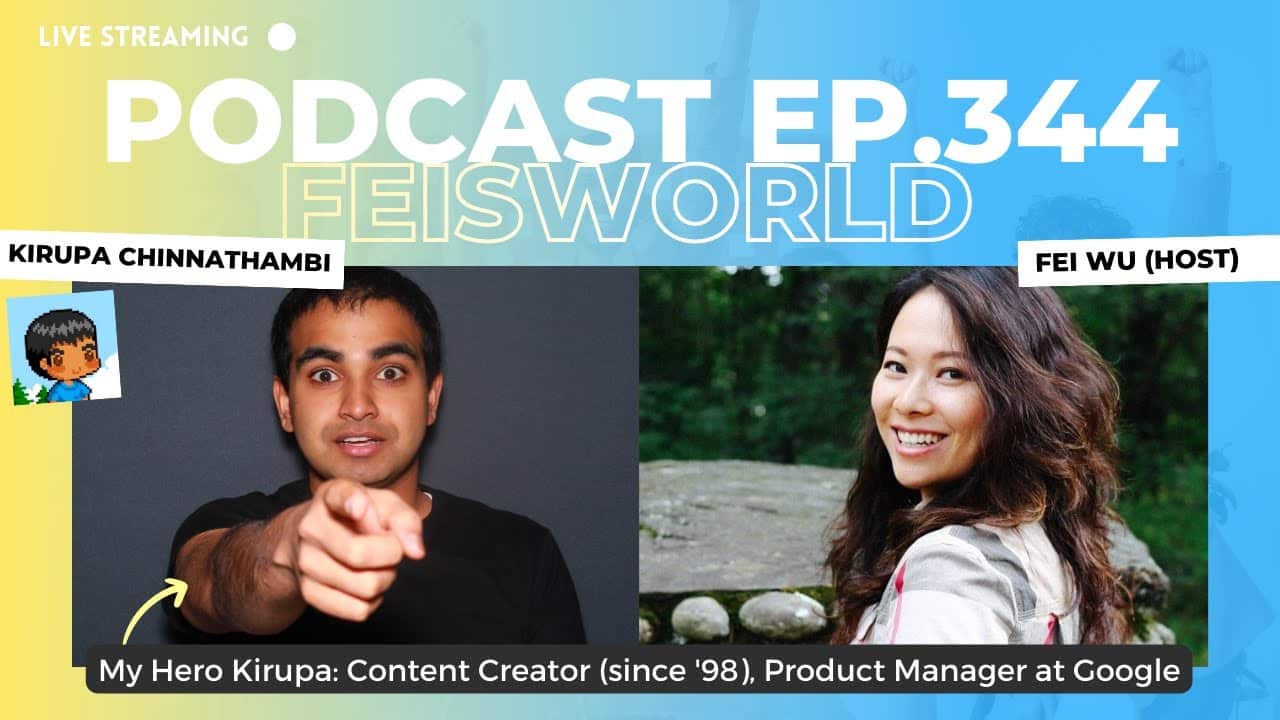
Our guest today: Kirupa Chinnathambi
Kirupa Chinnathambi has spent most of his life trying to simplify app development by helping build a variety of tools, platforms, frameworks, and products – many of which you may have heard of. It is only fitting that he is continuing to follow that passion as a Product Manager at Google, leading an effort to reinvent how apps are built.
In parallel, Kirupa is a popular content creator who has been blogging and recording videos about web development topics since 1998 with a few best-selling tech books and some totally sweet bios (written in 3rd person, of course) sprinkled along the way!
Watch Our Interview
Transcript
Transcript
Fei Wu: From Feisworld Media and on the screen I have with me right now, the person I've been referring to as Kirupa, he's the Kirupa on Google. So welcome Kirupa.
Kirupa Chinnathambi: Fei, great to meet you again. You know, we had a chat a few weeks ago, so much topics to cover that we weren't able to get to because it's only 24 hours in a day as it turns out. And so let's continue round two of it here.
Fei Wu: I absolutely love it. And I forgot to ask you how to pronounce your last name. So please, once and for all, we should learn how to say your full name.
Kirupa Chinnathambi: It's pronounced Chin-nathambi.
Fei Wu: Chinathambi. Okay, Kirupa, finally, for the first time, I even learned to speak your, your last name and, um, super thrilled that you're here. I think. Hopefully this is a rare opportunity for my audience and your audience to get to know you at this personal level. And, uh, I, I feel, you know, so grateful to have really met you online as back then the flash, not just a flash developer, but the storyteller, a content creator back in 2002, I can still envision myself living in a, an apartment on beacon street here in Boston, Massachusetts, and just browsing your website for hours. Hours every day and I was sending and emailing out to people. Um, I feel like it really gave me a voice. It felt like, you know, a project, a website created by a friend. Kurupa. com that's still live and thriving today. So yeah, this, this is fantastic. Does this surprise you when I introduce you that way?
Kirupa Chinnathambi: It does because I typically don't have these conversations with people on a regular basis and. I let my content speak for itself. So I try to pick myself out of the equation oftentimes. So many times people have no connection with like me being the person and then the content doing its own thing with its own, like, you know, weird icons and logos and so on, people think it's just more of a brand, not an actual person behind it.
Fei Wu: But you're very, very real. And, uh, if I may, uh, for those of you who are new to Kurupa's content, I just want to give you a very quick background and then we're going to delve into today's series of questions. I'm so excited to talk all of, talk to all of you guys about what it's like to be an intrapreneur, an entrepreneur, because Kurupa now is a product manager also at Google, um, as well as continuing to run Kurupa. com. And also we're going to cover AI, the AI mindset. What it means for your business, how to really leverage AI without the overwhelm. So, uh, Kurupa has spent most of his life trying to simplify app development by helping build a variety of tools, platforms, frameworks, and products. Many of which you may have heard of. If. It's only fitting that he continue to follow that passion as a product manager at Google, uh, leading an effort to reinventing how apps are built in parallel. Kurupa is a popular content creator who has been blogging and recording videos about web development topics since 1998 with a few bestselling tech books and some total, totally sweet bios written a third person, of course. Sprinkled along the way. You can find all of his work on his blog. Kurupa. com. Yes, that's just his first name, his YouTube channel, as well as Twitter account also searched by at sign Kurupa. And, uh, we're going live on restream. If you're curious how to get started with streaming live streaming, there's a link, uh, all in the description below with that said. Krupa, I would love for you to finally share and talk about what was it like for you to be like a middle school student back in 98. And I saw you were at least 25 or someone I look up to. Um, and, uh, what was it like to be a middle schooler? And be able to, like, start from scratch and build an audience that way.
Kirupa Chinnathambi: It was just fun in many ways, because today, the whole idea of content creation and being able to do things has all these structures and these, like, criteria for success and so on with social media and all of these things. Back then, there wasn't really any of it. My goal was, I'm doing fun stuff in Flash, I'm learning cool things. I started sharing it with some friends, they had some questions on, Oh, how do you do this? I want to create it myself. I started emailing out my instructions on what I did, and that doesn't scale well after a certain point. So let me just put it on a website. And I just played with like FrontPage Express and Netscape Composer. They came free with the browsers back in the day, you know, you saw that in Netscape or in Explorer. You got, in addition, a very basic notepad like editor where you could Type in content and it would display as HTML. It didn't matter that I had no idea that what was being created was HTML tags. It'd be uploaded, images would be uploaded and so on. Geocities was a popular web hosting service. It was just getting started at the time where you have like probably one or two megabytes total to be able to upload your content and you got this like really long URL. And, but that was good enough for me. I was like, okay, I can now share this URL or link. To people and they can now learn more about it. Let me have to personally email them and do these things. Now, newsletters were not really a thing back then. At least wasn't something that any one could just start on their own. And so today would be like case for like, why do you change away from newsletters? It would have been the best thing ever. I'm like, yes, you know, 30 years, 20 years later. In hindsight, maybe, but the URL on the web was like just getting started back then. It was just exciting to be able to create content, upload it. You know, there, it's a funny thinking back at it. There's supposed to be some Iomega zip drives, you know, in my, you know, parents attic somewhere that shows the very first versions of these websites where. In the HTML, the path to the images was hard coded to a location on my hard drive. I had no idea that it had to be, you know, slash images relative to the server you're hosted on and things like that. So that's how early the days were of both me not knowing anything about web development and also the state of what was available in terms of learning about web development at all. I think web monkey was a very popular website that existed back then. I think lynda. com was just starting to create content. So to some of our audience right now, they're probably wondering like Wait, this sounds like, you know, 80 years ago. And for the most part, when it comes to technology, it might as well have been,
Fei Wu: wow. It's just incredible to hear that mindset of being a kid and want to share the work that you were doing, uh, and not having so much fear and doubts. And I love talking to folks like yourself because now fast forward, you know, 20 plus years, 26 years after 25 years. And do you feel any different along the way? You know, when you hear other creators today, Oh, I have so many doubts. I'll never be able to be successful. I won't be able to make money to quit my full time job. And along the way, you know, did you feel like that anxiety? somehow followed you? Or do you feel like your intention these days is different? I'm just curious, like what goes on in Karupa's mind?
Kirupa Chinnathambi: I mean, it is very different. I do speak to a lot of creators just explaining, like they want to make a career in content creation, what it's going to be like, and so on. The hard part really is that As with any kind of a creative endeavor, the power law applies where only a very few people succeed. Many are in this middle where they're just basically making break even and a large number are basically, you know, not profitable or anything to make it successful. So what I always tell people is that do it because you genuinely enjoy doing this, you know, not because you're seeking external validation or the kudos that comes from like being a popular content creator, because there's a very good chance. We may not be a popular creator forever. And so you should do it for things like you want to learn better. You want to better articulate your ideas. You want to reach a new audience. Do it for those reasons because those will never change. And they'll give you a goal that you can keep working towards. Even when the external world is not giving you the validation you might think that you deserve. Because, and then I always explain to myself as well, you know, I talk about my space. story here is that I was very lucky in many ways. You know, my parents were both very highly educated and so therefore I didn't have to worry about like, you know, juggling like school with like a part time job and then also being able to do all this. And, you know, I had all the resources to have like a computer, internet, you know, all the software I needed, like, you know, I had all those luxuries. So those gave me an advantage as well. And so I'm never going to like discount any of those efforts. Absolutely played a big role in helping me have this mindset of being able to do all these things. You know, I grew up where a lot of the books that I read as a kid were, you know, biographies, you know, but also had like all these business books and books on stocks and investing that my parents would always read. So in the back of my mind, I had all these access resources that kind of just incidentally led me to doing some of these things and thinking about problems in a way that just gave me an advantage.
Fei Wu: Wow. I love to delve into your childhood a bit more because I realized you're probably living pretty closer where I was at the time as well, where I still am. For those of you who are joining us live, I know that I can't see all of you, especially if you're tuning in from LinkedIn, but we can see your questions. You don't have to come on live to join us in the live show, but if you have any questions, please leave them in the comments. We're going to do our best to organize them and answer them live. Throughout this conversation. And so back to you in terms of upbringing, should I assume that you grew up in Massachusetts or somewhere in New England? Cause I know you ended up going to MIT here. No,
Kirupa Chinnathambi: no, no. Actually, you know, I grew up in a few places. My dad was a material scientist. And so in the eighties, Europe was really big into like lighter, more fuel efficient vehicles. And so Italy. What's one of the first countries that I lived at age of two, actually I moved to Italy, you know, time was one of the first languages I learned. And then I went to Germany a few years later where I did my kindergarten, first and second grade. And then it was the U S ever since, you know, the early nineties was the U S started investing heavily in vehicles that were more fuel efficient, lighter weight, the same thing that Europe did about 10 years ago. And, and ironically, Alabama. was a place that so much auto manufacturing and investments in R and D happened in the US, at least, you know, at the time. And so I lived in Birmingham, a suburb of Birmingham, Alabama called Hoover. And that's where I spent most of my life until I went to college in Boston. And then I moved to Seattle where I live now for work. And, you know, this, we enjoy it here now. Wow.
Fei Wu: What a journey. Do you think, uh, you know, I, I, do you think this Moving around, especially in an earlier age, uh, do you have any memories of it? Do you feel like you belong? You know, there's some backstories when it comes to creators and technologists that I'm trying to like dig in a bit here. Maybe I don't know. Maybe it's a normal, very normal childhood.
Kirupa Chinnathambi: I mean, I think it's, uh, it's normal in many ways. I think. I think kids adapt to whatever situation they're put into. I do enjoy the idea of having moved around in many places. You know, initially I always felt like, you know, I wish I could stay in one place that can have like friends for longer than X number of years and things like that. But in looking back at it though, you get to learn. To think on your feet, you get much better at, like, adapting to a new environment, new school, how to make new friends very quickly, but I do also think that because I moved around so much, I really, you know, glommed off this online world in many ways, because the URL, the community built online doesn't change no matter where you went to. So once I started creating the blog, and then once I I figured out how to create an online forum. EasyBoard was the first like software as a service kind of thing we just went to. You signed up, you got like a very basic forum. Again, the URL was like completely bizarre, but that's okay though. And then I moved to vBulletin, which is a very popular service in the early 2000s for creating large communities. You know, Envision, PowerBoard and so on. And so. By creating that online community, I was able to kind of in some ways form friendships and people that I met there that I still meet with today. In fact, actually today at 2 PM, I'm going to be meeting with like a bunch of people online from the community. I've known for like 20, 30 years, but I've actually never met in person. And we just have this like, you know, monthly or every two months, we just have this like hangout where we just chat and just like catch up on life. And a lot of them were also around the same age as me when they got started with web development and the forums and so on, they're also like working in various tech companies or work in their own companies and so on. And that's been an interesting way for me to kind of balance out the, my real world, where it was always changing, even if you're like middle school to high school, even in the same city, it changes. So, you know, including college and later on, you never really make. And so therefore, it's actually great to have this online community that always has an anchor for me, where no matter where I went to or what I did, I always ended up like having that connection with these people who always stayed there, regardless of what was going on in my personal life. Wow.
Fei Wu: That's a staple right there. May I ask if the community is private or public if people do want to learn more about it?
Kirupa Chinnathambi: It's just, it's just on my website group. com. If you go to the forums, you'll see there's a link for like a hangout meeting, and they can just go there and join it. Okay. Wow.
Fei Wu: You're so casual about this. Oh, I still have some follow up questions. But first we have a question also from a longtime follower, Adam Leffert. Are there parts of how the tech industry is talking about the future direction of AI that you feel are closer to reality and others that maybe missed the mark?
Kirupa Chinnathambi: Wow. That's a very good question. And I think as with any new technology, There's a bit of a hype cycle that gets created where everyone is like going to talk about this is going to change the world. It's going to destroy the world, you know, all extremes of it. And then once it does from that settled, you'll get to the point where like, okay, here's the tangible problems that AI is going to be solving. Yeah. I think a lot of us have seen many of these cycles going in a year in and year out all the time. I think like chatbots were the really big thing that happened. Like, you know, maybe. You know, 15 years ago, and then it keeps coming back every five years. I think we're probably due for another cycle where chatbots become the next big thing again. It's going to replace humans completely, but I think AI and crypto was the other one that, you know, keeps coming up in various ways and cycles as well. I do think that AI is more closer to reality in many, many of the things that people are saying, because it does solve a very tangible problem. Because if we take a step back and take away all the layers of just, uh, the fantastic narratives that have been created around it, a lot of the work that we do, whether it is in our personal life or our professional life, it's just repetitive memorization, regurgitation type of activities. And if we say that that level of work is not really the thing that our brains are really suited for, can we automate that away to something that can? So we can spend more time doing higher level thinking and higher level tasks. As it turns out, AI has been fantastic for this. And we talk about AI today as it's like, you know, brand new thing, but we've been having AI for many, many years. We just don't really realize it. You know, when you, for example, you just type in a URL in your browser and you happen to connect to a network somewhere in the middle of the world, like in Europe, for example, you get really fast connection. We don't really think that it's actually really smart routing and really smart machine learning behind the scenes to know that at this time of day, when someone's accessing this service, it's going to be a lot more traffic coming in. So instead of sending them to this location, we're going to send them somewhere else. Or when you look at your photos on your phone, both on an iPhone device or an Android device, It's ability to be able to search based on what you type in from the images it's been analyzing. It's been going on for years and that's fantastic. I can type in cat and it knows exactly which pictures that I have of my cats. As opposed to like, you know, looking for actual descriptions I might have specifically specified of it being that. Spell check, autocomplete, when we look at, you know, any kind of like airplane ordering. When you go to like order seats on an airplane to travel somewhere. All of these things. We've been benefiting from AI greatly for a very long time. What has happened recently though is that. We've hit the technological tipping point where it's no longer just something that very smart people with very deep technical knowledge can take advantage of and then we benefit indirectly from it. We can now more easily access some of the capabilities directly. So I do think that in the future we're going to see more things that AI is going to take care of for us because those tasks may not be the most important things that we should be focusing on. The downside of course is, you know, creative destruction has two sides to it. One is the utopian idea. Is that how people are freed up to basically do more higher value things? The downside, of course, is that what if there aren't any more higher value things that are available to do where those new things don't pay as much as what was done before. It's a quality of life, something we can continually sustain. Those are all open questions. I think the entire industry is grappling with and trying to figure out. But I'm definitely an optimist when it comes to A. I do think that we've seen a lot of great benefits over the years. About what happened, you know, another great example of it is just like, you know, whatever credit card fraud detection. It's my favorite examples of it. It's like they have so much data about you where they know that if you are not in this region making a purchase, they ping you very quickly about it. So I'm always amazed the number of things that aren't really called AI, but realistically, it's AI. It's a large data set. With a computer trained on it, it does interesting things. Ah,
Fei Wu: fantastic answer. I love it. And thank you, Adam, for the question and kicking us off into this AI direction because, uh, I feel like I live in this bit of a, like a dilemma and like almost like a dating situation. So a bit of a context, I'm going to try to break down into several questions, which is on a regular basis. I get emails from AI companies. You can tell it's always something, something dot AI. Faye, Faye's World, I would like to collaborate with you on, you know, creating content, video, review blogs, and we really want to connect with creators and even small businesses. And on the other hand, I also run these creator communities, and I also am very happy that sort of the first hand insights into why creators are hesitant, uh, or struggles, or experience these unique challenges that they find adopting AI can be quite Difficult. Um, or maybe not in a way that's not very sustainable. So I'm going to break down the questions here because group of giving your experience in tech and now working as a product manager at Google. I would love to pitch your first question, which is related to. What are some of the trends and things that you have seen the general AI, whether it's generative AI or other AI companies are doing that are helpful versus not very helpful. Or maybe when it comes to like product marketing, what are some of the common mistakes that they're making, uh, to kind of find it more difficult to reach the audience that they want to, they want to reach?
Kirupa Chinnathambi: It's tricky to answer that. And the main reason is that everything is changing so rapidly. With many technologies, we often have this cycle where something brand new is introduced. We hit the wall, maybe six, seven months later, and then the water then bounces back and it hits steady state. And at that point, you can take a step back and be like, okay, what worked? What didn't work? And let's now figure out what the best practices are in this. Even though chat GPT and some of these technologies came out over a year ago, we still haven't hit that wall yet. You know, there's still this massive influx of changes continuously coming in. You'd think they're coming out that people were like, I didn't know it was possible to do some of these things. And so we're right now observing the world changing a lot of these content creation areas without really knowing like what the boundaries are yet. So for me to say at this moment, you know, here's what the best practices are, and here's what aren't, it's very tricky because whatever idea I have today, I'm like, Oh, this is a really bad idea. Tomorrow overnight becomes a massive success. And I'm like, I was wrong. You know, it turns out my assumption here was not correct. Still more energy left in this, in this current beam of, you know, AI technologies that hasn't fully hit a wall and reflected back
Fei Wu: yet. Yeah. It's very true. Now I think about just different tools, like whether it's one where many things change so rapidly, even the AI features that exist within a certain AI tool, they are changing so rapidly. So one very severe customer support ticket just could just be easily solved by tomorrow. So things are constantly changing. I do think about, uh, some of the things that you have learned as you know, I worked as a project manager and briefly as product managers as well back in the day, more than a decade ago. So I'm kind of trying to also learn as much as I can from you. One of the things that comes to mind is that we spend a lot of time, for instance, marketing, creating content, but once the product is sold, a lot of companies. Kind of complained to say, well, there's very quick to cancellation. There's a lot of dissatisfaction from customers, but then I look at the successful, relatively successful companies and notice certain trends. And I would love to kind of get your ideas and thoughts. One is definitely the sense of a community, whether it's. Discord or, or Facebook community, whatever it may be kind of gather people who are actively using this, including influencers and active users to address their questions and really listen to their feedback. So I think that's really helpful. And the other is like humans speaking of AI, human support, somebody understanding what the issue is being very attentive. And all that. And the thirdly, I guess, generally is how to think about like integrating whatever it may be a feature with the entirety of the product into a creator's workflow. So it's one thing to say, right, right. Look at this. Generally show notes so easy. Automate. But it doesn't actually, the company doesn't fully understand how creators actually think and do their work and having different variations of it. So we'd love for you to, you know, comment on my observation, my like, ah, for maybe something I haven't paid attention to.
Kirupa Chinnathambi: Yeah. I think you summarize it very nicely in terms of like what companies are trying to do and why some are having difficulty here, because. AI is not going to solve ultimately your inability to talk to customers or understand market needs. Maybe it will, you know, I may be wrong, maybe five years from now you can just tell the AI it's going to automatically solve some of these things for you, but it still requires you to do some homework to make sure you understand why are people, what's the main problem you're trying to solve, what is the price point they want to solve this at, and how are you going to build something that's going to meet their appropriate needs. But to go back to the first part of your question on how do you make sure that companies are successful here, I think so much of the industry, and this is purely from both academic and from best practices, there's a huge emphasis on what's known as customer acquisition costs. It's like you have a customer, how much does it cost to acquire them? And everyone optimizes heavily for that particular metric. But then there's a long term value of how much does it cost to maintain the customer? Because we also know that when a customer churns and leaves your world, getting them back in is either impossible or Exponentially more expensive than it was to get them back in and the amount of feedback they might give to other people were word of mouth spreads, and they say why they're dissatisfied with you. It's all trust and brand loyalty that you'll never get back. I think too many companies over index on just acquiring the customer, but then once they have it, they don't spend as much effort into how do you make sure they continue to be happy. This is where I think I could play a role on one hand. Yeah. The idea is you want to be genuine, you want to make sure that you want, you know, you don't want to be seen as like a corporate entity. You want to put, you know, your human face forward because as surprise, surprise, humans relate to humans more than they relate to machines. But the challenge of course is that it takes time, it takes effort, it takes difficulty to scale how to actually make sure that you can make the communication happen in an efficient and timely manner. If you have millions of customers, for example, how do you give them a personalized experience? This is where I can play a huge role because As you've seen already with various startups today, they have used AI extensively to make not just a chatbot experience if you have a problem, but also with the follow up conversations around like, hey, how's it going? You know, you've been using the product for X number of days, you've done A, B, and C. How, what is your experience doing that? The AI has the knowledge of being able to kind of personalize the message almost the same level that a human being can, which is something that is going to be interesting because that kind of, A high touch experience was often limited to very expensive deals, expensive products where you had a dedicated human being assigned account like a handful of these products. What we're gonna see that is that level of service might be given to a lot more individuals who are using a free service or freemium service, for example, who may never have had the experience of what it's like to have a personalized follow up that genuinely seems to indicate that there's interest from the company or the service provider in doing something better for you.
Fei Wu: Wow. I love how you tied right back to, uh, AI and being able to help in a very specific manner and, uh, without interrupting the sort of the human intervention, a lot of companies, I think when they think about, even from the AI company's perspectives about. Focusing automation, but I also find a really intriguing when certain AI companies really emphasize the human capabilities where whatever tool features may be, it's only assisting you to you as a creator or the company to have your stories be heard. Um, you know, and to be able to, you know, share your products and connect you with the right audience. So that's fascinating. Um, I would love to touch upon community. This is like a really, I feel like community can be a little rough. Subject for me, because over the years, especially most actively since I would say 2015, maybe 2017, I've been trying different angles, trying to build a community. And now I end up with a very small, intimate mastermind community of creators that I've seen. And I can't even fathom like how huge companies with millions of users trying to build a community and service them because oftentimes. You know, it really depends on where you're going with the product, where you're, where you're traveling as a company. I mean, that could be, you know, going from, you know, public library to public bathroom pretty quickly, like all the complaints and things like that. So you have somehow, uh, you know, build a very successful community and how do you nurture, how do you think about community building? How do you nurture, um, the community
Kirupa Chinnathambi: members? I think the number one thing is moderation. You know, one of the things that when I, you know, manage the communities that I, you know, for crypto. com, for example, it's very particular, the, there's not a three strikes and you're out rule. It's a one strike and you're out rule because. It's just noise, and so it's been a very strict policy, and there's always been a great team of moderators over the years that, you know, have done a fantastic job making that happen, and I get a lot of criticism for it, you know, I get criticized for, you know, you're being too strict, you know, why can't we talk about, you know, A, B, and C, you know, like, there's very strict rules, and like, you know, if it's, if you're going to talk about something that's going to cause unnecessary drama and negativity and friction, Do not talk about it, which means most political topics are off topic, anything controversial is going on publicly, you know, because the community is laser focused on one thing, which is foreign development, building cool things, designers and developers coming together to create interesting things. If it's not related to that, I don't want to hear it, you know, because it's not designed for that kind of a world. And so it's very much a, you know, I have a very strong point of view on that and that, you know, I help. You know, work with a lot of moderates to make sure that point of view is actually in many ways enforced. So it's not a democracy, it's not a town square in that sense. And that's one way to maintain a community without having the, the massive amounts of work that goes into what you might see from like, let's say, Facebook slash meta or Google or Twitter in how they have to handle it. Because one of the things is that I still am the only person officially works on Kriblet. com and all the various things, and I automated so much of everything else around it. Or then I. work with like volunteers and a crowdsource, whereas other capabilities for it. And my goal has always been to keep it that way. Like it should be something where if I don't touch it for like a month, nothing should be on fire. I come back and just pick up where it goes on because life gets in the way, work gets in the way and all these things. And I always made sure that this would not be a situation where I have to basically sacrifice quality of life to maintain the side project of, you know, writing and creating content. There's a fun part. It's always be there and community is one of the things where, like you mentioned, you can go from being fun to being a terrible experience very, very quickly. So I'm always very conscious of. In the slightest amount of like things from like, this is this conversation going the right direction. It gets immediately pulled because it's okay. The nice thing is there are many other communities that you can go to to have those kind of conversations and it doesn't have to be this
Fei Wu: one. Wow, very clear and concise. Thank you. And since you brought up Karupa. com again, you guys are watching. Now is the time to ask any, any questions. My questions related to thinking about building a team because I know that when you're a middle school student. You started out this project, you probably did not expect the massive impact and growth rate that it had in just probably, you know, months or just a few years. And at one point, I don't know which point, cause I wasn't there. Did you realize that you needed a team or someone other than you to support it? And then today, as we're recording this 2023, it sounds like. Is it now a project, a company you can walk away for one month, things are not going to be on fire. So could you maybe give us an idea of how to think about structuring a team, you know, who you have on the team to be able to do that?
Kirupa Chinnathambi: Yeah, in many ways, there's never any full time, you know, people working on it. You know, the only place where I actually had people was in the moderation side. So as the forums got more popular, there were hundreds of thousands of people online at any given time. I, you know, it was easier to have like a few people who were already on the forums, already spending time there to be able to, you know, help clean up and make sure that things were going well. And even for that, it wasn't like a full time activity for anybody, you know, it's most people. The thing is that... When they see the center of gravity of your content being generally positive, generally on point, technical, and factual, it creates this idea that, okay, here's acceptable content, here's unacceptable content. So, it's not a case where every new person needs to have a level of hand holding to be moderated. It's more of a case where some... You know, a very small minority of people will have to be, you know, educated on the proper ways of how this forum operates. But the, as long as you maintain the quality of content in general, it creates a self documenting kind of a philosophy where, yep, it makes sense. I would not go and do, you know, these kinds of things. Just like you wouldn't go to using a library example, go to a library and start like, you know, playing the drums for some reason. You know, you just kind of know that, okay, this is a library. The general idea of libraries. It's meant to be very much, uh, you know, a place of, you know, quiet. You're trying to learn, you're trying to be respectful of other people doing things in a personal space and all of that. So therefore, you know, what is acceptable and acceptable behavior. I think it's very important for a community to kind of have that same level of like, at a glance, here's what is and isn't acceptable. And that greatly reduced the amount of. extra work they need to do on there. The content itself, you know, this is a pro and a con in some ways, right? You know, I'm the primary writer for it. I've tried hiring writers to do, you know, content, you know, on my behalf and pros and cons of it is that yes, I get more content out, but I do spend a lot more time editing it because it doesn't quite fit the style, the tone that I want to have for the content to be. So I stopped doing that, you know, furiously I said, okay, you know what, no more excellent writers again, because I think it's Best for me to create some of this content early on, though, some of the early writers that we had were fantastic. And they were ones that were actually learners, just like me, because they were genuinely doing this because they were learning and they want to share their knowledge as a way of retaining that information. And that was actually a really great way for them to create some of that content. And that content is still on the website. It's still fantastic. I'm still highly, you know, educated, you know, inspired by seeing some of it as well. When you start hiring people though, who are not. I'm not in deeply immersed in creating content or how the beginners mindset of like if I put myself in the shoes of someone who has never done this before, how would I do this? It gets more tricky because that little genuineness is often missing. And today when someone brand new comes to me, it's like, Hey, I want to write, I'm learning about this. Can I write for your blog? I'm like, no, please don't actually create your own blog WordPress or GoTo. You know, Squarespace websites, I started building your own portfolio and old brand because I don't ever need content anymore. But it may be beneficial for you to have your own platform where you can do this. And I'll be happy to link to it instead. And that's the approach I take nowadays. You know, back then I was really more of like, yeah, it's difficult for them to do so. And they have no opportunity to get their content out. So let me go ahead and make this be a place for them. But nowadays, I think it's much better to create your own area. And that's something we'll talk about in the future as well. How do you make sure that you create your own brand, especially in a world where the idea is for each of us to be diluted into nothing but a metric in some of these big social networks.
Fei Wu: Wow. Now I, I had to write down personal branding. It wasn't even part of, uh, what I thought about in the agenda, but again, it naturally just surfaced up. Um, so. Right now it sounds like, wow, you have community moderators, people who are already in the community, know the ground rules, and then you create the content. I just have a couple of maybe follow up questions in terms of cadence, because, you know, this traveler blogger burnout, I think in general, content creator burnout is very real because of the competition on Google. You're not, you know, these days I noticed it takes a long, long, a lot longer. For example, some of our top ranked content has been written, you know, from six months ago or even before that. So I can see, I think that's actually a secret sauce of who are doing this, who are creating a new website, start a new blog yet. Don't expect things to just start surfacing into, you know, top ranking positions on Google within days or weeks. It doesn't work that way. Um, so I wonder how you think about, Metrics, which you mentioned, SEO and the cadence of your content creation, publishing schedule.
Kirupa Chinnathambi: Yeah, actually a long game, as you can probably tell by now, you know, I'm still doing this, even though I started in 1998 and the number of times my traffic on the website has dropped by 90%, you know, over a period of like six, seven months, it's probably like, you know, eight, nine times. In fact, right now my traffic, you know, compared to what it was, let's say like eight months ago, it's down about 80% and I'm completely okay with it. And the reason is this. is that the way I create content nowadays is that my goal is to reach as many people with my content as possible. And one of the things I've realized is that there's only so many people who can reach online. A lot of people still like physical books and so on. So a lot of my time nowadays is spent working with publishers on taking some of the content they have and creating of course a lot of new content and going into these areas, especially like, you know, around the world in educational institutions and schools and colleges and universities where They just are much more accustomed to learning from a book instead. And so I mentioned earlier that I like to write books. A large part of the books are based on the kind of already created and provided for free on the, on the website, but the other parts of the tune to what teachers are trying to do to teach their students on some of this material as well, because at the end of the day, My goal really is that I want to have people learn enough to create cool content, create cool apps, cool websites so that I can check and be like, Oh, that's a really well done website. You know, it's probably the nerdy side of me coming out, but that's the ultimate goal of like why I started doing this a long time ago. And why I keep doing it right now. It's less so that they only learn from me or they only use content that I created or only spent time in my. community. So I realized the best way for me to democratize some of this is that there are millions of teachers and millions of college professors around the world who are looking for content on all these various topics, but it's often written by people who aren't people like you and I, who actually, you know, learned about programming, learned about this the hard way and care about these kind of things is done purely from a lens of like, okay, here's an academic topic. Here's where the job market requires us to have top skills. How do we match the guys write, you Those two equations together and create something and some folks that area have been quite good, but I'll say most of them are absolutely not relatable to a student who is trying to learn something for the first time. And we touched upon this when we chatted last time as well about, like, how I had great difficulty, you know, doing computer science in college because I felt the material was just like. Not speaking to me in a way that made sense. I'm like, first, like, give me the, why, why don't you know about this? Like, give me a reason for why I need to learn this giant wall of text, because just learning for the sake of learning. So I can regurgitate an exam. It's not a good enough reason for me. And the back of my mind, I always wanted to go back. And if I had the time and the bandwidth to go back and revisit some of this, how would I create a better book, a better learning material as part of it? And that's what I've been spending a lot of my time on. So my content creation on the website. Has gone down significantly, which is, of course, as you know, unless you create more, keep creating more content, you're not going to get that flywheel has to keep spinning anytime you stop it. That means the traffic is going to drop as well, and I'm fully okay with that because, you know, a year or two from now again, I'm gonna get back to creating content again for the blog and the website and the YouTube and all the videos and all of that stuff, and it's gonna get back up again as well, because once you see the formula, like what it takes to build an audience that had good traffic from it, you don't really forget it. It doesn't really change its human nature. doesn't really change much either. You know, people are looking for a problem. How can you solve it? Well, and then how can you do some very basic SEO optimizations to make sure that your content reaches their audience? And so from to answer your question again, it said, I don't think what analytics and success in quite the same way as a content creator might, because, you know, I, I'm not using the website or the blog or success from that in any way to sustain my everyday quality of life. It's a thing that I do on a side too. Kind of reinforce things I learned to retain the knowledge of things that I'm learning right now, but it's not in any way designed to. You know, continually have to grow because I need to meet the external needs of investors or audiences and things like that So I can take a break like that for a year and come back and it's okay Nothing would have ever gone off.
Fei Wu: Wow. So I must ask this question because I think we are in a slightly different situation So i'm someone who is a full time I don't have any dedicated clients. I don't have a client who's considered like a corporation that pays me a salary. I do have, you know, three to five clients at any given time. And this has been the case since 2016. And I tell people these days about 50% of my time is spent on face world, anything face world, blogging, video content creation. So just like group dot com. Now, Could you imagine like, uh, or envision one day doing carupa. com full time? Um, because I'm sure you have multiple revenue streams and all that at this point, do you think you will be, uh, you might be happier or do you really, do you still like this hybrid approach? Because I think this is something very relatable to people that I think possibly more people. Prefer having a salary and working something on the side. I just want to kind of break it down a
Kirupa Chinnathambi: bit. So I tried it actually for a year. You know, I was at Microsoft. Hey, my, you know, I hit my, like, I think it's like eight years at that point. I was like, okay, you know what? I'm going to just take, take a year off and just do this full time. And the thing is that. I had a hunch going in and my wife was always telling me, you know, I'm not, are you sure you're going to do this for, you know, these reasons. While the website was more successful than ever, the content was more popular than ever and so on, I was extremely unhappy. And the reason is that I genuinely enjoy the, the conversations and the challenges my day job in some ways often brings. I often like to talk about like, you know, I like to specialize in working at very large companies because there's a certain survival skill you learn at being, you know, in a large environment. And I really enjoy that. You know, both the ups and downs of like what large companies provide, both in terms of like, you know, political drama, you know, exists in any large organization, but also the ability to have impact at scale without having to do a lot of the typical work smaller companies have to do around like, you know, building up their brand, building up their awareness and figuring out the scale of the problems to solve. So you can really swing really big and hit for go aim for the fences when you work at large companies. And I missed that, you know, working for myself, I was like, I need the drama. Like I'm not creating any drama myself, nor am I creating drama for me. I don't talk to people about interesting, challenging problems. I love like, you know, working with other PMs, you know, mentoring and managing and editing all of these things. I missed all of those kinds of things as well. And so about, you know, a year later, I wrote three books in the same period of time, actually. So it was a very productive time for me in many ways. But I say, okay, you know what? This is great that that can now go on in parallel for a couple of years, you know, because books have a lifetime that goes for a while and I'm going to go back to getting back to like doing work again. And so, yeah, I tried it. I like keeping it as a hobby, not as a full time job because I'm just not tuned for it. Some people are.
Fei Wu: So I think that's such a positive message for people who are watching this segment. To know that you don't have to quit, uh, whether it's your current or future full time jobs or part time jobs, uh, and still be a content creator, you know, I think we're all kind of born differently, different, different chemistries, different brain chemistries, uh, you know, we, and also depending on like, I think the seasons of our lives as well, like different ages and, you know, who we invite into our lives and whether we become parents or not, I think. Yeah. That truly has a lot of impact on how we design our work and personal lives. With that said, Krupa, are you currently working remotely? Where do you prefer to kind of go into the office?
Kirupa Chinnathambi: Yeah, I prefer to go into the office. I live very close to the office as well. So, you know, multiple times a week I go to the office. And, you know, do my usual work there and then I work from home as well, which is, and I think what we're going to tech job is that as long as you have a laptop and an internet connection, you can be productive pretty much from any where you want. And so, you know, the only thing you miss, of course, is the in person interaction with various people you might be working with. So there's a nice combination of it. So I think the world's going to figure out how do we navigate back into, is it going to be. Fully remote is going to be fully in office is going to be hybrid. And, you know, the pendulum keeps swinging, you know, you know, different directions, depending on which month of the year we're talking about right now. So I think right now we're going to the hybrid world where, you know, you spend some time in the office, you know, and then you spend some time remote, but you have to have that balance between.
Fei Wu: Yeah, absolutely agreed. So, uh, I kind of pivoted a little bit away from personal branding when you. Brought it up. So I do want to talk about it in case I think still on both our channels, there are a lot of people who are very new into their personal branding journey or those who are, you know, just build a website, wrote a couple of blog posts. And there are also people, uh, sitting there feeling like this is something they've been wanting to work on. And this. Frankly, could be people of any ages. I know people in their fifties, uh, you know, still working corporate and thinking about this for the first time. So I would love for you to talk about how to get started when people are thinking about their personal brand, you know, different niches that they should consider, like where they should, what kind of mindset, where should they start?
Kirupa Chinnathambi: I think the important part is to start, start somewhere and, you know, I'll talk about why I think it's important to have your own personal brand, you know, and it. It's evolved over the years in terms of how I've seen the industry evolve as well. But in many ways, there's probably something unique about you that is, that makes you very successful in your job or your things that you do. And that knowledge is something that only you can actually share and get out to others because others can be looking for information on this very topic. And that's where I think the first place to start with is find out what sets you apart from everyone else out there. You know, if you're not, you know, if you're someone who enjoys, let's say you're very good at like, mountain biking or hiking or doing something like that, then absolutely share some of your insights onto not just why you like it, but how to be, you know, how to get better at it and things like that, because there's a lot of genuineness and authenticity that comes from you talking about it that others can't really replicate. And then over a period of time, you'll be known as the person that's like, Oh yeah, there's something about, let's say hiking. I'm going to talk to this person because they know all these things about it. And it used to be that that's all you need to do. It's like, yep, just put your content out there. You're going to be good and you're going to be Fine. The challenge, of course, is that, you know, I like to say that we're living in this world right now where every minute of our day is in some ways, you know, being competed for by various products and companies and services, because at this point, they realized we can maximize everything except the number of hours in a day that we have. And so even, you know, it's like, it used to be that, yeah, you know, except for sleep, you had all this time of day to do various things that, you know, company couldn't, you know, companies will like, you know, look for you. But even now, like, you know, for sleep tracking, there's so many companies out trying to like buy for attention on like, you know, who's, yeah, there you go. And so on. So I think it's no longer just important for you to just have, you know, create content and build your brand on your own. It's to actually own the messaging of it on the platform as well, like own your own platform. Like, you know, you have Faze World, for example. It's not. Twitter. com slash face world. There's not like, you know, facebook. com slash face world. It's face world itself. So it doesn't matter if, you know, 10 years from now, 20 years, about 30 years from now, the platform goes away or they decide that, you know, we don't really care about content creators anymore. So we're going to download any content creator content, and we're only going to talk about content that results in people buying, you know, product A, B, and C. Instead, and having done this for such a long time, I think I stumbled upon this accidentally, but I'm glad this happened because if I had built my entire website and blog on, let's say, on a third party platform, whether it was even WordPress or whether it even was, like I said, GOC or so on, you know, except for WordPress, all the services end up going away, which means all those links and URLs went away, people's emails, addresses to me would have gone, would have bounced and all these things so that it was a hassle. But then it happened to build my own platform was probably the one thing that I always go back and say, like, I have no regrets at all in any of it, not even like an ounce of regret on it. And so even today, when I see people saying, like, I'm gonna post all my content on Twitter, or I'm going to go to hash note and create all my content. Then I'm like, it's great to start off on it. Maybe create as a duplicate, as a parallel, you know, copy and paste version of it, but own your own domain. Own your own U R L, because that is never going to be going away anytime soon. Whereas everything else, you're at the mercy of the algorithm and your mercy of the con creation because the incentives. aren't aligned. You know, the incentives you might have for why am I sharing content? Why do I want to be successful? What do I want to do? Things are often counter to what networks have as their main reason for motivation, because at the end of day, they are for profit corporations, and their goal is to optimize for what will get people spend more time in my products. We can get more data about them so we can then use that to better influence what Purchases you might want to make because we know that if you're searching for let's say, you know You know the food of these type of type things you might be interested in like the ingredients for buying that instead So here's a link for it and so on and that flywheel for them It's very different than the one that you want, which is I just want to teach people I want to make people successful in these areas And for the most part there's not a lot of money for them or for you to be making this outside the internal Satisfaction you have of having taught someone these things and so owning your own platform Absolutely critical. And your brand needs to be tied to that, not to be anything else because, you know, twitter. x. com. What do we do now? Do we all go back and change the blue bird to an X? I have no idea. Oh,
Fei Wu: that's true. I didn't even think about the impact of all our signatures and things like that. But actually I forgot to show you the shirt, which is teach everything you know. So I wore this especially for today's interview because I feel like this is so this is true to your brand as well as mine. Um, I must, you know, at the beginning, I want to ask this question. I think it's kind of that moment now, which is as a young child, uh, people who might not even be able to. Really understand like the impact of Kurupa from 98 till I was sitting there was already very, very popular and it's, it's up there, you know, to me, it's one of the most successful like tech websites of all time and still thriving today now coming in like at such a young age, it's like a little Hollywood star. Uh, you know, being, I don't know, it's like Macaulay Culkin. Like a lot of these people didn't really end up in, in, in good places. But to me, it's like, you're this entrepreneur at such a young age and having one of the most trafficked website. And then now 25 years later, I'm sure there are ups and downs. What have you learned in terms of setting your own expectations and mindset? And, um, you know, how have you.
Kirupa Chinnathambi: Yeah. So, uh, I think it's just one of those things where partially it's remembership bias. I think I just happened to be at the right place at the right time where technology was getting to be like the hot industry wanted to be in. So the blog was doing its own thing. I went to a, you know, a good university. So it's easy for me to get my first job and then, you know, do interesting things on that side there. So I think a lot of it, you know, it's hard for me to figure out exactly how much of it was like. tangible things that I explicitly did to get to where I am was how much of it was just the environment that I was in that is naturally led me to being where I am right now, because, as I mentioned, I was at MIT, which means for me to get a job at Microsoft was I just walked into career fair, you know, it's like, Hey, I'm interested in joining, you know, doing this. It was like a 10 minute chat. And then they flew me in, you know, the chat went well, they flew me in. And then like, you know, I was interning there and then, you know, my internship went okay. So I got a job offer, went back, you know, went back a year later. It was in many ways like the things, you know, when I look at it right now, and I, I mentor like a handful of students who are currently, you know, in, in graduating from business school right now in product management and talking to them about like how their job experience is going right now and things like that. It is very different, you know, because the environment, the economic environment is very different. The expectations on people on what it means to be, you know, to be successful in industry. It's very different as well. There was no social media. There was no pressure for me to have to compete against, you know, all these various people. Yeah, there were a handful of websites that I, you know, always tracked as like, you know, am I doing better than them or worse than them? Or, you know, how are they handling all these things? But it was entirely casual. It's like, yeah, I can see indirectly, but I don't know, like, exactly, like, You know, what are they doing day in and day out? There was no Instagram and all these things. So I think the pressure on people today to be able to veer off any direction and not be focused is very, very high. For me, it was always laser focused on being able to make sure that this is always going to be a hobby. It wasn't going to be a full time business because, you know, I knew enough about myself to know that wasn't going to be a good idea, and of course I got to prove that out many years later when I actually tried to make this a full time thing, I'm like, yeah, I'm not cut out for this, this is not my cup of tea in so many areas. I think those really helped, you know, having a strong, you know, family, you know, foundation, having strong set of friends, having the real world, you know, in many ways for me, it's like, it's a real world, I'm like, this is the online world, and this is real. This is the real world, like what I'm doing right now, and being very conscious about that, I think always played a big role as well, because I always knew that, you know, friendships and things you make online aren't the same as, you know, the strength, the bonds of the friendships you make, I think, is a big one. And I knew that there are a handful of people I met online who I met in person and are lifelong friends with, but then there's a lot more people in real life, though, that I tend to rely on a lot.
Fei Wu: Wow. So how sweet of a statement and it's so truthful to you, your brand, and yet you're so humble. Uh, yes, it's true that perhaps in many ways, both of us are privileged and blessed to have lovely families and our education, uh, at the same time on top of that, it still takes a lot of effort. And, and self esteem to kind of keep pushing forward, especially in, in today's climate. And we have, you know, just about like six, seven minutes left. For those of you who are listening, watching, thank you so much. Please drop your questions and let's you, whatever time we have left, we're going to try to answer them. With that said, I do want to pivot a little bit to the maturity of a content creator. And one of the pain points that I, I've been thinking about and I aim to talk about it is the mindset of automation. And clearly AI is inevitably part of that conversation. For content creators. So especially for my community, people are running in this case, they're blogging regularly. They're creating podcast content. Bunch of people are moving towards video podcasting, live streaming, like what we're doing right now and have the right newsletters. It just, this overwhelm has been hovering over us for, for quite a number of years. So yay automation. So I would love for you to talk about the AI mindset for content creators as opposed to for companies, but for content creators. You know, some, how do you actually think about it? Like to actually integrate whatever it is into their workflow without the overwhelm, without the regret and still be able to learn something new.
Kirupa Chinnathambi: I think the way to think about it is AI is a way of scaling your abilities, grading. And so if you think about, you know, let's say a one person, you know, shop. Creating content, you know, you're playing the role of, you know, here's my, I'm going to source ideas for the content. I'm going to create the content. Now I'm going to edit the content, market it and do all these things. But with AI as a content creator, put yourself in the minds of like an editor in chief of a really large magazine. Let's take wired. As a magazine example, right? They have a large number of people who are making, you know, creating content, doing the website, doing all these things. But they have an editor in chief or someone whose primary job it is to make sure the content is going in the direction that it needs to be going in. Whether it's the design, the editorial, the art content, you know, the content of the text and all these things. With AI, we need to switch the mindset around a bit now. Now you're no longer going to be playing the role of all these eight different, you know, wearing all these eight different hats. You're going to be playing the role of this one singular person who has full creative control. Over the output itself, and your job now is to write the right prompts. So imagine you had a staff of writers, you know, write me a topic about A, B and C. What type of A, B and C you go to the team and say, like the research team and say, what are the topics you should be writing about? All those things can now be done by an AI system instead. So automate as much of that as you can. So when you wake up every morning in your inbox, you see. Here are the top five topics that are coming up in all these areas. Here are the articles written on these topics. Here are the images generated for it. Do you like this or do you not like this? And your answer should be, I like this, don't like this, change that, change this. 30 minutes later, the AI system comes back and gives you here the things that we want to do, like great, ship it, and that gets shipped on your blog, on YouTube, if it's a video, on TikTok, if it needs to be turned into like a video automatically, and then on your newsletter, and all these things, and as the AI is getting more and more capable, it's going to be a point where yeah. you know, when your TikTok and YouTube videos will actually look like you're actually speaking, you know, even though you're not actually in recording or you're into speaking, your face is absolutely perfectly represented. Your voice and your tonal inflections are perfectly represented and the output is essentially the same as what it would have been had you been in a studio recording in all these great detail. That's where I think the future is really going to get into, which means there's going to be a lot more quantity of content, which has always been a thing in the past where you had. Crowdsource firms, you know, externalizing just creation of content and the quality of it is an often hit or miss just like before, higher quality content will win out, lower quality content will naturally not win the aggregate number of quality. The quantity of content will, of course, probably exponentially grow, and this is going to be, you know. More incentive than for you to be able to be on top of your game. But this also means that a lot more people who would have been intimidated by the connotation process would not be able to say like, constantly, I can write this really well, but I have great ideas, I write, or I can write really well, I don't have really good ideas. These large number of people can now make up for some of their, you know, skill gaps by using a I to, you know, close that for them and then be very successful as well. So we're going to see is like our jobs, we become more difficult. We have a lot more competition, but I think in aggregate society will benefit because the higher quality content created by a human being, you know, augmenting their skills. with AI and not needing a large number of people to make some of these things happen will probably create content that is almost gonna rival Wikipedia in level of depth for a large number of esoteric topics that you wouldn't normally think about. And you could have the most, you know, very precise, you know, hobby or idea that only about 10 other people in the world might be interested in. But those 10 people now will probably get content that was almost like it was designed for a millions of tens of millions of People kind of an audience. So I think there's going to be a lot of great things that automation going to bring here.
Fei Wu: That's a, I feel like we all need to take a pause and rewatch this and think about the fact that we could literally start an online magazine. And this time around, it doesn't require hiring dozens of writers, a big budget, but you could literally start. From your little office, your bedroom, wherever that is. And that is so powerful. You still have the creative control. I think that's such, that's so important to emphasize that you should make decisions. Good, bad. How do I iterate based on this? May I ask a crew, but what are some of the AI tools or technologies beyond AI that you're interested in exploring? You're reading about, you're testing out.
Kirupa Chinnathambi: Yeah, I'm a big video gamer. I love video games. I love like, you know, the, that entire world of like being able to play role playing games from early, so I can like. try out, you know, what works and what doesn't work without doing it in real life. And so the fallout series is one of my favorite series of all time. You know, it's basically a post apocalyptic world where, you know, early 1900s, 1950s, America discovered nuclear technology and found like really great things with like robotics and all of these things. And then the world kind of went haywire because the robots kind of, you know, did some things and then the world ended and people were in a pallet shelter. You know, it's a great, it's a great story in that sense. But what I always. Loved about that game is how sophisticated robots became to be able to do everyday chores. Like, you know, clean their, you know, clean your car or like walk around and like, you know, do all the things that you might not be interested in doing. And they also had the ability to learn from what you're doing, you know, in the past. So five years ago they've been like, yeah, still science fiction is still further away and so on. And you know, Boston Dynamics was creating really nice videos of like what robots can do and not do and things like that. I'd say in the last two or three years we've seen this massive shift where like you went from like, You know, Roombas and like iRobots, it's like robotic vacuum cleaners to really having robots that do, you know, in the industrial sector, like machinery and manufacturing robots have been doing a lot of great work for quite a while, but just like with chat GPT, I think we're going to see the consumerization of that into our everyday lives. And that to me is both terrifying and fascinating because on one hand, robots have almost unlimited strength. And they have unlimited capacity to work and to process information. Now imagine that now they have access to being able to not only realize what their shortcomings are and how to address them, but also the ability to go and make those addressing automatically happen. It's not going to be us going like, Oh, here's a new firmware update. So I'm going like, they're going to know how to go to the computer, install something, get it on their machine, and insert it into their brains. And I'm absolutely fascinated by that world. So I know some people are going to be like, that's going to be the end of humanity as we know it. Maybe, but it's inevitable, and so I'd rather embrace it and be ahead of the curve on that as opposed to, you know, being too worried about it. And so I'm reading a lot about that
Fei Wu: world. Ah, fantastic. Well, the last question I'll ask, uh, what are some of the newsletters that comes to mind, or resources, or people, or places where you read? Because we all, you know, we're all following Kurupa. Who do you follow?
Kirupa Chinnathambi: Oh, this is gonna be a tough one for me to answer because no matter what I answer, I'm gonna end up offending a subset of my friends and people that I, that I follow. And so I'm gonna say in general, you know, I'm not abandoning Twitter, uh, you know, X right now. And so I still use that as my primary source for being able to source content. I do curate that very heavily so the people I follow and the information I allow in my news feed is very heavily tied to my areas of interest, which is really... Front end design, development, a lot of cool artwork, and of course, AI related things. And through that, I met a lot of interesting people. And of course, my day job keeps me very inspired.
Fei Wu: Oh, fantastic. Thank you so much for your time. And we're right on time. For anybody who's looking to learn more about Karupa, please do follow him, especially if you're a front end developer. But in general, I think you're a content creator. You don't understand the AI designed, you know, development philosophy. Kurupa. com is the way to be, and it has been for the past 25 years. Thank you so much, Kurupa. What a dream come true to finally meet you in person and, uh, and be able to talk like we're, you know, friends and peers. And this is such a blessing for, for me.
Kirupa Chinnathambi: It's a great conversation, Faye. You're fantastic at this. So keep doing this. Thank you so much.
Fei Wu: You're going to take us offline now. Hey, everyone, leave your comments and we will see them, read them, reply to them later. Thank you for joining us.
Connect with Kirupa Chinnathambi
You might also enjoy…

Written by
Fei WuFei Wu is the founder and CEO of Feisworld Media, a Massachusetts-based digital media company helping brands get discovered by people and by AI. An Adobe Global Ambassador and brand partner to ElevenLabs, Synthesia, and 50+ other tech and AI companies, she hosts the Feisworld Podcast (400+ episodes, 500K+ downloads — guests have included Seth Godin, Steve Wozniak, Chris Voss, and Arianna Huffington) and co-created the documentary Feisworld: Live Your Art on Amazon Prime. Fei writes for CNET, Lifehacker, and PCMag, and her work has been featured in Forbes, Harvard Business Review, and WIRED. She has been publishing on the internet since 2014 — long before AI discoverability had a name.
View all posts by Fei Wu→Stay updated
Weekly insights on content, AI, and digital media.
Keep Reading
Related Articles

Focal Alpha 50 Evo Review: My 2026 Pick for Creator Studio Monitors
Joanne Lipman on Mentors, Untapped Talent and Why Women Should Stop Waiting to Be Perfect