Sean McDonald: How to Create a Content-Based Marketing and Sales Strategy (#343)
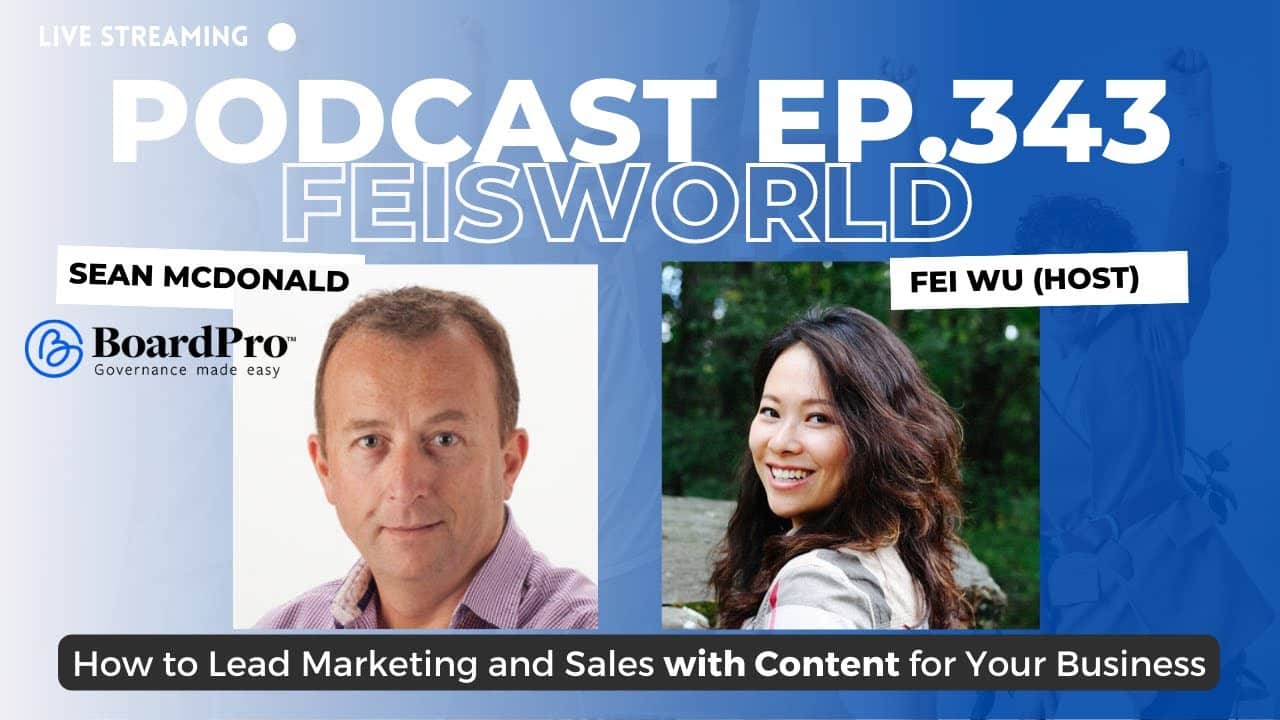
Our guest today: Sean McDonald
Sean McDonald is the Content Programme Director at BoardPro, a Board Management Software & Board Portal.
Prior to joining BoardPro, Sean founded Sales System, as well as MOBIT Messaging and Marketing Automation (which was acquired by Engage Media LLC in 2018).
What I find most interesting about Sean’s approach to marketing and sales is choosing to build a content-based business that does not rely on ads and direct sales alone.
Sean organizes and hosts weekly webinars at BoardPro that invites engaging conversation with industry experts, providing strategies and tactics for people in the industry.
The consistency and quality of these webinars really help BoardPro stand out from the crowd, and is also what connected us.
We are going to unveil exactly how Sean goes about creating a content strategy that works! This conversation is not just for tech and software companies, but any business that wishes to learn how to get started in creating a content-based marketing and sales strategy.
Watch Our Interview
Transcript
Transcript
Fei Wu: Hey, everyone. This is Fei Wu from Feisworld Media, and I'm super excited about my conversation today with Sean McDonald from BoardPro. Hi, Sean. Welcome. Hey,
Sean McDonald: how are you, Fei? How are you going?
Fei Wu: Doing very well. I am sincerely. You know, looking forward to this, Sean, because we've known each other, I think a little over a year now. And in such a short period of time, I feel like we have not only crossed paths, but actually have done projects together really get to know each other. I've written about board pro first of all. And there's a lot to cover for those of you who want to learn how to create a content based Marketing strategy for your business, whether it's small or big business. So before we get started, let me briefly introduce, um, Sean McDonald, who is the content program director at board pro a board management software and board portal will explain more to you about what it is, what it does. And prior to joining board pro Sean founded sales system, as well as mobit, uh, M O B I T messaging and marketing automation, which was acquired by engaged media LLC in 2018. What I find most interesting about Sean's approach to marketing and sales, uh, is choosing to build a content based. Business that does not only rely on ads, social media, direct sales alone. So Sean organizes and hosts weekly webinars at board pro. I've included a link in the description, wherever you're watching this, that invites engaging conversations with industry experts, providing strategies and tactics for people in the industry. The consistency and quality of these webinars really help WordPress stand out from the crowd. And it's also what connected us in the first place, talking about zoom webinars and zoom meetings. Right. We're going to undo exactly how Sean goes about leading the strategy and creating a complete content strategy that works. And this conversation is not just for tech companies and software companies. It is for any business that wishes to learn how to get started in creating a content based marketing and sales strategy. So with that said, welcome, Sean. I'm so glad you're here.
Sean McDonald: Thanks. Great to be here.
Fei Wu: So Sean, I would love for you to kind of help us understand, uh, what. Uh, board pro does who your target audience is. So kind of, we have the, the backdrop, the context before our conversation
Sean McDonald: starts, right? So our company board pro, um, we're a software board software provider, sometimes known as a board portal. And we help board meetings, um, to, uh, maximize their time to be more efficient and create the content needed for their particular board meetings. So we enable that process, um, and our target market. Is, uh, small to medium businesses around the world and nonprofits. So we have about 20, 000 users around the world and across about 16 countries. And we're growing, um, you know, every year.
Fei Wu: Wow. So, you know, I know that's a niche audience, but you know, since face world, my blog has written has really covered word pro I got to learn so much more about it. So when it comes to board, maybe correct me if I'm wrong, Sean, it's really about like maybe border directors and people on the board in general who have to, um, really get together and make decisions. And I feel like that is the type of meetings that are so important, but because sometimes it happens Frequently as needed or sometimes, you know, like seasonally or quarterly. Therefore it's so much is so important to be able to capture the decisions made to be made that sort of thing. Is that sort of the essence of how, what inspires the software?
Sean McDonald: Absolutely. So we, we basically empower board members, board administrators, CEOs, and chairs to run their board meetings more effectively.
Fei Wu: Fantastic. So I'm going to just dive right in here for people who are watching. Uh, by the way, feel free to ask a live questions because I think Sean has really mastered what I consider as quality and consistency of the content. So now Sean, when we look at board pro, it is such a well boiled machine. They're ongoing webinars. We're talking about weekly webinars with experts and you have an ongoing blog. You know, one of, I would say only a very small percentage of the for companies that are actually updated. Regularly with quality content. So could you maybe walk us through first at a high level and we can kind of drill in on what you consider as a content strategy, what are some of the funnels and different areas and Venn diagrams that are happening for board pro when it comes to
Sean McDonald: content? So we, um, about two and a half years ago, when we embarked on this journey of, uh, content marketing, we aligned ourselves with, uh, two industry experts in this part of the world. Um, we realized very quickly that we couldn't develop content on our own because as much as we're software experts, um, we, we weren't really experts in the genre and the governance genre itself. So we looked across the market to align ourselves with, uh, governance experts to help us write. Our first series of content, which led to our first webinar. Um, and that's pretty much two and a half years ago now. It's a long time.
Fei Wu: And then the, when you first planned your, your very first webinar, that's where some of our audience get a little tripped up is sometimes we overthink. Who's gonna be there? What is the attendance gonna be? So what was it like planning your first webinar versus now the ongoing webinars? What are the differences?
Sean McDonald: Uh, firstly, we were very nervous, , if you recall, because we, uh, we worked with you on our first webinar Wow. To produce the first webinar across Zoom. And we had a whole team of ours, our, our ourselves, you know, ready to, uh, Talk on the webinar. And it was, I think it was about an hour long. Um, we had 23 people on the webinar, which was so small, it was ridiculous, but it sounded like a lot at the time. And nowadays, nowadays we get three, 400 people to our webinars. So it's, it's grown quite substantially.
Fei Wu: Well, that's a huge jump. I mean, that's just not 10 X. That's nearly 20 X. How did you see the progression of having so many more people joining in? What was driving? What was the driving force than referring other people or just how did people discover the webinar over the past two and a half years?
Sean McDonald: Primarily, our focus was on LinkedIn, uh, so we marketed our webinars and the content for our webinars on LinkedIn. Uh, we had white papers that preceded the webinars and guides and business templates that we would promote, uh, which also linked back to the webinar. So it really grew from there. Um, it took us about six months to get a good head of steam to the point where we had, you know, about 100 to 150 registrations on our webinars. Uh, but like I said, nowadays we get seven to 800 registrations on our webinars, so it's, it's grown like topsy really.
Fei Wu: Wow. And so what's interesting also, since I still run a lot of webinars for clients and some for my own content is I noticed that that ratio of, especially for free events, roughly about a third of the people who register actually show up. So it sounds about right of seven to 800 people register and typically 300 or so people will show up. Um, do you see that? That's so fascinating, Sean. Do you see a lot of over repeating attendees or do you feel like you're getting new people all the time?
Sean McDonald: Uh, about 30 to 35% of our audience are returning. Um, so 60 odd plus percent are new contacts to our, um, CRM. Wow.
Fei Wu: Look at those analytics. Are you getting those 30, 35% from like zoom webinar analytics? Oh, wow. So, um, what are some of the metrics that you typically pay attention to when it comes to creating content attendees and what actually. I mean, let me reframe the question a little because we all tend to pay attention to so many different analytics and metrics at the beginning, and then over time, we realize What actually can drive results? What actually matters? So could you maybe talk to us about that?
Sean McDonald: About just explain that a little bit, a
Fei Wu: little bit further. Sure. So what are some of the metrics that, uh, Bort Pro or you in this case, uh, we're paying attention to when you first started the webinar, meaning, you know, a number of registrants and maybe some survey results, um, That you were really focusing on back then when you first started the webinar?
Sean McDonald: Uh, well we were aiming for a hundred registrations, so that was our first goal that we set ourselves. We fell short on the first, uh, webinar. I think we had about 60 people on our first, uh, webinar as registrations, and about 20 turned up on the day. Mm-hmm. . So we were aiming for about a hundred. Um, and we were also looking to really grow substantially, our LinkedIn audience. So we did quite a bit of promotional work on LinkedIn to drive traffic to the webinar page over the first, you know, two months, three months. Um, yeah.
Fei Wu: And compared to two and a half years ago, when you're trying to grow the webinar and now you have so many more data to actually rely on, to look at what are some of the. I guess the most critical, uh, numbers or analytics that's actually worth paying attention to. I think we're all overwhelmed, you know, like, uh, I think, uh, analysis paralysis. So I was just wondering, what are some of the things that to you, Sean, you look at and to realize, well, this is an indicator that the web webinar is really successful or It converted to real signups. I don't know whatever that may be. It could you talk to us about that?
Sean McDonald: Yeah, there's three metrics really. Um, the first one was attendees on the day. Obviously, um, our registration, um, ratio between registration attendees is typically about 36%, which is about a little bit above industry norm. Um, and also we were looking to, um, you know, maximize the, the audience across LinkedIn. Um, we were looking to, uh, attract anywhere between sort of 300 and 500 followers on LinkedIn from our webinars. Um, what we did realize very quickly though, was the webinars was a big driver of revenue. It took us about three months to realize that. Um, but after putting out a lot of content, um, pre content on LinkedIn and on our website, in terms of our blog information, our white papers and guides, we really started noticing great conversions on our website. Uh, we're doing very, very well and it generated about 2 million worth of business, uh, in the last financial year. Wow.
Fei Wu: Just from webinars alone.
Sean McDonald: Yes. Attributed directly to webinar traffic.
Fei Wu: This is fantastic for you to be able to measure that. I'm going to dive in and just a bit for those of you guys who are watching, don't go anywhere, but I want to acknowledge, uh, Adam Leffer sent a question now, hundreds of webinar attendees with 30% returning sounds like a powerful community. In addition to the webinars does Boar Pro ever. Gather this community or are there user groups?
Sean McDonald: No, we don't have user groups yet. It's something that's on our roadmap, but, uh, no, with this stage, we don't have user groups.
Fei Wu: Oh, I see. So what stage I think, uh, companies, we talk about this also on this podcast a lot is at what point, uh, does it make sense to have user groups? Are there a certain volume of, you know, ongoing repeating customers or webinar attendees? Do you think Sean?
Sean McDonald: Yeah, we have, um, themes developing across our webinars now. Um, so we typically have five or six different themes that we see emerging or we we've seen emerging over the last six months. So, um, a webinar, we, we found the 45 minute webinar slot to be the most effective. Um, we did try 60 minutes and it wasn't, uh, it wasn't as effective as our 45 minute webinars. Um, so that was just trial and error really.
Fei Wu: Wow. So how did you figure out 45 is more effective, uh, from 60s based on the. Attendance rate or, or, uh, attention spanned from the attendees
Sean McDonald: drop off both, both the registration rates and the, uh, completion rates. So the number of people that were still on the call at the end, um, we noticed on the 60 minute webinars, we had about a 15 to 20% drop off. Um, at about the 40 to 50, 50 minute mark. So we then, it was really just trial and error. If I, we, we realized very quickly that a 45 minute webinar, we had a really tight, um, drop off rates of about two to 3%. So that was the sweet spot. Wow.
Fei Wu: I wonder how much of that translates to other industries as well. I, I almost feel like there's probably a common theme of people not wanting to go over 45, especially when you look at the hourly blocks for busy people at work or working from home. Correct. Right. It feels like for the last 15 minutes, we've concluded we're, we're really on point. Go have a restroom break or grab a snack or something. I just feel like having that offer really helps.
Sean McDonald: And it's not a long time, but you know, by the time you do your introduction and your outro, you really only have about a 30 minute spot where you can have a discussion. So it's a, it's a very short space of time, really.
Fei Wu: Since you mentioned intro, I just realized, you know, when it comes to webinar intros, I had this whole, uh, discussion and debate happening, uh, on my LinkedIn. I witnessed that people talk about when to introduce your guest speakers, presenters, panelists, of course, always introduce them. But I feel like sometimes the feedback, not towards board pro, but in general, uh, people feel like webinars are spending way too much time introducing each person. Um, what are your thoughts on that? Like what are. some of the learnings you've witnessed.
Sean McDonald: Yeah. So, um, again, a little bit of trial and error. We used to, uh, back in the early days, uh, spend quite a bit of time introducing our speakers because we felt we had to for credibility. Uh, so we spent quite a bit of time on their bios, um, about four to five minutes. Uh, now it's really only two minutes. So we have a short 50 word bio from our speakers and expert panelists, uh, and we move on quickly. So the whole introduction for our webinar takes anywhere between three and a half to five minutes.
Fei Wu: Wow. I, I love, oh Sean, I really appreciate it. I, I barely, you know, it's very hard to get to these like detailed analytics. I really appreciate you sharing and paying attention to these details. I also noticed you have many different ways of keeping people's attention. Um, for instance, like giveaways at the beginning, what are some of webinar?
Sean McDonald: We really only have one fight. To be honest. Um, we have a really cool gift offer, which is a nice gift hamper that we provide people that stay till the end and complete a survey. So we have a very short exit survey, which is about I think it's about 7 to 8 questions now. Really, really easy questions. They're multi choice, just wanting to gather feedback from the audience as to how they found the webinar. Do the, and did they want to engage with any of our speakers? Um, so if they, if they go through to the end of the webinar and complete the survey, they, they simply go into a really fun draw to win a gift hamper.
Fei Wu: So with versus without the hamper, do you notice the drop off rate difference? And what, yes,
Sean McDonald: what's the difference? Um, we would typically get between 10 and a 15% drop off. Without an offer. So remember our webinars are non selling webinars. We don't sell anything at the webinars. It's all about content. It's all about information, expert content and advice. Um, so we don't, we don't sell anything.
Fei Wu: So, uh, I want to talk about the content of the webinars for a lot of people when it comes to webinars. They, I think we've all been annoyed by people giving very little value and the whole thing. It's about a whole, you know, a, it's a long drawn out 45, an hour, uh, sales message, or in the end it's, Oh, there's always a sales call to action. It's a pitch and, um, I love how genuine the content itself is. I have attended these webinars. I've watched the replays. I'm currently on the subscriber list just because for anybody, frankly, if I may say this, subscribe to the board pros webinar, you get these email updates with genuine highlights of the points being covered and they will be talked about. I feel like this level of structure is oftentimes missing, frankly, not even from just small. I've seen YouTube, Google sending out these webinars without clear agendas, and then literally spending the first 10 to 15 minutes trying to manipulate the technology for it to work. It's kind of hilarious when you think about these huge companies are still trying to figure that out. Um, but before I forget, I want to mention the revenue real quick. You mentioned specifically the webinars themselves are driving over. 2 million in revenue. And if I may ask how much of a bump, an increase compared to the, the average revenue for work pro, like, is that a significant increase?
Sean McDonald: Uh, about 40%. Wow. Yeah. 40% on the, on the previous year's revenue was attributed to webinars. That is people actually signing up for our webinars and converting into customers from free trials. Wow.
Fei Wu: How many people, uh, I know every webinar is different depending on the presenter, but on average, how many people actually convert to be, uh, subscribers before they become paying customers?
Sean McDonald: Uh, I'm not sure of the numbers, but it's typically between three and 5%. From the webinars.
Fei Wu: Okay. I'm going to do a quick math here. Over time. I see. So let's say 300 people attend a webinar out of which three to 5%, we're talking about like nine to 15 people or so, if my math is correct, we'll sign up and there is a free trial. There's a free trial. So, uh, out of the free trial, I wonder how many people actually do convert to be paying customers? Uh,
Sean McDonald: 55 to 60%. That is huge.
Fei Wu: Wow. I feel like I can't believe I can nerd out about these things. I feel like I'm at a candy shop. Um, so, okay. I don't know why these numbers just, I gotta say like as a creative entrepreneur, I look at my content, whether it's affiliate marketing content or, you know, content I write for my own courses and for my consulting services. I love. looking at these numbers. And, um, for instance, Sean, like to me, that's like music to my ears because it's the conversion to a lot of people. It's not like, Oh, you know, 80% of people sign up for trials. It's never the case, but coming out of, um, the webinar three to 5%, um, convert free trials. But then out of every nine to 15 people, there are more than half of them. We're going to actually sign up and stay with the service. And board pro is one of the software that I would say people stay for a long
Sean McDonald: time. It's very, it's a very sticky product for sure. It's a very hard product to leave. Yeah. Why is that? Well, the, our, our target market community of directors, chairs, and CEOs, uh, really don't like change a lot. So when they implement a system like board pro for their board meetings, um, it's a very strategic decision. Um, and they'd really don't like change too much in terms of the software applications. So a board pro
Fei Wu: one second, Sean, I think I just lost you, uh, for a moment. Audio wise, uh, Are you back? So
Sean McDonald: are we back?
Fei Wu: Yep. You're you're back. Awesome. Okay. So you're literally just lost you for five seconds, uh, about, you know, people not wanting to change once they sign up for the software.
Sean McDonald: Yeah. I mean, and if it works for them, they'll stay with us and our, our lifetime value of our product is, is very high in terms of revenue.
Fei Wu: Fantastic. Um, now I want to. mentioned briefly, it's so funny, like talking about the webinar. So these long form content, 45 minutes or so, uh, it's something that you have converted into shorter clips. I've seen you publishing them on LinkedIn and with full transparency for anybody who's watching this, uh, there is a link I've also included at the bottom of the description to talk about pod intelligence, which is a product Adam Leffert, who has. Ask a question. And I developed since early 2022. And, uh, we primarily work with webinar and knowledge based content. So knowledge workers, knowledge experts to convert their 45 minute, one hour content into shorter clips. And these clips are keyword and topic. driven. So Sean, I wonder if you could speak to your experience realizing like how to leverage this product and that you've been so creative. It's such an advocate for us. So thank you.
Sean McDonald: Yeah, you're welcome. It's been a game changer for us. Pot intelligence has really been a great game changer. Um, it's enabled us to create those short form blogs, those vignettes that we call them, uh, and to drive traffic to our webinar recordings. So when we actually have a live webinar 24 hours after the event, um, we place all of the content, including the webinar, it's white papers, the presentation slides and the podcast, uh, on our resources section of our website under webinars. Uh, and then. About a week later, we use pod intelligence to cut up the webinars to have multiple segments or sound drops as we call them or thought drops. And we use a product called Descript to create the audiograms that we promote on. LinkedIn. So the whole, the whole purpose of the pod intelligent video segments or vignettes is to, uh, attract people on LinkedIn and drive people back to the webinars where they can watch a recording and download the content.
Fei Wu: Wow. Why do you think it's important for people to watch clips from webinars instead of kind of pushing them just to the 45 minute webinar? Why is it important?
Sean McDonald: I think it's an intent attention grab. It's fine. It's something that appears on linked in for 25 seconds. They can get a high level quote or a thought drop off an expert and look at it and go, Yeah, actually, I'm interested. Now I'll investigate a little bit further. Rather than just having to sit down and watch a 45 minute webinar without knowing the content or context.
Fei Wu: Wow. It's so fascinating because I love using pod intelligence and I noticed that I use it differently for different clients. There are definitely some overlapping themes. Um, and so for instance, most recently I use pod intelligence to find clips from my documentary, which is. You know, we shot for weeks there, dozens of hours, but eventually what you see on Amazon prime is only 12 minutes and there are five episodes. So I finally use PI pod intelligence to find the clips. And honestly, I I'm kind of stunned by 30 seconds, 45 seconds, and using them to one drive back to the documentary and the other, just for me to reflect on, you know, we often talk about marketing strategies for creators and for me to kind of rediscover the content that I have. 2018. So what are some of the, how do you go about finding these clips? Like, cause it can be overwhelming. There are so many goodies. Like how do you prioritize and choose the ones that you like?
Sean McDonald: So we have now a full time marketing quarter coordinator, sorry, that, um, is responsible every morning for, uh, reviewing all of our. Pot intelligent video clips, and she literally reads, listens to the video clips and picks out those ones that are really meaningful and valuable. And those are the ones that we review. So we take we take three vignettes for the morning. We review them, have a little bit of peer review, and we choose one and we push that out. So we do one every day. We push one vignette out every day.
Fei Wu: Wow. So out of about 45 minutes, you know, roughly speaking, you're looking at 20 to even 30 clips. Um, so perhaps. So, so how often, like from your experience, like how many, uh, quality content or, or how many clips are reasonable to choose from a 45 minute webinar?
Sean McDonald: Um, wow, that's an interesting question. Um, um, I would imagine it's somewhere between sort of 10 and 15 quality clips, uh, for each webinar, which is plenty. Yeah, plenty. I mean, even if we, even if we had three or five um, clips, Faye, it would be valuable.
Fei Wu: Yeah. Wow. What a difference it makes. And would you say, uh, when it comes to keywords and topics, um, you know, our softwares running on, uh, you know, like an AI engine and that's improving every day and we're improving our algorithms every day, what are some of the, uh, learnings and reflections you've had shown when you look at those, you know, AI Selected keywords and topics versus those free text search. Like what has helped you to kind of discover some surprising content or finding things that you're like, wow, this is really helpful. I'm just curious.
Sean McDonald: Well, we've, we run a lot of the transcripts through to AI tools, um, barred from Google, obviously, uh, and, uh, chat GPT for, so we use those two platforms to run our transcripts for the webinars through them and they develop, uh, really great long keywords for us to use in the vignettes and also the, uh, transcripts that we upload to the website.
Fei Wu: So interesting. So I'm going to pop in another question for a long term board pro users. Have you seen any differences in how they conduct business because what they have learned?
Sean McDonald: Have you seen any differences in how they conduct business from now, from what they've learned? We get, uh, I don't, I haven't really got an answer to that, but we get fantastic feedback from, uh, our audience on. Really look the content that we're pushing out there. It's it's a bit of a void. A lot of the times in the governance world, there's not a lot of information out there. So we do provide we appear now to to provide that content, which is really highly valued by people in the governance world. Hmm.
Fei Wu: So cool. So cool. All right. So I'm going to kind of get into the idea of a content based, um, business or content based strategies with webinars. And I am really stunned, Sean, by, you know, two and a half years ago, I can't believe this is how long we've known each other. To me, like visually, I was thinking about a year ago, but two and a half years ago, you started your first webinar. Now you're doing on a regular weekly basis and I've seen you repeating very little content. In fact, uh, I can see that your. Really, you know, organizing different experts, different groups of people, individuals to talk about different topics. I think for some folks, do the math you've done well over, I think at this case, maybe over a hundred different webinars, how do you keep coming up with content and, and to pivot, to build on top of existing content or occasionally having to start from scratch, like find brand new content. What is that process like?
Sean McDonald: So, um, we start, we started, I should say with one expert speaker. Um, in the governance world in Australia, and the content really came from him. Um, so he had the great topics, had four or five topics that enabled us to run out the first three or four webinars. Uh, we now have 42 odd. Uh, expert speakers in our stable so you can imagine the amount of great content that comes from those experts and that is where a lot of the, uh, the topics come from, from the webinars, um, but also at the end of every webinar and that little short survey I suggested that we had, um, we asked the audience, uh, what they would like to hear about and for us to talk about in our, in our upcoming webinars and that forms the basis of a lot of our webinar topics as well.
Fei Wu: That's interesting. I totally forgot about the fact that user can input and provide feedback for where they want to learn next. Do you find those, uh, feedback often based on the webinar you just had? Or oftentimes are topics completely even outside of the,
Sean McDonald: it can be, it can be quite topics way outside the webinar that we're running. It's quite interesting.
Fei Wu: Wow. What about like, do people ever ask for how to more effectively use the software or, uh, you know, what are some of the, um, things that they wish they knew that those sort of thing?
Sean McDonald: It's interesting. We, we don't get anyone on the webinars asking about our product itself. It's it's really all about the content. It's about the topic. It's about the questions. It's about the conversation. Um, we really try hard not to talk about our product because, you know, you and I both have set on a number of webinars, which is sales based webinars and they push very hard to push the product very, very hard. And right at the right at the beginning, uh, I, I really decided that I didn't want to do that. I wanted to be all about the topics and all about the content and all about the conversation. Uh, and that's true today.
Fei Wu: Wow. I mean, first of all, I just want to acknowledge that BoardPro is very lucky to have you. You know, I've worked with a number of, um, I would say the internal content marketers, content creators, and I have often seen people, number one, really struggle with this. And they also don't have, many of them do not have the autonomy to make decisions to say, I think we should go in with this approach. Sometimes they get permission to do it once, can never repeat it again, even with positive results. And so. I wonder, like, I feel like you're very much empowered by your company and maybe speak to that a little bit about how to actually empower content creators, content marketers within the company suit to do their very best.
Sean McDonald: Well, you have to align yourself with experts. Um, you have to realize very quickly that, you know, you're not the font of all knowledge. Um, it doesn't really matter what industry you're from, whether you're from tech or manufacturing or retail or what topic you're talking about, you have to realize very quickly that you don't have all of the information that the market needs for content. So aligning yourselves with experts in the field is Um, can be really powerful and it is really, really powerful. Um, so that's, that's, um, a piece of advice that I could give quite freely.
Fei Wu: How do you go about finding the right experts? Is it something that you proactively do outreach for, or how often do you get people to say, wow, I've been on a webinar. I really feel like I could contribute something to it.
Sean McDonald: Uh, sort of both things happen. Really. We, we get people that attend the webinar that, um, would like to join our team. Um, and we don't pay them for it, so it's a non non paid event. Um, and we use linked in quite a bit to to look at people in the marketplace across the different countries that we operate that can work with us on our team to present the con or their content to the world.
Fei Wu: And I want to use a specific example for for people who are listening right now. You know, I really start to pay attention for how you structure your webinars. And you know, the email I'm looking at Hi, Faye, join our live webinar on this date. And this one I'm looking at, it's actually upcoming July 27, benchmarking board performance 500 reviews later with our special guests. Nicholas Barnett and down below. So clear registration, learn how to in bullet points, better boards, mean better organizations, pick a good board survey from a bad one, find out how benchmarking makes all the difference. So I want to call out a few things, which is really quite strategic that number one, I noticed you use plain English without having to jazz it up so much. So could you talk to us about actually how to structure these marketing emails or marketing messages as well as call to actions?
Sean McDonald: Yeah. So the first thing is we don't use a lot of imagery. It's pure text based. Um, the call to action is right at the front, so we make it very clear in the first sentence what it is they're looking at. So when they open the email, it's right, right there above the fold. What it is, what time it is, what date it is, uh, and then they can read further down from there. Um, The actual, uh, uh, registration keys or calls to action, uh, you know, as you pointed out there, they're right there in the big green buttons. It's interesting though, we, we don't tend to get a lot of, uh, readership below the green button there that you're at. Um, it's quite interesting. Only about 15 to 20% of viewers, uh, will read past the, uh, registration buttons.
Fei Wu: Wonder is a good thing. Uh, if it's a good thing, Sean, because they just register and then maybe Bounce off.
Sean McDonald: I think you're right.
Fei Wu: Wow. So they, they feel like they're you're sold. You've sold me on this and below our introductions to the green button. And I think specifically you're referring to the first register here, but not the second one, right? Correct. Correct. I mean, this is such a, I, you know, I'm going to stop screen sharing now, and it is just so fascinating to be able to see what we're able to learn from such a, such a great example. What are some other types of content that comes to mind? Sean, have you experimented with different types of content and how did that turn out, like different speakers or different ways of presenting your content
Sean McDonald: and, We have, uh, white papers, which can be from our expert speakers, their own content, or we can, we interview them and develop our own content. We have a small, small writing team here of three people that, uh, spend time with our experts to develop those white papers and they're on topics, um, around our webinars and also our keywords that we look to push to the marketplace. Um. Have guides and business templates, uh, on our resources section. So hundreds and hundreds of business, business governance templates that we make freely available to people on our website.
Fei Wu: You know, you mentioned there are currently four content writers or four people in addition to you on the content team and to a lot of, I don't know if people are reacting to this, please let us know in the comments that a lot, is that not enough, or I wonder. You know, people often say, we're so tight on resources. We have no resources. We have no time. So based on your expertise, I know you didn't just start doing this at VorePro. I know your prior experience has already taught you many different lessons and all that. What would be an ideal content team setup, um, that people should consider? Yeah,
Sean McDonald: so ours aren't full time, uh, all our content writers are on contract, uh, so we don't have a, uh, a full time headcount, if you like, for writers, so we're not carrying that overhead in the business. Um, when we, when we started, uh, I was the writer. Uh, and I did that for the first six months. Then I moved out. We found one additional writer that worked with me for six months, and then I built out the team from there. So you don't have to start with four people on your on your team. You can start small. You can use any number of contract writers from organizations like Upwork or Fiverr. Really, really quality people are on those platforms.
Fei Wu: Such a great reminder for people. I have leveraged help from Upwork and Fiverr before. And frankly, the team now I have are, have worked with him for a long time. They're part of the phase role team. Also not full time, primarily contractors, but those people I consider, you know, friends and colleagues, but, um, you know, I bet people are thinking about one thing, given the rise of AI and the various tools available today, I have heard. Uh, at least generally from the industry that people who are bloggers and writers are really worried that they're going to be the first ones, um, without a job. So what's your take on, uh, actually maybe prior to AI, the AI era versus now with all the tools, I know you're using pod intelligence, Descript AI, as well as content at scale. Oh, what's your vision for whether AI is helping you and your team? versus the parts that still need human intervention.
Sean McDonald: I don't think I will ever replace a good quality writer. Um, you know, we work with, you know, three or four really, really good people that we've had a relationship now for the last 18 months, two years. And they are really great governance writers. Now, whether again, whether you're in manufacturing, retail or sports, you know, there's writers out there in that genre that can do the work for you. And it's very, very hard for an AI tool to run to write. Uh, good, good quality information that makes sense. Um, that's simple to understand and strategic at the same time. Uh, we've, we've, we use a number of AI tools, as you've pointed out, Content at Scale, ChatGPT and BARD. Um, but we only use them to augment the content that we have and to check information that we have, uh, on our written word. So, we don't rely on AI tools for our content.
Fei Wu: That's, that's really wise. I have to agree that I also tried, uh, for instance, content at scale, I think has a lot of potential, but it certainly needs the review needs the human touch. Uh, especially I find that content that works best has an emotional element that that type of human emotional element. That's clearly coming from a person who's living with the same struggles, pain, success, whatever it may be. Um, I think I would love to coming from, I'm going to pivot real quick. Knowing that word pro is a software company and John you're, you're managing so much that's happening right now. I know you're, you're sitting in the webinars. You're probably doing some of the outreach and, uh, really nurturing your audience and measuring all the analytics. There's a lot going on. I would love to know what are some of the other software. or analytics tools or keyword research tools that you have used, uh, you're using now or you have used, uh, in the past, uh,
Sean McDonald: two main tools. So our CRM platforms, HubSpot, we would, we would be lost without HubSpot a little bit like pot intelligence. It's one of our tools that we would hate to do without. Um, so all of our, all of our analytics comes from HubSpot and they do that very, very well. Um, we also use, uh, SEM rush. To do our keyword analysis. That's not my area of expertise, by the way, but, um, yeah, so we use those two, uh, tools primarily for all of our keyword analytics and, uh, analytics across our webinar.
Fei Wu: Oh, wow. So, yep. Very familiar with. Both and I've listed, uh, in the description here and what are, I mean, a HubSpot is such an interesting area to, to get into a real quick, because we have also started using HubSpot to keep track of prospects and leads and conversations for pod intelligence. I've been using it for FaceWorld for a little while and believe it or not, the free version is already super powerful. Yeah, it's fantastic. So, but I bet you guys are using a paid version at this point for sure. Absolutely.
Sean McDonald: I think we use almost every module of HubSpot. Marketing, sales, service, provisioning. Yeah, it's, uh, we're deep into HubSpot for sure.
Fei Wu: Do you remember how long, have you always been using HubSpot at the moment that you joined Boar Pro or, you know, did you, you know, start using it at one point while you were there?
Sean McDonald: We started with the free version, um, for about four to six months. This is going back. Goodness me, about six years now. Wow. And, uh, very quickly moved into a paid version and we customized a little bit of it, um, and built it out from there. So, um, yeah, it's been a long time with HubSpot.
Fei Wu: Wow. And I know your website's right where your entire website where just the blog is also running on HubSpot. Yes,
Sean McDonald: it is. Uh, and that, that enables us to interrogate, you know, a lot of the information and the content pages we have on the website through HubSpot, we would, we would be lost without the analytics. We would be lost.
Fei Wu: Wow. This is a fascinating. I feel like HubSpot should reach out to you guys and, uh, and really use it as a case study or have they done that already? No,
Sean McDonald: I don't believe so. They certainly haven't called me.
Fei Wu: They should. I mean, they really should. So I'm going to pivot real quick to, um, talk about, I mean, I'm Always been, and especially in the past two years, I've had clients in both Australia and New Zealand, and I've been so fascinated by businesses running in both countries. My colleague, someone I actually met through L10BA, Ryan Jennings actually wrote this book. I, I think it's fantastic. It's called a hundred percent businesses, nine Kiwi success navigators. And so it's like a really thick book and it's so well designed and, um, organized. And so. I realized for some reason, I have noticed just the level of focus and rigor that I've seen from these businesses. And for some of you who don't know, like for instance, canva. com, which is a multi multi billion dollar companies run by started by a woman in her still in her early 30s, I think, mid 30s. It's just fantastic. There are just a lot of hidden gems. So I wonder If you may know this, John, like what, what contributed to the mindset and the way of going about business or running a business in New Zealand? Let's start where you are.
Sean McDonald: Wow, that's a, that's an interesting question. So we really started with a problem. We were very careful to identify the problem in our sector. We knew there was a There was latent demand in the governance community for a product like ours. We're not alone in the in the sector. There are a number of organizations that live in the governance world products, such as diligent, convene, boardable. There's a number of products. But we were very, very careful to address the segment that we really wanted to focus on. Well, the two segments, which was small to medium business and nonprofits, uh, and develop a product, uh, within that, uh, environment that could, uh, be efficient and effective at the same time and cost effective.
Fei Wu: Mm. I mean, niching down is something that we've been talking about. Uh, it just, I feel like niching down. Know your niche has been, uh, I think over dramatized by the YouTube community, a content creation community. But really, when you look at it from your perspective, um, I wonder It's so important. What are some of the characteristics, a distinction of, uh, you know, nonprofits, small businesses that make them very suitable for board pro?
Sean McDonald: Uh, well, in our world, every, every, uh, small business, um, well, not every small business, but a large proportion of small businesses, uh, and nonprofits have board meetings. Uh, and they all have the same needs and, and, uh, drivers as, you know, tier one corporates, but they don't have the, uh, the budgets, uh, or the resources to cope with, uh, complicated board management products. The board, board pro is a really simple cost effective product, uh, aimed specifically at the small to medium business market and non profits. Um,
Fei Wu: uh, when I read the reviews of board pro. Um, you know, it just happens once you search for word pro and, you know, there are many different major software sites evaluating it and the reviews have been very positive. So that makes me think about the fact that, um, you know, there are a lot of software with very inconsistent. Frankly, even, even for content at scale, I realized it's like, wow, there are people who love it, know how to use it. And there are people who are like, well, I just can't figure it out at all. But the feedback has been so consistently positive for BORPRO. What are some of the things from maybe from a customer service perspective, follow up, educational. elements that you could possibly speak to? Why are people so happy with the software?
Sean McDonald: Um, we right at the very beginning, we wanted to deliver a superior level of service. One of the one of the issues or one of the products with one of the problems with a lower cost product is being able to develop or deliver a service that is affordable within that environment. Um, so we right at the beginning, we really wanted to develop. A 24 by seven support desk, real people to help our customers because we, we know it's not, they don't typically, uh, uh, put together their board packs during the day. They, they work in the evenings, they work in the weekends and, uh, you need to be able to reach out and call somebody if you need help. So support is very, very important for us. It's probably our, one of our key drivers. Hmm.
Fei Wu: Wow. It's so true. I remember signing up for a free trial, just to explore and even right then and there, I was already, I can see that help is already on the way, even for people who just signed up for the trial. Um, that's fantastic.
Sean McDonald: Talk to real people.
Fei Wu: Talking to real people as opposed to AI, I guess that made a difference for Bort Pro as well. Very
Sean McDonald: much so.
Fei Wu: Why do you think it's so essential for, you know, while AI can replace so many different tasks, like why is it so essential for, again, once again, human intervention at the support level?
Sean McDonald: I think it's the many nuances, uh, you know, in and around support queries. You know, people ask questions in multitude of different ways. And you need a human, um, mostly to interpret that and to provide, you know, structured and meaningful content or information back. And AI tools don't really do that. Um, they're very, they're very structured in their approach and their response. Uh, they're coming along in leaps and bounds. Don't get me wrong, but, um, you're In my, my opinion, you really can't beat dealing with people on a one to one level.
Fei Wu: I would agree, even looking at all the software I've once seeked help from like uscreen. io or Podia, these online course platforms. I realized that I had to talk to a human being because just the complexity of these questions and frankly, the lack of knowledge learned by AI for these like very specific niche software. It's just not there. And I don't know, right, as quickly as we train AI based on this version, the software very quickly will, you know, go through the next iterations or a different version. And a lot of answers are simply changed. We even run into that with pod intelligence of, you know, before we had the web version, you know, when at one point people ask us about obsidian. Which we then develop the whole, you know, like API and everything. And then now it's just all web. So all of a sudden the content before becomes obsolete. So that's actually a followup question, Sean, like about a lot of the webinars you've developed over the years. Like now some are archived live on YouTube. How do you go about, uh, really managing content that may not be relevant or do you specifically design content for them to be evergreen for a long time?
Sean McDonald: Um, we do design content for them to be evergreen for sure. Um, we make sure our topics are really on point there on the keywords that we are looking to rank for, uh, and we push those webinars out after the effect after the, um, the webinars themselves. We push those out, uh, about every three months on linkedin. So we make, we make sure that we are, we're continuing to promote those evergreen webinars. So they're not just sitting on our website, hoping for someone to. Fall across them.
Fei Wu: Right. All right. Wow. Time really flies. I feel like I'm just bombarding you with a lot of questions. What are some of the things that come to mind, John, that I haven't asked and you feel like we should talk about that might help our audience?
Sean McDonald: Well, we were talking about real people needing to reach out to human beings. That's how you and I met. Remember? We had, uh, when we started, uh, with zoom, we really had to, uh, reach out to, uh, to you at the time to understand, you know, how to get the best out of it. Um, what were some of the nuances of the software that we had to be aware of and, and you were fantastic. You were, your, your service was just fantastic.
Fei Wu: Oh, thank you so much, Sean. And, uh, I, I know that, you know, it really goes a long way. It means so much because I feel like. I always, I've always seen you as a creator as well for you to take on such a massive initiative to set up these webinars and work with these experts. And, uh, really warms my heart to realize that you didn't just do it once, but you thrived in what you have created. And now it's, I feel like 40% of the revenue is, is huge for any company and. You've started this thing and you continue to do it. Uh, it just makes our connection even more meaningful. And you've been so supportive of, uh, so phase world, my work as well as pod intelligence. And I want to give a shout out the fact that you have introduced us. To so many people, uh, in your, you know, in your business, your friends and colleagues, that is just tremendous because at the end of the day, Sean, if you people like you, well, like me in some cases don't exist. And frankly, we have to rely on, you know, endless ads and content creation, which is really exhausting. Finding, you know, what you have done, um, for, for us, as well as for Bort Pro is really helping people who are trying to look for the solution to actually meet the solution. So that is, that is really tricky. That's not very easy.
Sean McDonald: Indeed. Yeah, it doesn't happen. It doesn't happen instantly. That's for sure.
Fei Wu: Yeah. What, what are, I mean, what have you noticed about, uh, people maybe returning to the webinar? They didn't purchase the first, they didn't sign up for the first time or the second time. And they're just waiting. And do you see people like engage with you or board pro multiple times before they make the decision to even sign
Sean McDonald: up? Oh, for sure. We have, we have people that have watched. 12 20 webinars without engaging with us. Uh, and and then they'll they'll pop up on a trial one day and you'll go, Ah, that's interesting. That's where they came from. Uh, so they've been consuming our content for months and then we have others that really are just happy to consume our content, which is fantastic.
Fei Wu: Yeah, wow. Then maybe they can teach us someday. I, I agree with you. I think this is so, you know, positive, uh, to hear that from you because whenever people sign up for my content, I think including you as well, uh, you may have watched one video and we built trust right away. You reach out to me, schedule a zoom, things get done. Uh, but most of the clients that I have picked up from YouTube or social media. Exactly like you said, Sean, is they, they have seen, they tell me I've seen 15 or 20 of your videos and I know I can trust you. I was like, Oh, 15, 20 videos. Uh, people have to see more than once.
Sean McDonald: Yeah, very much so. And that's why we have such a huge depth of content in our library. Uh, we just make sure we can cover the basis in terms of, you know, um, uh, content relating to the governance world. So we, we really work hard at that. Oh,
Fei Wu: fantastic. Oh my God. Thank you so much, Sean, for your time, for joining us. I really would love to continue this conversation. I really mean it because the future of WordPro with these ongoing webinars, content snippets, and it is just absolutely brilliant. I would love to invite you back in the future. We can continue this conversation WordPro. Wonderful. Look forward to it. Fantastic. So everyone, I'm going to take us off a live stream now. And wherever you're watching this, please do share with a friend or a colleague if you find it helpful. And I hope this helps you let us know if you have any questions in the comments below, and I will see you next time.
Connect with Sean McDonald
You might also enjoy…

Written by
Fei WuFei Wu is the founder and CEO of Feisworld Media, a Massachusetts-based digital media company helping brands get discovered by people and by AI. An Adobe Global Ambassador and brand partner to ElevenLabs, Synthesia, and 50+ other tech and AI companies, she hosts the Feisworld Podcast (400+ episodes, 500K+ downloads — guests have included Seth Godin, Steve Wozniak, Chris Voss, and Arianna Huffington) and co-created the documentary Feisworld: Live Your Art on Amazon Prime. Fei writes for CNET, Lifehacker, and PCMag, and her work has been featured in Forbes, Harvard Business Review, and WIRED. She has been publishing on the internet since 2014 — long before AI discoverability had a name.
View all posts by Fei Wu→Stay updated
Weekly insights on content, AI, and digital media.
Keep Reading
Related Articles
Joanne Lipman on Mentors, Untapped Talent and Why Women Should Stop Waiting to Be Perfect
Marc Randolph on Curiosity, Messy Starts and Why “Nobody Knows Anything”