Rosemary Ravinal: Learn to speak, engage, and persuade as a Bilingual Creator and Speaker (#334)
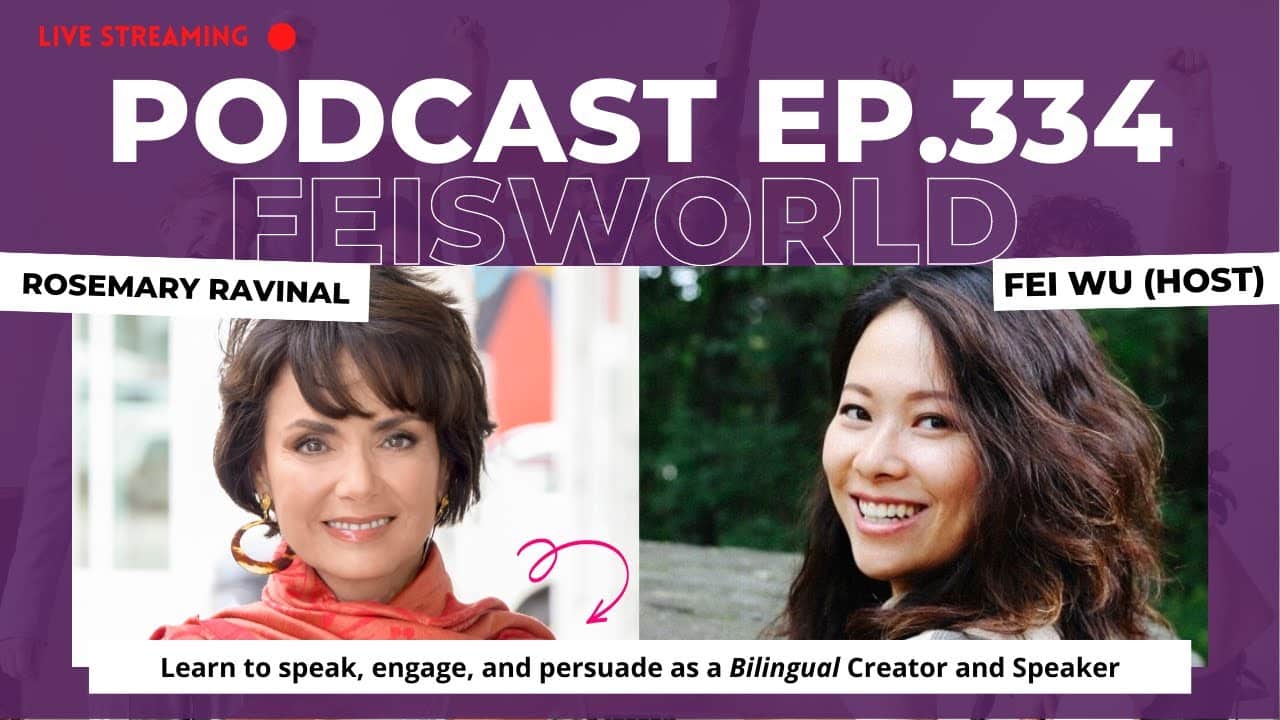
Our guest today: Rosemary Ravinal
Rosemary Ravinal is a public speaker and executive speaker coach who overcame decades of stuttering and now uses her disfluency as a metaphor for habits and mindsets that get in the way of people fulfilling their fullest potential when they speak.
Rosemary is a former international media executive and broadcaster on a mission to “Slay the dragons of bad communication” and promote clear, concise, and honest communication that lifts the human spirit and unites people everywhere.
This session is for anyone who fears public speaking or creating content for a small or big audience.
If you happen to be a bilingual creator, we’ll address specific challenges for your needs.
Watch Our Interview
Transcript
Transcript
Rosemary Ravinal: I am thrilled. I'm thrilled. Wish you were here with me in. Me
Fei Wu: too. Me too. And uh, I really look forward to this for a variety of reasons. But for those of you who are not as familiar with Rosemary's work, I don't wanna give you a brief intro and I really want today's discussion to serve you guys. So if you have any questions, please let us know in the comments, wherever you're watching this. And if you're listening to this on a podcast and network afterward. Feel free to comment as well. So Rosemary Ravenal is a public speaker and executive speaker, uh, speaker coach who overcame decades of stuttering and now use her disfluency as a metaphor for habits and mindsets that get in the way of other people fulfilling their fullest potential when they speak. Rosemary is a former international media executive and broadcaster on a mission to slay the dragons of bad communications and promote. Concise and honest communication that lifts the human spirit. It unites people everywhere. And I have to say that I, I really look forward to this because some of you guys know that I'm also bilingual, and I came to this country not when I was a baby, but I was 17 years old, get dropped into that, you know, 12th grade private school setting, and then went to school in Boston at North. And even then after that, to be honest, Rosemary, I, I, I so look forward to this because I remember the beginning years of me working as a consultant. I mean, young consultant, talking to clients, looking around. I mean, at the time and around like 2006 seven, there were very few people who looked like me, sounded like me, who were playing in a consulting role. So, Frankly felt really intimidated and I had to hide it all the time, which was quite exhausting. So with all that said, for people who are watching this, there's many, many reasons why. I'm glad you're here. Um, but let's get started. with today's good
Rosemary Ravinal: discussion. I am excited to. So, uh, I, there's just so much to say about this topic of, of, of good, clear communication that unites. right? We're at a, at a point in time, we're at a crossroads where I think we are dangerously heading towards the precipice where we're. even listening to each other properly. Mm-hmm. . And it seems simple, but you know, we talk so much every day, but do we really understand, do we really communicate? There is just so much chatter and do, how does that resonate? How does that leave us More enlightened, uh, more informed, more connected, more in touch with our humanity. Mm.
Fei Wu: Yeah, I, I love what you're bringing up because frankly, your teaching not only applies to onstage very serious settings, TED Talks, but I do see that, like you said, Rosemary, in everyday communication, I think we misunderstand each other all the time, whether it's at work, at home with people who are familiar with people we're meaning for the first time. So what are some of the things that people who are new to this, thinking about this for the first time, what are some of the things they should think about and the mistakes, common mistakes that people do?
Rosemary Ravinal: Yes. You know, I, I use the, the phrase, you know, slay the dragons of bad communication because the dragons are all of those self-imposed obstacles, uh, are phobias. We can talk all length at length about fear, but I don't wanna talk too much on that. Although it is an important dragon that keeps us from really connecting, uh, all of those things about the dragons can be our sense of self. Uh, the belief that we are introverts and therefore introverts are not necessarily loquacious or able to articulate their ideas wrong or the way that we have imposter syndrome. something that affects more women than men. And by believing that we're not really qualified to speak, to share our ideas, or to impose or to be forceful in our point of view, that holds us back from communicating effectively. So there's all these dragons. Stuttering to me was one dragon that I, thankfully, overcame, and I used the overcame very cautiously because once you are a stutterer, you're always, it's always there. You just learn to deal with it. And I've been, I've been able to deal with it, although there are many people who continue having this dis fluency, and that's another area that really merits understanding because. There are people who say, oh, you don't speak well, therefore you're not intelligent. Hmm. Oh, you have a stutter. There must be something missing up here. Why can't you get the words out? Mm-hmm. , or you speak with an accent, can't you speak English correctly? You see, there's all of these ways that we create. Whether it's intentional or not, barriers to understanding each other and barriers to our own ability to express our ideas. Hmm.
Fei Wu: It's, uh, just incredible what you just said reminded me of many, several conversations, uh, you know, related to different topics, that it is the construct that sometimes we put on ourselves and people who are close to us and other people that makes communication unnecessarily difficult. Uh, and one thing I wanna kind of dive in because I happened, you know, my dad, my own father happened to have, um, stuttering his whole life, and I believe it. When he was young and even before my mom met him. And you know, he's passed away about, you know, 12 years ago. So we, we never really sat down, never really fully understood what it was about. It was, I think it was kind of a, a challenging situation that we just never really talked about because I remember going to school and my friends were talking about the fact that my dad stuttered. And they were all trying to guess how it happened. Was he in a shock? Like what he, you know, what did he eat when he was growing up? It was all these like misconceptions and for a, you know, stunning reasons. My dad was also very much of a, like a public speaker figure. Whenever he spoke publicly, he had no issues. He never stuttered. But when he's home and when he is with his friends, , he did it more so I wonder if you could shed some light on for me. Nobody ever did.
Rosemary Ravinal: There is now, thankfully, because of, there's a movement to, to, to raise awareness about this, this language, disfluency. Mm-hmm. . And it's, it's an impediment if you choose to make it such, but let's say that it's, it's just a different way of speaking, but there's a rising consciousness about the fact that some people stutter. Our current president, Joe Biden, God bless him, he rather. Unwittingly sort of put it on the radar because he publicly has, has, you know, explained his whole history with it and how his sister helped him, sort of pushed him to the edge, you know, of of, of being a public figure and, and, and running for senate and where he would need to use oratory, obviously to, to do his job. And so he has made it, he's rather normalized it to some, . But as far as what brings it about there is scientific research of course that says that, you know, from vocal, um, voice coaches that it starts, it, it young child, you know, age when we're first learning to speak and that we sort of grow out of it. Mm-hmm. as we mature, some people don't grow out of it. Mm-hmm. , some people, uh, have more of a psychological trauma. , um, infused experience with stuttering, which was what happened to me. Although there are some scientists, behavioral scientists who say, no, it's neurological. It's the way your brain is wired. So there's a lot of, of still this nebulous area as to what brings it on. The point is that there are probably close to 2% of people on the planet who, who have a self-reported. , uh, you know, sort of a, the, the, the, the characteristic of your speech is, is, is tainted by the stuttering. Mm-hmm. , and I say tainted because that's the way it's perceived, that it's not a good thing. Mm-hmm. , you can say, oh, your accent is charming. Oh, where are you from? But when someone's stumbles on a word, it's like jarring. Get it out, let it, you know, or, or worse saying the word for the person. Mm-hmm. , fill in the blank. So the, the concept of that delay and how it breaks from our patterns of, of verbal communication is something people need to understand that people have different speech patterns. Mm-hmm. . So where, where does this. , I'm not an expert on, on stuttering from the point of view of its, you know, it's the, the, the behavioral patterns. The neurological factors. But I can tell you my story. Mm-hmm. , and my story is that I wasn't born that way when I was raised, being raised in Cuba, came to this country at the age of seven and a half. I didn't stutter. Of course, I only spoke one language that was Spanish. But as I started to live the experience of, of an immigrant and developed a bilingual brain mm-hmm. and lived away from home in boarding schools, that's where there was born in me. This, this e enormous bowl of. And the trauma of being a separator from my family, being in a new culture, being a, you know, being really in a totally exile environment. You know, that was totally foreign to me, that that traumatized me to the point where, uh, as I got into my teens, I was really, Unable to speak. However, when I was asked to read a passage in English class, for example, I was able to read, I was able to read, just like you described with your, with your father in a, in an oratory setting. He was able to speak fluently and without, uh, any, um, in verbal ticks. . But in my case, I wasn't able to have a conversation, a playground conversation, you know, among girlfriends. I and I, I went into a shell and I withdrew mm-hmm. , and I found my voice in writing. in writing. I was the editor of the school paper and the, and the high school yearbook. And then in college I was the editor of the, of the college newspaper and developed really, uh, what has sourced me to this day. Uh, very, very strong, uh, ability for written communication, but it was where I broke out of or started to, to train myself out of. Vocal therapy didn't, didn't voice therapy, didn't help me very much at all. Mm-hmm. , the exercises, the breathing, all of that is good, you know, to be able to, to use your vocal toolbox better. Mm-hmm. , but it was doing college radio. That was part of my, the requirement for my major of broadcast communication that when I had to do live radio and there's this microphone in. , you know this, this cabin in a radio station, and I have a guest in front of me and I have to speak into that microphone without stumbling. Mm-hmm. , no stammer, no tripping over words. I had to enunciate and articulate. As a broadcaster, and I found that that immediacy, that spur, you know, that electrical charge that went through my body saying this is life or death. I have to do this right? Because there's people listening, there's people, I can't take it back. This is it. This is live. And that, that helped. And so that opened up a career in broadcasting. Although still in my private conversations, I still would fall back into some of those pattern.
Fei Wu: Wow. I mean, there's something to, to break down here. Um, and before I kind of go into, I mean, I have a question just like the, the tip of my tongue to ask you, given your, your history and what you have lived through, knowing that stuttering is something that you're trying to, you know, either not overcome, maybe is not the word, but trying to manage even as a young child and then majoring broadcasting communications in college. Like, what was that decision like to. . I wanna study that. I wanna be on camera speaking into a microphone. What, what was yeah, what went through your head?
Rosemary Ravinal: It's funny because when I was, uh, maybe in my early adolescence, uh, at 11 or 12 years old, I had an imaginary persona After coming home from school when I was alone, I was sort of a latchkey kid for a long time, and I had. I was, I would imitate what the broadcasters were doing. Mm-hmm. I would take, I would play newscaster. I would talk to my dolls, I would talk to these, you know, these imaginary friends, as if I was doing a speech. I was saying something important, and I don't remember what it was, but the rhetoric was just like, I'm going, I just didn't loved it. Mm-hmm. And little did I know, I think that I was sort of anticipating, uh, what I would be doing much later in life. No, I not only did some television, I a lot of television, but I also was spokesperson for many companies, so there was a lot of stake there. , and I remember I so enjoyed it, but yet I wasn't drawn to the theater arts or to the performing arts. I was, I was really drawn to, uh, to broadcast journalism and to, uh, public speaking. But, uh, that I sort of played that out. I role played and I listened carefully and I imitated the speech patterns, so people who were on televis. .
Fei Wu: Wow. You know, I'm, I'm smiling because I have literally recorded, you know, at this point, throw into 50 episodes of the podcast and during, which I have also mentioned as an only child coming home. I still remember third, fourth, fifth grade. I would literally line up my stuffed animals. In my bedroom. And then there are the audience and I will be giving a okay, uh, telling stories. And I remember how embarrassing was when one of my friends showed up. My parents didn't tell me. I remember he or she walked into the room and said, who are you, who are you talking to? So I, I also, did you grow up as an only child
Rosemary Ravinal: as well? Rosemary? I was an only child until I was 11. Then my brother was, . Oh, wow. And, and I was still an only child, cuz obviously in his, the first few years of his life, you know, he was a baby that I, I helped to care for. Uh, so we, we didn't have, we weren't, you know, we weren't friends until much later. Uh, but yes, I did grow up as an only child. Wow. Did you place
Fei Wu: him with a stuffed animal be like you are now part of the audience, . I just imagine how cute that would be.
Rosemary Ravinal: Oh yeah. Although he wasn't really very interested in what I had to say at that time. ,
Fei Wu: this is so cute. Uh, we have one common, uh, someone also said, uh, I am the brown. Uh, my stuttering only happens when I, when I've talked for a while and I've only, it, it's like my mouth was on a time clock and notice the same thing with my dad. It's like, it's okay, and all of a sudden he goes into a, a different pattern altogether. Hmm. That's
Rosemary Ravinal: interesting. . I, Hmm. I can only hypothesize that. Maybe it's because you start to think too much about what you're saying. Mm-hmm. become very self-conscious. Mm-hmm. , it's, and, and that's again, one, one of those dragons that as you start to speak and you're enthusiastic and then maybe you're not getting the reaction from. people who are listening that you would like or you're not getting the smiles or the head nods, or the acknowledgement, you start to, I'm, I'm just guessing cuz I, I've been there and you start to wonder, am I, am I doing this right? Are people interested in what I have to say? And then you start to, that worry, that worry machine starts to, to, to, it turns on. And I think that, that, that could be a factor of what other people perceive. Because really the big, big, big, the, the, the sort of the, the big elephant in the room for public speaking is that most people are afraid. not afraid because I think, which is a foolish notion that people fear speaking more than they fear death. I think whoever did that survey probably asked the wrong questions, but people do. I think that the statistics are that maybe 70% of people on the planet report some form of performance anxiety. and that could translate into fear of what people are going to think of you. So make that maybe more granular, you know, basically rejection. You know that you're not gonna be accepted, people aren't gonna love you because of what you're saying and how you're saying it. And that's from a hierarchy of needs, I think much more, much more, uh, easy to, easier to compute than, than. You know that people, you know, prefer to die than to be in a casket, I think is, uh, uh, Jerry Seinfeld said, you know, people prefer to be in a casket than to be the one giving the eulogy. Okay, , it's a great joke. So, The, the, the point being that, that the fear kicks in and then what happens? Your mouth gets a little dry, your tongue gets a little thicker, and your vocal chords become more constrained and more tight. You tighter. And so what happens then? All of these wonderful muscles. And ligaments and such that we use, and the breath that we take to make the sounds start to get a little more constricted, tighter, more difficult, less fluid, less relaxed, and that also contributes to the stuttering.
Fei Wu: Wow. Uh, you know, I'm the brown. Actually, confirm what you just said. It's like our mental model of keeping people interested or is this even worthy? And I have to say that like one of the things, Rosemary, I've been training myself since 2020 is to instead of imagine, uh, an audience, now we're going li I've been going live since 2020 with all. The one of the reasons is because I wanna share the conversations much sooner rather than waiting for a producer and editor to release it and something goes wrong two weeks later. Cuz I just feel like if I can engage with people, helping one person today is good enough. And I try to think about the fact that I don't wanna be influenced or triggered by, there's a number for those who, those of who are watching live, you don't know this, but you know, we can actually stare into a number of how many people are watching live. It's says three right now, which is probably partial because we don't see everybody. And as a number go down, sometimes I feel my heart, it's like, oh, it's because I'm talking for too long, not letting the guests speak. It's so important. Now I've trained myself to not just to have thick skin, but also to realize that I don't wanna be, our conversation shouldn't be dependent on the live audience and other people can also find it helpful. But it, for me, like that mental model to train myself to speak into an empty room and feel like there's still power in my voice, I still wanna contribute is really helpful. So thank you for clarifying. ,
Rosemary Ravinal: yes. If I could build on what you said, which is so important in this hybrid world that we live in, and we're going to continue interacting, I think an equal measure in person in real life as we are interacting on video conferencing or platforms like this one, is that we need to be able to toggle back and forth and understand that the audience. on the screen is, is just as, just as engaged as the ones in real life. It's up to us to then adapt somewhat to the dynamics, to the modality that we're in. Mm-hmm. and I, I reflect back on the first video meeting that I organized. It was, It was really it. The, the content that I was sharing was how to survive on Zoom, how to do, how to speak effectively, how to conduct good meetings, how to, how to, uh, show your leadership on Zoom. And so I created a whole curriculum based on that. But I remember the first time that I shared it publicly and I'm looking at my screen and people, they're not nodding. There's no smile, there's no expression. Or some of them weren't, most of them weren't even on, they didn't have their videos on them saying, I'm talking to myself, does anybody care? Is there anybody out there? ? And cuz I hadn't really tested this material yet, I was still developing it and it was such a, a sense of like, I wanna abort this. I want out. Oh, forget. I hope maybe there's a power outage and I don't have to continue because I feel so horrible. But yet, we scheduled to 45 minutes and it's only five minutes in, but like I'm, I'm lost already. So it took a lot of patience to understand. It's very different, but that then afterwards people were writing and commenting, oh, we're so amazing. I love to, what are you doing the next one? So you see, we, it's our own it own heads talking, you know, in, in a negative way. Because if we have that, that nature, which I have of, of really being very self-critical and very perfectionist and, and needing to be validated often and needing that feed. and not getting it immediately then leads us to think, oh no, I'm not worthy, or nobody wants to hear, and so mm-hmm. , obviously all of our energy is zapped at that point. Mm-hmm. ,
Fei Wu: I wanna build on this. This is so fascinating because what you have just said to me also translates really well into, uh, not just podcasting, video production, but also writing and communication overall. because I came here at the age of 17. Frankly, I pretty much struggled through learning English, I mean regular college level English classes. And, uh, you know, it was just such a joke. I would be given these books and a, I'm supposed to finish within two weeks and near, you know, near, at the end of the two weeks. I'm barely going through some chapters. And I, you know, I have surrounded myself with friends, you know, living in Boston, a lot of people from literally from m i t, Harvard. Grew up speaking English fluently and I remember the articles and things that they would talk about and share with me were really intimidating cuz I, I would have to pause every time I read a paragraph. However, now in the past five to 10 years as a content creator online, I couldn't even lie about, I couldn't even like, use these fancy words to really express myself, even though I knew. What they meant. It was hard for me to incorporate them into the writing that I want to achieve, like the the meaning behind my work. And after watching some of your videos and your teaching, Rosemary, I finally realized that when I speak with ums and ahs, with the choices of simple words, they actually had more power, that I have more control and my listeners, viewers have have more control. So that was. You know, eye-opening moment, could you maybe elaborate on that and, and help people understand maybe the misconceptions, uh, of
Rosemary Ravinal: communication? Yes, yes. Uh, I, I love that question. There's so many, uh, of the people I coach privately, cause I do small teams, I do corporate work and I do individual work. I really love the individual, the one-on-one, because there's a sense of intimacy that's built with the person I'm coaching and there's. Most often a end goal, like someone's doing, uh, a conference or doing a panel or doing a podcast interview. And so we have something to work towards most often. The first question amassed during the get acquainted meeting is, oh, I wanna get rid of my filler words. I wanna eradicate my ahs arms, you know, like, and. . Okay. But that should not be the, that's not the objective of this. If you are using them with too much frequency, then that can be a hindrance. But let's work on what you really have to say, because the fact that you are using these, uh, uh, uh, these, these verbal ticks, these, uh, unnecessary sounds mm-hmm. is, is a, is a factor of you're not being clear in what you wanna. and who your au what your au most importantly, what your audience needs to hear from you. Mm-hmm. , and how you are serving your audience. because that is fundamental. You can talk all day. I can talk to my dolls, you can talk to your stuffed animals. But they haven't told us what they need from us cuz they can't talk . So what does, if you are doing a, a business presentation, there's an expectation from the other side. You know that you're gonna give them a solution, right? An inside, uh, illuminating thought. , you're gonna give them, you know, something that they need to respond to and, and they will help them do their jobs better. So that, that's so important. So it isn't just the mechanics. The mechanics are important, but sometimes people get so stuck on the mechanics of oratory that they forget to think about the content, the value that they're bringing.
Fei Wu: Mm. And speaking, wed, the, the value, something that I've learned from your resources and lessons is our body language. And I think sometimes a lot of us will go on stage and we'll just freeze. And frankly, even for me to sit right here, Facing my camera for a lot of my YouTube videos, which I've done hundreds of them since 2019. I still struggle to to know where to place my hands. Sometimes I realize, are they too low? Are they actually not on camera? Mm-hmm. , are they too high? Am I getting tired? Can I hold my script somewhere? Uh, what do I do when I don't have a script? So could you maybe show us some basics, like incorporating our body movements as we're communicating our ideas?
Rosemary Ravinal: There is, well, we could go hours, and I know you know that I've done several videos and still more to be done. I'm only, I'm only limited by the fact that my, uh, that when I'm working in my home studio, I only have so much depth. And so there's the, the, the shot possibilities are more limited, but. You, you might be, you might like to hear this. I'm gonna sort of leash out and start doing some, some recordings outside outdoors. So I have a lot of room to move. Okay. Because the body is, is essential. It's, it's in some cases more than two thirds of everything that people receive from us. And let me break that down. There's the words that we use, then there's the sounds that we make and our intonation rate of speech volume. And then there's everything else, the body language, the facial expressions, the smile, the nodding, the breath intake, breath, the pauses, that the lack of sound is just as important as making a sound. So it is, it is. It has been proven that. By by and large, most of the actual interchange or exchange of information happens without the words. hence video conferencing became so, became so vital for people to actually learn how to sit in front of the camera and interact, because most of the n 90% of what people were taking in was video because that's the 90 10 formula. Given they were in that two-dimensional world of only having sight and sound, you know, we can't with this. No, there's no taste or this no smell. There's all those other senses are, are unavailable to us when we're doing video. The point is that you, you need to just work everything. Everything is part of your toolbox. So hands are, are where it starts, right? And there's culturally, in some parts of the world, hands are more, right? Part of the every syllable you say, and others, they're more muted. But the, the point is to use them and know what certain things mean. Uh, for example, if I were to do, uh, In this manner, and I wanted to make an important point. That's almost like giving it an exclamation mark, right? Just with a thumb up like this. Mm-hmm. . So you don't keep this up for very long. Because if you're doing this, then it sounds like you are an, you're imposing, right? You're, you're angry, but it's simply a little accent mark. Or if you are doing a series of, of things, you're enumerating. If I said, Fay, I have three important points to share with your listeners. I have number one and I have number two and number three. So by using your digits to enumerate, you're also helping people follow along. Do you remember? Well, this is, this is a long time ago when there were cartoons that had followed the bouncing ball, and there would be like the lyrics to a song and the little bouncing ball would take you, well consider that your hands are like the little bouncing ball. Mm-hmm. , if they wanna take you from one idea, from one extreme to the other, I wanna take you from, from poor to. , right? My hand is, is marking those steps that you have to take. Mm-hmm. . And similarly, if you want to go from, you know, high, oh, I mean, okay, high to low. Mm-hmm. , but also use it to say, you know, the, the, the highest potential you have is this. And if you stay. down in the mundane, mediocre area. This is not the kind of speaker you wanna be, but let's work to get you to your highest potential when you speak. So all these are small things that are part of our arsenal. Mm-hmm. , and that we take for granted. Certainly , it's a lot easier to say, well, I'm gonna sit, you know, cross armed because I don't know what to do with my arms or my hands, so I'll be safe. I'll just do this. Right? Mm-hmm. , put them in your. because, oh, I don't know what to do with my hand, so I'll just put 'em in my pocket. So all these things that we default to because we haven't learned how to use all of our assets. I call them assets because they're, they're, yeah, they're all part of our vocabulary.
Fei Wu: It, it's so interesting cuz I want people to be aware the fact that you are working with a vertical or like a portrait screen right now as opposed to something that I could have done this. But Rosemary is very clear, very aware of, you know, some, some level of spatial awareness. Some people. Don't. And I have seen people, as you know, on Zoom, completely unaware of where they are, how they're being plays. They're gesturing something that people simply can't see. So sometimes, especially when you go livestream or create, uh, online content, you do have limited real estate to work with. Yes. Um, but it's so natural. To you, uh, that seems like, and do you practice Rosemary? What are some of the things that people can practice, let's say they need to go on stage, keep those speakers in the making, or somebody who's presenting something for the first time. I know a lot of college students are trying to learn that because now it's part of their. Thesis or, you know, their finals. Um, and, and I also work with some of the doctors, uh, who realize that, you know, their interpersonal skills are not optional and they really have to learn how to, how to do this Yes. And be kind.
Rosemary Ravinal: Yeah. It starts with using the tools that we have. Right here. , right? Mm-hmm. . It's, we can record ourselves anywhere. Mm-hmm. , record yourself rec if you don't want to, or you don't need to record your image. Record your voice. Mm-hmm. , there are a multitude of different ways of recording your video. Now it's, it's readily available in not only Zoom, but countless other ways of recording yourself just for practice. Mm-hmm. and, and start to love the way you sound. That's a big one. Most people don't like the sound of their voice and, and because our voices, when we're in a recorded mode, it sounds a little different, right? It's never really as if we're listening to ourselves. In our own heads, or because it's all environmental. , right? It's, it's, the sound I hear right now is going through my ears and through certain chambers and resonating. It's resonating in the room that I'm in. But when you're transmitting through a microphone, it's being, it's being somewhat, um, I say altered, and then depending on how it's perceived at the other end, what kind of speaker the person has, the listener, that's also altered. So there's all these different variables, but the point being that. Hear yourself, hear your intonation, your rate of speech. Listen to the way you say certain words or phrases. There might be some words that come a little bit, uh, easier than others. Mm-hmm. , some that you might want to substitute. And this I say to some of my clients who are not native English speakers. I'm not an accent production coach, but I can tell you that if you have a 10 syllable word that you're stumbling with because somebody else wrote it for you in your. Feel perfectly at ease in replacing it with one or two other words that say the same thing. Mm-hmm. that just come more, more, more comfortable to your tongue. Yeah. So we, we, and then when we listen to ourselves, we hear that I was doing a, um, a recording, uh, for a friend who's doing an audiobook in Spanish. And I caught myself clipping my Ss, which is a very Cuban thing to do, and I'm saying, ah, I wasn't aware that I'm clipping my ss, I don't wanna sound Cuban. Besides, I need to be really, very, uh, very neutral. Have a, a, you know, a reading that's very neutral that doesn't identify me with, with any nationality. But I didn't realize that I was clipping my S's and this, I was horrified. Now I really have to. at the end, and so this self-correcting, but you have to be comfortable doing that because no matter who you're talking to, an audience of one or an audience of 10,000, you have to feel comfortable with the sound of your voice. How
Fei Wu: do we avoid. Self judgment, self, uh, sabotage to a degree because I have felt that, uh, as an immigrant, a lot of people are like, oh, you sound like you're from California. Well, I never even know that you're originally grew up, you know, in Beijing, China. And I know that I've had an easier time, but still I remember to be quite honest, like even for my own journey. And I cannot imagine other people really, really struggle to learn English. like my mom. Uh, when people, when people who speak English as a second or third language make a mistake, obviously that's natural, but what can we, um, do to our self-talk to not self-sabotage and to be able to move on?
Rosemary Ravinal: You have to be, have a sense of humor. And to know that if you've made a mistake, people in the audience can relate to it. Mm-hmm. , huh? I just used the wrong word. Have, have any of you ever done that before? And, and, and have that, that can be a moment of connection. But if you freeze up and go into your, uh, you know, this, this protective ball of shame. You're not serving anyone. You're not serving yourself. And then you, you, you rather, cuz you are condemning yourself to failure for anything that happens afterward. So it's just letting it, letting just, you know, just roll off your back and your audience will love you for it. , you know, there might be a moment of humor or in some cases, um, a, a speaker will forget, oh, where was I? Hmm, hmm. Well let me, lemme pick up where I left off. Or, you know what, let me skip that part altogether and take it to the next section. Mm-hmm. . So you sort of make it playful because this is live and people are there to listen to you. Otherwise they can just, you know, call up one of your YouTube videos and where it's perfect.
Fei Wu: Yeah, yeah. Oh, I love that. Consider it a, I never thought about it as a moment of connection, and it's absolutely true. Like when we, when we drop something, when we, even when we get heard and when we, you know, that's really a, uh, the power of vulnerability. So, uh, I realized that I have never, I mean, we, we chatted a number of times and I never really had the opportunity to, to ask you to really explain and talk about how you work with people. So I see as you mentioned, two groups. So individuals, individual entrepreneurs, maybe creators and the other group are, you know, media and to even enterprise companies. Could you maybe give us like a breakdown of like how, who would be an ideal client, especially people who are watching this right now? Uh, what is it like to work with Rose?
Rosemary Ravinal: Oh, I do. Perhaps I need to narrow it down a little bit, Faye, uh, because I do a lot of different things. I work with large corporations, multinational corporations with their teams, their remote teams who need, uh, uh, to improved up-level their performance on video. Because now they are being expected now after more than two years that we've been working, uh, not only remotely, but on video conferencing, that there's an expectation that you have to really get it now, that you have to have a, a level of skill and, um, and, and not only etiquette, but skill and comfort and ease. When you turn on your camera, if you're talking to a colleague, a peer, a superior, or to a client or a customer. And so I work with small. really working on not only they're the mechanics of their virtual presence, executive presence, all the things that go into that perception of trust. Mm-hmm. , reliability and competence, but also the mechanics of, of sharing screen, sharing information, collaboration through whiteboard or whatever other devices are built into the platform, how to run a meeting, how to make a meeting. Shorter engaging, less taxing, how to work in, uh, moments of engagement and then of, of, of a pause or change the tempo and the, the, the run of show, uh, in, in essence of a meeting, which needs to be different than it would be in person. So I work with small teams from multinational companies and I do this in English and Spanish. And then I would be working with, right now I'm also working with a, uh, with a conference with a major national organization doing a. Here in Miami, helping them not only scripting their main stage speeches, but working with their presenters and their executives on the delivery of those messages. So working in a, in a, in a forum or a conference setting from a stage, doing both live to the audience. They are gathered as well as streaming into different parts. So helping them with their, their content as well as delivery. And then, as I said earlier, my favorite part is working with individuals. So I might work with a C T O, uh, or c f o more recently of, of a major company who has. Trusted me to help her in many cases as a woman. Uh, do a better, um, annual meeting, an all employee meeting. Uh, do a press conference, do a, do a podcast. , uh, do a panel. Someone recently said I A C T O said I've never done a panel. Uh, uh, help me, you know, feel more confident. How do I organize what I wanna say? How do I interact with other panelists? So we'll work together, uh, across several sessions to to, to have that person feel comfortable and enroll with whatever may change. You know how sometimes you, you're doing a panel and you get short changed on time, mm-hmm. , and there's, oh, we're about out of time, and. Three things you wanted to say, how to navigate that and how to work with the moderator and, you know, to make sure you get your points across. And then there's, uh, and another thing that I've done recently is work with students, uh, with, uh, aspiring students who are applying for scholarships or who are being considered for, uh, internships abroad, where there's a lot of competition. And it may could be someone who's, uh, 16 years old and. You know, there's a certain Generation Z grew up with a mobile device and grew up on video, but when it comes to speaking from their heart and speaking for themselves, it's challenging. So I enjoy working with a young aspiring talent to give them some fundamentals that they can use later in.
Fei Wu: Wow, this is so interesting. Uh, how do the sessions work? Uh, how early would you prefer to, um, to engage with a client? Cuz sometimes I know it's not really up to us as a consultant sometimes, literally I have gotten emails. Faye, the huge webinar is tomorrow. Could you help us? Of course. I would much prefer that we had weak leading into this. So could you give us an idea of when would be ideal to engage?
Rosemary Ravinal: Yes, I would say if the moment that you were invited, let's say take a panel, uh, presentation. The minute you receive the invitation and you accept that invitation. If you are feeling overwhelmed, you don't have time to prepare and or you've never done, you've never did one before, uh, or, uh, this is a make or break thing where you're representing your company in a very high stakes environment. Call me early, because at that point I can help you with the crafting of the messages and the talking points. If it's very late, I really can't participate in that because it's, it's, it's already, it's already too late. I can. Rehearse with you and give you pointers, right? You know, towards the last hours leading into the event. But I can't help you create something that's truly your own, that's in your words, but still incorporates the corporate messaging, but that you're delivering it in your words. So I'd say as soon as you, uh, accept, uh, an invitation to appear in public or participate in an electronic forum, and three sessions minimum. one, to create the work plan and to ascertain where the time needs to be spent. Is it in creating the content first? Is it in rehearsing? Uh, and then the second session is a sort of a pre pre-event rehearsal of sorts. Mm-hmm. , there's a lot of exchange. In the interim, I record the sessions I provide. A coaching report for every session, and this is what you need to work on. Or why don't you re-record, record this part and put it on the, on the drive. Let me see it. I'll critique it. Most people don't do their homework , but it's a factor of time. And then we'll do the, our last session close to the actual date. Uh, and just do a full run through. And in some cases I'll do a, you know, a FaceTime before that person goes on stage. Hey, how do you feel? Uh, do you know, do you have your note cards? Or, uh, what did you wear? What did you choose to wear today? Uh, and, and, and really be the coach almost onsite to ensure that person's.
Fei Wu: Wow. Yeah, I, I so love the fact that you brought up outfits because Rosemarys actually has a series of videos on her YouTube channel about what to wear, and it comes completely on point. Especially my limited knowledge is from limited experience working my documentary, but not wearing busy patterns, comfortable clothing, things I won't show through, especially. Sweating around your armpits and things like that. It, it's so, and then lapel mike that needs to be clipped on. I learned that It was so interesting that for men, mostly when they wear those tight shirts, because since they don't have cleavage , uh, you know, it's much harder to have that space, that gap. Never thought about any of those things before. Um, but as you were talking about the way that you work with clients, I thought about something else, which is the fact that for a lot of people who are watching this now or later, There, there are people still limiting their services as consult, you know, consultants, freelancers to be in person. Whereas, you know, we can do so much as we are nowhere near each other and be able to record this. So are you able to work with clients in person as well?
Rosemary Ravinal: As long as we to achieve. . Yes. Yes, most definitely. And that's ultimately what I enjoy most. I've had the pleasure in the last year to do both, you know, to do. I like to do the first, if it's someone within a reasonable, um, reach like an hour, an hour and a half of where I live, uh, to go there and do the first session in person to really establish the warmth and the connection mm-hmm. . And then from there we can move to, uh, to, to virtual mm-hmm. and, and then continue our work that. Oh, and, and, and also I, I like to get a sense, sometimes it's, if you learn so much about the person's space, the workspace mm-hmm. and the corporate culture, there's so much information that's available environmentally that you don't always pick up when you're on video.
Fei Wu: So true. Yeah, absolutely. For someone who's far away, that's a good idea. Like if someone is in California or in Boston who wants to work with you? Uh, I think I've asked clients to do the same, taking pictures of their work environment or simply shoot videos so I know where the corners are, what they're working with, and asking to record those sample videos where I can hear how echoy it is. Are they really using the right setup? Um, there. There, there's so many hidden gems, um, and I hope really people can take pointers. But, um, if you guys are hopping on right now, absolutely encourage you to check out. Rosemary's website is Rev Nell's, r a v i n a l.com. So definitely check it out. They're so much, you know, their workbooks, they're. Resources and their chats, and you can, you can schedule to meet with, uh, Rosemary directly. Um, this is fantastic. So before we conclude, are there some things that, there's so many tips on your site, on your YouTube channel? I, I want people to check out the things that you wanna leave people with, things that you wanna talk about. We haven't had a chance to go
Rosemary Ravinal: over. Ye yes. I wanna encourage everyone to. To, to, to take, they're speaking seriously, to understand that the power of the voice is enormous and that we need to, you know, we're, we are overwhelmed with information, but we are very short on understanding. And the understanding comes from being able to not only speak, but to. The other half of the equation is to speak, but also to learn how to listen and how to make room for different points of view and different styles of speaking. So it is, it is a dynamic. It is circular. It is not one way. . And then the other point, Faye, is important, is for aspiring speakers. People who come to me at a, at a conference and say, oh, I need to improve my public speaking. Well, yes, certainly you can hire me or you can just speak at every opportunity. Speak to the Girl Scout troop. Speak to the. , uh, to the, in the local church or synagogue or whatever your faith organization is or your, your rotary club or, uh, speak to the, uh, community association. Speak up at a meeting. Go to a a city commission meeting and ask a question. Put your name on the, on the list of, of, um, of, uh, concerned citizens and ask your question. Live. Speak at every opportunity. Speak when you are and speak when you are. Breakthrough. Breakthrough. And you'll see, you'll see sort of the skies opening up and you'll say, ah, I did that. I did it. I did. And, and the sense of accomplishment is huge.
Fei Wu: Oh, I, I absolutely love this. I know I should like, close on the perfect moment for, for so many of you who are watching right now and later. I just have to say that even for us going livestream right now, you know, growing up I thought people on stage, they're in like their perfect zone of genius. Everything just feels right, everything clicked. Oftentimes it's not the case, like even when. Conduct these sessions. Sometimes we don't have a good night's sleep. You know, there's a huge pimple on our face. Our hair, just not feeling right, not looking right. And don't let any of those things get in the way because what you know, everything we see is so magnified, how we look, how we sound, but so many times that other people won't notice at all, like, why are we doing this
Rosemary Ravinal: Indeed, if you're doing video conferencing, please turn on your camera. Otherwise you are not even present. Don't count. , you know, it's, it's why bother? I mean, yes, certain, if you're doing a webinar and, and you're, then you, it doesn't really matter. Uh, cuz you, you can't, can only interact. Well, I wish I could see everybody who's, who's, uh, made a comment or asked a question, but this is not that kind of a, of an environment. But if it is a meeting where you do have an opportunity to raise your hand, make a comment live, or at least even with your rectangle. Well composed, well lit. Say I'm present. I'm interested. I'm, I'm, I'm, I'm enthusiastic about this topic. It goes a long.
Fei Wu: Yeah, I, I love that. And also, as you know, Rosemary, like, especially when you go to a bigger Zoom meeting, like 40, 50, a hundred people when most of the people have their cameras and videos turned off, but you have yours turned on, your video's actually gonna be towards the beginning of like on the first screen, and you are closer to the host, especially if that's networking. What's the point? Turn on your, uh, camera. Don't worry about, don't feel ashamed of your background. If it's not perfect, uh, you know, you may be sitting in a basement or your bed hasn't been made, make the bed and, and just, you know, just relax and just connect with one another. So, with, that's not
Rosemary Ravinal: thing, lemme jump in on that because we maybe out of time, but is important when you, when you, even if you cannot turn on your camera. imagine, and I'm sure it's happened to many of people who are listening, you put your, your name in the chat, right? And you ask a question and then the host will say, oh, faith from Boston has a question. Hello Faye. And you feel, oh, they're record, they're acknowledging me. So it, it's a tiny thing to do. Just I'm saying don't stay silent. Who, whatever means is given to you to say, I'm present, I matter. I count, I'm thinking, I'm engaged. Any whatever you're given, use it. Because it, it just, I know how I, I feel when, when I hear my name, oh, Rosemary from Miami has a question and it's a great question. Oh, what do you think? And then it's like, I feel like I've been, been invited to the.
Fei Wu: Hmm. Wow. This is so lovely. You know, one thing before we conclude, I like to chat a a little bit, which as I notice, um, Rosemary, you listed, you were born and raised in, um, Cuba, or is that right?
Rosemary Ravinal: I was, I was born in Cuba. I came when I was seven and a half. I was really raised in, uh, suburban. New York.
Fei Wu: That's what kind of, uh, I found really interesting going from Cuba to New York. And you were there until around like 2000. So you, you grew up there and what was, what was it like, and you mentioned private school, so I never, I just wonder what like the, the young rosemary was like, what in suburban New York? It
Rosemary Ravinal: was, it was not pleasant. It was not pleasant because particularly, My, my family, for many reasons, went to a community where we were for many, many years, the only Spanish speaking family. So you can imagine, uh, I was bullied. I was the Spanish girl. I was different. Uh, and, and then I had to stutter on top of that. So there, there was a great deal of bullying that I had to endure. Mm-hmm. . Uh, because we, we were different. I was different. And that, uh, that, that wasn't fun in, in boarding school. That was, that was even worse cuz I was the only one, uh, in my cohort who did not speak a word of English. . So it was, it was difficult. It was difficult. It, it's, of course all these things we can repurpose, we can use as experiences. That can certainly illuminates my coaching because I do have a, a sense of, of, of having lived experience with that resonates with many of the people that I try to help.
Fei Wu: Wow. Incredible. And, uh, one of my guests once said, don't, uh, don't fear the pain. And don't waste the pain. Yes. Uh, average losing his brother to young brother to cancer. I realized that our lived experiences, including the suffering and everybody has suffered, can really empower, and I love the word illuminate, the work we're doing to relate to people who work with us. Uh, this is. Fantastic. And, um, let's see. , I'm sure all those people wish they were friends with . Oh,
Rosemary Ravinal: thank you. Well connect with me, connect with me, uh, on my website. You can subscribe to my weekly newsletter. Uh, this next week is going to be a video newsletter, video lesson, and I put something out of, I hope, value every, every week. It's my commitment to the people in my inner circle. So join the inner.
Fei Wu: Join the Inner circle. Check out rosemary ravel.com. I absolutely love your newsletter. I'm also a subscriber. It's such a carefully, thoughtfully, uh, curated list of resources and your voices in always in the mix. It's always so important, right? There's nothing generic, and I appreciate your work and your service too. , all of us, and thank you so much for everyone who watched this video and we appreciate you, even if you're listening, watching this at a later time. Please send us questions, connect with Rob, you know, Rosemary, uh, at any time. Thank you so much. I'm gonna take us offline now. Bye.
Connect with Rosemary Ravinal
Website
LinkedIn
Facebook
Instagram
Twitter
YouTube
You might also enjoy…

Written by
Fei WuFei Wu is the founder and CEO of Feisworld Media, a Massachusetts-based digital media company helping brands get discovered by people and by AI. An Adobe Global Ambassador and brand partner to ElevenLabs, Synthesia, and 50+ other tech and AI companies, she hosts the Feisworld Podcast (400+ episodes, 500K+ downloads — guests have included Seth Godin, Steve Wozniak, Chris Voss, and Arianna Huffington) and co-created the documentary Feisworld: Live Your Art on Amazon Prime. Fei writes for CNET, Lifehacker, and PCMag, and her work has been featured in Forbes, Harvard Business Review, and WIRED. She has been publishing on the internet since 2014 — long before AI discoverability had a name.
View all posts by Fei Wu→Stay updated
Weekly insights on content, AI, and digital media.
Keep Reading
Related Articles
Joanne Lipman on Mentors, Untapped Talent and Why Women Should Stop Waiting to Be Perfect
Marc Randolph on Curiosity, Messy Starts and Why “Nobody Knows Anything”