AI-Ready Website Blueprint: Our Migration Checklist for Brand Visibility in AI Search
Transparency note: Fei is an Adobe Global Ambassador, so I want to name that relationship plainly. I am mentioning the acquisition because the market signal is directly relevant to AI visibility, and because we wrote about it separately here: Adobe Acquires Semrush.
The stack is not the blueprint.
That is the line I kept coming back to after the Feisworld migration. Not while reading a framework comparison, not while choosing a database, but while looking at old posts and asking whether the new site was actually making Feisworld easier to understand.
The technology mattered. Of course it did. We moved from traditional WordPress to headless WordPress, Next.js, Turso, and Vercel. We used v0 for design exploration. We built Feisworld Ops for review, curation, affiliate links, redirects, monitoring, and publishing checks. But the stack was not the reusable part.
We cleaned 15+ years of content and made the site faster, more resilient, easier to understand, and more prepared for search and AI discovery. If I were advising another creator, media company, course business, or small brand, I would not begin by saying, “Use our exact stack.”
I would say, “Start with the operating model.”
This is Article 8 in the Feisworld site migration series. The earlier articles covered the reason for the migration, the headless WordPress publishing system, the AI-assisted content audit, plugin replacement, affiliate links, YouTube and podcast SEO, and the build-vs-buy question. This article is the blueprint I would reuse.
Not the perfect blueprint. The one we earned by making mistakes, arguing with old content, checking sources, testing assumptions, and refusing to let the new site become a prettier version of the same operational mess.
The Short Version
An AI-ready website is not a website with a few AI buzzwords added to the footer.
It is a site where people, search engines, and AI systems can understand what the brand does, who is behind it, what content matters, what is current, what is old, what should be cited, and what should not be silently trusted anymore.
For Feisworld, the reusable blueprint became a few clear layers: WordPress as the source, Ops as the review surface, Turso as the approved state, Next.js and Vercel as the public rendering layer, and monitoring that turns GSC, GA4, Ahrefs, YouTube, link checks, and editorial context into review work.
The final layer is not technical. It is human judgment. Somebody still has to decide what becomes public truth.
You can build those layers with many tools. WordPress can be replaced. Next.js can be replaced. Turso can be replaced. Vercel can be replaced. Ops can be simpler than ours.
The principle is the thing I would keep: do not let every source change become public truth automatically, do not let every plugin decide what your brand says about itself, do not let every AI suggestion become a decision, and do not let monitoring data sit in one tool while editorial work happens somewhere else. Connect the work, then keep the human in charge.
Why This Needed a Different Kind of Checklist
Most website migration checklists are useful, but they tend to focus on the visible technical sequence.
Backup the site. Crawl URLs. Map redirects. Move content. Check metadata. Test forms. Submit sitemaps. Monitor traffic. Fix broken links.
Those steps still matter. We did them. But they were not enough for Feisworld.
Our problem was not only “move the site without losing traffic.”
Our problem was “make 15+ years of work easier to trust, easier to maintain, and easier to understand in a search and AI environment that is changing quickly.”
That meant the checklist had to include questions that normal migration lists often skip:
- Who owns the public version of a post after it is edited?
- Which old plugin output is still useful, and which is old residue?
- Which author, organization, course, video, podcast, and brand relationships should be described in schema?
- Which pages should stay live because they are part of the archive?
- Which pages should redirect, and which should return 410 because they no longer belong?
- Which images should be cached away from WordPress so the public site is more resilient?
- Which content is stale, which is evergreen, and which is quietly dying?
- Which AI-generated suggestions are useful, and which ones would flatten Fei’s voice?
Those questions are not glamorous. They are the work. We are not writing this as a software vendor. We are writing it as a media company that had to make the decisions ourselves, with our own archive, our own old content, our own audience, and our own maintenance bill.
What AI-Ready Really Means in Plain English
I do not love the phrase “AI-ready.” It can sound like something you buy in a dashboard.
For me, an AI-ready website means the site is easier for humans and machines to understand without making things up.
That means the basics have to be clean:
- The site can be crawled.
- Important content is visible as text, not trapped inside messy wrappers.
- Pages have clear titles, headings, authors, dates, media, and internal links.
- Structured data matches what people can actually see on the page.
- Old URLs either resolve, redirect, or intentionally disappear.
- Important brand pages explain who you are without sounding like a vague agency bio.
- Public content reflects current editorial decisions, not old plugin defaults.
That sounds simple, and it should.
Google’s Search Central documentation for AI features says there are no extra technical requirements or special markup needed beyond the usual search fundamentals, including crawlable content, eligible snippets, good page experience, structured data that matches visible content, and clear text around images and videos.
Google also published guidance in 2025 on succeeding in AI Search. The part I keep returning to is that AI experiences still need high-quality, crawlable, useful content, plus good supporting context across formats.
In other words, AI readiness is not a shortcut around good web work. It is a reason to get more serious about it.
The Blueprint We Would Reuse
If we had to rebuild another content-heavy brand, I would begin with these layers.
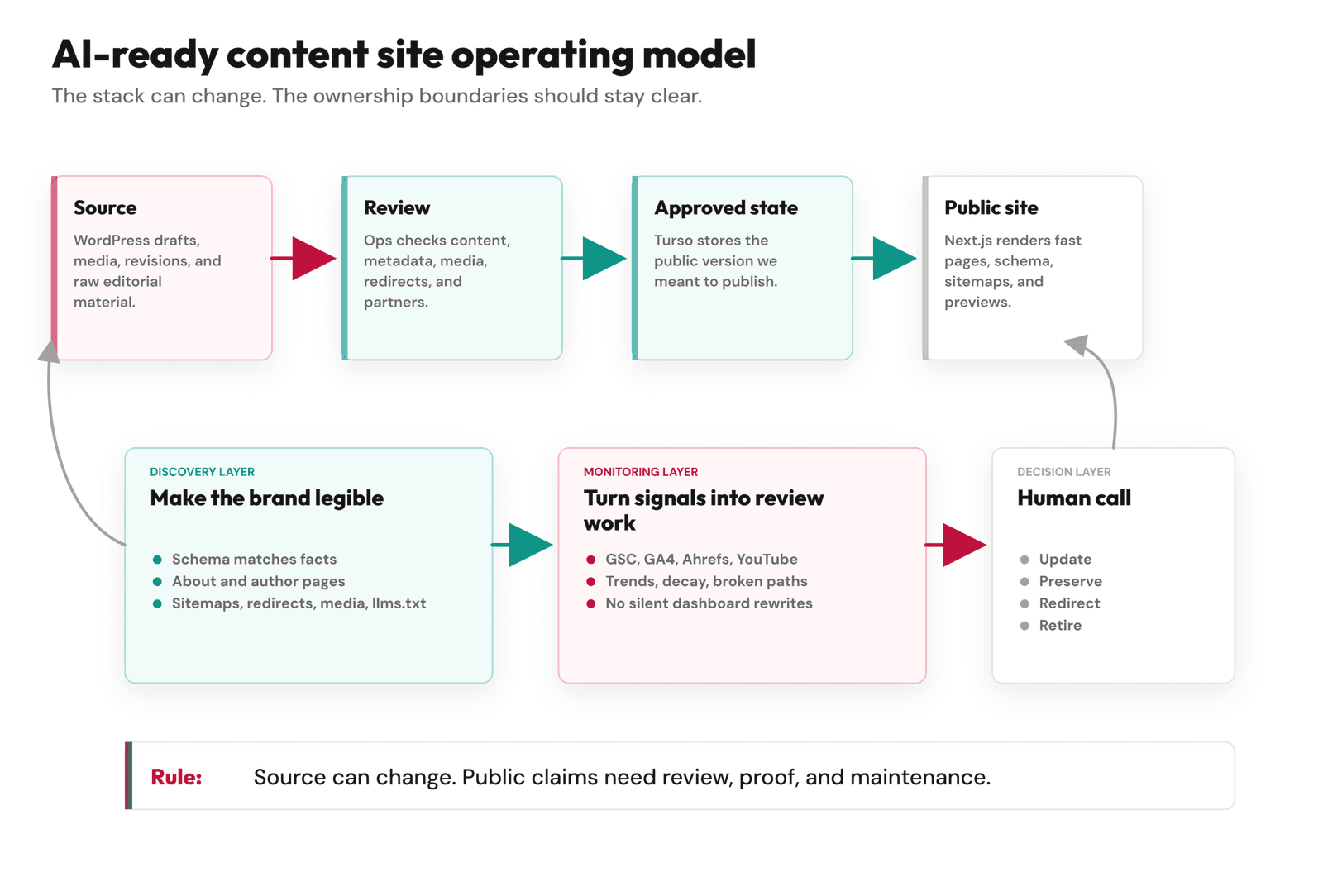
Layer 1: Source
You need a place where people can write without being afraid of breaking the public site.
For us, that is still WordPress. We did not leave WordPress because it was useless. We moved away from asking WordPress to do every job. WordPress is still a strong writing environment. Fei can draft there. We can keep revisions. Media can live there as source material. Editors can work inside an interface they already know.
But WordPress is no longer the final public truth. That distinction changed everything.
Layer 2: Review
This is where Feisworld Ops became necessary.
Ops is not there because dashboards are fun to build. Ops is there because a source change is not always a public decision.
A post edit might need a metadata check. A removed source might need a redirect. A stale image might need to be cached. A new affiliate link might need approval. A YouTube video might need to be connected to the right article. A piece of schema might need to be removed because the old claim is no longer visible on the page.
Before this migration, many of those decisions were scattered across WordPress plugins, spreadsheets, manual memory, and good intentions. Ops pulled them into one review surface.
Layer 3: Approved State
Once a change is approved, the public site needs stable data.
For us, that is where Turso became useful. We could have pulled fresh data from WordPress through GraphQL every time, but that would have kept the public site too dependent on WordPress availability, plugin behavior, and source-state changes.
Instead, we use approved snapshots. That gives us a cleaner public boundary. WordPress can change. Ops can review. Turso can hold the approved version. The public site can render what we meant to publish. This is not the only way to do it, but for a long-running archive, it felt right.
Layer 4: Public Rendering
The public site is where all the private decisions become a reader experience.
We use Next.js on Vercel because it gave us a strong path for performance, image optimization, routing, structured data, previews, deployments, and future iteration. Vercel’s resource on headless WordPress with Next.js and Vercel maps closely to what we needed: keep WordPress where it is strong, and move the public layer into a faster, more secure frontend.
The public rendering layer should be fast, stable, accessible, easy to preview, easy to deploy, and faithful to the approved content. If another stack can do that for your team, the principle still holds.
Layer 5: Discovery
This is where SEO, AI search optimization, and brand visibility start to overlap.
The discovery layer includes the obvious SEO pieces, titles, descriptions, sitemaps, redirects, author pages, organization pages, topic hubs, and internal links. It also includes the pieces that became more important for us during this migration: schema that matches visible content, image and video context, a clear llms.txt file, and useful about and work-with-us pages.
For Feisworld, this connects directly to our about page, Feisworld Media, Fei’s author page, Work With Us, the podcast archive, YouTube, and the public story of what we actually do.
It also helped connect the proof that was already public: Fei’s interviews, long-running podcast, YouTube tutorials, courses, partner work, and creator education. The migration did not invent that work. It made the work easier to read as one body of evidence.
That last part matters. If a brand page says you do everything for everyone, it is not useful to a reader. It is also not useful to an AI system trying to understand what you are known for.
Layer 6: Monitoring
A site is not finished when it launches. That sentence is obvious and still easy to ignore.
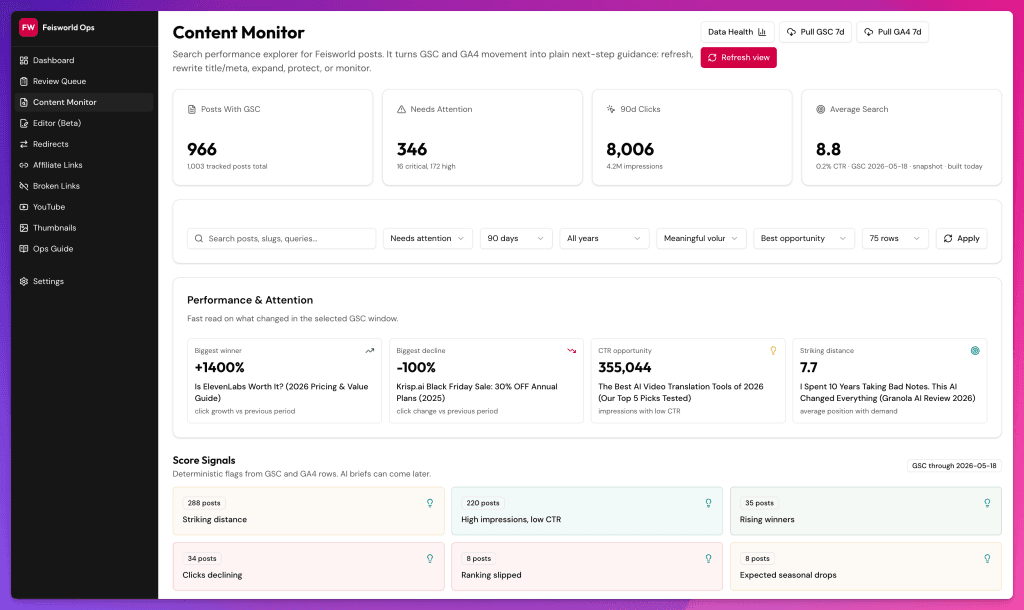
Our monitoring layer looks at Google Search Console, GA4, Ahrefs, YouTube, podcast content, broken links, redirects, affiliate status, image behavior, and editorial context. It helps us see which posts are losing search visibility, which older articles are still bringing readers, which videos should be connected to related blog posts, which affiliate links are stale, and which evergreen pages need a cleaner summary, updated screenshot, or better internal link.
This is where Article 6 matters. Ahrefs published a 75,000-brand study showing strong correlations between AI brand visibility and signals like YouTube mentions, web mentions, and other brand visibility signals, while also being clear that correlation is not causation.
That finding made sense to us because Feisworld is not only a blog. It is a podcast, YouTube channel, course business, creator brand, and media company. If our systems treat those as separate islands, we lose part of the story. AI search makes that problem more visible.
Layer 7: Human Judgment
This is the layer I trust the most.
Tools can pull signals. Search data can show patterns. Ops can surface warnings. AI can hand us possible fixes. But somebody still has to decide what Feisworld should say.
That is not sentimental. It is operational.
A stale post can be updated, merged, redirected, or left alone. A recommended tool can be kept, retired, or rewritten with a caveat. A source page can stay public because it is part of the archive, even if it is not perfect. A keyword opportunity can be rejected because it would pull the brand away from its real work.
AI can help make those decisions more informed. It cannot make them for us.
The Migration Checklist I Wish We Had at the Beginning
If I had to turn this into a practical website migration checklist, this is the version I would use now.
I would have printed this and kept it next to the keyboard, honestly. Not because it would have solved every problem, but because it would have reminded me which question we were answering when the work got noisy.
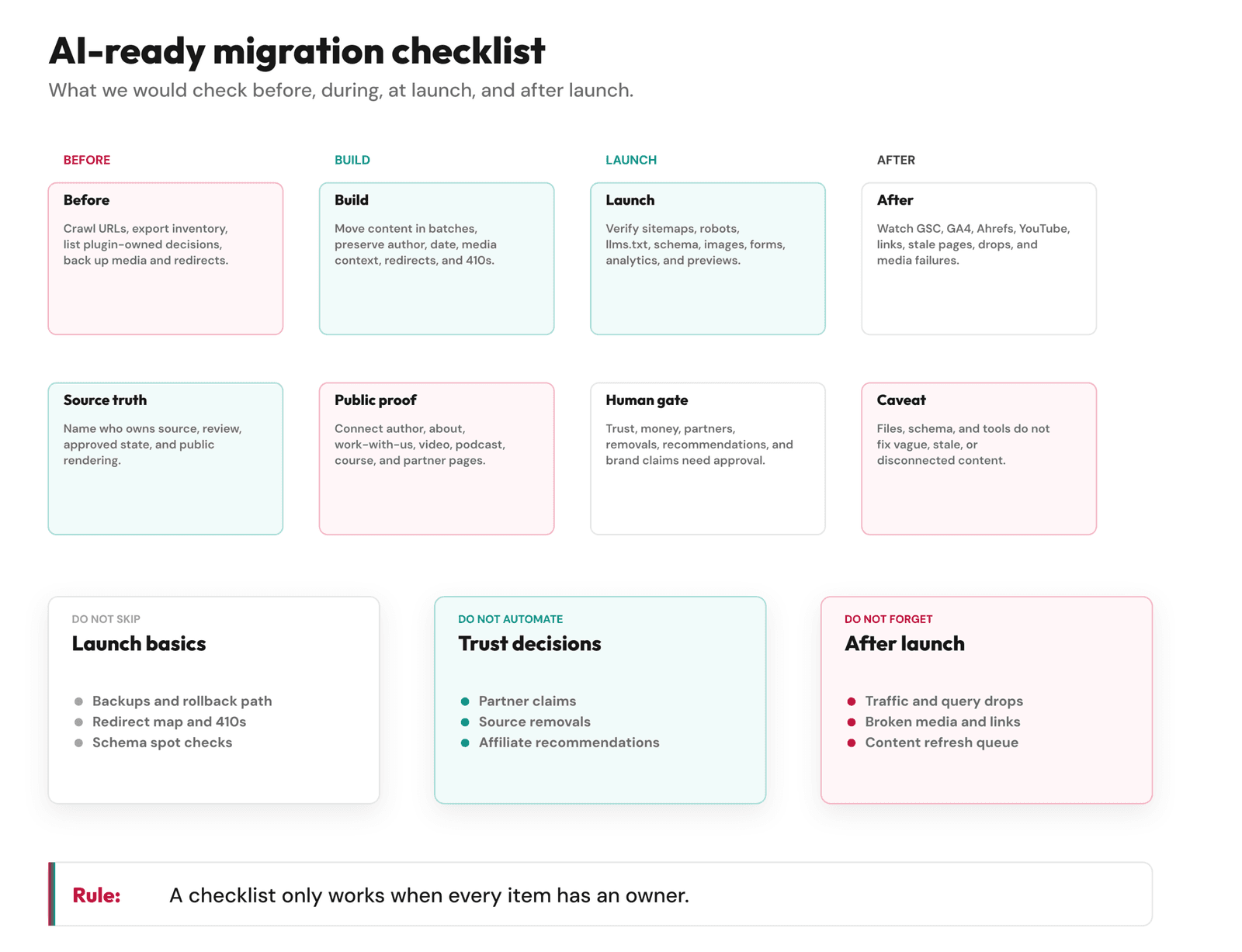
Here is the checklist I would actually use:
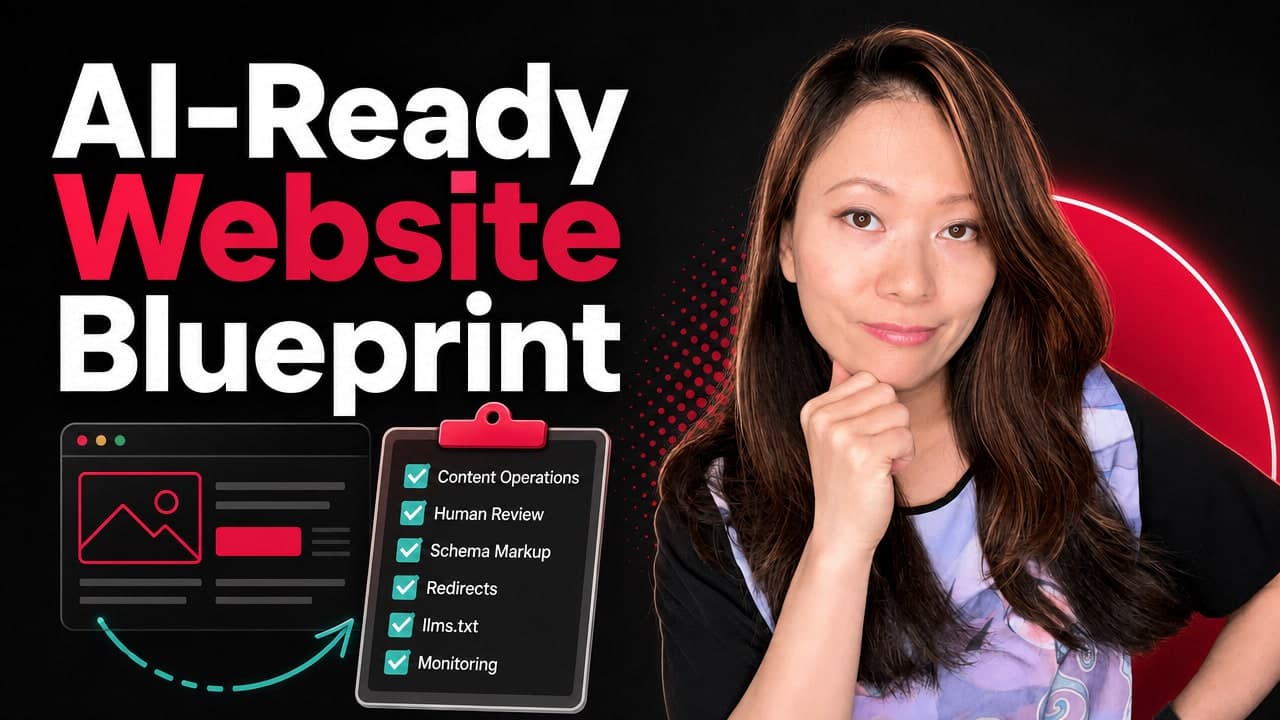
- Before migration: crawl the old URLs, export the content inventory, list plugin-owned decisions, define source/review/approved/public owners, and back up media and redirects.
- During the build: move content in small batches, preserve author/date/media context, map redirects and 410s, verify schema against visible facts, and keep notes on private workflow assumptions.
- Before launch: test critical URLs, sitemaps, robots.txt,
llms.txt, schema, image behavior, affiliate redirects, forms, analytics, and Vercel previews. - After launch: watch GSC, GA4, Ahrefs, YouTube, broken links, traffic drops, stale pages, media failures, and search behavior that needs editorial review.
- Human gate: anything involving trust, money, partners, source removals, recommendations, or brand claims needs approval, not autopilot.
The mistake I would watch for is simple: optimizing the visible launch while leaving ownership vague. Every layer needs a person, a reason, and a failure mode. Otherwise the new site starts clean and slowly becomes confusing again.
Where llms.txt Fits
We added llms.txt because it gives us a clean, machine-readable map of Feisworld.
I like it for that reason. I do not like pretending it is magic.
The llms.txt idea is simple: place a Markdown file at /llms.txt that points language models and agents toward important site content.
But it is not the same as robots.txt. It is not a W3C or IETF standard. It is not a confirmed ranking factor. No serious team should treat it as a replacement for useful public pages, clean internal links, strong about pages, structured data, or content people actually want to cite.
I would add it. I would not sell it as proof that AI tools will now find and describe the site correctly.
For Feisworld, llms.txt is an editorial map. It says, “If you are trying to understand this site, these are the places that matter.” That is useful. It also keeps us honest. If the file points to our best pages, then those pages need to be good enough to represent us.
How We Think About GEO, AEO, and AI Search Without Acronym Soup
There are many new terms in this space: generative engine optimization, answer engine optimization, AI search optimization, agentic search optimization, AI visibility.
Some of them are useful. Some of them sound like people are trying to sell a new dashboard before the old dashboard invoice clears.
I do not mind the terms as long as they point back to real work.
For us, the real work is:
- Make the brand easier to understand.
- Keep important content current.
- Connect related work across blog, podcast, YouTube, courses, and partnerships.
- Use structured data carefully.
- Make sure public pages match the claims we want machines to repeat.
- Monitor whether the brand is visible in the places people now ask questions.
The Adobe and Semrush story is a good signal here. Adobe completed its acquisition of Semrush on April 28, 2026, and framed the move around brand visibility as AI interfaces and agents become a primary way people discover, evaluate, and engage brands.
But I do not want Feisworld to chase acronyms for their own sake.
The best version of AI search optimization still starts with the same uncomfortable question:
Would a real person understand who we are and why this content matters?
If the answer is no, the AI layer will not save us.
Why Site Creation Getting Cheaper Makes This More Important
There is another reason this blueprint matters now. Making and launching a website is getting cheaper, faster, and more democratic.
I like that. A lot.
We have already seen this with v0, Lovable, Replit, Wix, Squarespace, and other AI website builders. In our Best AI Website Builders in 2026 guide, we compared tools based on what a real creator or small business might need. In our Squarespace Blueprint AI Builder review, we looked at how AI can help someone get a polished starting point without becoming technical first. In our v0 story, I Created One of the Most Modern Content Sites with v0, we showed how design and frontend work can move much faster when a human is directing the taste and the tool helps with scaffolding.
Then OpenAI announced Codex Sites on June 2, 2026, in preview for Business and Enterprise customers. OpenAI’s announcement says Codex can create and share interactive, hosted websites and apps.
I think this is a big deal. Very soon, a creator with a good idea will be able to create and launch a reasonable site without knowing much about hosting, build pipelines, deployment settings, or frontend implementation. That reduces friction for artists, educators, consultants, podcasters, coaches, filmmakers, and one-person businesses.
I am excited about that. But it also means the site itself becomes less of a differentiator.
If many people can launch a nice site quickly, the harder question becomes: what is true behind it?
Behind every quickly launched site, the slower proof still matters: a body of work, a point of view, public evidence, good writing, and a system for keeping content current. You still need to know which old pages should stay, which should change, which should go away, and how your YouTube, podcast, blog, course, and partner work support each other.
That is where Feisworld’s migration becomes more than a tech project. It becomes part of our larger brand work, including the ideas we are updating in How to Build a Brand in 2026.
The future is not only that more people can build websites. The future is that more people will need to prove what their websites mean.
The Small-Team Version
Most teams do not need what we built. I want to say that clearly because it is easy to read a migration story and think the lesson is “build everything.” That is not the lesson.
If you are a solo creator with a simple website, a clean CMS or website builder, a clear about page, a strong work-with-me page, a few cornerstone articles, basic schema, a redirect plan, and Google Search Console may be enough. That is not a compromise. That is a sane starting point.
If you are a content-heavy brand, your needs may grow. You may need a content inventory, stronger author and organization pages, a system for stale content, and a way to connect blog, video, podcast, newsletter, partner, and course work. If you are an archive-heavy media site, you may need approved snapshots, custom monitoring, image resilience, schema governance, content decay reporting, and human approval queues.
The right blueprint depends on the risk. Do not copy our complexity unless your problem has earned it.
What We Would Do Differently Next Time
We got a lot right, but I would still change a few things.
First, I would define the source-of-truth boundaries earlier. We eventually got clear that WordPress was the creative source, Ops was the review surface, Turso was the approved state, and Next.js was the public renderer. I would write that on day one.
Second, I would create the content inventory earlier. We knew the archive was large, but every pass revealed another hidden category of legacy weirdness: old blocks, old image wrappers, partner pages, podcast embeds, dead tools, thin pages, old SEO metadata, plugin residue, and internal links that no longer reflected how Feisworld works.
Third, I would make diagrams earlier. Not fancy diagrams. Practical ones. Who owns what? What happens after a WordPress edit? What happens after a source removal? What happens after a YouTube video updates? What happens when an image fails? We built the diagrams after many decisions were already made. I would use them sooner.
Fourth, I would set stricter language rules for AI earlier. AI can make technical explanations smoother, but it can also make every sentence sound like it came from the same committee. We learned to ask for simpler language, more specific scenes, fewer generic claims, and more honest caveats.
Fifth, I would build the publishing checklist into Ops even earlier. A migration is full of moments where a technically correct change is not editorially ready. Having that visible is calming.
These are not regrets. They are the notes I would hand myself before doing it again.
The Main Caveat
Do not confuse AI readiness with adding files, schema, or buzzwords.
A site can have llms.txt, structured data, sitemaps, perfect Core Web Vitals, and clean redirects, and still be hard to understand if the content is vague, stale, disconnected, or written for nobody.
That is the uncomfortable part. Technical cleanup exposes the editorial truth. It does not replace it.
If a brand has not decided what it does, who it serves, what it is known for, and which parts of its archive still matter, AI search will not politely hide that confusion. It may reveal it faster.
That is why this project belonged to both technology and editorial direction.
Feisworld needed a better website. But more than that, it needed a clearer public system for the work Fei has been building for years.
Why This Matters for Brands That Want to Work With Us
This series is not only about our site. It is also a way of showing how we think.
When we work with brands, creators, and platforms, we are not interested in surface polish alone. We look for the same things we had to solve here: a story that holds, content that matches the audience, workflows creators can actually use, verifiable public claims, and AI that helps people move faster without making the work less human.
That is why Work With Us matters as part of the blueprint. It is not only a services page. It is a statement of how Feisworld Media works: storytelling, education, creator-led strategy, brand partnerships, courses, video, podcasting, and practical systems that make the work easier to sustain.
The new site should make that obvious without forcing people to dig through 15 years of history. That was the real migration.
FAQ
What is an AI-ready website?
An AI-ready website is a site that is easy for humans, search engines, and AI systems to understand. For a migration, that means more than crawlable content and schema. It means old URLs have a plan, source changes have review, public claims match visible content, and someone owns the work after launch.
Do I need llms.txt for AI search optimization?
No single file makes a site rank or appear in AI answers. We use llms.txt as a helpful editorial map, not as a magic switch. Your visible content, internal links, author pages, schema, and public brand clarity matter much more.
Is generative engine optimization different from SEO?
It overlaps with SEO. AI search and answer engines still need clear, useful, crawlable content and strong brand signals. The difference is that people may discover your brand through summaries, AI answers, citations, video context, and conversational tools, not only through a traditional blue link.
Should every WordPress site go headless?
No. A simple WordPress site can work very well with good plugins, clean content, and a clear maintenance habit. Headless WordPress made sense for Feisworld because we had a large archive, custom workflows, performance goals, AI/search visibility goals, and a need for human-approved public snapshots.
What is the biggest mistake in a website migration?
The biggest mistake is treating the migration as a design or hosting task only. For a content-heavy brand, migration is also an editorial, SEO, operational, and trust project. If you do not decide what should stay, change, redirect, or disappear, the new site may carry old confusion into a prettier wrapper.
Can AI tools build a website for me now?
Yes, AI tools can help create and launch websites much faster than before. Tools like v0, Codex Sites, Lovable, Replit, Squarespace, Wix, and others are lowering the barrier. But launching a site is not the same as building a brand system. You still need taste, judgment, content, maintenance, and a reason for the site to exist.
You might also enjoy…
- AI Brand Visibility and the Website Migration We Had to Do
- Headless WordPress with Next.js: Our Human-Approved Publishing System
- SEO Content Audit With AI: How We Cleaned 15+ Years of Old Blog Posts
- AI-Assisted Web Development: When to Build Custom Tools vs Use Plugins
- YouTube and Podcast SEO Workflow: How We Connected Video, Blog, and Search Data
- Best AI Website Builders in 2026
- Codex Sites and the Democratization of Website Building
- How to Build a Brand in 2026
- Work With Feisworld Media
Topics

Written by
Germán CeballosGermán Ceballos has worked with Feisworld Media since 2016 and serves as Editorial Director. He co-created and edited the documentary Feisworld: Live Your Art, has overseen the editorial direction of the podcast across 300+ episodes, and shapes Feisworld's coverage of AI tools, creator workflows, video production, and content strategy.
View all posts by Germán Ceballos→Stay updated
Weekly insights on content, AI, and digital media.
Keep Reading