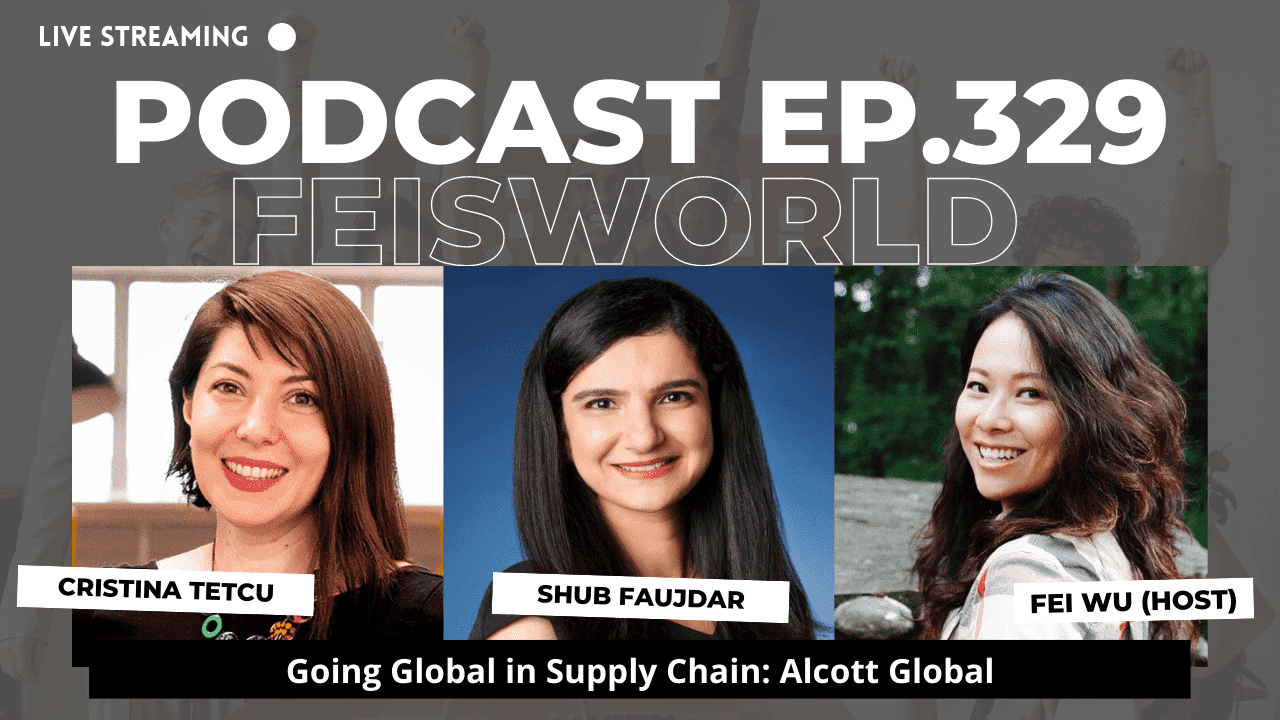
Today I’m joined by Cristina Tetcu, Head of Marketing & Partnerships, and Shub Faujdar, Head of Training and Development at Alcott Global. Alcott Global’s mission is to connect & upgrades Supply Chain ecosystem by finding the right talent through executive search, developing talent through learning solutions. They have several leading #podcasts in supply chain and a thriving community. With all the changes that are happening in the world especially in supply chain, Alcott has adapted and grown tremendously. They are makers, movers and content creators.
Watch Our Interview
Transcript
Transcript
Fei Wu: Go . All right. Hi everyone. This is Fei of Feisworld Media. It is like 8:30 PM my time. This is probably the latest I've ever gone live, but I have two such lovely ladies with me here. I'm so thrilled. We have Christina and SH from Elcot Global. Hello. And uh, I'm just so thrilled to be here with you and, um, you know, again, just a very, very brief intro. We're gonna jump right in. Christina is the head of Marketing and Partnerships, uh, at Alka Global. And Shoe is head of training and development and I feel like you both wear so many hats and, uh, I've done such interesting work with you since April this year. And to be honest, As a result, I've learned so much about supply chain. I've always been interested and now because of you working with you, knowing Alco, I'm just now even more eager to explore more. So welcome, welcome to the show. So Faye,
Shub Faujdar: I will just say one very quick thing. Since the time we spoke last, we've already rebranded what I take care of. It's now, uh,
Fei Wu: I'm.
Shub Faujdar: Learning solutions because we have, we just move very fast. I'm sorry. We forgot to, uh, update you about
Fei Wu: that. Oh, absolutely. Shoot. Say that one more time. I think you, uh, froze for a second. You said the rebrand was for
Shub Faujdar: Think Solutions. So we rebranded training and developed as learning solutions because it'll be covering more, the more than just training our workshops.
Fei Wu: Awesome. So I think, you know, this conversation by the way, is for a lot of people thinking, well, I understand supply chain sort of, but also, you know, a lot of people don't fully understand and what it entails, the opportunities that exist. So thank you for leading the way. I'm just gonna hop right in and kind of. Ask first is, you know, what we're here for is introducing Alco to the global audience. So for more people to understand what supply chain is, the opportunities are. So who wants to jump in first? So who wanna maybe explain a bit about Alcott? Um,
Cristina Tetcu: I can go, I can go please. Christina . Um, So Alco Global is a few years old company in offering services in the supply chain space. Uh, we have clients in major regions like from, uh, north America, Latin America, Europe, um, middle East and Africa, and of course Asia Pacific, where we are based. That's why this call is so late for North America. Um, And, um, our mission is actually to connect and upgrade the supply chain ecosystem. Uh, we do that through, uh, finding the right talent. Um, via executive search. We, um, have learning solutions that, uh, sh has mentioned just now, uh, for developing skills in the supply chain. Um, and then, uh, we, we have recently launched a better version of a marketplace for the supply for supply chain technology. So in the nutshell, this is what Alcott
Fei Wu: Global does. Mm wow. I'm learning new things already. Go ahead, too, . So I was
Shub Faujdar: just going to say that, uh, Christina is being very humble here, but, uh, one of the, one of the things which differentiates Alcott Global from other organizations, which started out as executive search, is the fact that we are also providing, uh, quality content on the industry to our. To our audience, to our clients, to our candidates, to anybody who's interested in supply chain as well. And Christina leads that. So I think that's why she was being a bit humble to share about it. So that would include, you know, doing podcasts, creating infographics, uh, creating content. We've done events, virtual conferences and summits, which had 10,000, 12,000 people during the pandemic, bringing them all together to understand how we as supply chain can come. To the varying issues which the pandemic brought, uh, and highlighted about, uh, different organizations and how critical supply chain is to the success of any organization.
Fei Wu: Mm. I have to say as a podcaster, I am impressed and also a little jealous because I started my show in 2014 and you guys started kind of in the midst of the pandemic. So to break that down a little bit mm-hmm. , uh, may I ask, whose idea was it to start a podcast and how did you idea to create the show? Um, a few years ago.
Cristina Tetcu: So, so actually Alco Global, um, started in 2017, but mostly focusing on executive search. All the other services were added to the portfolio later. Um, but quite soon after Alco Global started a podcast channel already took off. It was actually, it started a bit earlier, but then, um, it took off, uh, with high speed , um, after that mm-hmm. . So, um, Uh, that is our oldest podcast channel, the leaders in supply chain podcast. And, um, through the nature of the job that executive search, uh, consultants do, right? They have to always be on top of what's happening in the industry. So they speak to so many people. I think in a weekly basis, they speak to, I don't know whether they reach a hundred, but. Uh, few tens of, um, of, um, industry professionals right at high level understanding what's happening. And through the podcast, actually the intention was, okay, let's give an insight to, to the community as well, into what's relevant. What are people dealing in the supply chain, um, real time. Mm.
Fei Wu: Wow. You know, again, like you said, it just, it took off, uh, right around, I think in 2020. Even though you had the show running, you put in a lot of work, but all of a sudden did you see like tremendous amount of viewership comments on like, when did you realize, wow, this, you know, this is really taking off. Um,
Cristina Tetcu: I think it was before, because the audience, right? The audience would come back and say, wow, I listened to that podcast. It's amazing. You know, the authenticity and how people share, um, case studies and things that are relevant is very useful. So, um, for, for that particular channel, that, how it started, but, uh, what really happened in 2020 is a very positive turning point where, For us pandemic played an important role in, um, in, in going into the events world. It's basically expanding the podcast. , but having, instead of having a weekly, um, guests or monthly guests, we suddenly had between 50 speakers, or 70 speakers in one forum. But the spirit was the same, right? The same kind of tone, the same kind of sharing, um, people discussing real matters. And, uh, for the audience, many times people would, would send us, it's almost like we take the front seat. We can see what's happening and what these people are dealing with and, um, what's what comes next, right? As a supply chain professional or somebody who wants to, um, grow in their career, this is very relevant information because then they will know, oh, but I would like to do this. Look, that's an interesting problem people are solving. Yeah, so interesting. I think that's,
Shub Faujdar: that's the key here. What, uh, Christina mentioned it's real people, it's their authentic stories, things which were, which they're dealing with because you know, you have a lot of. Leadership forums or leadership podcasts of how you should be doing it. Mm-hmm. and what you should do versus what people end up doing can be very different. So the whole spirit of the podcast and events is about share where you are right now, what are the challenges, how are you facing it? What led you to do it. So it's uncovering people's stories. Um, and learning from them because then it's much more relatable to the audience and they're like, oh, this person is going through, I'm going through something similar as well, so if they can solve it, I can solve it too, rather than a theoretical concept. You throw at people and talk about that.
Fei Wu: Absolutely. And, um, just as a reminder for people who are watching on some LinkedIn, we can't really see you as a person, counselor. If you have any questions and comments, we absolutely welcome that. I know it's a little late for people in North America, so we do monitor the comments and if you wanna drop in later on. So I just wanna take a moment and, and thank everybody for being here. And sh I know that you've been sort of the forefront, the face, you know, one of the faces, uh, at a media. For Alcott. So I've seen you interviewing a number of guests and I really like your style both, uh, via audio on the podcast, as well as, um, you know, in front of, uh, there's a YouTube channel as well for Alcott Global. I recommend people to definitely check it out, and I'm sure you're very, uh, both of, you're very active in the event, uh, section or sector as well. So could you maybe talk about that, like yourself as a creator, were you surprised by it and, and do you find it exciting? .
Shub Faujdar: I definitely find it very exciting. Uh, I think speaking to people who, so I, what, what I take care of for the podcast channel is to come from the perspective of talent. So it doesn't have to be people from hr. Uh, it could be people, uh, who are from hr. It could be people, leaders, people who are focused on supply chain talent and how to bring it and bringing their stories. So I think my job is very easy because I ha I, I just need to ask them about what's going through with them. The power of the people who come on the podcast, which makes the podcast very interesting. And that's the whole idea behind all our podcasts, I think bringing their stories. Um, and I, I love to do all these, uh, kind of things. So, um, I, I'm a trainer by background, uh, so I'm, I'm very comfortable being in the, uh, on the stage, having conversations with people. Connecting with people. Um, Came easily. It wasn't like, oh, I don't know whether I should be doing a podcast, but what, what, uh, the Alcott Global Channel provided was a, was really a platform to bring together those people and share those stories. And that's what we are very conscious about. When we are reaching out to people and we have the prep call, um, my role is to help them find what are some area. And niche areas, which they can talk about. Because if every podcast guest talks about the same exact things, very soon, the relevance is lost. So finding that particular superpower of this person related to talent, um, makes it a bit unique with every guest. Hmm.
Fei Wu: How do you do that? How do you both find that niche? Again, your, your content creators to me, you know, not just podcast hosts. You actually design, develop the content. There are numerous blog posts. Very useful, very informative. Um, blog content on alco global.com. Also infographics also reports that I've downloaded, and frankly, I'm really surprised because it just shows. How much hard and soul and hard work that actually you put in there. It's very extensive and it's unlike anything else. You know, as I was searching for supply chain related information, it's really not presented in such a humane and very connective way. So I wonder how do you guys find your niche and say, I know this is my audience and I'm putting together content that will resonate with them. Well, what was that process like? ,
Cristina Tetcu: I think. I think it just comes. from the people the consultants work with, right. Uh, in the executive search, I think because they are interacting so much with the industry, right? Um, and then from the feedback we get after the podcast or after our events, right? Even our events. The content that is discussed there, it's meant to bring, to shed some light right on, on, on things that seem so theoretical or they just appear in the news. But you know, you can't, uh, shadow somebody at the senior level to know what they are actually doing, right? How they are actually handling, um, that situation. So supply. Is, is an ever evolving space. Um, there's a lot of transformation. It's a complex global problem, right? It's in the news many times just because sometimes disruptions affect like the, the common person, right? When you can't find things in the supermarket, right? Um, on the shelves. And we have all experienced that in the pandemic. Um, There are, there are things that like rates increased, uh, inflation, um, demand fluctuation, and all of these are problems. Um, and of course sustainability. Let's not forget this one, which is super important, right? So, um, all, all of these, uh, projects, right, that supply chain professionals take on and uh, the leaders are leading, um, are quite interesting. It's super informative. It's a learning journey. That's why every time, uh, we fi we finished a virtual, uh, event. We left the content there for a few weeks so that people can watch it on demand. Like you can watch your Netflix at home with DC Right? Because there are some conversation that they might want to go back to. Oh, but let me see. What did, did this person say? It sounded like he was saving costs somewhere, right? Or he was avoiding some cost. I have the same problem. I, I want to, um, go back to that information. So the blog posts come like that, right? And the infographics the same. They are just, Uh, basically our way of sharing this knowledge, right? That comes in high volume mm-hmm. . And, um, we do our best to capture as many, uh, interesting stories and, um, relevant, um, relevant topics for our audience.
Shub Faujdar: Mm-hmm. . And I think, um, for me, especially for content for the Academy, because that's content is a, at a very large scale, and I have this question asked by one of the journalists, how did you go about, oh, did you just tell people This is the content. I'm here. Can you guys hear me? Uh,
Fei Wu: yes, yes. Yeah. Repeat that. Uh, one more time. Yeah. Okay. Alright.
Shub Faujdar: So, uh, what I was saying is for us it wasn't prescriptive when we started creating content for the academy and you were part of the process phase. So yes, of course we had buckets, we had pillars we wanted to cover, whether it's for the hard skills or it's for the, uh, business. That we wanted to hit that nail, but I don't think I ever went to one of the experts and said, these are the topics. Can you cover any of them? So a lot of it was about going to people and saying that. What are some of the areas where you feel you have a lot of content to share? You have a lot of knowledge. You will bring relevance related to the contemporary topics, and then we would have brainstorming session. It would be sometimes multiple sessions where we would talk about what are the different areas they can cover, how we can bring relevance to it. So that was with the experts. And the other part is the market, which Christina touched on if we have consultants and executive search partners who are talking to people. I'm always talking to people whether they are in l and d or uh, chief supply chain officers or VPs of supply chain of what is it that them, and from there, uh, we see what makes the most sense to them. It doesn't. Plus we are also doing life sessions with organizations. So depending on, you know, what kind of sessions get the most traction, it, it gives us a bit of a guidance. So I would say it's a bit of trial and error, a bit, bit of brainstorming, a bit of understanding the needs of the market. And then when it all comes together, it start making a lot of
Fei Wu: sense. Mm. I love it. And I was just sharing very briefly, um, projecting the Alcohol Global Supply Chain Academy, which is a Netflix style type of academy. It's so exciting because it really touches and addresses to. You know, not just the senior executives and directors and and above, but you could be a newcomer, you could be intermediate level, you could be people who are considering a career path there. You could be a company who want your, uh, workers to level up and really learn the holistic, uh, side of supply chain. I am so excited about this. I'm on. Other things I've, you know, there's a book coming out. There are additional, uh, you know, awards, ceremonies and sessions. So could one of you, maybe, well both of you please speak to the Academy? How does that follow, you know, sort of, I feel like the mission of Alcon's behind it, you know, why, why were you excited to really pour so much time and energy and resources into building this platform?
Cristina Tetcu: Do you wanna go first, ?
Shub Faujdar: Yes, absolutely. So, uh, we started learning solutions last year, beginning of last year. And it was designed, you know, to have life workshops curated for the organizations, very much customized to them. And then, you know, again, the need of the market. We are talking to people and they're like, you know, The topics are great, but we've realized with, with the pandemic, and actually the pandemic brought supply chain as a very mission critical function. Before the pandemic, it used to be a backend function. Now people started realizing it's the backbone of any organization, which it used to be before, but it didn't have that kind of visibility. And suddenly people from other departments have started becoming part of supply. They change themselves, have become so complex and for a lot the issue was, you know what? Our people sometimes don't even understand the basics, what they learned 20 years, no longer relevant. So can we have sort a platform the topics where they feel they might be missing out on different things.
Fei Wu: And then, um, you
Shub Faujdar: know, bridge that gap, uh, learn in their own time while we continue investing in the LED workshops and learning fiestas and business talks and curated capability conversations. So the platform driver to look at, it's, it's catering to that need of bridging that. Knowledge gap on different subtopics. Um, and then moving to having very customized knowledge. And then we are launching some exciting things next
Fei Wu: year. I look forward to Christina. Do, do you have anything to add?
Cristina Tetcu: So what I would say it's, um, the academy, it's somehow an evolution from the virtual events as well, because, um, that's when the impactful learning, right? We got that feedback that people are learning those things. So we wanted to go at it. More fo focused right on, on this. But the, the idea behind is this has to be taught by experts in the industry, right? Who are dealing with that, who are solving these problems, right? That's what makes it so special. Um, it's not like the textbook that, where you have all, all these, um, information that has not been upgraded, right? Because it's very hard to catch up at the speed supply chains change, so, Actual professional experts who are dealing with, um, they are created by, by these professional experts who are dealing with, um, these matters of supply chain. Um, of course, um, the, the event basically had few hours, right? Or the sessions would be very long. Um, honestly, uh, academy comes in short bites, impactful bites. That's, that's, uh, something. It's very, very easy to learn. So you go, you, you go through the modules and then, you know, every time you learn something in a few minutes, it's not so much introduction and so much theory. It's really, um, something that you can go and run with it and maybe use it as a, cuz it's based on case studies and on real situations.
Fei Wu: Yeah, I really love the content and the people that you have spend so much time, I would say to recruit and, and to, to really encourage them to work on the project because I think most people don't realize that it takes a lot of time and effort to work with these collaborators and, and edit these videos. Put on, you know, subtitles and in particular, I love the fact that they are not only bite sized, but it's very holistic approach to supply chain, to really any career including storytelling, digital transformation, you know, business acumen, functional. Uh, skills and, and, you know, technologies that people need to focus on. So it's just, it's really interesting and I know that you're thinking about adding even more courses, uh, maybe early next year and that is something that we can all really look forward to. So anybody who's watching right now, I know there are a few of you floating, feel free to send us any questions here. And I'm gonna just. Pivot a little bit into the fact that, um, there are people who are approaching me to say, well, that's really interesting that there are a lot of career opportunities now in supply chain. And which is sort of, you know, initially, or still today is the bread and butter of, you know, who Elcot Global is. So could you maybe talk about the importance of supply chain as a career and why is it a good idea to develop a career in supply chain in general?
Cristina Tetcu: Should I, should I get this one?
Fei Wu: Yeah. You with Christina ? So,
Cristina Tetcu: go ahead. Maybe, maybe. Supply chain is such an abstract con, um, concept, right? Mm-hmm. , um, most people are familiar with, um, Manufacturing with logistics, right? That are maybe they have a longer history, right? Um, I would quote Rado, Rado p our managing director in his book, um, in his first, the first pages of the book, he says, so what is supply chain, right? So he says, like this, every company that makes products has these pillars plan. Make deliver return and what connects them on is the supply chain. Um, so I love this definition because it's quite clear. In the same time, it explains the complexity and the fact that supply chains are large people's organizations, right. Um, we did, Rado did have on the podcast few guests, like the Chief Supply Chain officer of Colgate Palm and, um, the chief Supply chain officer of Lexmark. They have spent half of their careers, so over 20 years, or even their entire careers over 40 years, uh, in the supply chain organization evolving, uh, through different roles because there's so much opportunity. That's one of, one of the things, uh, when considering a career in supply chain. Um, second, there's just a lot of technology in supply chain nowadays. There are digital transformations happening at a. Very high speed. Um, and a lot of tech people spending time creating these solutions and others implementing them, of course, in the, um, the company sides, the, the product makers. Yeah. Um, I would go on and add, right, for the people who have a mission to contribute to a sustainable world, I mentioned that a bit earlier in, in this conversation. There are so many interesting projects happening in supply chain and they are impactful, right? Because there's so many things that have to, um, be restructured or re yeah, maybe restructured is the right way in from the planning perspective and then the implementation, uh, in the supply chains. Mm-hmm. , um, And then, um, Chu said before that the supply chains are the backbone of an organization. Yeah. Um, they can make or break the business. Right. , there can be a lot of cost involved. There can be a lot of, um, It's a business function nowadays. It takes a business sit. So, um, business skills are welcome in supply chain and people evolve to leadership positions, uh, while developing this type of skills. So, um, I was a project manager actually, um, operations for project management in supply chain before joining Alcott Global. So even , all these, uh, function. Maybe are more popular in other industries. They are actually present in, in supply chain. Mm-hmm. .
Fei Wu: Yeah. I'm learning so much shoe, but were you gonna say something as well,
Shub Faujdar: No. So I, I, I was just going to add, I teams have become so relevant in today's, uh, date, you know, as. They've got a seat at the table, not only in the business but also all our dining tables because we've seen the brunt of it when your supply chains don't, uh, make an impact. And again, we um, I think Rady wrote a fantastic article of Why Cos and Csco, so the chief supply chain officers and chief operating officers are now at a very good position to. The CEOs because they understand the business. So I think anybody who's looking at making an impact in the business world, supply chain is a fantastic area to look at it. Um, I think we all who are in supply chain space and we are interacting with people in supply vouch, we love the people in supply chain. These are very humble people who are looking at making a massive difference in the world, in the organizations and the way they. It's a very, very different way of being. I've been an executive recruiter before and I've worked in the finance space before, and I can tell you that I absolutely love the people in supply chain. So it's a very good, very impactful people who makes on a daily basis.
Fei Wu: Hmm. That's so good to hear. And, uh, you know, again, I wanna point people to, uh, directors and up, you know, there's some senior level jobs that are available at jobs@alconglobal.com, so definitely worth checking it out. And I've also included links if you're thinking about checking all the podcasts, job search, the Academy, that's also in the description. So thank you for being here. Um, I know that you both shared something new that I'm looking at. I'm getting very excited. Called, is it called a Supply? Am I saying it correctly? Simplify. Oh, simplify. So could you maybe talk about that and, uh, what it is and what it does?
Cristina Tetcu: It's, it's just a marketplace connecting. It's a platform where all, um, um, technology for supply chain. It's present. So all the companies, um, it's a crunch base as well to, to understand that offers, um, offers companies, sorry, an opportunity to search for the solution they need in their supply chain. As I was mentioning, there's a lot of digital transformation and different companies have different needs, right? In different, um, parts of their or supply chain organization. So, uh, simplify. Has all these solutions listed so far? It's still in better version. So we are still crunching the data. We are still, um, updating, um, to, to the latest, um, to, to the latest developments on the market. And this is gonna be ongoing, uh, because, um, digital transformation and new solutions are coming. Um, like at a very high pace. . Mm-hmm. . Um, it's also a place for, uh, investors to see what is new, um, what, what are the potential, um, what are the potential investments they would want to make in the new, um, startups or even sometimes scale up. Right. Scale up, still receive funding. Mm-hmm. so. Uh, international. This is what simplify does.
Fei Wu: I'm impressed. There's a lot of work that went into this, I can already tell. Um, I also know another area that Al-Qaeda's been focusing on. Um, you know, again, I'm not an expert, so I'm also learning. Here are the, Workshops, you know, custom, we're customized, the program and training even for the academy itself. And I know that, you know, I overheard and learned from you guys that you are also working with, you know, HR leaders, l and d leaders, to develop potential career paths. So there's a customization that you also provide there. So could you maybe talk about the different topics and areas that you're focusing on and, and whoever's watching right now, maybe this is the right program for.
Shub Faujdar: So career customization, uh, from do you mean the comp companies that we are working on?
Fei Wu: Yeah, actually yeah. If we can talk about that on the academy side, that would be great. But I also know that as part of, um, the website, there's also training and workshops outside of the academy if you wanna speak to. Or one of them, that'll be great. Okay.
Shub Faujdar: So, uh, for, for the learning solution side, what we want to give way of looking at their career, uh, within supply chain, uh, in their organizations and beyond. So within the academy, we have the option of doing assessments. Now, these assessments have 25 plus years of data attached to them, where suppose if I'm a buyer or a category, And I want to move to the next role investment and see what are the different skills gap I have, not only in my organization, but also from the industry standard. And then I have a clear path of what I need to learn, what are the skills I need to develop and then go from there. So that's one way of chartering out your career. What we also want to do is to enable agents, certain competencies, which are very critical to. And if you read our, uh, source to solve, which was written by Ra Mario here, the in model, which talks about the five main, like we've bundled main things and can together organizations can use to, you know, And look at the twin solutions they have, as well as do succession planning. Allow their own staff to plan their own careers. That's for the first part, which you touched about the careers. Then you talked about the live workshops, which we do so. So we together, uh, supply chain leaders, so we do have live round tables, uh, close networking sessions, uh, um, for leaders to come together and discuss the contemporary issues. We have one happening next to December where we are getting, uh, some of the leaders. Uh, in a virtual round table to talk about some of the second challenges we are looking at in 2023 and how we as a community can support one another. Um, on top of that, we also do ca four organizations based on where they are right now and where they want to be, uh, in the coming years. And we've done 10 people shops over a course of three months. Uh, But we've also done, uh, you know, uh, twice a month sessions on different supply chain topics, getting, bringing in experts who are dealing with those things for an organization for 14 months now. And we've done a learning FTA for a large three pl. Organization having 10,000 plus people for a course of three weeks, getting to them external perspective of what's happening in the organization and what they can look at, uh, moving forward. So I think it depends where the organization is at and then for us to connect the dots and then bringing together who are experts in that particular field to give. Very holistic learning solutions there because it's no longer just providing training. It is looking at end to end learning for their workforce.
Fei Wu: Mm. . Wow. How exciting is that? Christina is smiling. That's good. You both work so hard. My goodness. And then I can feel like your energy wise, you just, you do love, you know what you're focusing on. I think you can not, you can see, you can feel the impact. And I have to say that I love the fact that it's such a global team as. We are all in. You know, we have been in different time zones. We work with people really all around the world. I have not seen, I've not been on a project. More global than this one. Um, and I, everybody's very happy. You know, I, I've really expressed this, um, previously, probably more than once, but the fact that there's a lot of synergy among team members. People are smiling a lot when we're hopping on calls. And the crazy thing is like, we're smiling and tackling problems even we're facing. Challenges, right? We're coming in together, we're smiling to say, Hey, how do we, how do we, you know, get around to this? Um, so I really appreciate and really enjoy that, that energy. So I,
Shub Faujdar: I'll give you an example.
Fei Wu: Go ahead.
Shub Faujdar: So I, I'll get you an example, which, which I told some friends. We had our team building for the senior people, uh, just beginning of this, uh, mom. We had a session. We were talking about each, the superpowers and also the weaknesses we had and. I have people being so joyful in, in a session usually, you know, the past corporations I worked with, these sessions are very intense and, you know, everybody hates these sessions and the, you know, you feel you're attacked. We were literally laughing and there was a big ruckus about it and, and the whole idea, and I think here the credit goes to, uh, Christina and Rado, uh, for creating a culture where people can be very, And still have fun. And, and that's what you touched based on we had mm-hmm. big challenges during the Launch Academy, but finding solutions, it's never case of, oh, you've done this wrong. That's some which I appreciate. Um, and I think ev appreciates, uh, and that speaks a lot on the culture. So to both Christina Jurado, uh, while he's enjoying his time in the y.
Fei Wu: Oh, that's nice. Christina, you're gonna say something as well?
Cristina Tetcu: Yeah, I was, I was saying because, um, as we had the team building, right, we spent some time reflecting on what happened this year, especially Um, and it, a lot of things happened, right? And, um, uh, we, we were looking at what brings the energy right and what makes us go and. We just take a bite of it. Right. And we don't know. We created out of nothing. We created something and we created many somethings this year. Right? We had the academy, the better launch of simplify, um, Rado and Knuts book. We had leaders in supply chain awards. Right. So, um, it's, it's exactly this, right? The, the creator energy. I was saying that sometimes it feels, I, I, I'm, I'm imagining that that's how an artist feels when, you know, is in front of a camera and starts creating something. Right? There is nothing . Mm-hmm. . There's absolutely nothing. And then at the end, when you look at what the MA masterpiece or the. Brings, um, so much value, energy, beauty, right? It's, it's just there. So, um, not only the outcomes are motivating, but being part of that, uh, create, creating process for me, it's amazing. And I think I, um, this is not only me in our team, everyone enjoys this kind of journey. Sometimes it's hard, but as right, um, bringing a bit of humor, um, but. Like trying to find solutions and making, making things. Workable. Right. And yeah, try to to be the best. .
Fei Wu: I'm a little jealous cuz I've, you know, I've been working with you guys for seven, eight months and I look at LinkedIn, everybody's smiling. You have these team outings are just groups of people eating, sitting together at a restaurant. Then you have the team building events. I just, I was literally thinking the other day, I was like, I have to, you know, get over there and participate. Yeah. Yeah, then you travel and, you know, I, I felt like, man, I thought I worked for really fancy marketing consulting firms. I didn't really get to do this part as much. And, um, shoe is back and I, I love the talk about. The creator energy. And that really is something I, it kind of leads to my next question, which is, you know, what's next for Alco? And I feel like really when we say what's next, we don't mean like next year, five years from now is number one, how do you balance and choose the next project to work on? Because you're always working on something, you're always creating something like from. Planning, leadership, creative perspective, like how do you choose? That's something that sometimes I personally struggle with and I know my audience certainly do as well. ,
Shub Faujdar: we're both laughing right now because, I think we, uh, you know, I, I was having this conversation with somebody from supply chain and they were talking about, you know, the crisis brings about a lot of change and we've realized a lot of organizations, they, they change only crisis, and I was joking with them. We create crisis for ourselves. We think of an idea and we'll give, okay, this is a very good idea. Typically, organization takes six months to two years to launch. Let's launch it in two months and then we'll have this whole crisis for ourselves. But I think it makes it a lot of fun. It it, it allows us to launch things in modular formats like you, you can, it's, it's very difficult to launch a perfect product. And what's perfect to you may not be perfect for the audience you're targeting. So it would rather be that you launch. And if it doesn't work, you can always change gears. Uh, but you do it fast. Um, and it keeps the energy of everyone ongoing, uh, versus, you know, you think and think and think, and it's two years and you're still thinking about a project. So I think that's how most of us operate here at Alcott. Um, yeah. Christina, do you have anything to add? Yeah,
Cristina Tetcu: so the bias towards action, out of charts. That's, that's definitely , not an un understatement . So, um, that's pretty much what, what should said, right? We, um, we work in modular formats, right? We speak to the people in the industry and sometimes there are these needs, right? So, um, we assess what's the minimal viable project that we can go ahead. To have a go at it and to see whether this is what actually will make the, the impact, right? Mm-hmm. , because we work on impact and we work on like, on strategic, right? In our mission, we are strategic, but the next point is it has to be impactful, right? So if it's not impactful, then there has to be a change, , a change implemented, I think a bit of a different route.
Fei Wu: I, I love it when you, when I first, you know, got in touch with you and the moment I remember was in April and you said you have this vision for this online academy, your launch in June. I was thinking, oh my goodness, this is so exciting. Let's do it. Uh, I found it's, So exciting and I love these impossible projects. Peoples like, you should always plan over, plan and wait. Wait for the perfect moment. I don't think the perfect moment ever really exists. Like you said, it's very subjective and oftentimes when you wait, that's when your competitors are actually step in and you know, create something. You know, very similar to yours. Whereas now I feel like we're, you know, leading the charge and presenting something that the industry has not really seen before and then done in a very friendly, very accessible way. And then I, you know, when I remember I was doing some, you know, internal user testing and people who are not as familiar with supply chain, they look at this and say, I can learn from that. I wanna learn how to do be a better storyteller. Oh, my company's struggling with digital transformation. This. Absolutely relevant. So yeah, it's very, it's very, very exciting. Um, so what's next for Alcott in 2023 for people to wanna, you know, stay in touch and, and learn more about you? What's the best way to do that?
Cristina Tetcu: Um, of course you shared some links. I think those, those are the relevant links for, uh, on how to, to get new updates on Alco Global. Mm-hmm. . Um, of course I would suggest following Alco Global on LinkedIn and, um, I've got global consultants as well on LinkedIn and yeah, I've got global employees. Um, sometimes even the posts can be a learning lesson through, through the what is shared, the engagement, what people put in, right, in those comments. Sometimes it's like I bookmark them and I go back. It's also a learning for me, so I, um, that might be quite useful for, um, For people interested supply chain enthusiasts, or just as a curiosity, because supply chain is everywhere, so yeah,
Fei Wu: I think a lot of people find it. Really interesting. Uh, the fact that Elco Global itself, the LinkedIn page has a lot of traffic and you know, you both individually, I know shoot, but last time I checked was like 13,000 followers. Rado himself has something like 250,000 followers. Uh, it's, it's crazy. These are the people I know that I paid attention to, but how are you able to build up such an empire? Because it's really not trivial for people to gain that many followers on LinkedIn or really frankly, anywhere. So what is the trick? There's everybody, I'm sure, ask you about that. I wanna learn how to do it. I will
Shub Faujdar: give you that trick very easily and Christina will will add hers. Just add value. I think the moment you stop focusing on, I need followers and start focusing on, let me add value to the kind of people I want to attract, you start getting followers.
Cristina Tetcu: Mm-hmm. . Mm-hmm. . Um, I'm not as popular on LinkedIn, but I did, um, had, I have a lot of, uh, discussions with Rado about this. Right. Because it's amazing the the amount of followers he has. And, uh, he did say in few interviews as well, right. Another, another thing besides adding value is authenticity. Being yourself, having your own voice and standing by, by the things you believe first in, but also sharing relevant information for the um, and, and having a voice about it, right? Not just. Uh, taking a link and putting it there. Mm-hmm. . So I think tho those are, um, the conversations that get the most engagement. People want to talk about this, and I believe that that played a very important role in him gathering this, this kind of, uh, insane amount of
Fei Wu: followers, . I love it. I mean, this is really, this is really important next step. And, uh, like you said, add value. Be authentic. L you know, I think Elcot is kind of this content machine. There are a lot of people kind of rehashing the same idea, same post. Whereas Elcot is always sharing something new. And I wonder, do you ever find that exhausting? Uh, or you know, how do you know that? And also how do you know that you're adding value? You're speaking to your solving problems with people.
Cristina Tetcu: I think it's the audience. That gives this feedback, right? So you, you can see from the tracking you have, right? Mm-hmm. whether people feel that this is relevant, right? Or sometimes even some reactions are quite, um, um, strong, right? Some people really, um, um, get that idea. They associate themselves with one idea or they agree with it that this is how it happens, and some would be the, the total opposite side of it. Mm-hmm. and, and that's where actually. People learn more things because there are more, more perspectives. If everyone has the same opinion, it's very hard, right? Mm-hmm. . So I, I believe that those kind of posts are, um, very insightful. Um, and. Yeah, , that's the trick.
Shub Faujdar: Paying
Fei Wu: attention to audience engagement is huge. It, there are a lot of, uh, hints actually the next type of content that you can create right from the comment section. A lot of people do ignore it, don't reply, but I saw just how engaging, like all, all of you reply to all the comments there are on LinkedIn. That's a lot of effort. Yeah, this is really interesting and I wanna respect your time. I think both of you have the run to a meeting pretty soon, but is there anything that , you're like, please,
Shub Faujdar: we can't be late.
Fei Wu: Um, anything before we close? Anything that you wanna leave our audience with that we didn't get a chance to talk about?
Shub Faujdar: I think it's too, too general. Like I have a lot of things going on in my mind right now, which may not be relevant for the audience, but uh,
Fei Wu: yeah. You think we did pretty well? Yeah, I think so.
Shub Faujdar: Most of the topics we wanted to cover,
Fei Wu: yeah. Fantastic. So, we'll, you know, we'll leave some, uh, call to actions. Again, all the links are in the description, but I definitely encourage people to check out, uh, alco global.com if you haven't heard of them. It's a great way to learn, frankly, not just about supply chain, but how they build their audience, how they build their influence and create content. Uh, you know, content based strategies is just the very. So make sure to check out the academy alcohol global.com. Their job search Simplify, which is brand new. And with that said, I just wanna take a moment and thank you both for being here and for people who hopped on, and, uh, hope to see you back here again in the near future, .
Cristina Tetcu: Thank you.
Fei Wu: Thank you
Shub Faujdar: guys. Thank you very much. Thanks. Thank you. I'm gonna
Fei Wu: take us offline now. Bye guys. Bye.
Media Links
Learn more about Alcott Global
Alcott Global Academy
Supplify
Connect With Alcott Global Om Social Media

Written by
Fei WuFei Wu is the founder and CEO of Feisworld Media, a Massachusetts-based digital media company helping brands get discovered by people and by AI. An Adobe Global Ambassador and brand partner to ElevenLabs, Synthesia, and 50+ other tech and AI companies, she hosts the Feisworld Podcast (400+ episodes, 500K+ downloads — guests have included Seth Godin, Steve Wozniak, Chris Voss, and Arianna Huffington) and co-created the documentary Feisworld: Live Your Art on Amazon Prime. Fei writes for CNET, Lifehacker, and PCMag, and her work has been featured in Forbes, Harvard Business Review, and WIRED. She has been publishing on the internet since 2014 — long before AI discoverability had a name.
View all posts by Fei Wu→Stay updated
Weekly insights on content, AI, and digital media.
Keep Reading
Related Articles
Joanne Lipman on Mentors, Untapped Talent and Why Women Should Stop Waiting to Be Perfect
Marc Randolph on Curiosity, Messy Starts and Why “Nobody Knows Anything”