How to Obtain Music License for Your Project in America (2026 Guide)
Do you need a music license for your project? If so, you’ve come to the right place.
If you want to record or distribute a song that you do not own or control, U.S. Copyright Law requires that you get a mechanical license. This is required regardless of whether or not you are selling the copies that you make.
That’s when things get complicated — and sometimes so much so that independent creators abandon the path they were on. It’s extremely frustrating. Not everyone wants to or has the time to learn all about music licensing, and the information available online is surprisingly limited. I hope this article brings light and hope to both independent creators and musicians.
Since I first wrote this guide, a major new wrinkle has entered the picture: AI music generators. Tools like Suno, Udio, and others now let creators generate entire tracks from a text prompt. That raises a whole new set of licensing and copyright questions that didn’t exist a few years ago. I’ve added a dedicated section on AI-generated music and what you need to know before using it in your projects.
Whether you’re licensing a cover song, clearing music for a video, using royalty-free libraries, or exploring AI-generated tracks, this guide walks you through the options available to you in 2026.
HEADS UP! Check out the latest Epidemic Sound deal here (FREE trial)
In This Article, You’ll Learn
- NEW: AI-Generated Music — What Creators Need to Know in 2026 (copyright status, royalty-free vs. copyright-free, and practical steps)
- How to find the information (artist, record company) you need to begin securing music licensing
- Ways to contact people for music licensing
- The easiest, cheapest, and most streamlined option is a pre-cleared library (https://search.rumblefish.com/)
- Working with https://www.songfile.com to secure most of your music licenses
- Choose the right music licensing service for you
- Songfile (distribute up to 2,500 physical units, digital downloads or ringtones, or up to 10,000 units for interactive streaming)
- HFA (labels that distribute over 2,500 physical units, digital downloads or ringtones, or over 10,000 interactive streams)
- Rumblefish (comprehensive licensing and royalty administration service for all formats)
- A general guideline for different music licenses
- Synchronization license for music reproductions with visuals (film, video, etc.)
- (Alternative solution) Working with indie musicians and indie record companies
- Royalty-Free Music Services
- Conclusion
As a reader, you can skip to the section that’s most relevant to you. If you identify any information we can improve upon, please leave us a comment, or drop me an email.
Also, a friend of who’s an expert in music licensing recommended this article which is very helpful How to License Music For Your Videos. Please have a read too after this article.
AI-Generated Music: What Creators Need to Know in 2026
If you’ve been anywhere near content creation in the past two years, you’ve probably seen AI music generators pop up everywhere. Tools like Suno, Udio, and others let you type a prompt — “upbeat lo-fi track for a cooking video” — and get a full song back in seconds. For creators on a budget or a tight timeline, the appeal is obvious.
But here’s where it gets tricky: just because a tool generates a track for you doesn’t mean you’re free to use it however you want. The legal landscape around AI-generated music is still being worked out, and the assumptions many creators make — “it’s AI, so it must be free” — are not legally grounded.
Here’s what you need to understand before using AI-generated music in your projects.
“Copyright-Free” vs. “Royalty-Free” — They’re Not the Same Thing
This is one of the most common points of confusion I see among creators, so let me break it down clearly.
Copyright-free means the work is not protected by copyright at all. It’s in the public domain. Anyone can use it for any purpose without permission, attribution, or payment. A work becomes copyright-free either because its copyright expired, because the rights holder dedicated it to the public domain, or because it was never eligible for copyright in the first place.
Royalty-free does not mean free of copyright. It means you’ve obtained a license that allows you to use the work without paying ongoing royalties each time you publish or distribute it. The copyright still belongs to someone (usually the platform). You’re just licensed to use the track under specific conditions.
Most AI music platforms that describe their output as “royalty-free” are using the term in the second sense. You’re getting a license, not ownership of an unprotected work. The rights available under that license vary considerably across platforms and subscription tiers.
Can You Copyright AI-Generated Music?
Under current U.S. law, the answer is: it depends on how much human creative input went into the final work.
The U.S. Copyright Office has consistently held that a work must have a human author to receive copyright protection. In January 2025, the Copyright Office clarified that AI-generated work can be copyrighted — but only when it embodies “meaningful human authorship.” The portions of a work created entirely by AI, without human creative judgment shaping the output, are not eligible for copyright protection.
In practice, this means:
- If you type a prompt into Suno and use the output as-is, that track likely cannot be copyrighted. It may effectively be in the public domain.
- If you use an AI tool to generate a base track but then substantially edit it — adding original lyrics, rearranging sections, layering in your own vocal performance, making significant creative decisions about the final product — the human-authored elements can receive copyright protection.
The European Union takes a similar position: copyright requires the author’s own intellectual creation, which presupposes a human creator. The UK is an interesting exception — it has a narrow provision that extends limited copyright protection to computer-generated works — but even that may change as the legal landscape evolves.
Training Data and Infringement Risk
A related but important concern: several major lawsuits have been filed in the U.S. and Europe by music publishers and rights holders against AI companies, alleging that using copyrighted recordings to train generative models constitutes copyright infringement. As of 2026, these cases are still working through the courts and haven’t produced definitive rulings yet.
For you as a creator, the training data question is largely outside your control. What matters practically is whether the platform you’re using has taken steps to license the music used for training, and whether their terms of service give you clear commercial rights to the generated output.
Practical Steps If You’re Using AI Music
Here’s what I recommend:
- Read the platform’s licensing terms before publishing. Every AI music platform has different rules about commercial use, attribution, and ownership. Don’t assume “royalty-free” means unlimited commercial use — check the fine print for your specific subscription tier.
- Prefer platforms that are transparent about their training data. Platforms with active licensing arrangements with rights holders put you in a stronger legal position.
- Document your creative process. If you want to establish copyright over an AI-assisted track, keep records of the prompts you used, the edits you made, the elements you added manually, and the decisions you took during production.
- For high-value commercial projects, consult an IP attorney. The law here is genuinely unsettled. If a track is going into a major campaign, a product launch, or anything where the stakes are high, get professional advice.
The bottom line: AI music generators are a powerful tool, but they don’t eliminate the need to think about licensing. In many cases, the rules are actually more ambiguous than traditional music licensing — not less. If you want the clearest path to legally safe music for your projects, the options below (licensing through established channels or using royalty-free libraries) remain your most reliable routes.
First, Why I Wrote This
Jorge (a good friend and a talented dancer) and I decided to put together an online course for people to more easily access and learn how to dance from home. Jorge isn’t only a dancer but also a choreographer. Over the years of working as a dance instructor in various local gyms, he’s built a name and a following for himself.
This is one of the most exciting projects for me in 2019. But…
Music licensing is a nightmare – or rather I should say – a black box to most people in and outside of the industry.
Even if you are a musician, you will likely work with a record label and let them handle everything for you.
And the rules change frequently and vary from country to country.
After researching for days, speaking with friends in the industry and influencers, the outlook was not positive.
Several YouTubers (who also happen to be dancers) told me that YouTube (and other social platforms alike) will always be able to detect music. Even after you’ve clearly indicated where the music is sourced, licensing information, etc., there’s a still a chance for the music to be blocked for your video (this means the music will not sound in your video, yikes! All your post-production work goes out the window). In addition, if you’ve received thousands of downloads as a YouTuber, you will not be paid for the viewership from YouTube.
This article on StackExchange was very helpful for me to read as a start. In which the person called out the following steps to obtain music licenses for his cover songs. By the way, a cover song is your recording of a song you didn’t write. Read a more in-depth explanation here from CD Baby.
We contacted the bands (which included successful folk artists such as Show of Hands and Tracy Grammer) whose songs we were covering, explained we would like to put our versions of their songs on a CD that we’d be selling, and asked their permission/conditions.
Some of them sent us a standard ‘Mechanical License Request Form‘ with a fixed royalty rate per 1000 copies of CDs produced. We paid this rate upfront.
Some of them gave us permission to use their song for no payment, but told us how they would like to be credited.
One artist’s estate refused permission. We therefore did not record their song.
For singer-songwriters who are our friends, we drafted a suggested Mechanical License Request Form for their agreement – to respect the fact that they too deserve to earn money from their music! We are therefore still both colleagues and friends.
The key element of the information above is the “Mechanical License Request Form”. I’ve never heard of that term but it sounded a lot more promising.
While it’s one of the options and sometimes a good idea to contact the musicians/bands/record companies directly, they may or may not respond. This alone leave the music licensing unresolved and you the musician is sent back to square zero.
Instead, if there are license request form and a standard process in place, it’ll make EVERYONE’s lives easier. I went down a rabbit hole.
How to locate the MOST IMPORTANT information about a song you need to license
I used YouTube to look up the exact song I’m looking for. Keep in mind that there could be many versions of the same song that exist. For example, Love Me Love You (Bachata Version). You’ll notice that by searching that on YouTube will result in many search results. Therefore it’s often necessary to include additional information such as “artist name” or “song writer name” in your search term. In my case, it’s DJ Snake
Here’s the crazy amount of information you’ll find inside the YouTube video details (you might need to click “Show More” to see this level of details)
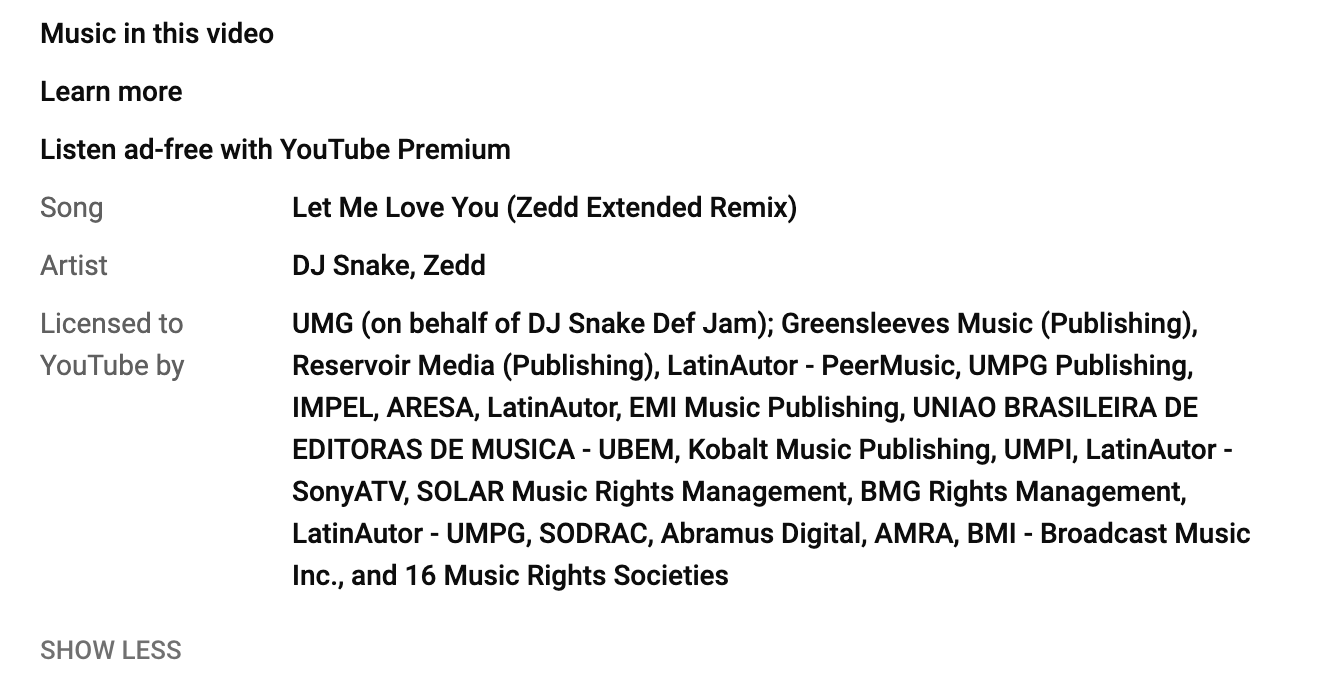
I call this crazy amount of information because it’s difficult to figure out who you need to get in touch with.
There are a few solutions that might just get you there, or at least most of the way there…
Pre-cleared Library
The easiest, cheapest, and most streamlined option you’d have is a pre-cleared library (https://search.rumblefish.com/). If you can’t find the type of music in pre-cleared library that can work for your projects, then keep on reading…
Songfile.com
Songfile.com is a great music licensing option for you if you need to distribute up to 2,500 physical units, digital downloads or ringtones, or up to 10,000 units for interactive streams.
Songfile is part of HFA – Harry Fox Agency (https://www.harryfox.com/). “The Harry Fox Agency (HFA), established in 1927, has long been America’s premiere licensing agent for issuing mechanical licenses, and continues to serve the industry today through its commitment to innovation while enhancing value for music creators and publishers.”
Songfile is a limited quantity mechanical licensing application that gives all users the tools to license copyrighted works. They have made it easy for users to pay the proper royalties to publishers and songwriters for their work.
Songfile can be used to get mechanical licenses for up to 2,500 units of physical recordings (CDs, cassettes, vinyl), permanent digital downloads and ringtones made and distributed in the U.S. Up to 10,000 interactive streams per song. Please note that HFA only grants mechanical licenses for units that are manufactured and distributed in the U.S. All processing is done online, and in most cases, you will have your license in 24 hours. Once processed, licenses are made available to you electronically for viewing and printing through your Songfile account.
What Does Songfile Cost?
Royalties for Songfile licenses are based on the statutory mechanical rate set by the Copyright Royalty Board (CRB). As of January 1, 2026, the rates have been updated under Phonorecords IV:
Physical product and downloads:
- $0.131 (13.1 cents) per unit for songs that are five minutes and under in length, or
- $0.0252 (2.52 cents) per minute or fraction thereof, per unit for songs that are over five minutes in length.
Ringtones:
- $0.24 (24 cents) per song, per unit
Interactive Streams:
- Streaming rates are calculated using a formula tied to revenue and total content costs. The mechanical royalty rate for interactive streaming is set at 15.3% of revenue for 2026, increasing to 15.35% in 2027 under the Phonorecords IV settlement.
In addition to royalty fees, there is a per-song processing fee of $16 for up to five songs. If you license 6 or more songs at one time, the processing fee is reduced to $14 per song.
Note: The previous statutory rate of 9.1 cents per copy (which had been in effect since 2006) was replaced in 2023 with an annual cost-of-living adjustment. The rate has increased each year since: 12.0¢ in 2023, 12.4¢ in 2024, 12.7¢ in 2025, and 13.1¢ in 2026.
About the Public Search Feature on Songfile
If you aren’t convinced that Songfile could work for you and before you create an account, check out their Public Search Feature which allows you to look up the song you need to license with a Song Title and Writer.
However, I personally find the Public Search Feature earlier to use once I created an account.
As a reminder, you need to be patient with the search. When you search for a general term such as “Let Me Love You”, you’ll see more than a dozen results. It’s important to combine other search elements such as “Writer”, or simply try different combinations before giving up too early.
If Songfile.com isn’t for you, and you need to distribute over 2500 physical units, digital downloads or ringtones, or over 10,000 interactive streams.
If HFA’s licensing account still isn’t sufficient for you, and you need a comprehensive licensing and royalty administration service offering for all types of formats. This is their premium service. You can schedule a call with them to learn more.
Caveats with using Songfile.com
- Songfile is US Only
- Songfile covers audio-only reproductions — keep reading if you are working on other types of media such as online courses, videos, etc.
- Songfile has a license limitation (as described above)
- The Songfile/HFA licensing percentage is not always 100%.
What to Do if Songfile/Hfa Doesn’t Own 100% Of a Song’s Licensing
During checkout of purchasing a music license, you’ll see an indicator letting you know if the HFA (Songfile) licensing percentage is 100%, or not.
See example below – Body Can’t Lie is only 9% licensed to Songfile
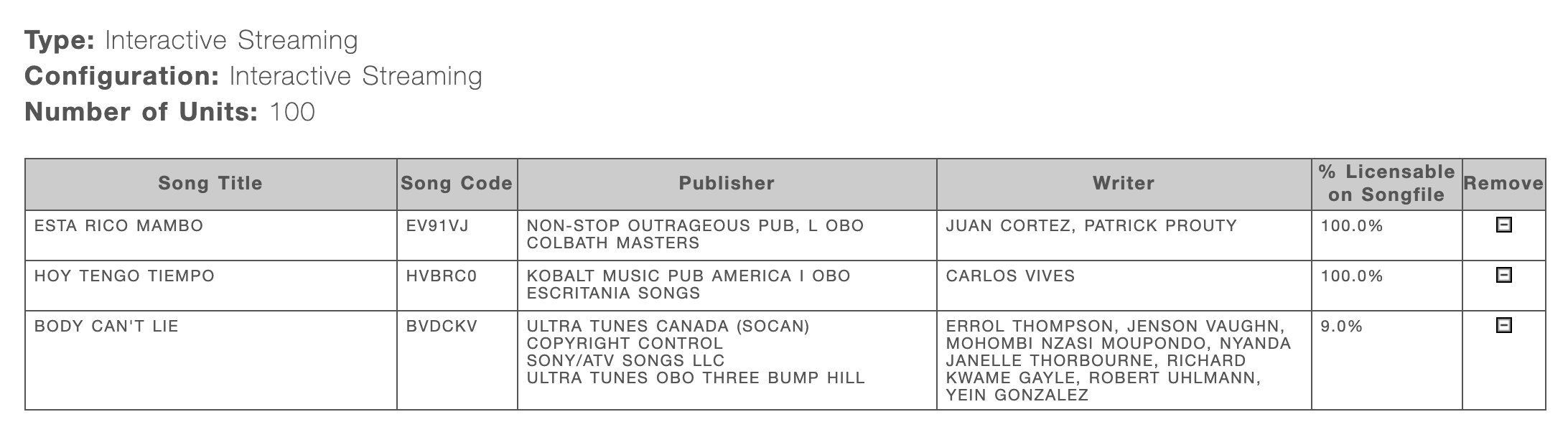
If HFA represents 100% of the rights to the song, you are all set!
If not, it means HFA may not represent one of the publishers that has partial ownership, or HFA may not be authorized to license this format.
If HFA licenses part of the song, you can complete your licensing transaction through Songfile for the percentage of the song that HFA represents.
To obtain a license for the remaining percentage, or for a song that is not represented by HFA for this format, you will need to contact the publisher directly. It is your responsibility to obtain licenses from each publisher that owns part of the song so that you are licensed for 100% of the song. If you are not licensed for 100% of the song, you could be liable for infringement.
You can use the Songfile Public Search to find information on this publisher, or use the databases at the following websites:
That’s annoying and sounds like a lot of work. What can you do instead?!
HFA/Songfile has various licenses to different versions of the song. See an example below right from Songfile.com. Instead of choosing the song you originally planned on using, it may be much easier to find an alternative so that you can secure 100% of the rights in one place (I.e. Songfile.com)
I understand this isn’t always an option but worth a thought.
Are you a public performance artist?
The Harry Fox Agency does not handle public performance rights requests. However, a publisher may assign its public performance rights to one of the three following societies, in which case you may secure performance rights from that society:
http://www.ascap.com
http://www.bmi.com
http://www.sesac.com
There’s a lot more information available on HarryFox.com, and I recommend you check it out HERE.
Type of music licenses
The first you’ll see after you choose “Get a License” within Songfile is the following screen
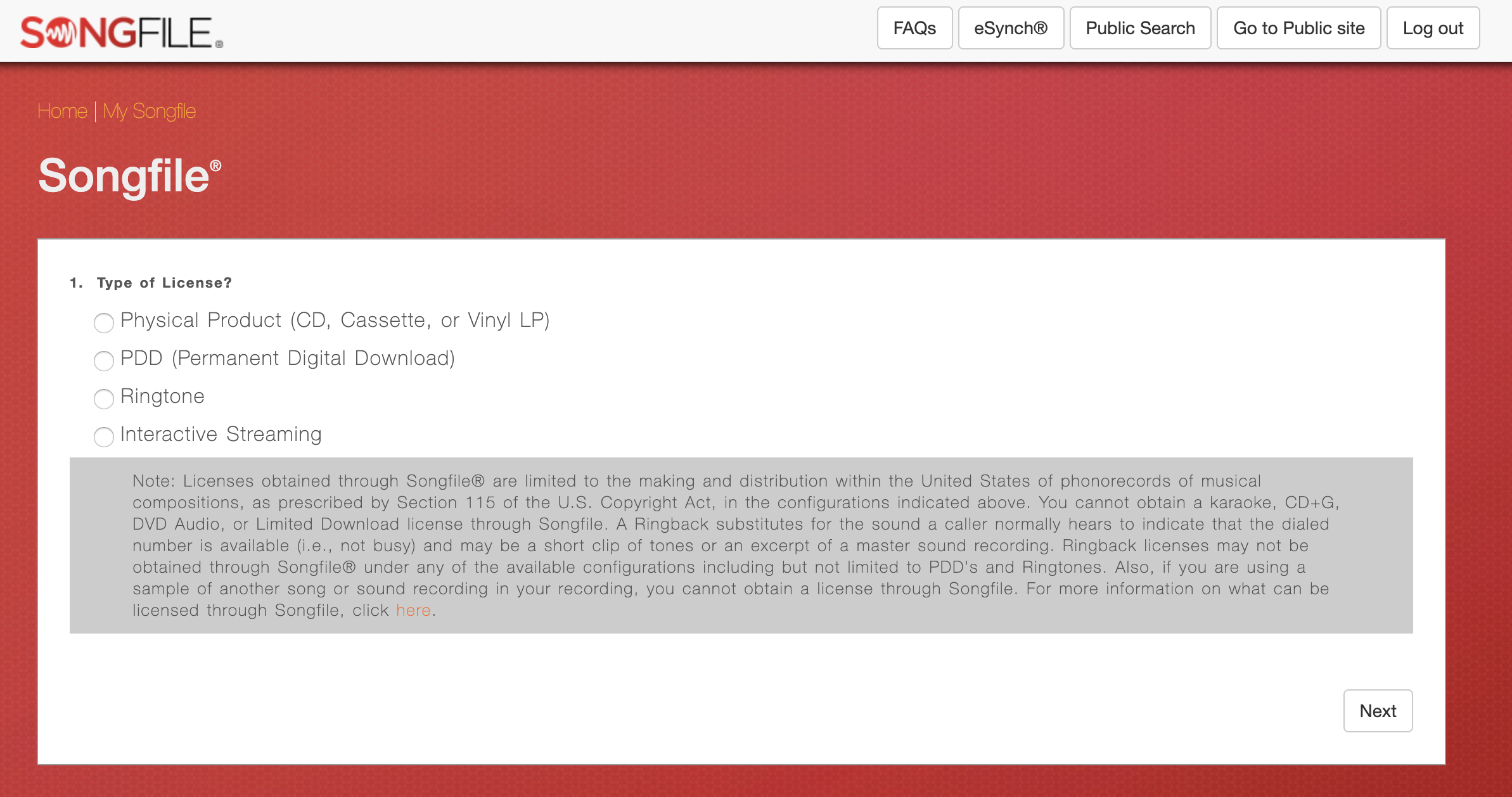
Here’s what they mean:
We’ll skip over “Physical Product” as most people are familar with this type.
Rate chart for Physical Products
Permanent Digital Downloads
A permanent digital download is each individual delivery of a phonorecord by digital transmission of a sound recording (embodying a musical composition) resulting in a reproduction made by or for the recipient which may be retained and played by the recipient on a permanent basis.
Ringtone
A ringtone is an excerpt of a musical composition embodied in a digital file and rendered into audio. Ringtones are stored in a user’s mobile telephone, pager or other portable communications device and played whenever the device activates its ring or alert function (upon the arrival of a call, message or other notification). There are two basic types of ringtones: Phonic Ringtones and Pre-Recorded Ringtones. Phonic Ringtones are, most commonly, standard MIDI sound files that are either monophonic, where the ringtones are recreated using standard single notes, or polyphonic, where notes can be played simultaneously creating harmony and/or counterpoint. Pre-Recorded ringtones play actual clips from sound recordings.

Interactive Streaming
Interactive streaming is when a digital file is transmitted electronically to a computer or other device at the specific request of the user in order to allow the user to listen to a recording or a playlist contemporaneously with the user’s request. Interactive streams are sometimes referred to as on-demand streams.
Rate chart for Streaming (online only)
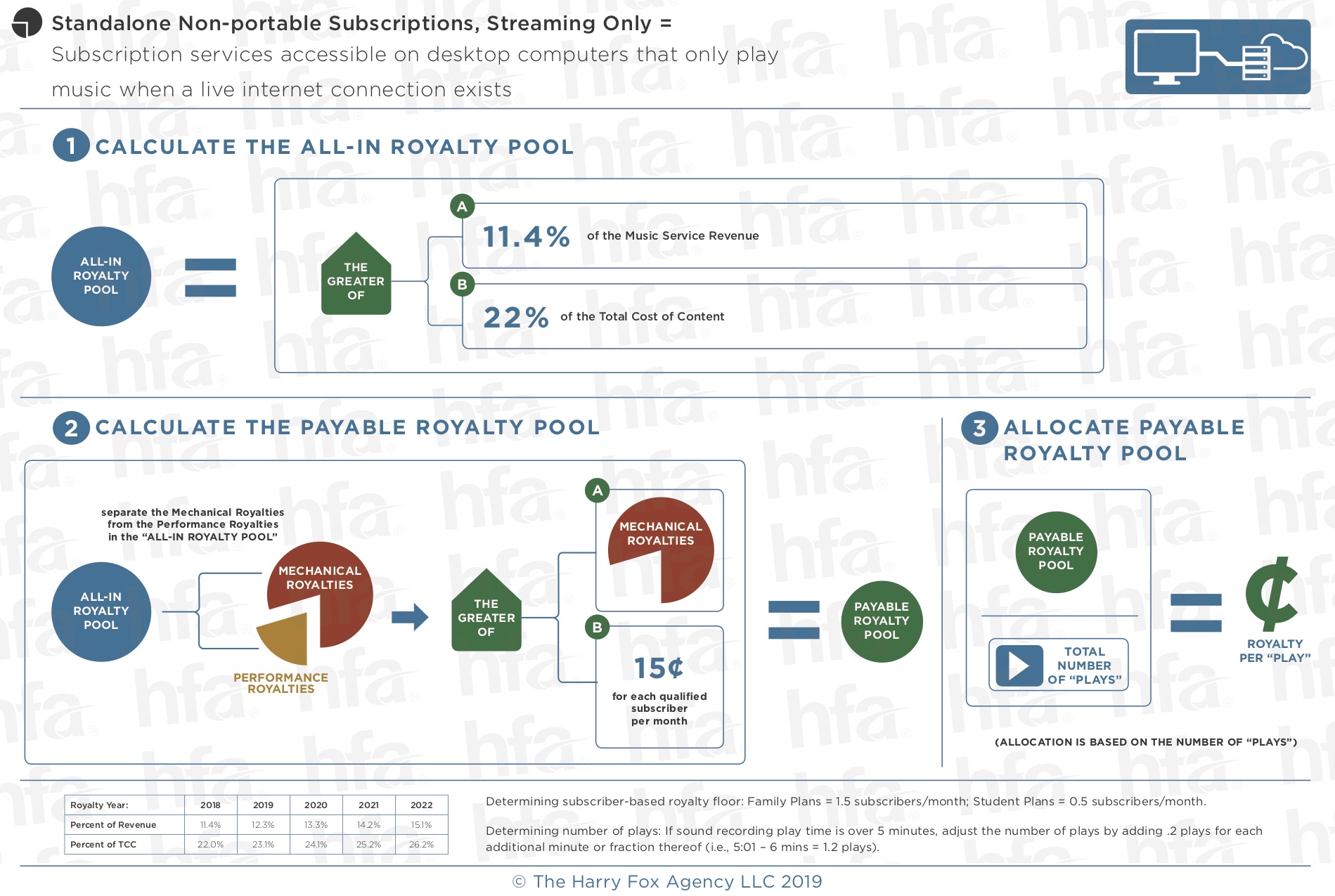
Rate chart for Streaming (online and offline access)
Synchronization License to Use Music in Combination With Visual Images, Video, Etc
Songfile licenses would only cover you for audio-only reproductions. For videos, courses, multimedia, it would require a synchronization license, which is an authorization to use recorded music in combination with visual images such as film, television, video, web sites, video games and the like.
Esynch (Commercial)
eSynch makes licensing songs you’ve combined with visual images or videos, such as a wedding, corporate, or personal website video, background music on websites, or in a film that will be shown at film festivals, simple. eSynch is limited to non-commercial use ONLY. eSynch cannot be used to license music for use in videos that will be uploaded to a third party website including YouTube and Vimeo.
Contacting the Publisher Directly (For Commercial Use)
You might also enjoy…
How You Pay For Licensing
Ok, if you’ve made it this far, you may be wondering – how do I estimate the number of streams, or the numbers of CDs you could be selling before you do it?
You estimate and pay based on that estimate.
Once you exceed the license threshold you’ve purchased, you can go back into Songfile and update the information before submitting a new payment.
Working With Indie Musicians and Indie Record Companies
At this point (or perhaps way before you even stumbled upon this article), you know how challenging it is to obtain music licenses without legal concerns. I want to remind us all that there are very talented indie musicians and indie record companies you can work with to achieve similar results. When it comes to negotiation with indie musicians, the process is often a lot easier and dare I say, more human.
The record company we’ve had a long-standing relationship with is ginTONIC Records.
Royalty-Free Music Services We Love (2026 Update)
I remember a time when I couldn’t find high-quality or the exact type of royalty-free music we were looking for. I gave up on this idea for a long time until I came across a number of incredible resources. Here are the royalty-free music services I recommend in 2026:
Epidemic Sound
Epidemic Sound remains my top recommendation for royalty-free music. They own the rights to their entire catalog — over 55,000 tracks and 250,000 sound effects — which means you won’t get hit with unexpected copyright claims after publishing. That alone sets them apart from services that work through Performing Rights Organizations (PROs), where “royalty-free” can sometimes come with strings attached.
They’ve also added AI-powered features since I first started using them, including voice generation tools and smart soundtracking features built into the platform.
Pricing (2026):
- Creator — $9.99/month (billed annually). Unlimited downloads for personal channels. Covers YouTube, TikTok, Instagram, podcasts. One channel per platform.
- Pro — $16.99/month (billed annually). Commercial use, client work, digital ads. Up to three channels per platform.
- Enterprise — Custom pricing. TV, film, offline events, multi-seat teams.
All plans include a 30-day free trial. Any content published while your subscription is active remains cleared even if you cancel later.
Artlist
Artlist is another strong option, especially for video creators. Their catalog includes royalty-free music and sound effects, plus they’ve expanded into AI voiceovers and stock video. It’s a more all-in-one creative asset platform compared to Epidemic Sound’s music-first approach.
Pricing (2026):
- Music & SFX Social — $9.99/month (billed annually). For social media and content creators.
- Music & SFX Pro — $24.92/month (billed annually). Broader licensing for all types of video creators.
One thing to note: Artlist works with Performing Rights Organizations, which means there’s a small chance of encountering additional royalty obligations in certain use cases. Read their terms carefully if you’re using tracks in broadcast or advertising contexts.
A Note About AI Music Generators as a “Royalty-Free” Alternative
You might be tempted to skip royalty-free libraries entirely and just generate your tracks with an AI music tool. I covered this in detail in the AI section above, but the short version: AI-generated tracks come with their own set of copyright uncertainties that established royalty-free libraries don’t have. If legal clarity is important to you (and if you’re making money from your content, it should be), a subscription to Epidemic Sound or Artlist is still the simplest and safest path.
That said, if you want to understand the full picture of how AI music copyright works — including what “royalty-free” actually means when it comes to AI-generated tracks, how training data affects your legal exposure, and what steps to take to protect yourself — I recommend reading this detailed guide on AI-generated music and copyright law. It covers the legal nuances that every creator should understand before publishing AI-generated audio.
Conclusion
Obtaining music licensing for the songs you want to work with can be tough. Hopefully this article equips you with more hopeful and useful information than when you started reading.
The landscape has gotten more complex since I first wrote this guide. On one hand, royalty-free libraries like Epidemic Sound and Artlist have made it easier than ever to find high-quality, legally clear music for your projects. On the other hand, AI music generators have introduced a whole new set of questions about copyright, ownership, and commercial use that the law hasn’t fully answered yet.
Here’s what hasn’t changed: there isn’t always a set path. Everyone’s situation and needs are different. Whether you’re licensing a cover song through Songfile, negotiating directly with an indie musician, subscribing to a royalty-free library, or experimenting with AI-generated tracks, the most important thing is to understand what rights you have before you publish.
Take the time to read the licensing terms. Document your creative process. And when in doubt, consult a professional.
Best of luck!
You might also enjoy…

Written by
Fei WuFei Wu is the founder and CEO of Feisworld Media, a Massachusetts-based digital media company helping brands get discovered by people and by AI. An Adobe Global Ambassador and brand partner to ElevenLabs, Synthesia, and 50+ other tech and AI companies, she hosts the Feisworld Podcast (400+ episodes, 500K+ downloads — guests have included Seth Godin, Steve Wozniak, Chris Voss, and Arianna Huffington) and co-created the documentary Feisworld: Live Your Art on Amazon Prime. Fei writes for CNET, Lifehacker, and PCMag, and her work has been featured in Forbes, Harvard Business Review, and WIRED. She has been publishing on the internet since 2014 — long before AI discoverability had a name.
View all posts by Fei Wu→Stay updated
Weekly insights on content, AI, and digital media.
Keep Reading
Related Articles
Ecamm Review 2026: Dual Mode Changed How I Create Video (Here’s How)
The Ultimate Guide to Adobe Firefly Video Generation: Choosing the Right Model for Your Project (2026)