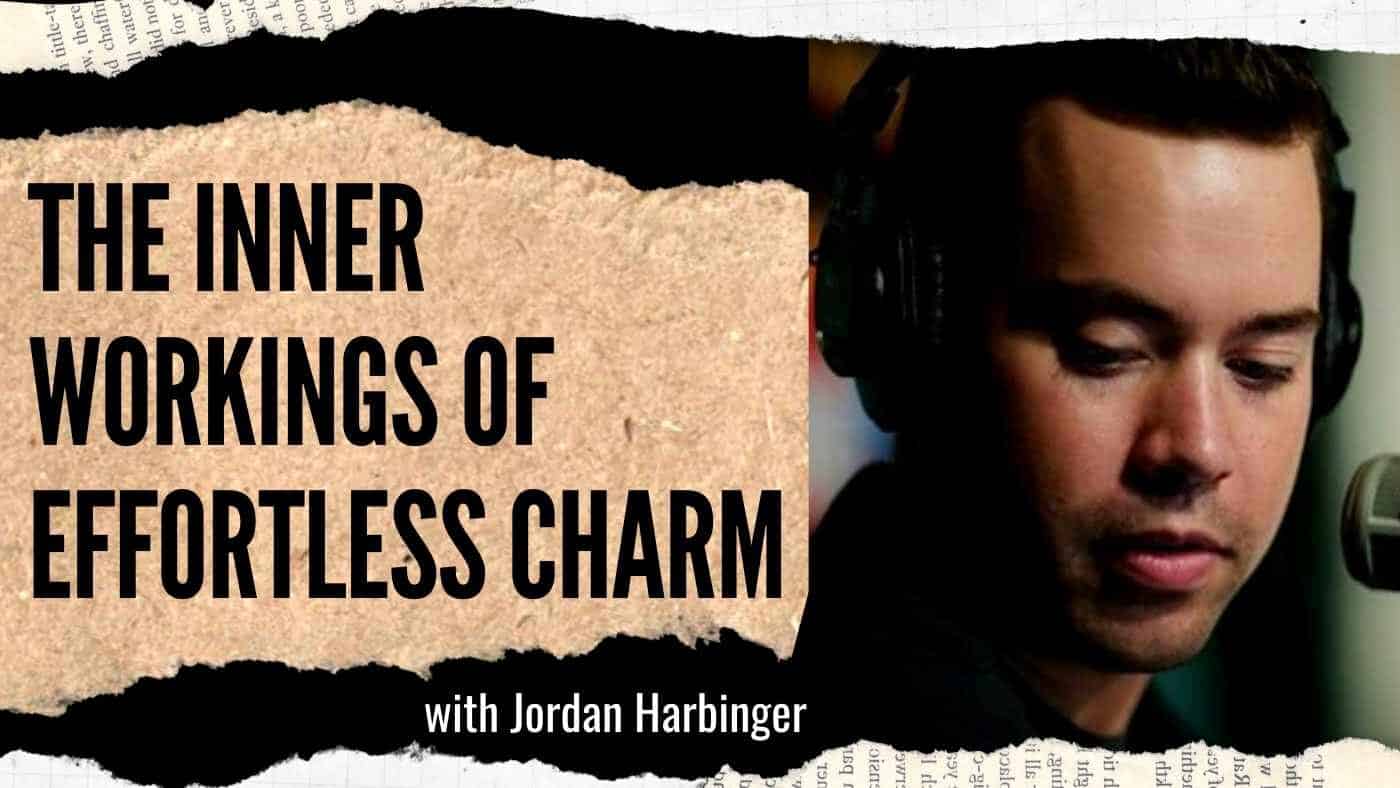
Our Guest Today: Jordan Harbinger
Meet Jordan Harbinger (jordanharbinger.com), show host for an iTunes Top 50 podcast called The Art of Charm (AoC). AoC also offers in-person training to help people become more charismatic in any situation, master their careers by becoming “super-connectors” and revamp their love lives and intimate relationships with confidence.
The AoC podcast receives over 2 million downloads per months, with over 440+ episodes featuring guests such as Tim Ferriss, Seth Godin, Ramit Sethi and Noah Kagan.
The AoC’s in-person training is so popular that attendees need to register months in advance. The residential program is currently only open to men. In our conversation, Jordan helps answer why this decision is necessary.
Jordan Harbinger is a public figure. He is known as a “sung hero” on the Feisworld Podcast. Why did we choose to interview Jordan?
We wanted to know what it’s like to run a popular brand, a podcast and a training program all at the same time.
Key Discussion Points With Jordan
Being famous isn’t always easy. How does Jordan deal with negative feedback and (even) “hate mail”?
- As a podcaster, I struggle with some of my interviews, especially under the circumstances that I’m speaking with a guest for the first time. What’s Jordan’s advice on managing one’s anxiety?
- What Jordan means by “rescuing yourself” and why it’s a crucial skill to have (for anyone)
- What was the early days like at the AoC before millions of downloads, interviewing world-class leaders, businessmen about their hopes and dreams?
- How did Jordan start his passion project? How/When did it transition into a legacy business?
- What are some of the lessons Jordan could pass onto other podcasters and entrepreneurs?
- My favorite segment: what was Jordan like when he was 10 years old?
The Bonus Section
All the software and hardware used to run The Art of Charm:
- Power Conditioner
- Universal Audio Control (with 3 devices plugged in including MacBook Air – for Producer, iMac – for Jordan, Console – proprietary)
- Proprietary chain (gets rid of statics, amplifies voices, etc.)
- Electro Voice RE20 Microphone (on a shockmount)
- Logic Pro X
- Zoom Recorder (for backup)
Other Recording Advice
- “Use nice cables!” (Jordan purchases his from Japan)
- “Everyone should have their own track during recording”
- “Producer (Jason) prepares show-notes in realtime” to easily recall information immediately after recording
Transcript
Transcript
Fei Wu: Welcome to the Phase World Podcast, engaging conversations that cross the boundaries between business, art and the digital world. Hi everyone. This is Faye W from Face Royal Podcast. A platform dedicated to sung and unsung heroes Amman us and have stories told by themselves in the most authentic way possible. Today, I would like all of you to meet Jordan Harbinger. He is the host for an iTunes top 50 podcast called The Art of Charm, a show and in person training that teach you to become more charismatic in any situation. Master your career by becoming a super connector and revamp your love life, and intimate relationships with confidence. The Art of Charm podcast receives over 2 million downloads per month with over 440 episodes featuring guests such as Tim Ferris, Seth Goden, Remi Sat, and Noah Kagan. The Art of Charm Weeklong Residential Bootcamp offers in-person training. It is currently only open to men, and Jordan explains in details during our conversation on why he needs a separate men and women. I thought his answers were absolutely fascinating. Jordan is already a very public figure, as you can imagine, so I guess he's more of a sung hero on Face World Podcast. Why do we choose to have Jordan join us? I wanted to know and learn how Jordan deals with negative feedback. Were even hate males.
Jordan Harbinger: Spotting valid feedback has been a skill set that I've been developing for, you know, we've all been developing hopefully for our whole lives, and it's really, really crucial and it's something that most of us never even think about.
Fei Wu: Seconds into our conversation, I felt so comfortable talking to Jordan even though we had never met before or had a single conversation. I immediately open up about my own insecurity, sometimes interviewing guests that are communication experts. While I couldn't string two words together, Jordan responded with similar experiences he had with his world famous guests. He taught me an important lesson I will never forget and have been sharing with many others ever since.
Jordan Harbinger: You learn this skillset of rescuing your. There's so much to you being self-conscious and you being us as show host in general, and anybody who performs anything in their whole life of thinking, I completely blew that, and you're totally fine. Most of the time it's just anxiety.
Fei Wu: What was the early days like at the Art of Charm, before millions of downloads, interviewing world class leaders, businessmen about their hopes and dreams? How did Jordan start with his passion project?
Jordan Harbinger: I think the idea that it was so fun and we were so blissfully ignorant was what kind of led us through all of those lean times. I couldn't start art charm over again and make it again. It would just be too damn hard.
Fei Wu: Jordan hinted that he doesn't really regret the mistakes he made while running the Art of Charm early on as a hobby, and he probably wouldn't do anything Differe. With that said, what are some of the lessons we could learn as podcasters and entrepreneurs?
Jordan Harbinger: I knew REIT back in 2007, 2008 too, and I was like, this guy really is focused on his business. We should do that. And we've been lucky that we're probably up in that same sort of level of success as him, but I guarantee you, he tested things that we tested just recently and he probably tested them almost a decade ago.
Fei Wu: Our one hour conversation goes above and beyond these questions, and I really appreciate you choosing to spend a precious hour of your time with us. To navigate and to revisit this conversation, I welcome you to stop by phase world.com, F E I S W O R L D, where you'll find show notes, links, and other resources. A bonus section is also available from this interview where Jordan reveals the entire setup for running the art charm from power conditioner to recording devices, post production software, and other tips besides just the software and hardware. Without further ado, please welcome Jordan Harbinger from the Art of Charm. I think your show is very authentic and I actually went around the office today. Uh, I know a few people who are also listening to the Art of Charm, and, and I ask the questions like, what do you, what do you like about Jordan and Jordan's style of interviewing people? And then I think you like what they said, which is you are very authentic and you have the natural warmth. Um, but at the same. You really get to the point, you drill into the questions. You don't let them, let the guests off the hook very easily. And you really get to your point, you know, there's a lot of interviews, you're like dancing around. It feels like the same idea or one party or the other, trying to be too polite. And I'm guilty of that too. Um, but I like your style. It's very crisp and, and it's very engaging. It's so fascinating to talk to someone who's a podcaster and, but your stats is outstanding. I must say. I've been listening to the Art of Char and I kind of take it for granted. And, and uh, finally as part of our conversation, I did the research of. 2 million downloads per month, top 50 podcasts and iTunes. And that's, that's more than top one 1% If I'm, uh, right with my math and over 440 episodes, over probably 200 countries of listeners, uh, tuning in every month. Does it feel real? I mean, does it, you know, does that like make you happy and thrilled and do you think about those numbers at all?
Jordan Harbinger: I do, but here's the thing, and I don't know if it's just me not being super amazing at math, read bad at math, but I can't wrap my mind around the numbers that much. So I find myself being like, oh, 90,000 people downloaded that. That's a lot compared to maybe another episode that only got 80,000. I try to, I try to think about college football games. I'm not a football or sports fan by any means, but I remember going to Michigan Stadium a decade plus ago when I was in college, and they're like, today there's 110,000 people watching. And I'm like, okay, so if this is 110,000 people and this episode got 90 or a hundred thousand downloads, basically a whole stadium like this at some point downloaded this episode of the show. But then it still doesn't really click in because some of those, those people are so far away from you that even that, you know, you're in the middle of all that. You kind of don't really, you don't really feel it. Or you maybe even you feel that energy is a huge stadium, but it, you don't think, I don't ever think like, wow, basically I'm talking to this whole stadium full of people. I mean, I fully realize there's people on their phone that are like, ah, click. And they never listen to anything. Or they're like, I'll stream this, and then they forget or, or whatever. And, and also it's also really easy to look at some of my colleagues and friends. Who are, they have a YouTube channel and they have like a million subscribers. And you've gotta kind of parse it out because a, a podcast download is different than a YouTube subscriber, which is different than a YouTube view, which is different than a radio listener, which is different than a someone who bought something from you or a Facebook, like, like there's all these different metrics and they don't mean anything. So for me, I'm proud of what we've done. I would love to, you know, five x my audience over the next five years if that's something that's possible, or 10 exit over the next decade or less. But it, it's all just kind of, after a certain point, after a few thousand people, you're just kinda like, I, I don't really know, because you can go to a bar or a club or an event with a thousand people and you're like, man, it's so crowded in here. The line for the bathroom is enormous. But after that it's just a, it's just, it's like Greek counting where it was anything over, I think a thousand back in ancient Greece, they just said infinite because they're like, nah, there's no point in counting this. And that's kind of how it feels with, with podcasting, don't get me wrong. Uh, when I'm trying to pay my mortgage, I'm like, oh, thank goodness we have all these really cool fans and listeners and downloads, and we can, you know, tell host Gator that they need to pay us this much money this year. That's great. And, and that's cool. And I, I try constantly to separate the number from the person. So I, I reply, I don't know if you know this, but I reply to all my email, like everything that comes in, unless it's absolutely patently ridiculous and insulting or something like that, I will reply to just about everything, which is thousands of messages every month, and that. is, that's the struggle. Not wrapping your mind around how many people are listening, but trying to get to everybody so that they don't feel like you don't give a crap. Mm-hmm. . And that's, that's kind of like my unrealistic fear is that people will be like, oh, you know, you don't even care. You're just, you're just not even checking your email. So I might reply and I might be pretty short, or I might send somebody a shortcut to something that they're looking for that's prescripted. But I, I'm there typing all of those emails. There's not somebody pretending to be me. There's not somebody in Bangladeshian. And I find it kind of insulting cuz some people will be like, oh, whatever your stupid virtual assistant, you know, wrote me back. I'm like, that was me, first of all, that was me. And, and second of all, you know who, who entitled you to reply? This is something that I do kind of for me and for the, the show fans. Man, no good deeds sometimes, you know what
Fei Wu: I mean? That just shows again, you are, you are up there and you know, I have never received any hate mails yet. Some people might have some, something negative to say, you're being too nice and all women podcasters are too nice. And uh, but it just shows and when people, it does start replying with such negative feedback. And I think, I think both Rami said and James Cher went in Miles, I'm talking about like, you know, people were threatening James to like, you know, to kill him or something and some crazy stuff going on. And I really personally still can't believe there are people out there. And then I'm glad that they're not really impacting you. You can just like filter them out. Yeah,
Jordan Harbinger: I mean I get stupid emails like that a lot and I'll get people that are like, you're just a scammer. And I'm like, well, alright. You know, at first it used to be like, oh my God, how dare you? But the last several years I just kind of think of, okay, what's this person. Really dealing with in their, you know, it's a compassion exercise, really. What's this person dealing with in their life where somebody who's been around for almost a decade now, this is the ninth year of the show as of January, 2016. Wow. And been running programs that are life changing, that have really good reviews, that have a really strong alumni network of people who've graduated that still participate in helping other people who've just recently graduated from our live programs and have had listeners for, who've been listening for nine of those years that still write in all the time and tweet and Facebook. It's like, who's this random person who all of that evidence aside is still like, this is a scam. I mean, where have they been burned and why is their self-esteem so low that anything that looks like it can help them, they just immediately dismiss as that. And, and I just feel bad for people like that because, The, the, to put it bluntly, it's such a loser mindset that I just feel like, wow, this person's life must really kind of suck and I'm really glad that they're, that that's not me because it's, what's that expression? But for the grace of God, go I, where you see somebody who's really down in their luck and you're like, wow, that could totally be me, except for cosmic coincidence that made me start podcasting and slash be born in the United States and have great parents. I mean, all of those things are, are. Really, they're just, you know, luck of the draw. So I try to bear that in mind when people are like, oh, kill you. You, you're such a bad person. I'm like, yo, real reality check. I run a podcast that has a blog element. Like, what have I done to you that could possibly elicit that reaction? And then I have to kind of gut check myself and go, okay, nothing. All right. Dismiss not, not relevant to my life. Let this person go. Pick on somebody else on, you know, blog comments or YouTube and just leave it alone. You might like
Fei Wu: this because I know we all get very angry thinking about that these people exist and you know, you're, you're due service. Not only do men, clearly in this case, you know, I, as a woman, I'm impacting as such a positive way. I've directed a lot of my guy friends to listen to your podcast as well. But you might like this saying, uh, I don't remember the source of it saying, you know, they're famous people or people who have done something become statues and pigeons. Well, shit on statues. So you have to make a choice. Do you wanna be a statue? Do you wanna be a pigeon?
Jordan Harbinger: I love that. I've never heard that, but that's amazing. I love it. So true. Yeah, it's so true. I mean, you know, it's, it's hard because at some point I never thought of myself as artistic or creative at all. And, and sometimes when people say like, oh, this is this, or you're, you're supposed to be that, you're some kind of like artistic or creative person, I still have trouble sort of swallowing that identity. Um, but I will say that I definitely get offended like an artist and sensitive like an artist, cuz people will write back and they'll be like, Uh, even, even if, uh, even if it's not offensive, I take things really personally sometimes if the feedback is structured really well. And I don't necessarily mean that in a negative way. Maybe I should say take it to heart because people will say, Hey, look, I'm an audio engineer and you've got this thing is driving me frigging crazy. And the good part is I take that feedback and submit it to our own engineers and they go, oh yeah, you know, this guy's right, or that guy doesn't know what the heck he's talking about. And it makes the show better because people can give feedback and it can be really valuable. But I, I will also say that it took me years to realize that 95% of feedback is super uneducated and has absolutely nothing to do with making your show. At least not for the audience. It has to do with other people's insecurities. And that's true across the whole spectrum of life in my experience, where somebody will say something like, I, I literally got this email a couple weeks ago. Hey, you should do another version of your podcast that's only like 10 minutes long and just has the important stuff so we don't have to listen to all the other crap that you're talking about. And I was just like, well, aside from being completely socially inept, which this person obviously is, they clearly don't really understand that a lot of the value in what we do is the interaction between the guest and the host. It's not about getting a list of five bullets of things you've gotta do next, cuz without context, all that stuff is useless. And so when you extrapolate that, you go, wow, this, this person probably doesn't listen or look at or read context at all very well, they're probably completely unable to do that. And so this is probably hurting them throughout their whole life. So don't change. I'm not gonna change the show and make it 10 minutes long. And just for this one person, It doesn't make sense to do that. And so you really have to take feedback again in context, which is impossible to do in an email. So if somebody says, look, I've been listening to your show for nine years. Here's what I love, by the way. I would love to see more of X, Y, and Z. That's great feedback. This person knows me better than most of my friends probably at this point, right? Yeah. They've been listening for so long. The the guy who goes, I found your show last week. I really wanna hear more podcasts about insert ridiculous topic that's been covered 87 times, seven years ago. They didn't even search the website. That's not really feedback and that that's the same thing in your life where, you know, your, your, your boss might say, look, you've been here for three years. I would love to see more of this take on a leadership role. That's great feedback. The person you went out on one date with and they were like, you're too short. That's not feedback. That's their own weird thing coming into play. Don't listen to that. You can't get taller anyway. But there, there'll be tons of totally invalid feedback and spotting valid feedback has been a set that I've been developing for, you know, my, we've all been developing, hopefully for our whole lives, and it's really, really crucial and it's something that most of us never even think about. We either take all of it or we reject it because our ego. Screw you. I'm, you should like me the way I am, which is also a crappy fixed mindset.
Fei Wu: It's funny, I, you know, had lunch with a coworker today, and this is precisely what we were talking about, but, you know, there are young people and older people included, but like a lot of us don't deal with negative feedback, you know, uh, in front of our families. We're certainly not at work, uh, oftentimes because we're trying to create this harmony and we're all trying to be a little more conservative, a little careful with what we say. But I think you are in, you and me gradually kind of into that public space, and I really still feel crazy and kind of insecure, and I'm so comfortable talking to you, which is the feeling I haven't had, um, interviewing some of the other, uh, guests who I've never met before. I get nervous. I get this like weird and stupid rush of saying I'm not worthy, and oh, these are professional and they truly are professional communicators, and I couldn't put. Two words together and overanalyzing myself. And so I'm so glad you're saying this because I think it's in addition to sort of the outside force and what other people are telling you. But at the same time, internally with me, uh, leaving and interview saying, oh, that person was great. I I was a hot mess. And then when during post production, it's like, oh, I wasn't so
Jordan Harbinger: bad. You know? Yeah. Oh yeah. Giving yourself feedback in the moment is not a good idea. I, I've got a producer that's with me live on every show that I record. His name's Jason, you probably have heard of him a million times cause I thank him at the end of every show, and there's many, there are many times where we have a back channel where we can communicate. There are many times where I'm like, am I blowing this or what? And he's like, no, it's fine. Or I'm like, oh, is it just me? Or is am I totally unprepared? And I completely, and he'll be like, no, it's fine. It's totally unnoticeable. Sometimes he's lying to make me feel better, but most of the time he is like, no, the episode turned out really well. And I'm like, Everyone can tell I'm hungover. It's like that first time you, you tried pot in college and you're like, everyone knows I'm high. And everyone's like, no one knows you're high except you keep talking about it. That's kind of how I feel on my show. I don't smoke marijuana. I haven't smoked probably for 15 or 20 years now. It's a one time thing in college, but I will tell you, I still get paranoid that I'm blowing it in the middle of a show and yeah, absolutely. You know, if I really blow it, it gets cut out. But I will tell you, it's been, you learn this skill set of rescuing yourself and sometimes, sometimes I'll, I'll pull something out of thin air and I will, at the end of the show, Jason will go, I can't believe you just came up. Were you thinking of that as you went along? And I'm like, yeah, I can't believe it. And that just comes with practice. But, but I will. , there's so much about, there's so much to you being self-conscious and you being us as show host in general, and anybody who performs anything in their whole life of thinking, I completely blew that, and you're totally fine. Most of the time it's just anxiety triggering like a hyper critical feedback loop that makes it the worst. And, and I will, I'll cap it with this. A lot of times when you interview professional communicators, I'll say, some of the worst shows that I've ever done have been with people who supposedly teach communication skills. And I think the reason there's a lot of context there too, speaking of context, that people who claim to be amazing communication experts, a lot of times they're so unaware of themselves. Not aware of themselves, unaware of themselves, that they don't realize they're actually really bad communicators. So they're so confident. This is like that Dunning Kruger effect. Have you ever heard of that? They just, they don't know how bad they are, so they just assume, I'm so good at this. Why do other people find this hard? And they'll come on the show and they'll talk over you and they won't have any valid points. And they'll make a joke and they'll laugh at their own joke and they'll just keep moving. And it's like you're not even there and you think, oh, I. You just pitch really well. Companies bring you in as a quote unquote communications expert. You, you train, you steamroll everyone, and then you leave and cash your check and nobody ever has the guts to say, what the hell was
Fei Wu: that? Yeah. And I, you know, what I also struggle with, uh, to your point is I think it was all on your show, uh, I don't remember the guest, but you mentioned that, you know, when you interview these professional communicators or semi-famous or tier two people, they tend to have these go-to stories. Yeah, they barely steer. I mean, there's just, it's so hard for me to pull the information or anything other than what they haven't already talked about hundreds of times. Um, so that has, that has been the struggle for
Jordan Harbinger: me. But yeah, we call those sound bites. And the reason, I mean, obviously the, the reason we call 'em sound bites just be pretty obvious, but the, the sort of rationale behind it, which, which makes perfect sense. Is that they've done the interview so many times that they, and they've worked with PR people and usually people are selling something. Yeah. So for me, it's actually pretty easy because when I'm on podcasts or radio, I'm just like, Hey, go listen to the Art of Charm. I don't have to say there's over 500 hours of this and that and the other. Like, I no one, it's, it's not really a great way to do it. And it, again, it's really inauthentic, but if your whole roi, your whole return on investment is that you're gonna sell a couple copies of your book, you just won't shut the hell up about your book. So these people all have soundbites like, oh, I'm glad you asked that, Fay, because in my book in chapter 17 entitled Giving Sound Bites on Air, I discussed seven major points. And I'll give you the first three and the rest you can find in my book@phaseworldpodcast.com. It's just like, ugh, God's sake. This is awful. And um, one of the tactics that I have for getting, if you're interested for getting rid of. People's soundbites is, I always book 90 minute show slots, but you'll notice the arctic charm is only about 45, 50 minutes long. And that includes with advertisements and with the intro and with the clothes that we don't record during the, the booking with the guest. And the reason is because there are people, especially the more well known folks, the authors and the performers, those people, what we'll do is we'll just let them talk for the first 30 minutes or so, which is well over the average interview length that these people are used to for their little radio and maybe TV soundbites. And after 30, 40 minutes, they're tired and, and we just cut all of that garbage most of the time. So they'll come through and they'll give all of their fancy sound bites, some of which are interesting and we keep, and most of which are just, you know, they. Kind of their deal, their pitch, their spiel, and we just, we just dump it and then we get them answering real questions. And that's one of the reasons why people go, gosh, you know, this is, you really get to the point. It's like, well, no, I just cut off the part where the guest couldn't get to the point. And then we got to the point, I don't do it that fast. I do it faster than most, maybe. But it's not instant like it seems. It's, it's the fact that they, we just let them tire themselves. It's like having kids. I don't have kids, and I don't know if you do, but if you let 'em run around long enough, they'll take a nap. And that's exactly what I'm doing on air. I want them to chill out and get real. And sometimes you just gotta let 'em run in circles until they do.
Fei Wu: This is fa w and you are listening to the Face World Podcast. Today I am with Jordan Harbinger, show, host, and coach from the Art of Charm. Jordan shares his nine year journey of the art of Charm from a passion project to a legacy business. I hope you share this conversation as well as your own feedback with us via face world.com, where you can also explore other conversations with guests invited to Face World. You can now listen to Face World and subscribe via iTunes, SoundCloud, Stitcher, and Google Play back to the show. Great advice. And as you're talking, I just realized one of the episodes I suffered with the most, I could have done so much better knowing that the first 15 minutes was such was not interesting. Um, and so, and then to your point, it's like when other people listen to this, they don't know the backstory. So they won't persevere through the first 15 minutes. Why don't, why don't we lead them into the most interesting when the energy actually picks up? Yeah. Oh man, this is so valuable. Uh, I don't have kids and I teach little kids TaeKwonDo, and you just have to run them around and then they can actually have the energy to listen to you.
Jordan Harbinger: They need to burn out. And, and that's true for, for these, these, uh, thought leaders or influencers or whatever kind of buzzword because they, their goal is to get their message out to people. And what they think their message is, is their spiel for their book or their product. Our goal is different. Our goal is to get a good interview and a good show and to really get kind of something that they haven't talked about much that they're really good at, most of which mainstream media that they've done in the past isn't interested in anyway. So, They don't realize your goals don't necessarily align. And even if they try to match your goals, they kind of don't know how to do it. They've probably never done it. So yeah, you let 'em burn out and, and there's plenty in there that you can keep. I'm not saying you just get rid of everything and there's no ROI in it for them. Usually the show that they do with us, our goal is for them to go, dang, I've never had this kind of response. I've never been asked this before. That makes it more interesting. But, but if they've been conditioned by their PR people and their media people to just go and pitch because they have 17 minutes to get their URL out a total of five times, that's what they're used to and that's how they're gonna run it. So you can just clip. And that's the beauty of prerecorded media. You can just do whatever you want and you, you just have to be responsible and not make people look bad or, or have them communicate or look like they're communicating in a way that they didn't intend to. I, I like to think we make 'em look better, and I think most of our guests agree with that.
Fei Wu: And I love how you're, this is so valuable. I feel like just. You're giving away some of the most valuable information. It makes me feel so much better because I'm not physically in LA and I go there once a year when as I'm listening to the Art of Charm, I feel like I'm missing out so much. On the in-person training that you conduct on a weekly basis, I believe it's to men only. Can women join that too?
Jordan Harbinger: No, I mean, we have in-person training for women, but it's done differently. Our, our boot camps and workshops are generally for men. We do have some for women, but the ones we do for men are residential, where they stay in the house in Los Angeles for a week at a time. We've got two properties there, and we run these programs every single week. The ones we do for women are more one on one, and they don't stay in the house. They don't stay residential either. The coach will come to. Or they will stay at a hotel in LA and do it that way. And the reason is because the goals that guys come in with are a lot different. The science of a, of, if they're coming in for like dating purposes or charisma purposes, the sciences between what makes a man and a woman charismatic and magnetic are completely different. And the last and possibly most important thing is in order to get to the root of the issue. For most people, especially guys, we need them to get really vulnerable. And it takes a really, really long time. There's a lot of building comfort and trust with each other and with the coaches. But if you. Any estrogen or too much, I should say, estrogen or any female within a hundred yards of the place, when guys are opening up about their fears and their secrets and things like that, it will, it will slam shut like the mouse trap. And we even have our female coaches who are trained in all of this stuff. They even have, they, they're not there all the time for that reason because the male ego is so powerful that even when we wanna control it, we can't, uh, without a lot of practice anyway. And so we just have to make it really conducive. And so you can't have mixed classes. And again, you know, we're teaching from experience for a lot of this stuff and, and so it becomes a lot harder to have a mixed group or anything like that. But we do have coaching for women. It's just not the same style as it is for men.
Fei Wu: It, it's so magical for you to be in the middle of all this to observe, absorb and, and being able to talk about it, you know? Is there anything you've learned about yourself? I mean, were you surprised by how difficult it is for men to be vulnerable or you kind of, were you kind of prepared for that, I guess?
Jordan Harbinger: Um, we were kind of prepared for it because we were the same way. Right. It took us years to, it. It took us years to get there, and so I, I definitely understand. I don't think like, oh, these guys can't be vulnerable. That's so weird. It's like, yeah, these guys can't be vulnerable because. It's really hard. And so we just make it really comfortable, really, really comfortable. You know, we don't ask people to divulge crazy stuff the first day they get there. Most guys will. Um, and we have just a close knit group of guys. Anybody who's negative or judgy gets shut down, like just so quick with prejudice, basically. And we screen the attendees. I mean, I, I've got phone calls with guys before they come in. My assistant has phone calls with guys before they come in. One of our head coaches has the same call with the guys before they come in. So if there's gonna be somebody who's not a good fit, we just say no. I mean, we're sold out months in advance. So we don't really like need, we don't need to go, well, this guy's a crummy fit, but we gotta pay the bills. I mean, we don't have that problem, thankfully anymore. So we are just so happy to screen out people that we think are gonna. A pain in the butt. Are
Fei Wu: you planning on traveling to other states? Because I assume you get a lot of these local guys and then you're in LA and to us here on the East Coast, like those are the happiest guys. Like they're so confident they're, you know, the weather is great and, but what about us? Like what about people in New England,
Jordan Harbinger: Yeah. Well, here's the thing, it's not local guys. In fact, when we did our taxes, we had to figure out how many clients even came from California where we're based. And it was like 10. And we don't have to pay certain types of taxes on people that are not Americans, uh, citizens. And that was like a double digit percentage of our clients as well. More a high double digit. So people come from all over the world. Oh, us, Canada, uk, Australia, New Zealand, Germany, France. And we've had handfuls of guys from countries like China, Japan, middle East, Italy, uh, we have guys from all over the world. Yeah. So, so whenever people go, oh, I can't make it. I live in Arizona. I'm like, look man, that excuse might work for you and other areas of your life. Like, I can't get to the gym. It's too far away. But this is a week long program. You gotta fly here Anyway. So, and, and I kind of feel not kind of, I feel like this, look, you want something that's gonna change your whole outlook on life and give you a skill set that's gonna change the way that you behave and help you network and maintain connections and improve the, in the relationship you have with your wife and your kids. If you can't get on a plane for that, you don't deserve it. And in fact, if you won't get on a plane for that, I know you're full of crap anyway about making big changes because successful people will fly to the other side of the globe to go to a conference, meet the right people, do the right kind of training, somebody who makes an excuse that they've gotta get in the car for five hours or drive to the airport and spend a couple hundred bucks to get here. Those, that's a loser mindset. And, and I'm not saying everybody who thinks that way is a loser, but what I am saying, If things like that stop you from succeeding. Wow. I mean, that's just such a low obstacle. It's legal, safe and and easy to travel across the United States slash the globe these days. So when people make excuses about why they can't do it or, oh, I can't get the time off work, I know it's baloney and I know it's just the same excuse they tell themselves for why they can't do other things. It's just one of a billion excuses that control that person's life. And at, at some level, I feel bad for them, but not bad enough to try to really convince them of it because I got other people who can't wait to get here. And so I just focused on those guys. It
Fei Wu: totally self-selected and I So funny, I had no intention of, of, I didn't realize how interested I am. Program. So now I learned that these guys are coming from all over the world. I, I, I will conclude with my final question, but what is it like to have a single program and approach? Well, you have such different, huge diversity of men speaking not only different languages, but also cultural background. I mean, Asia, Europe, you know, how do you, how do you tailor your program to everybody in, in the classroom?
Jordan Harbinger: Yeah, it's tough. And that's a great question and you, you actually nailed it. We do tailor it. And the reason that we have to do that is because of the cultural background. And you've got a 23 year old kid from China and you've got a 35 year old guy who's married from Indiana and a Canadian guy who's 28 and single. So there's all these different guys here, and some of them are military and some of 'em blah, blah, blah. English is their second language. So we cap the programs at 10 guys and we have several coaches because we need to dig deep with everybody over the six days that they're here. And you just can't do that when you've got a room full of 50 guys. So it's kind of funny, people sometimes will say, well, I'm deciding between Art of Charm and this other thing, and it's like, well, do you wanna stand in a room and stare at a PowerPoint presentation or do you wanna sit down and get coaching hands on from a bunch of different people who. Really know what you wanna get out of it and are gonna help you get there. So it's different. I mean, we've, we've had clients in here that are 69 year old guys and they're in the same class as a 25 year old guy and they've got very different goals, very different life experience and yeah, we've gotta take all of that into account and it's, it's exhausting. That's why my coaches, they rotate because otherwise they'll burn out and, you know, we'll find them teetering from the roof if we made 'em work four weeks in a row because it's, it's a tough job. And, and we just, we put everything into our clients and our students. So, you're right, it's, it's gotta be tailored. It's no easy task. And it's something that we work on with every single group of guys. Uh,
Fei Wu: that's beautiful and thanks for sharing those stories. But if you don't mind, I'm gonna jump around cuz I am really interested in learning more about you in particular. There's one thing I've been contemplating recently is not sure who said this again, but, um, people are saying when you talk to entrepreneurs, creators such as yourself, um, I wanna ask you the question of what were you like when you were a 10 year old boy and what are some of the dreams and wishes you had, um, back then?
Jordan Harbinger: So when I was a 10 year old boy, I, oh man, I, I was probably pretty bossy and. I was pretty strong willed. My parents tell me all the time, they're like, you would ask for something over and over and if we said no, you would spend a ton of time researching it. And I would ride my, this is pre-internet, I'd ride my bike to the library and I would call the stores that sold whatever it is or call people that knew about it. So now that you mention it, looking back on this, I probably was interviewing people when I was a little kid. Cause I remember wanting a stereo when I was like 11. And I called, uh, this is so funny, I've never thought about this really good question. I called this electronic store. And they would tell me all about the stereos. And I would say, okay, how much is it? And they would say, oh, we can't quote prices over the phone. You have to come in. And I would say, well, that doesn't make any sense why. And nobody would tell me the honest answer, which was, we wanna get you here so we can sell you the stupid stereo. One guy said it's illegal. And I said, that doesn't make any sense. And he was like, yeah, it's illegal. And I thought that doesn't make any sense at all. So I hung up and I called the police, not the emergency line, just the regular police. And I said, hi. I called this stereo store as electronic store and I asked what the price was of this item and they said that they couldn't tell me because it was illegal. Is that true? And the cop or dispatcher or whatever was like, I don't think so, but I'm not a lawyer and I'm not sure how you could get that information. I'm 90% sure it's not illegal. He is probably lying to you, but you can't quote me on that cause I'm not allowed to give legal advice cuz I'm, you know, blah blah, blah. And I thought, okay, that's fair. How do I get the answer to that? And she said, call an attorney. So I called a bunch of attorneys and they were all like, who is this freaking kid? Calling me asking about stereo prices and one guy goes, look, I can't engage with you cuz you're a minor. I'm not even supposed to be talking with you at all, but you can call this number and it's called friend of the court. And basically what this is, now that I'm an attorney, I know what this is. It's basically like legal aid for people that are poor, like indigent or you know, una. Just people who have nowhere else to go and they need legal resources. And this is like a pro bono legal thing. So I'm calling friend of the court and I'm leaving voicemails and I finally get ahold of somebody and. Look, I don't know why you really need to know the answer to this, but it's not illegal. That person was just lying to you, and I got the answer and I called the electronic store back and I got the same guy and I said, by the way, it's not illegal so you can tell me the price. And he hung up on me.
Fei Wu: Oh, this is the, this is the funniest story I. And the reason for me to ask that question without telling you why I did, is because, uh, according to research, but who cares is that the, the dreams and things we did and the mode we were in when we were right around 10 years old is basically what shaped us into who we are today. And you know, unfortunately a lot of this is somehow, if you look at people working in law firms, financial services, and they tell you, you know what? My life is totally different. This is not how I am. I'm just putting a show here. Um, you know, I feel like oftentimes I have, you really have to peel through the layers to really get to who people truly are. But based on that story, I realize I, I'm not surprised at all how you started, uh, founded Art of Charm because that that is who you are and try to get to the bottom. And I, I love how you kind of is very inquisitive and you ask questions and, and especially when the guest is kind of contradicting himself or herself, you're like, could you explain that one more? Why is that exactly? You know, and I love
Jordan Harbinger: it. Well, I, I appreciate that. It's funny cuz I did wanna be a talk show host when I was like eight years old and I bought the parts for this transmitter that would transmit to the radio and um, one of the guys at Radio Shack, which like doesn't exist anymore, he goes, look, if you build this, it's not gonna go very far. So you're not really gonna be able to be kind of like the DJ for your neighborhood, which is, I know what you wanna do. Cause I was there soldering things together and this cool guy, it was probably like 19 was helping me do it because nobody knew how to solder anything in my house, even though my dad was a mechanical engineer. And, um, And so I said, well, how can I make it more powerful? And he goes, well, you would need what's called a high gain antenna, and you'd need something that's gonna power this thing enough to put it through this high gain antenna. So I was saving up my money for a high gain antenna, which by the way, if you don't know what that is, which no one does, you ever see an old TV antenna on people's houses back in the day where it's like this, this kind of metal pipe that sticks up. And then there's metal pipes that stick out like a t. And on thatt, there's like these little metal rods that are horizontal. That go out from that, it's ugly and it's ginormous. And I thought, okay, I gotta like hook this thing up to my bike or my fort in my backyard and figure out how to make this work. And, you know, it didn't work, but I always wanted to do that. And then I went to law school and became an attorney and all this stuff, and I totally get what people mean by putting on a show. And while I was in law school, we actually started putting on this show, and this is my job now and it's awesome.
Fei Wu: That's, it's so funny, you, you let me right into, uh, the story of you talking about yourself, you know, as a, I assume you're a very accomplished lawyer and you talked about how hard you worked in law school, but the certain things didn't quite jive with you. But there's, you know, there are snippets of things that you talk about, but because you're a host on those episodes, I know you don't wanna go too, too deep in and turn into about yourself, but. I was very drawn towards when you said, you know, being a lawyer, going to law school, getting into a top law school and, and drop out. And uh, I'm not sure if you drop out or, or not, but to, I Jordan Harbinger: graduated and Oh, you did? I I practiced on Wall Street for a while. I'm definitely not an accomplished lawyer. I'm just technically a lawyer. I would not, don't trust me with any legal thing of any importance whatsoever. You'll regret it cuz I, I graduated and I practiced to un financial stuff on Wall Street and then just left really quickly after that and it, it, it actually ended up being pretty cool cuz I got paid for so much. So much of the startup capital from the Art of Charm came from this old firm on Wall Street that I worked for. Um, because I hadn't have any work to do. Cause I sucked at my job. what,
Fei Wu: what age were you when you left the law
Jordan Harbinger: firm? Um, 2028, I believe. Wow, that's
Fei Wu: perfect. Um, and then you start talking about the first few years of living in New York, if I remember correctly, Manhattan, and start, this is the very beginning of the Art of Charm. And you talked about something like 10, $20,000 per year of income. And that was, you didn't use the word suffocating, but I mean, what was that period of time like and how did you persevere through that and prepare yourself to see the light at the end of the tunnel?
Jordan Harbinger: Oh, oh, you mean when I left Wall Street making 160 grand and I made $24,000 a year after that? Um, yeah, you know, I had savings, so that was awesome. That was great because I basically didn't have to take that much of a ding in lifestyle. But on the other side of the coin, I wasn't on Wall Street for that long, so all that money that I had, I was still kind of in student mode. So occasionally I would splurge and buy really nice food or I would overspend on clothing or something like that, or going out, but I was still kind of in. Law student mode, even though I was making Wall Street salary. So I was in, I ended up saving tons of my first year in salary and change, uh, when I worked on Wall Street. And then I still got paid for a really long time, even though we had no work to do, cuz of the economic downturn. And I still made full salary then. So the amount of money that I spent wasn't $24,000. I mean, it was, but I was able to kind of not care I guess because it, it didn't matter as long as I had a roof over my head that I had to go and eat cheap food or that I couldn't afford that much by way of going out. And also at that point, we'd really been leveraging that art of charm skill set. So we never paid for drinks and we never paid to get in anywhere and stuff like that. We basically just paid for taxis and, you know, our bills were paid for by the company at that point. So we didn't How long, how long did that go for? It was a couple of years where we made very little money and then it started to catch up with us and, and then it didn't even sting because. We were having so much fun. We were working with our friends and we, you know, there were tons of stressful periods of business, but we kind of didn't worry about it that much because we just figured everything would be okay in the end. Now, I don't recommend that because there's so many times when things are not okay in the end. In fact, I think it happens more often than not. Things are not okay in the end. And if I had the, the choice to go back and start thinking of this as a business in the beginning rather than like a fun hobby that's kind of our job right now and hire all mad dumb friends, I, I would do things a lot differently. But I, I don't know if that would've been a great idea either, because I think the idea that it was so fun and we were so blissfully ignorant was what kind of led us through all of those lean times. I couldn't start Art of Charm over again and make it again. It would just be too damn hard.
Fei Wu: This is Fa w and you are listening to the Face World Podcast. Today I am with Jordan Harbinger, show, host, and coach from the Art of Charm. Jordan shares his nine year journey of the art of charm from a passion project to a legacy business. But why, why was this so important to you? I mean, because it was so important. I mean, there was a job that was promising, a quote unquote air quoting that guarantee, uh, your parents may be fully supportive. You can take girls out without money, go anywhere you want. And why was the art of charm or the idea to star something so profound that important
Jordan Harbinger: to. Um, you know, I don't wanna, I don't wanna rain on your real great question, but mostly I had never thought about that. I just didn't wanna be a lawyer. I knew I didn't wanna be a lawyer. I thought this was fun for a while. I wasn't even sure if I was gonna have to get a regular job. At some point, we were helping so many guys. It became rewarding, but it wasn't like, all right, I'm gonna save up and quit this law job and go pursue my passion, which is teaching and doing this podcast and blah, blah, blah. It was more like, oh my God, I can't believe I'm getting paid for this. This is so cool and the guys are having a lot of fun. We're gonna be rich. Maybe don't know. Bye. That was my whole thought process. Let's go get a beer, right? I mean, it was 29 and 28 if that, and it, I was immature, probably even for that age, frankly. And I still. Probably immature for my age. And, and so there wasn't a whole lot of deep thought behind, oh, you know, this is, we gotta plan ahead and this is gonna be a business. We're gonna scale that way. That whole mindset, that whole, that's kind of a Silicon Valley thing that's trendy now where people think, all right, implementation, scaling, automation, these different phases of business, that stuff, nobody thought about that. Nobody was talking about that back then. There wasn't passive income. There still isn't. But there wasn't passive income then. It wasn't trendy. And we didn't treat the podcast like a business. I probably released an episode every two weeks. I did it in whatever room I could with the microphones that I had, and we were drinking the whole time. And then guys would show up for their bootcamp and then we would use that money to, to pay for things that we needed. I mean, we weren't, we weren't, we were not planning ahead. We were not thinking. This is some sort of undeniable passion. And it just kind of became that way because we're like, wow, this is so rewarding. And also we know what we're doing now. And hey, you know, now it's more profitable than it was. But it, for years, we just never gave it a second thought. It was a, it was a hobby business and that was not a good way to start off with a bang. But I also think it was probably the only way that we were gonna be able to make it. Cause bear in mind, we weren't selling a better, what's that? What's that stupid analogy? We weren't selling a better widget. We were making up a training program that didn't exist before that we had created that we were constantly improving. And so we were not thinking like we're gonna retire at age 40. I mean, that was not in the cards. This was let's kill time until we figure out what else everybody's gonna do.
Fei Wu: So not that it's important to look back and say, we wanna change, change X, Y, and Z, but if there were a couple of things you would do differently, uh, you know, if we were to start over again, what would that be?
Jordan Harbinger: I would start focusing, I would focus on taking pride in the craft. Everything that we were doing. Cause back, if you listen to early episodes of Art of Charm, they're, they're terrible. And I'm not just saying that cuz it's my podcast and I'm better at it now than I used to be. I mean, they're just like, the audio quality stinks cuz I didn't care, I wasn't prepared for a lot of the interviews cuz I didn't care. I didn't release every single week at the same time cuz I just didn't really care. And several years ago I thought, okay, I've gotta start treating this like a business. And so I would start treating this like a business, like a legacy business instead of a lifestyle business. And the difference between those two things is a lifestyle business makes you enough money to do what you really wanna do, which is for a lot of people like hang out and work from the beach. I don't do that. I am much too hyper for that. And back then I was sort of running around New York City and traveling around having fun, which may have been a necessary part of my growth as a, as a man. And as a human, but I would've focused again, 2020 hindsight on creating a legacy business, which is quit screwing around, release the show regularly, figure out how to be a good host, get better equipment, get a producer and a team together. Start promoting your stuff like a normal human being. Cuz I knew REIT back in 2007, 2008 too, and I was like, this guy really is focused on his business. We should do that. And he was just like, this is step one. I'm gonna do this. I'm testing all this other stuff. We were not doing any of. We weren't doing any of that stuff. Ramit say T was. And so there's a reason now that he's so much more advanced than like any other business that you look at. And we're, we've been lucky that we're probably up in that same sort of level of success as him, but I guarantee you, he tested things that we tested just recently and he probably tested them almost a decade ago because he was always focused on that stuff while we were kind of just screwing around. And so I would've focused on this stuff earlier because I think that a lot of people, they treat their business like a hobby. And I don't mean just doing it part-time. I think you should start part-time so you prove the concept. But I think a lot of people start their business like a hobby because it's easier to do it that way. And if you fail at a hobby, you're like whatever. But if you fail at your business, you feel like it affects who you are. It reflects, I should say, on who you are as a person. And um, that was something that, looking back, we were probably afraid of. And so I would ditch that fear and just start building faster. I
Fei Wu: love it. And I'm gonna take, I'm definitely gonna get a, a transcript for this and take careful nos and think about where I'm, what I'm doing, where I'm taking my business, uh, in 2016. But I, I have this question from the very beginning. I do you mind revealing some of the, the microphone where, like kind of your brief setup because it sounds so good.
Jordan Harbinger: Yeah, sure. I, I have, none of this is secret. I should have my producer documented online somewhere so that people can buy this stuff. But let's see. I'll start from the power chain. So I've got a power conditioner, which I don't know, I probably don't need it now, but if you live in an older building, you know, man, I'm trying to figure out if there's an example of this, but you ever, when you were a kid, plug a TV in and like, whenever the washing machine turns on, the TV does something weird. So I've got this device called a power conditioner and it plugs into the wall. And it cleans all of the electricity cuz it threw outlets in your house. There's not just a bunch of electricity I'll spare you is science, but there's all kinds of frequencies and stuff going through there too. So this power conditioner gets all that and sort of scrubs it out and evenly distributes the right amount of voltage and amperage to all the devices that are plugged into it. So it's like a super smart spike bar. I, I don't think anybody needs that, but I have one. And then plugged into that is something called, uh, universal Audio Apollo. And, uh, that's a, it's an eight eight I or eight p and that has a MacBook, uh, air plugged into it for my producer to come in on Skype. And it's got an iMac plugged into it, which is what I look at, which has my show notes and Logic X, which is recording the audio for every show. And there's also something running on it called Console and Consoles. What controls the Apollo. And it has, it basically is a real time emulator of all these old. Electronic processing units that if you ever go to like a music studio, you see all these weird devices with cables sticking out of 'em that change the ways that things sound like guitars and vocals and things like that. Tube amplification, and this device emulates all of that. So I have a, a proprietary sort of chain that changes my voice into what you hear it. And that's an exaggeration. My voice really sounds like this. It's just that it, it makes everything cleaner. It gets rid of static. It's amplifies parts of my voice that I want amplified. And anytime I say like, if you do an s sound, it goes like, it'll remove that weird hissing sound that sounds really obnoxious in headphones. It removes, uh, a lot of. That comes through it, it removes those things where if you're too close to the mic you go and it makes that like air pop sound, it removes a lot of that. So that is really powerful and it's really a nice device that I have that most broadcasters don't bother with cuz it's expensive. And then I've got, uh, electro voice, re 20 microphone, which is great vocals or drum microphone. The same microphone that I used at Sirius XM when I was doing live radio on Sirius XM satellite radio. I've got that and it's in a shock mount so that if I bash the table, it doesn't do that thing where when a microphone is sitting on a table where it goes like this, you hear that it doesn't do, thats, it's all isolated by rubber bands and it's suspended from a band. And I invested in really nice cables so that there's no static from crummy uh, parts. Interference because cables are basically antennas that pick up everything in the air. So I got really nice handmade, isolated and insulated cables from Japan that I plug my microphone into the Apollo and I've got a mute switch so that if I cough, I can push it and it doesn't go into the microphone and everybody's gotta cut that out. I've got that. And then everybody has a separate channel. And this is probably even the most important thing. So when I'm recording a show, I've got my own track. You as a guest have your own track. My producer has his own track, so if we all talk over each other, my producer will just mute whoever he doesn't want and the other person's audio will be unaffected. And. If someone's quiet, I can amplify them without amplifying everybody else. And if they're really mousey sounding, I can add a little bit more base to their voice. And if they're in a noisy area, I can eliminate background noise using a plugin for the Apollo interface on their channel. So it gets rid of that stuff. So it really makes a huge difference when you're recording somebody on some crummy Skype thing and they're using their Apple headset versus going through all of these different plugins, it sounds like they're in studio, or at least the next best thing. And, uh, and it's, it's, it took a lot to learn how to use this stuff. But the truth of the matter is, we started going back to treating this like a business. This is a radio show. The chief distribution channel right now is on the internet. I don't know if that's gonna be true all the time. I mean, we have replays on satellite radio. We may go to FM and stay on the internet. We may license things out to other people. I create video content in here, so I need professional equipment. That sounds good because if we do go to radio, I don't wanna have to figure out how to use all this stuff suddenly. And now I've got that learning curve along with a totally different one of being on, on air or doing live again. Like I was with Sirius xm, so, so my chain and oh, and it's all recorded on the computer and there's a backup, there's a zoom recorder that's plugged into the Apollo as well that just gets all the output and records it so that if, if like there's a power failure or some catastrophic thing happens and my hard drive crashes, producer Jason has a backup on his end and I have a backup on my end. So we never lose shows anymore. Cause the Lord knows when I was using call recorder for Skype for all those years, if that crashed, you were just outta luck. That was
Fei Wu: it. Oh man, that was so miserable. That. Wow, that's amazing. Sorry to cut you off. You were, uh, did you mention the software you're using for editing post production?
Jordan Harbinger: I don't edit my own show. So we have an audio editor and it's not producer Jason. It's actually another guy who's also named Jason. And uh, he goes through and he edits in, I don't know what that is. I guess it's either Logic, which might be why I was instructed to get Logic so that I can just give him the whole project file he'll edit in that program without me having to convert anything. Which is great cuz that means he can mute the tracks and change everything. And then, um, we have a show notes guy who creates the show notes after listening to the rough cut of the episode. And producer Jason does notes in real time where he'll be like, all right, minute 40. Jordan has coughing fit and then has to pee cut through as audio
Fei Wu: your, your show. It's so, so high quality and I love, you know, and then people who haven't gone to your website, it's so detailed. You got the show notes, you have this key set of questions. So it's very easy to scan, uh, to say, you know, exactly what can I get out of this episode? Is it, is it gonna be very valuable and relevant to me? Um, so, you know, most shows are so, like you said, uh, the show notes are nonexisting and the, they're grammar mistakes. I mean, it's a hot mess for a lot of podcasters out there.
Jordan Harbinger: Yeah, it's, um, but I get it. I'm not like, Ugh, what an amateur. I'm like, Ugh, this is so much better than I was when I was a year old of a show. Like, I mean, our show was a hot. For probably like five years. I mean, we didn't even look at our download stats. We didn't care. Nobody knew what podcasts were. So when people asked me what I did, I was like, uh, do you know what a podcast is? And they would be like, no. And I'd be like, oh, it's like YouTube with no video. And they're like, that is never gonna be a real thing that you can do to make money. And I'm like, it's nice meeting you. You know? I mean, what are you gonna do now? I'm like, do you know what a podcast is? And people go, uh, yeah, obviously. And I'm like, oh, well I have a really popular one of those. And they're like, no way. Listen to 85 podcasts. What's yours called? And if they haven't heard of it, now I got a new fan. Right. So it's, uh, it's funny how things have changed. I mean, nine years ago when we were in iTunes, AJ and I looked at each other and we were like, look, no one's ever gonna find this. There's like 800 podcasts in here, and now I think there's 300,000 and. And I still think it's early enough that if you do get started and you do a good job and you treat it like a job and you love doing it, you'll be fine. Because look, Google is making it a native thing that you can play on Android phones. Spotify's got a limited amount of podcasts on there. I'm not sure how to find it. I know Art of Charm is on there. Somebody showed me once. You gotta push a lot of buttons to get, but that's gonna change. You know, your, your car is gonna have car play, whether or not it's an Android os, an Apple os or some crappy thing that Microsoft made for Ford or whatever is gonna have that on there. Uh, and people are gonna have it on their smartphones all the time, and they're gonna eventually figure out, many people will, that radio is not their only option. And satellite radio's gonna go outta business as soon as Howard Stern retires. So podcasts are still kind of early, it's just that it's not necessarily gonna be called podcasting. It's just that. Everybody's gonna be able to create their own thing. But people are gonna start in companies like Spotify, Google, all these other companies, even iTunes to a certain degree, are gonna start to figure out how to cultivate the stuff that's professionally made. And if you're in a seasoned, experienced host that's been treating this like your job for a long time, you're gonna be the people they call when they wanna test out the Google Play Store or the Spotify thing, like we are. And it's great because what that means is if you're on the cusp of that and Google needs to feature a hundred new shows, they're just gonna take the iTunes top on a hundred most likely. And if you're in there, you gonna get a million new listeners. And if you're not, you're, you're gonna have to work your way up like we did. You know? And it's, it's, uh, it's really, really cool because I'm looking forward to the next few years of seeing the podcasting market explode and watching, you know, hopefully my business do the same.
Fei Wu: Yeah. And it's so refreshing for me to hear this and. You know, Jordan, I, I really appreciate your time and part of me feels like I don't wanna let you go. I, I missed talking to you already, .
Jordan Harbinger: Well, you're a good host and you did, you obviously prepared really well for this, so I
Fei Wu: appreciate that. Oh, thank you. I I, if you were here in this room with me, you would see about three pages of, uh, research stuff. I probably have 30 questions and I must admit I didn't even look at it once I, cuz I didn't need to. That's,
Jordan Harbinger: that's good. I, I would say a great bit of prep and Neil Strauss, who, who writes for Rolling Stone, is a good friend of mine, is an author as well. What he does is he writes down all the questions he wants to ask and then he never looks at it.
Fei Wu: Yeah, exactly. So it's so funny, Chris, the t said the same thing. She prepares and the preparation allows you to not have to look at them otherwise. Have might have a panic attack. So
Jordan Harbinger: Yeah. And you feel like you have to get it in. You do that thing, and I, I did this years ago where you go, oh, before I let you go, total non-sequitur question, that's not as valuable because you wrote it down. You feel like you have to finish the, the assignment when really it's just like, This should be done. You should ignore this. I don't need to ask you about your favorite, you know, brand of underwear. Nobody
Fei Wu: cares. Yeah. Yeah. It's so true. And I, it's so funny. I feel so good at this point, and you just, you make me so relaxed about our conversation and it just flew by. And I wanna thank you for giving me this chance because, you know, after I, I have been so transparent about my downloads and your reply, as I've told many people, is, you know, again, yours is over 2 million a month. And I said, you know, I have 50 episodes. I don't have any commercial or advertising. I have about over 10,000 downloads, about average, 200 per episode. And you reply is like, cool, I'm in. And I will never forget that Jordan. I really wanna thank you for this wonderful opportunity and the fact that you're such a dedicated, um, there's so many words I wanna use, you know, creator, you were a creative person for sure, and you're influencing so many people out there, not just men, but also women. Um, so please, I hope you do this as long as it's still interesting and powerful to you. And, um, I, it's so funny. I promise I'll give you an intro, but we hit it off so quickly. I never, uh, needed to introduce myself. Um, but I am a digital producer. I am going solo effective this Friday, leaving a full-time job to pursue. Thank you, . I am so excited. I went through stages of uncertainty, fear, and now I'm excited. Uh, I, I will be working as a freelance consultant helping small businesses, people and students. And, uh, I would love to return this favor, even though you didn't think it was a favor probably, but to find a way where I can contribute and kind of help the art of charm as, uh, to kind of collaborate and partner with you in ways I can just volunteer my time, my knowledge will be, will be, uh, an absolute honor to do
Jordan Harbinger: so. Well, I appreciate it and I'm looking forward to seeing how you, how you roll. By the way, those, um, those feelings of like, I'm excited then I was uncertain. That never stops, so don't expect it to stop. I'm, I've been running my own business with my partners here for nine plus years. I can count, we call it the entrepreneurial rollercoaster. And my, my friend Cameron Harold, who I just interviewed on the Art of Charm, talks about this. You, you constantly go through that and you're gonna, it's gonna happen until the day you retire. And then you're probably gonna have nightmares about it.
Fei Wu: so true. I, I already had like different loops of these feelings, like, what's wrong with me? You know? And you're right. Maybe it's all natural.
Jordan Harbinger: Yep. It's all totally natural. It's never going to, probably never going to go away. And that's just how, you know, you run your own business and we are a human
Fei Wu: being. Right. We're still alive, .
Jordan Harbinger: Exactly.
Fei Wu: Exactly. Wow. Thank you, Jordan. I really appreciate and, and your time is absolutely precious, so please keep in touch and let me know if there's anything I can do to, to help you. And I will absolutely keep you posted on this episode. I think it's, it's gonna be so successful. You got it. Thanks so much, Faye. Thank you. Take. To listen to more episodes of the Phase World podcast, please subscribe on iTunes where visit phase world.com. That is F E I S W O R L D, where you can find show notes, links, other tools and resources. You can also follow me on Twitter at Face World. Until next time, thanks for listening.

Written by
Fei WuFei Wu is the founder and CEO of Feisworld Media, a Massachusetts-based digital media company helping brands get discovered by people and by AI. An Adobe Global Ambassador and brand partner to ElevenLabs, Synthesia, and 50+ other tech and AI companies, she hosts the Feisworld Podcast (400+ episodes, 500K+ downloads — guests have included Seth Godin, Steve Wozniak, Chris Voss, and Arianna Huffington) and co-created the documentary Feisworld: Live Your Art on Amazon Prime. Fei writes for CNET, Lifehacker, and PCMag, and her work has been featured in Forbes, Harvard Business Review, and WIRED. She has been publishing on the internet since 2014 — long before AI discoverability had a name.
View all posts by Fei Wu→Stay updated
Weekly insights on content, AI, and digital media.
Keep Reading
Related Articles

Joanne Lipman on Mentors, Untapped Talent and Why Women Should Stop Waiting to Be Perfect
Marc Randolph on Curiosity, Messy Starts and Why “Nobody Knows Anything”