Sarah Cooper: Behind the Scenes With the Creator of “10 Tricks to Appear Smart in Meetings” (#80)

Our Guest Today: Sarah Cooper
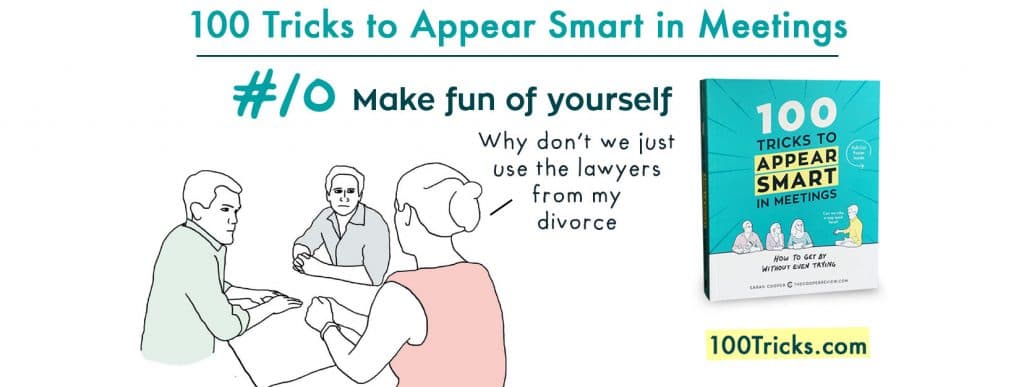
Sarah Cooper (@sarahcpr) is a writer, comedian, and creator of the satirical blog The Cooper Review, which attracts more than 500K page views per month. Her work has appeared on The Washington Post, Fast Company, Business Insider, and Huffington Post. Sarah has over 15 years of experience in the corporate world including Yahoo, Google, before leading to her first viral article, “10 Tricks to Appear Smart in Meetings” and my personal favorite, 9 Nodding Strategies for Your Next Meeting. Her first book, 100 Tricks to Appear Smart in Meetings, was released on October 4, 2016.
[Updated as of May 2020] Sarah Cooper’s Trump jokes are blowing up all over social media, with several million views within hours! Check out her interview with the Atlantic.
Discovering Sarah’s work and interviewing her on Feisworld was a journey on its own. From a job at a graphic design agency as a receptionist to a designer (at a different agency), to 3 years at Yahoo before transitioning back to an acting career, to 20K in debt before a friend referred Sarah to land a good job as a design manager at Google, where she met the love of her life.
That’s precisely why I enjoyed talking to Sarah and have her share the not-obvious stories of her upbringing. Sarah’s mother is half German and her father is half Chinese. Her family moved to Washington, DC when she was three. Due to the medical struggles of her two sisters, Sarah had to be strong, who paid close attention to others’ feelings and needs before her own.
This trait enabled her to discover and pay attention to things that most people experience, but can’t grasp easily. I think that’s why Sarah is successful in what she does, why she can read and walk in between the lines, and why she effortlessly finds humor in boring topics.
Sarah Cooper Was Featured in Feisworld Documentary
(available on Amazon Prime, Vimeo and more)
Show Notes
- [05:00] How was the experience of being interviewed by Srini Rao (on the Unmistakable Creative Podcast)?
- [09:00] You are becoming really popular, with thousands of subscribers and a book just released. How did all of this happened?
- [18:00] When you released ‘10 tricks to appear smart in meetings’, why do you think it went viral? Did you have a large audience?
- [20:00] Are your content popular on (a professional network) such as LinkedIn?
- [21:00] What types of feedback have you received from LinkedIn?
- [25:00] What is your feeling about our tendency to take our jobs more seriously than we should?
- [28:00] How would you recommend friends, or people outside of your field, that they could have a career like yours as well?
- [30:00] Did you transfer any knowledge from previous corporate experience to your life as a consultant/freelancer?
- [34:00] What was it like to grow up in such a multicultural environment (Jamaica to the United States)?
- [35:00] What was it like to move to the US, comparing other experience of yours in Jamaica?
- [39:00] Can you tell us a little bit more about your family, and how did they instill your values and influence your persona?
- [42:00] How do you manage exploring new types of humor, given that your audience expect more corporate humor [48:00] Sarah’s comments on comparing the creative work vs. the corporate work lifestyles
- [49:00] What are some of the things that people don’t know about you?
Video – 6 Tips on How to Be a Thought Leader
Favorite Quotes
- [23:00] In the business world, where people do have careers, the context of [my humor] can be off-putting. Sometimes it pisses them off.
- [25:00] I almost feel bad that I couldn’t take my job that seriously. I couldn’t take those meetings seriously, it was so awkward, there was so much passive aggressive stuff going around…
- [26:00] People wanted to be in the meetings with me because I was always cracking jokes…
- [29:00] Do as much as you can while you have a full time job.
- [33:00] In Jamaica, people are mixed already but here (in the US), people do want to know where you are from and […] that obsession with what I am is what I was really surprised when I moved here.
- [36:00] What can I do to fit in this tech world? What can I do to fit in in this meeting and make people think that I know what I’m talking about?
- [37:00] That’s been the heart of my comedy, that set of unspoken rules that these societies have, because as an immigrant you are coming into it from a different perspective…
- [48:00] It is just so hard to start from zero but you have to remember that everyone starts from zero. You have no idea what other people are going through (have gone through).
Transcript
Transcript
Fei Wu: Welcome to the Phase World Podcast, engaging conversations that cross the boundaries between business, art and the digital world. Couldn't take my job that seriously. I think it helped me actually get through the meetings and it actually helped me, like people wanted to be in a meeting with me because I just was always cracking jokes and you know. Me, what can I do to fit in in this, in this tech world? What can I do to fit in in this meeting and make people think that, you know, I know what I'm talking about. That's kind of been like the heart of my comedy in these set of unspoken rules that these societies have because as an immigrant, you are coming into it from a different perspective. You're sort of observing it and trying to understand. It's hard as a comedian to sort of balance the fact that jobs are important to people with the fact that we can still make fun of them a little bit, you know, we can still have fun with them and often. Actually learned something too. You know, it's
Sarah Cooper: just so hard to start from zero, but you just have to remember everyone starts from zero and all you have to do is just keep going and keep trying cuz that's kind of what we're all doing as we're just trying, you know.
Fei Wu: Hi everyone, this is FA W and I am your host for the Face World Podcast. Every week I interview a chosen song or unsung heroes and dissect their lifestyles and their tactics, resources you can use right away to improve your life. Well, this week I wanna welcome Sarah Cooper to the Face World Podcast. Sarah is a writer, comedian, and creator of satirical blog, the cooper review.com, which attracts more than 500,000 page views per. Her work has appeared on the Washington Post Fast Company, business Insider and the Huffington Post. Sarah has over 15 years of experience in the corporate world, including Yahoo, Google, before leading to her first viral article called 10 Tricks to Appear Smart in Meetings. Her first book, a hundred Tricks to Appear Smart In Meetings will be published on October 4th, 2016. Besides writing, Sarah speaks about adding humor to your writing, and she performed standup comedy around San Francisco. Discovering Sarah's work and interviewing her on Face World was a journey on its own from a job at a graphic design agency as a receptionist to a designer at a different agency to three years at Yahoo before transitioning back to an acting career, to then $20,000 in debt before a friend Refers Sarah to land a job as a design manager at Google, where she also met the love of her. Sarah painted a vivid picture of her journey. Adam Leer, my associate producer and strategist on Face World, said that our lives are often told as stories with a beginning, middle, and an end, but the actual experience consists many more twists and turns. It's not obvious when you're in the middle of it. That's precisely why I enjoy talking to Sarah and have her share the not so obvious stories of her upbringing. Sarah's mom is half German and her father is half Chinese. Her family moved to Washington DC from Jamaica when she was three years old. Due to medical struggles of her two older sisters, Sarah had to be strong, who also had to pay constant attention to others feelings and needs before her. Well trade can have a negative impact on Sarah's personal life. It also enabled her to discover and pay attention to things that most people experience but can't grasp easily. I think that's why Sarah is successful in what she does and why she can read and walk in between the lines and why she effortlessly finds humor in boring subjects. Her work has resonated with millions of people, including. Seth goin said it best in one of his blog posts named, what Is Your Art? He said, I define art as having nothing at all to do with painting. Art is a human act, A general's contribution, something that might not work, and it is intended to change the recipient for the better, often causing a connection to. Five elements that are difficult to find and worth seeking out. Human generous, risky change and connection. You can be perfect where you can make art. You can keep track of what you get in return, or you can make art, you can enjoy the status quo where you can make art. The most difficult part might be in choosing whether you want to make art at all and committing to what it requires of. I hope you enjoy this episode and it will be even better if you choose to subscribe to Phase World Podcast. New episodes will be delivered to your phone weekly while you sleep. You can do so easily using any podcast app on iPhone, Samsung, or any smartphone. Without further ado, please welcome Sarah Cooper to the Face World Podcast. Thank you so much, Sarah Cooper for joining me on Phase World. I'm so excited to have you. Yeah, thank you. I was just listening to the. Interview you had with unmistakable creative, uh, Sereni Row and, uh, what was that experience like for you? Um,
Sarah Cooper: that was fun. I have been doing a lot of, um, podcast interviews and that was, I think one of the first ones that I had ever done. And, you know, it's fun talking about creative process and he totally gets it. And so yeah, that was a, that was a cool.
Fei Wu: I really liked some of your answers there and um, part of what I'm trying to do is make sure I listen to at least a few of them and try not to have you repeat, uh, so much. But then there's also that power for you to kind of share your origin stories As much as I watch the video, you know, read the comics and uh, heard you and other shows, I certainly don't wanna take that away from, you know, what my listeners can get out of just hearing that story directly from you. Yeah. But I actually interviewed Sereni Young Fay's World as well, and. I don't believe he has been interviewed as much cuz he is every day he's turning out podcasts and he's great at asking questions. Is one thing I find him to be really interesting is he has the same tone and rhythm. Doesn't matter who he puts on the show. I don't know how he does it. Like with Seth Godin, with, with somebody else. It's. It's always the same , he's, emotion doesn't change at all. .
Sarah Cooper: I never noticed that, but I do, um, notice that he's incredible at like, putting out content and, um, connecting with people and, um, yeah, he found me somehow. I'm not, I'm not even sure how. And, um, yeah, I mean that's something that. Have realized more, the more that I do this is the relationships you build and the people that you can meet and the people that are doing similar things to you are like become really important.
Fei Wu: Mm-hmm. . Absolutely. So I really like to talk about the relationships and connections part of that as well. But as I promise, I would love to. Have you Sarah, sort of share your origin stories and how did this all come about? And for my listeners, uh, many of, uh, the people I know have read you on Huffington Post and a bunch of other places, but it was so funny. Not until recently I've. I drew the connection between, you know, 10 tricks to a appear smart in meetings. Mm-hmm. , I can't even say this without just chuckling . And, uh, I remember just laughing out loud from a while ago actually. And, uh, Through the connection, now you are, you're the owner of the Cooper Review. You'll have over 14,000 subscribers and you have a book a hundred Tricks through a pure smart of meetings and how to get by without you even trying. Coming out on October 4th this year. So, uh, congrats and tell us. More about how this all came
Sarah Cooper: about. Yeah, sure. Um, yeah, it's really exciting and, um, I have been, uh, kind of in love with entertainment and comedy all my life. Uh, but I came from an immigrant family. Um, my whole family's from Jamaica and I was born in Jamaica. And, um, although. Toyed with the idea of getting a theater degree in college. My parents discouraged that cuz they wanted me to be able to eat and support myself. And, um, so they encouraged me, uh, to get a business degree. So I ended, ended up getting a degree in economics was, which was incredibly boring. Um, I didn't enjoy it at all, and I knew that there was nothing for me there. But my last semester I took a, um, multimedia design course and I just fell in love with being in Photoshop and designing things. And that's when I realized, oh, I needed to go to grad school to really pursue that because that was more exciting for me and it was more creative and it was. Something that I could actually see myself doing. So I ended up in the digital design graduate program at Georgia Tech and I really just loved it and got out and started work at an interactive ad agency and created a lot of really bad flash banner ads. , so sorry, internet. Um, and, uh, I enjoyed it, but I never really let go of this idea that, you know, I wanted to pursue something in entertainment or writing or acting or comedy. So I was doing it sort of off and on. I ended up at Yahoo after the ad agency and, um, uh, after Yahoo, I, I did freelance work while pursuing acting and just found that I. Very good at acting. I, there's this kind of a misconception about acting that you have to become someone else, um, and really inhabit another character, which it's really more about being yourself as much as possible and finding yourself in the character. And so when a camera is on you, you. Everything you do rings true, and it just didn't work for me. I would get a camera in my face and I would just freeze up, and I was just very robotic and not very interesting at all, and I, I just was really frustrated with it. So I thought that maybe standup comedy might be a way for me to kind of get in touch with who I really am so that I could improve my acting. But then when I. Tried standup comedy for the first time after many, many beers, and, um, lots of encouragement, um, from a friend. I found that I really liked writing my own lines and, you know, coaching, you know, directing myself basically, and kind of like telling my own stories. And so, um, that's when I found standup comedy. And even though at that point, you know, I, I. Able to support myself at all. I was in a lot of debt. I moved to New York to try to, you know, continue pursuing acting, but after a year, I just, um, I couldn't afford to do it anymore because as many standup comedians out there know, you often have to pay to perform. You do not get paid to perform. You're actually in, you know, get into a lot of debt, um, pretty quickly if you aren't making money. Lucky for me, uh, an old, uh, friend from Georgia Tech was working at Google and recommended me for a job there. And ironically, I was excited about the job offer from Google, but I also felt like I was giving up on my dreams. Um, so it was kind of a bittersweet, um, acceptance of something that I just, you know, unfortunately I wasn't able to make it, um, doing something creative on my own. Again, it's Google, so it's not like I was, I had to go work at a restaurant or do something that like, I really would be terrible at. Um, I was doing stuff that I loved. I was working on Google Docs. I was, um, doing interface design and I, um, ended up becoming the manager of the design team at Google Docs and, um, really enjoyed it. But then you. When you have a bug of some sort, whether it's the acting bug or the writing bug, it never really goes away. So I continued to do standup while I was working there. Um, and I continued to write and came across a journal that I had written in when I was at Yahoo. And I had wrote down. A pure smart meetings, and I wrote down a Venn diagram that I just made up and I wrote down, um, translate percentages into fractions. Um, one fourth each equals 25% or something like that. This, these were observations that I had made while I was actually in a few meetings at Yahoo. And I thought to, oh, that's funny. You know, maybe I should, maybe I should actually finish, finish this eight years later, , um, you know, better late than ever. So I finished it up. I, I wrote eight more tricks from things that I had observed at Google and I, um, Put it together in a blog post and posted it online. Didn't really think anything of it, just thought, you know, I'm glad I finally finished that after starting it, you know, so many years ago. Um, but it just took off immediately and, you know, within a day it had 200,000 views within a week. It had a million views. It just really went viral without me having to do much of anything. It just really resonated with people. And I, I didn't expect it to, but it did. And. Finally with the success of that, I kind of saw, hey, maybe this is kind of what I need to be doing. And it's kind of a cliche, you know, write what you know. But it's so true. I was just writing what I knew from my daily experience every day, being in meetings as a manager and kind of having to, to sit in a conference room a lot of the time. So then I, I, I realized, you know, maybe there, there's something here that I could continue to write about with kind of corporate humor, making fun of, you know, working in an office, making fun of the tech world, um, which I knew pretty well. And so, That gave me the confidence to really pursue it. And in addition to that, I had a fiance at that point who was very supportive. And so I wasn't actually just on my own, I actually had someone to support me as well. Um, although it was really hard and, and he, you know, Discouraged me from leaving. My parents were like, why would you leave Google? It's the best place in the world to work, which I don't disagree with. It just came to the point where I felt more passionate about writing and creating things that I did about what I was doing at Google. Even though working at Google was. The best job that I could have had. Um, and it was hard to leave just because, you know, you feel like, well, if I can't be happy at Google, then I will never be happy. There's just something wrong with me. But I, I knew that if it didn't work out, I could probably go back to Google if I wanted to, or I could do something else, but I had to give it a shot. So I left Google and um, I started drawing, you know, one of my, one of my heroes. The oatmeal and I noticed that, you know, a lot of his visual content really spread really fast. And so I thought maybe I should try turning 10 tricks into a visual post. Um, and I didn't know how to draw, but my husband got me a Wacom tablet for Christmas and I just started playing around and I really was very bad at it. It was very frustrating. But then I found this technique that really worked for me, which is basically taking stock photos. Which are cheesy already, and then like tracing them, um, to make, you know, this sort of cheesy, you know, illustrated drawings of people in meetings And it, I actually felt kind of ashamed. I was like, oh my gosh, you know, I don't have the talent to draw, so I have to be a hack and I have to like do this, but it. Turned out to be, you know, just the right amount of cheesy factor to, you know, make that post, uh, do really well. And so when I re-released it as an illustrated post, um, it went viral again with another, you know, couple million views. And that's when I started hearing from literary agents and publishers and, and really started thinking about a book. I found my literary agent at that point because I had some idea of what the book would be. And that was, uh, that was it. That was. I guess over a year ago now that I found my literary agent put together the proposal and, um, she was amazing and she sold the book for me, but she also sold this other idea I had of a corporate coloring book where you could color in, you know, a low hanging fruit and someone getting thrown under the bus and. Do like, you know, little madlibs for your resignation letter and things like that. You know, she sold that, that idea as well. And then she sold a third book that will be coming out next year. So I went from notebooks to now I have two books coming out in, in October, and I'll have a third one coming out next year. And, um, yeah, it's been, it's been really great. So, so I think that catches us up to the current date .
Fei Wu: It's amazing, right? Just when you work on your own project and you feel so passionate about, did you have all the creative juice generating, even within a year or two, there's just so much going on and this is kind of the space I'm in, the clients I'm working for, uh, in, especially in visual clients, I see just many of them thrive and across, you know, different age groups as well. They're just the love of excitement, but just so great to see that coming out of you. I was curious, kind of going back a little bit when you said that, uh, after you published, uh, 10 Tricks to a Pure Smart in Meetings and you, you drew the comics and when viral, do you remember how long at that point had you had the blog and if you had an audience existing already or did you literally just put the blog post out in the void for people to find?
Sarah Cooper: Um, Didn't have an audience at that point. And what actually gave me the idea to, to finish it was, I think LinkedIn had just launched their publishing platform where you could actually blog on LinkedIn. But then I didn't wanna put it on LinkedIn because I read something about how humor doesn't work as well on LinkedIn because people are very, very buttoned up and serious on LinkedIn. So, I found Medium, which is actually pretty new at that point. But it's a beautiful blogging platform which connects you to, uh, people who you already know on Twitter and Facebook. It's kind of like YouTube for writers. And I put it there because I didn't have an audience. I didn't have the Cooper review.com. I didn't have anything. And again, I just. I just need to put this up because I just need to finish it. I don't even, you know, I don't even think anything is gonna happen with it. Um, and that's one thing I would give as advice to people who are trying to get started. Don't go out and buy a domain and try to set up a website and direct people there from the get go, because that's a, that's a much harder thing to do than to put content out on an established platform with sharing mechanisms built in that can help you build your. To a point where then you can launch a domain on your own, a brand on your own, and kind of direct people there. And that's pretty much what I did. Once I saw the amount of traffic and the amount of people that were gravitating towards that post, I started the Cooper review.com and started, you know, Crossposting between basically my, my domain and medium, which is I still do to this day. Mm.
Fei Wu: I love that advice. In fact, um, yesterday was just telling my friend as well, actually at the hospital, kind of give her some relief. Uh, you know, she loves writing. I said, you know, don't worry about spending any money or setting up a WordPress or Squarespace. Mm-hmm. star writing. And kind of gave her that overview. That's so kind of uplifting to hear that as well. But are you currently posting to LinkedIn? Because I must think that it's a, it's a, could be a good resource for the Cooper review For sure.
Sarah Cooper: Yeah. I just started posting more regularly to LinkedIn a few months ago after I saw other people posting my stuff and it was doing pretty well for them. So I figured I, I'd give it a shot. It's still a very weird place. Um, Some people are okay with the humor, and I think some things work pretty well, but a lot of things that would do so well on Facebook or so well on Instagram just won't do well on LinkedIn. It's a very strange, unpredictable place to be, but I, I do think a lot of the things that I've, I've written and, and made work well there, so I'm starting to. Put some stuff on there kind of cautiously. Mm.
Fei Wu: That's really interesting. Well, since you've brought that up and when I read the Cooper Review, when I go on Facebook, people love you, you know, over nearly 30,000 likes, you know, across different channels. And you know, men and women are saying you're funny and I love your type of humor. Uh, I wonder what types of. Feedback have you received from LinkedIn that may lead you to think that, you know, people are responding it differently?
Sarah Cooper: Well, I had a LinkedIn influencer with tens of thousands of followers, um, read a, uh, preview copy of my book and he wrote a very nice, um, review of it on LinkedIn, which was amazing and it got me lots of new eyeballs, which was great. But so many of the comments, not so many, but enough of more, more than a few of them were, well, you know, to appear smart meetings, you just need to shut up and listen or, you know, to, you should never use a trick to appear smart. You should just try to contribute as much as possible. It's, it's just this attitude of like, I really don't get the joke. And that's the other thing is that people do find my site by, by typing into Google, how do I look smarter in a meeting? Like people are actually looking for this advice. Which is something that to me is crazy . Um, for, for me, this joke is so obvious, but for a lot of people it's not obvious. The first sentence of, of the article was, you know, like everyone, my number one priority is appearing smart meetings, which just sounds ridiculous to me. But people, some people read that and they're like, yep. That's true . Um, yeah. So what's the tough thing is that with satire and, and especially in the business world where people really do have careers that they're trying to get, you know, they're trying to get ahead and they really are looking for advice like this, it, the context of it can be off putting when they see, when they're in this world. Here's some real advice and here's some real advice, and then they get this joke advice that could be real advice. It pisses them off, I think, in a way that wouldn't piss them off if they just saw it on Facebook posted by a friend.
Fei Wu: Yeah. I must say that when I think about when do we know that something will or won't work and that sort of desire to seek out for approval from others, it's quite interesting because in a way that kind of changes the. The way that we produce creative outputs. And I actually find it to be really fascinating that people are responding in such a way on LinkedIn because I, since I, I read 10 tricks to appear smart. Not only they resonated with me, I find myself purposely doing them , right? And I, I think about these moments yesterday I went to this pretty serious and yet fun mit uh, media lab meetings and, and, After that, after the presentation, there was, there was a q and a and somebody asked, you know, how would you replicate this? And, and all of a sudden I looked over to my friend and said, you know, will this scale? And we started just cracking up in our own corner. Um, as a result, I started to sharing my own stories with my friends while mentioning the Cooper Review that, you know, for, for instance, I. Project manager, producer, working and advertising for the past 10 years. I find myself constantly have to be the only one taking notes, the only one paying attention because I manage a timeline and budgets and such. And then there are times when the meetings are just so boring and I just pretend to take notes. Yes. Well, right, the CEO look over, well face clearly the only person paying attention please. And the notes after when I. You know, blank piece of paper with sharks on it or something. It just really fascinating. I think that not take yourself too serious, it's a message I really love about your work. I don't know if you feel the same way, but I feel like we were coming from an immigrant family, which I will resonate and I have about 12 questions for that as well. But we are trained, we're conditioned to constantly take ourselves. Seriously. And moreover, once we have a job, we have to take our job incredibly serious. And I think, you know, in a way that we stop ourselves short in finding out what we actually can do with this one life. Mm-hmm. .
Sarah Cooper: Yeah, I think that's, that's really true. People tend to. Take their jobs or their careers and make that their identity. I respect that and I, I commend it and I think that, that, that works for, um, a lot of people. And, and I almost feel bad sometimes that I, I just. I couldn't take my job that seriously. I couldn't take these meetings that seriously. It was just so awkward a lot of the times, and there was so much like passive aggressive stuff going on. And I think it helped me actually get through the meetings and it actually helped me, like people wanted to be in a meeting with me because I just was always cracking jokes and you know, that's just me. But, you know, it's, it's hard as a comedian to sort of balance the fact that jobs are important to people with the fact. Uh, we can still make fun of them a little bit, you know, we can still have fun with them. And often in making fun and in finding the humor, you might actually learn something too. You know, there's no, there's no need for it to be like one or the other. We gotta be serious and miserable, or we gotta have fun and not learn anything. So I'm hoping people will. Get that .
Fei Wu: Yeah, it, it's interesting that you mentioned that because I recall some of the most brutal, most passive aggressive moments, uh, at a workplace. You know, some of that, unfortunately, it's also, there's, uh, Kind of this tremendous amount of aggression, uh, coming from, from one person to another or towards a group of people. And, and truthfully, you know, the people I admire the most till this day are people who don't mind breaking the ice and drop a joke, you know, in the middle of, uh, Kind of an aggressive environment is, uh, an art in itself. And people who do that well really break the ice and help people relax, actually get back to work. Speaking of work, yeah, I really like, uh, I think your comic, you know, it's almost like that dose of happiness and it's right out there, you know, on the internet and it's, And it's free. So in a way I feel like this is almost like a labor of love from you, uh, having and experienced this environment. But I also wanna just add to that I wrote down, you know, Sarah decided to kind of create her own career at the age of 30. And I did that, uh, at the age of. 32 because I was waiting for a green card to happen. But , so I, I like that. When you said you had this desire to create your own career and you actually hired a few steps on how you go about doing that, so I wonder if people viewed your website or even family and friends come to you and say, how did you do this? Or if they're in a different field, how would you go about recommending that? This is, could be one of the ways that you can create your own career as.
Sarah Cooper: Yeah, I have a lot of people writing to me, several people who I have to get back to who wanna know how to do this. And, you know, it's not one size fits all, but a few things that I learned and mistakes that I made in, in doing it was, it's okay to have. These interests and side pursuits while you have a job. And in fact, I think I left my job probably a little bit too early. I, looking back, I would've waited until I had a book deal, uh, to leave and just been on kind of, uh, stronger footing. Cuz that first six months was really difficult. Not sure, not being sure if I made the right choice, if I would have to go back. I'm the type of person that does get stressed about money. And when you're stressed about money, it's hard to be creative. It's hard to. Bark and inspiration when you're worried that you won't be able to pay your credit card bill, um, and things like that. So do as much as you can while you still have a full-time job. And there's a lot that you can do. There's, there's people that have full-time jobs that are trying to do this right now. And the thing is, especially with writing, The biggest thing you need is to get your work out there and build an audience, because that's one of the most important things that you can take to an advertiser or a publisher or an agent to say, Hey, people already like what I'm doing. Let's take it to the next level. And in fact, Those kinds of people are more interested in how many people like your stuff more than like, what, how good your idea is, you know? So it's, it's more about really getting your, your name out there and, and really putting yourself out there before you take the leap of cutting off that source of income because you don't wanna cut off that source of income and then get so stressed about it that you, six months later, you just. Back at your job and you know, you weren't able to sustain yourself.
Fei Wu: I have a quick question there, which is, I know that you worked at multiple places. There are, you know, Yahoo, Google, these are real places and probably taught you a lot. And also you probably ended up having a lot of, uh, very strong connections there. I'm not sure exactly what you did as a manager at Google, but was there a possibility for you to kind of translate that knowledge and then start your consulting business and work for other companies as needed, maybe freelance work?
Sarah Cooper: Um, yeah, I, I'm not sure actually. I, um, before when I was a designer and I was really doing more hands on design, Freelance design work did help support me while I was pursuing acting and comedy as a consultant. Now, I might be able to do something like that, but I've kind of found that I wanna focus on the things that I wanna talk about, and so. It's, it's tough when, when there are constraints on like what you can say and how you can say it. I mean, that's a lot of the, that's one of the big biggest reasons that I felt like I needed to leave Google is because I didn't want to feel constrained. And I think for me, like staying as independent as possible helps me be more creative.
Fei Wu: Yep. Yeah, I totally understand that. Uh, I feel like in a way that so much of who you are and what you do are very similar to the way I, I think about work and life. And, um, one thing that I, I love that you actually brought up is money and, uh, the fact that having a runway of some money, like say set aside and in the bank will kind of remove some level of an anxiety and. I must say that's one thing, you know, since I started freelancing the beginning of the year, that's one advice I've given to a lot of people, especially those who are really new to their careers, to say, look, just because you put away 20, 50, a hundred dollars each paycheck to your 401k doesn't seem like a lot right now. But they really do accumulate and coming from, my background is Chinese and my parents, neither one of them knew much about finance and really didn't teach me much. So I sought out a lot of that information on my own and just very conservatively kind of saved money and make sure I never spent. More than what I made. I think that was a big reason, to be honest, that at the beginning of the year, to say, you know what? I can prepare myself for 60 months, even up to a year, not having a full-time job. I can survive. And being able to focus on the creative work. Mm-hmm. , so I thought that was really
Sarah Cooper: powerful. Mm-hmm. . Yeah, I think that was one of the things that, like I said, I wished I had stayed a little bit longer, um, just to have that cushion, you know, I'll give, I'll give a shout out to my husband as well because partners are really important. You need, you do need to have a supportive partner and I think a supportive partner can also go a long way to helping you take the leap. So that was definitely a, a big help cuz I, I tried to do it on my own once on my own and the second time that I tried to do it and I, I had a partner, I think that did make a big difference. Mm.
Fei Wu: Yep. Absolutely. I, I certainly have my support and network, uh, as well, you know, friends and family who really believed in this. Well, speaking of family, when I read your, uh, about section, and actually it disappeared and I realized there's a secondary navigation on your site and I was like, oh, I knew, I read something about you that you are a quarter Chinese .
Sarah Cooper: Yeah. Yeah. A quarter Chinese. Yeah. My grandmother is Chinese. Oh,
Fei Wu: wow. So you're born in Jamaica, you mentioned that, but you moved to DC with your family when you're three, and um, so your mom is half German. Uh, I believe your dad is half Chinese. Mm-hmm. Wow. So what is it, what was it like to kind of grow up in such a multicultural family?
Sarah Cooper: Well, it's a little bit different in Jamaica because it, it's such a multicultural place and there are full Chinese people there with thick Jamaican accents. You wouldn't even be able to understand them because they're speaking with a thick Jamaican accent. Seriously. Yes, there are, there are white kids going to, um, school in Jamaica that speak Patua and, and you wouldn't be able to understand them either. It's such a diverse country and the motto of the country is out of many one people and so many diverse cultures, but they're all Jamaican. And so coming here, you know, getting the question, uh, what are you over and over again, all my life is something I think I'll like sort of. People can relate to. Um, and that was always tough because in Jamaica people are just so mixed already that, you know, it's not really a consideration. But here people very much wanna know if you're Spanish or if you're mixed, or if you're Indian or if you're from South America, or like where they wanna know like what you are. And so that, that obsession with what I am, um, was something that was really surprising. Moving.
Fei Wu: Mm. Wow. So in a way, do you think that being multicultural here in the United States that actually helped you gain more friendship or in a way kind of set you back a little bit or created awkwardness or more diversity? I don't know.
Sarah Cooper: Um, I think I find it hard to identify with any one sort of group. You know, I'm check African American Black on you. Applications and things like that, but I don't, I don't feel like I truly identify with the African American experience in America. It's like I empathize with it, but I don't truly identify with it. Especially because my parents really, I identify with Jamaica, they don't identify with African Americans, and I have a whole, you know, set of jokes about this in my standup because it's just so funny that my parents. Perceptively, if you look at them, they're black, but they don't consider themselves black And so growing up that was like very confusing because I was telling everyone I'm black, but my parents were like, oh no, you're not really black. You know, like, well what am I then, you know, it's just like, and then you know, people would hear my voice and they'd think I'm white, but I'm not, you know, people would see me, they would start speaking Spanish cuz they think I'm Spanish, but I'm not. You know? So I just, it was just an identity crisis sort of. It's just taken a long time to be like, okay. Don't identify with anybody. And that's my identity. I don't identify , you know, that's so
Fei Wu: funny because I am, I'm a hundred percent Chinese, but somehow even I find myself, uh, living in, in Boston and depending on which restaurant I walk into, people are talking to me in Vietnamese, in Thai, and it's so fascinating. Sometimes rarely Korean and Japanese. So I don't know what that is. You know why I, I appear more Southern Asian than I am, so you never
Sarah Cooper: know. But I love that. Yeah, I noticed that. People would want me to be what they are. So like Spanish people would think I'm Spanish Indian, people would think I was Indian. I would always have people sort of, I guess, sort of project their own identity onto me. And interestingly enough, it kind of connects to the book in a way in that, you know, as an immigrant you come here and you really do wanna fit in and you wanna figure out how you can fit in. And this book of of tricks to appear smart or a lot of these things are just like, What can I do to fit in in this, in this tech world? What can I do to fit in in this meeting and make people think that, you know, I know what I'm talking about. And I think that's why I'm so keen on those kinds of things. And I notice them so quickly the sort of like, uh, norms that get established when you're in a group of, of this is how we behave in this situation. And that's kind of been like the heart of my comedy, these set of unspoken. Rules that these societies have because as an immigrant, you are coming into it from a different perspective. You're sort of observing it and trying to understand it.
Fei Wu: Mm, absolutely. That, that's something that I think about a lot the way I observe, just even looking at, in the past 10 years, just the number of, you know, mixed marriages that I have witnessed, uh, is really astonishing. And I remember you mention, This part of your childhood in a way that I find it kind of, uh, heartbreaking at the same time that I can see why you kind of became who you are today, which is you mentioned about your sister, you being the youngest child, I believe. Mm-hmm. , you know, because of your sister's medical condition, you had to be the one, uh, who's paying attention, who made sure everybody's okay. Mm-hmm. . So could you tell us a little more about that? I almost gave the whole story away. Sorry. .
Sarah Cooper: Yes. So. Yeah, I was the youngest of four and uh, my older, older sister was born, um, with a facial deformity. So she was born with no ears and no chin. And she is my, one of my favorite people in the whole world, and she's so incredibly supportive of me. And she is actually a nurse now, so she's had an incredible life and she's literally the strongest person I know. And my other older sister was born with a learning disability and then, Come Sarah, who's, you know, nothing's wrong with me. Um, so I think I just fell into this, um, role in my family of being overly empathetic, um, trying to make sure everybody was okay and everybody was getting along and people were being kind to my sisters, I was taking, you know, watching out for them. And unfortunately, I think for better or worse, it made me develop sort of a over-identification with other people's. Problems and other, what other people are going through to the point where I sort of forget what I'm going through. And that's been a thing that I'm still struggling with and still trying to understand and still trying to get around, really trying to not take on other people's problems basically. So,
Fei Wu: well, once you figure that out, I hope you write a book and really teach me how to do that too, , because that's something I, that really hit home for me. Think about that. Why is that someone in your position, you have such a unique ability to observe the world and being able to translate that and, and turn out these content and are just resonating. Because, you know, yesterday I was thinking about the same thing of trying to be at a hospital with my friend whose husband is very ill and I wanted to be there for her. Then like of course I found myself the night before that I could not sleep, you know? And before that, I. Seen my friend who was a previous colleague for at least a few years, and, um, waiting to get back in touch and, and she even apologized to say, why is this is the form? You know, we, I haven't seen you. And I look back, just like you said, you know, I. You make me think about the way I grew up and, uh, my parents pursue their career. So I grew up in a very, very strict household with my grandparents. And in a way that was my survival instinct, to have the always as a young child, to read people's mind to read. Their eyes and mm-hmm. to see how I can get through the day without being criticized or punished or, you know, what you're doing, which is just brings such joy to the world and in a way that, in a more subtle way and not nearly as funny. I feel like that's what Face World is trying to do. Um, because there's something really innate that we developed when we're really young to say that I always feel like I don't want other people to, in a way suffer where I have to go through the same thing that I did.
Sarah Cooper: Yeah. Definitely it's like a, a, you're sort of being, you know, very protective of other people, but I think at the detriment of yourself and the things that you might want, I did actually write a post about people pleasing, which is the thing that I had a big problem with and still do, and trying to. Highlight it and talk about it, but still do it in a humorous way. Um, you know, what it feels like to be sort of codependent with people and things like that. So it's something I'm very interested in. I love
Fei Wu: hearing that because one of the things I wrote down is it's predictability of, you know, humor, comics or any sort of creative work and, um, I think at this point, after you delivered so much of it, do you probably sort of know what resonated with people or the audience, whoever drawn towards you right now? So one of my questions was, where are you taking the Cooper review, uh, next and areas you wanna explore, and how would you feel if some of the new pieces of, uh, work might not resonate with people right away? How do you manage that?
Sarah Cooper: Yeah, it's a struggle that. I'm going through right now because I have built an audience that very much wants. A lot of corporate humor. The corporate humor that I share does very well. And the other things that I'm starting to do and talking about relationships and other, other things don't do as well. And I think it's, it's gonna be, it's gonna be tough. Uh, I. I've resigned myself to continuing to, to do more of the office humor and corporate humor stuff while I'm promoting my book, because that just makes sense, uh, that as people find me through the book, I, they're, they're seeing a consistent voice, but I purposefully named it the Cooper Review and not something. More, you know, corporate humor.com or something like that because I really do wanna expand it eventually, because again, you have to write what you know, and I just, I'm not in meetings all day anymore. I'm not in the corporate world anymore. And so I'm experiencing different things now and I wanna be able to evolve the Cooper Review. With me and with my life and continue to be able to talk about my life and mm-hmm. lovely.
Fei Wu: I absolutely look forward to that. I wonder. Star creation to completion. How long does it take?
Sarah Cooper: It's a, it's a very, um, it's a hard to track process. A lot of the ideas that spark for me come, uh, from things that I write on Twitter. Um, because for me it's the easiest, quickest way to. Just put an idea out there and see if it resonates with people. And I don't really have a good sense of, of what will do well and what won't. A post about a month ago called nine Non-Threatening Leadership Strategies for Women, um, which did really, really well, and I didn't expect that. And, and so it's, it's often, it's, it's, a lot of it is just testing things in a small way. And then if they do pretty well, then I'll spend more time on them and just kind of see what happens. Um, Like for the nine non-threatening leadership strategies. That was an idea I wrote down in my notebook a year ago, and I came across it again and then I, I worked on it for about a few weeks. I was sharing pieces of it with friends and family just to see what made sense and what worked and. You know, I got some responses like, I don't know, I think this is gonna offend people, but you know, I, I took a chance anyway and yeah, it did offend some people, but you know, a lot of people liked it as well. So, you know, from the time that I actually started working on it this year to actually producing it was probably about a month. Um, but the idea that I had for it was actually like a year ago. So, mm.
Fei Wu: I think it's, uh, interesting that when. Continue to kind of create work, and we all need to be constantly reminded that in a way that is almost impossible to predict what will resonate and how do we actually measure success, you know? Do we look at, uh, number stats or do we, do we look at the volume? Do we look at the quality? So how do we measure quality? And when I listened to Scott Adams from, uh, Dilbert being interviewed by Tim Ferris and after, gosh, like 30 years of nearly 30 years of Dilbert, and Scott honestly said there is absolutely no way for him to. Like every day and being able to tell you which one will resonate with his audience. And that blew me away,
Sarah Cooper: you know? Yeah, yeah. It's so unpredictable. Some things in your head just are like, oh my gosh, this is so funny and, and Oh, people are really gonna love this and get this. And then it's just like, it falls completely fat flat. And then the thing that you are like, oh, this is kind of stupid, but I guess I started it, so let me just finish it and put it out there and see what happens. Those things kind of take off, and it can be pretty. Frustrating. Not being able to like really control and predict exactly how it's gonna do. But then it's also the exciting part of it, you know, being able to move on and be like, okay, well no one really got that joke. Let me move on to something else. You know, being able to do that as quickly as possible without taking it personally has become sort of an art . Yeah.
Fei Wu: And an r And I think it's really like a muscle and uh, a real skill. You know, I've gotten a little comfortable, I realize that, to kind of see certain. Downloads or how people are engaging with a podcast. And there are pleasant surprises of me recording like a 10 minute mini, uh, mini episode, which costs actually mean no time to produce versus something like this. You know, I have a, a producer who spent a lot of time on it, kind of going back and forth, um, but those mini episodes perform really well yet. Um, some of the things, you know, I post for instance on LinkedIn and then the posts don't really resonate as well. And, uh, sometime I feel like, you know, what let's you laugh? Like, let's take a step back. We'll go back to the previous slide. Yep. And realize that nobody, I think Seth Go, says it best is like, They don't owe us anything in a way that we just, we have to persevere. We not even persevere. It's just we have to keep going and it becomes a habit rather than throwing something out there and wait for people to clap and, and cheer for us. So yeah, I really love that because I feel like, you know, the fail fast and failure is okay, is kind of not okay at work. Uh, oftentimes. I'm just so glad to kind of hear that you're experimenting and, and so am I in this, uh, in this freedom world and understand and trying to all find our places. And
Sarah Cooper: so, yeah, and I had a friend, you know, talk to me yesterday. She's just trying to get started, you know, she's already kind of frustrated because she sees so many people have, you know, These little bios that make them sound so successful. And you know, they have already all these followers and it's just so hard to start from zero. But you just have to remember, everyone starts from zero. And even the people that aren't at zero, you have no idea like what they're going through. Like me, for example, I don't know what I'm doing. You know, a lot of times I'm just. Try. I'm just trying things out. I'm just seeing what sticks and all you have to do is just keep going and keep trying, cuz that's kind of what we're all doing is we're just trying, you know?
Fei Wu: Yeah. Yeah, I love that and people will probably be kind of surprised to hear that from you. So thanks, Sarah. I know that, you know, an hour's almost up, I, I have to ask you this question because I, some of the guests really enjoy it, some really hate it. So we'll see, uh, how you manage to answer this, which is you produce a lot of work, you spend a lot of time thinking about what you're gonna produce and you're getting interviewed a lot. So you are what I think is like a very active mindset. And, and at the same. What are some of the things and questions that you feel like you really want people to ask you but you haven't had a chance to express, or things that people don't yet know about you, but it's really important of, uh, part of your characteristics Um, I
Sarah Cooper: guess the question that I, I dread, but probably would be a good question is like, Who is the real Sarah? Like what do you really think of what you do and what do you really think of the corporate world? And cuz I think a lot of times I do tend to use humor to hide behind and my, my true feelings, which I think I'm just kind of scared that a lot of my true feelings are amenable to a business audience. You know, sometimes I feel, you know, like in my head I can be very like, uh, negative and very sarcastic and so, There's a lot of me that I think I still am, you know, I'm scared to show and so I think that question would be both terrifying and interesting to try to answer . So please don't ask me that right now, Maybe I'll be able to answer it in a few
Fei Wu: years. I love that. Even realizing that that question might be, yeah, that's, that's awesome. So, well, thanks so much. I. Really enjoyed this and, uh, I'm going, you know, at the beginning I said that you really empower not just people, but specifically, you know, other women out there to say you can be powerful. You can be, you can still be creative, and you can still be funny and lighthearted, and you're very, you're great role model for young women out there. Thank you. Well, Sarah, on that. Thank you so much for joining me. I really appreciate
Sarah Cooper: this. Thank you. Have a great weekend. You too. Take care. Bye
Fei Wu: bye. To listen to more episodes of the Phase World podcast, please subscribe on iTunes where visit phase world.com. That is F E I S W O R L D, where you can find show notes, links, other tools and resources. You can also follow me on Twitter at Face World. Till next time. Thanks for listening.

Written by
Fei WuFei Wu is the founder and CEO of Feisworld Media, a Massachusetts-based digital media company helping brands get discovered by people and by AI. An Adobe Global Ambassador and brand partner to ElevenLabs, Synthesia, and 50+ other tech and AI companies, she hosts the Feisworld Podcast (400+ episodes, 500K+ downloads — guests have included Seth Godin, Steve Wozniak, Chris Voss, and Arianna Huffington) and co-created the documentary Feisworld: Live Your Art on Amazon Prime. Fei writes for CNET, Lifehacker, and PCMag, and her work has been featured in Forbes, Harvard Business Review, and WIRED. She has been publishing on the internet since 2014 — long before AI discoverability had a name.
View all posts by Fei Wu→Stay updated
Weekly insights on content, AI, and digital media.
Keep Reading
Related Articles
Joanne Lipman on Mentors, Untapped Talent and Why Women Should Stop Waiting to Be Perfect
Marc Randolph on Curiosity, Messy Starts and Why “Nobody Knows Anything”