Alyssa Ackerman: An Open-Ended Mission to Explore Human Landscapes… From a DIY Van (#69)
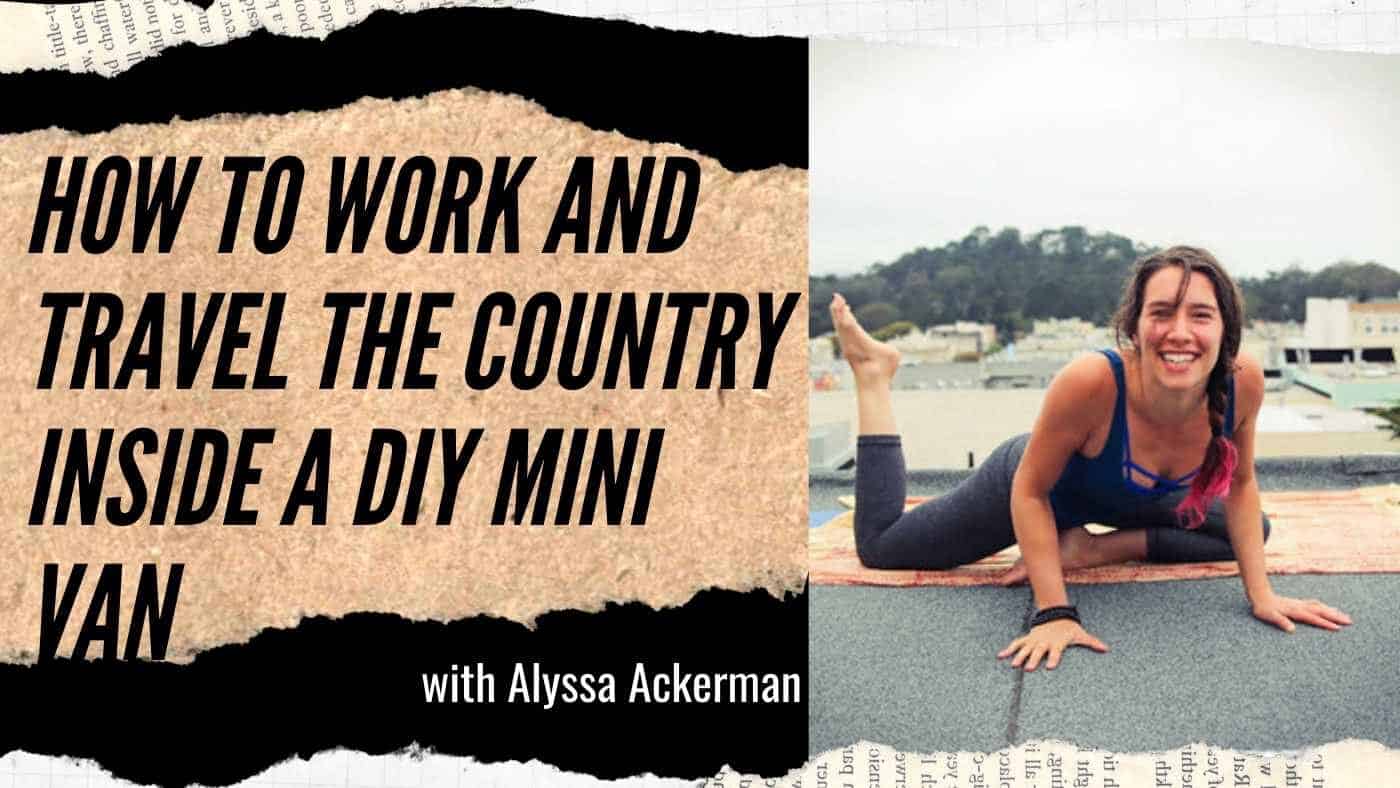
Our Guest Today: Alyssa Ackerman
Alyssa Ackerman (@alyrose15 on Instagram) is a Michigan native with a passion for travel and studying humans. From the road, she’s a Digital Marketing consultant, content creator, yogi, hiker, and photographer. In January 2016, Alyssa headed out in a DIY van to explore the United States. She converted her vehicle into a fully functioning unit including DIY sink build, storage shelf and table, cushions and curtains, extending couch and bed, (even) a solar panel installation. She created an entire DIY section on her website.
Alyssa Ackerman also brought her marketing strategy and social media skills along on the road. Instead of traveling like a tourist, she decided to tell stories. Not just her own, but others’ along the way.
Tools and Resources Mentioned on the Show
- World fest – http://worldfest.net/
- Pema Chodron – When things fall apart
- Ekhart Tolle – The power of now
- Tibetan book – Tibetan book of living and dying
- Brinery – Brinery Hotsauces
- Donnie’s CRV build
- Marie Kondo – LIfe changing magic of tidying – Here’s the video of Alyssa’s cleanse
Show Notes
(Timestamps are approximate):
- [02:40] Who is Alyssa Ackerman?
- [03:18] What triggered Alyssa to start such an adventure?
- [08:20] How is Alyssa journaling her experience?
- [12:00] Who are the people that Alyssa visits/networks with?
- [14:53] What are the most interesting interactions with Alyssa’s network/followers/family?
- [18:20] How is Alyssa trading of financial stability and spiritual freedom?
- [22:57] Alyssa’s comments about freelancing and the new world trends in working remotely.
- [24:41] How is Alyssa dealing with nutrition and health while on the road? (She wrote this article for MindBodyGreen)
- [32:12] How did Alyssa handled the transition to ‘solo-travel-time’?
- [35:40] How does Alyssa deals with emotional challenges?
[38:01] How to spot a safe place to park/sleep in an unfamiliar place?
- [40:55] Alyssa speaks to the use of technology to fight loneliness
- [43:55] Personal finance on the road
- [45:40] How does Alyssa spend her ‘free time’?
- [51:20] Alyssa’s comments about the future.
Favorite Quotes
- My family is happiest when I am not posting, because it means I am living and not thinking about capturing and sharing for other people.
- One major thing (this trip) helped me learn is to be intentional about my social circles. It helped contextualizing it.
- The biggest financial mindshift is simply that I can live with A LOT less…
- I’m not so focused on saving more, but I’m learning how to spend very little and that will continue to be a trend in my life.
- The best place to get sick is on a farm surrounded by people focused on holistic living.
- A big lesson I learned is to keep going. When I get lost, I keep driving. The act of driving is what I do when I don’t know what to do… it feels like home.
Transcript
Transcript
Alyssa Ackerman: Welcome to the Phase World Podcast, engaging conversations that cross the boundaries between business, art and the digital world.
Fei Wu: Hey, what's going on? This is your host, FA W, and welcome to another episode of the Face World Podcast. Every week I interview one person or sometimes a small group of people about their stories. I call them our everyday heroes because I believe they have the most to teach us about life through relatable stories, useful tools and tactics. But it's important to know that there isn't a step-by-step process that's going to work for every. phase world is an opportunity where I learn to see, to understand, and to transform myself and hopefully take a few others along the way. If any of these stories resonated with you, please share with family and friends. Today I have a young woman named Alyssa Ackerman joining me on the show. She is a Michigan native with a passion for travel and studying humans from the road. She's a digital marketing consultant, content creator, Yogi hiker, and photographer. I met Alyssa 2012 at Sapien Nitrol in Boston. This was years before she took on her new journey, which we hear all about in the next hour somehow. I was not surprised, and I knew all the skills she learned at Sapien. Being the marketing strategist, a little bit of a project manager will certainly come in. In January, 2016, Alyssa headed out in the van with her partner Donnie Rex. They had since then parted ways as planned to continue exploring the country separately. Alyssa Avan reminded me of Mick Eing, whom I interviewed on an earlier episode. Mick said, commit first, then figure it out. I think that's precisely what Alyssa did. Preparing for her trip was part of the adventure. Can you just imagine that she's got a a Honda CR-V and converted into a full functioning unit to live in, including. DIY everything. Sink build, storage, shelf, table cushions, curtains, extending couch and bed. Even a solar panel installation. She created entire DIY section on her website, a place and all its creatures.com, and you actually find van conversion as part of the main navigation in the upper right hand corner. So yes, Alyssa is not only prepared to live in a van, she brought her marketing strategy, social media skills along on the road. Instead of traveling like a tourist, she decided to tell stories not just her own, but others along the. Her experiences are real. Alyssa has to look at fear, uncertainties right in the eye, acknowledge them head on. I had nothing but questions during our interview. How does Alyssa make money and manage her finance on the road? How to stay connected to the internet or forget about internet, how to even be safe, especially when she arrives at a less familiar city and how to sustain nutrition health through a proper diet. Because Alyssa provided us with such an incredible amount of information and knowledge for how she did it together, we want to share it with the World On Phase World Podcast. And while you listen, you get head over to phase world.com and check out detailed show notes, favorite quotes, a list of resources recommended by Alyssa. Alyssa also inspired me to minimize my life. So recently I started an eBay campaign where I've listed a good amount of my clothes for sale. Over 150 items, mostly new with tags, gently worn items, A little embarrassing. I know. But it feels so liberating to let go. And by the way, 50% of the proceeds in August will be donated to the O'Malley TaeKwonDo Center in Peabody, Massachusetts, specifically to help support the anti-bullying program designed for children. Without further ado, please welcome Alyssa Ackerman to share her story with you right now. Hello? Hello, girlfriend. Hi. How's it going? Good. You sound great.
Alyssa Ackerman: Yay. Okay, cool. Um, it should be quiet. I'm in the. So it should be
Fei Wu: quiet. Oh man, I, I'm so blown away by your website, your YouTube video. Really well done. Thanks so
Alyssa Ackerman: much. It's been fun, and I'm so excited for you. I'm excited about all you're up to as well. Really? Yeah. This is great. I'm
Fei Wu: so proud of you. Oh, I'm so proud of you, . Thank you. You're onto something on your own. Yesterday I had lunch with Matt Linley. He, if you remember him? Totally. Oh yeah. Great. And he says something about the podcast, and I mentioned to him that I'm going to interview you this morning. He concluded that people doing what we do and many other walks of life is, uh, very intriguing because we might be doing something that other people are not ready for, willing to, or even in, you know, necessarily interested. Creating a craft, uh, out of, so you, you know, we're here to tell the story, so I'm so glad. Yeah, that's great to hear. Tell us a little bit about sort of who you are and where you are right now.
Alyssa Ackerman: Awesome. Yeah. Well, I am Alyssa. I am currently parked outside. Like outside of a Starbucks in Chico, California using their wifi and their coffee Starbucks. I've never been such a fan since moving into a van, and I am, yeah, I'm living in a van. I've been traveling since the beginning of January. I drove away from San Francisco, but my home is really in Michigan. Beautiful.
Fei Wu: Wow. You. This morning I wrote a note to myself, stop asking a million questions all at once and break them down into categories. , I'm sure my listeners are thinking about the same thing. So, uh, tell us maybe the origin story. Like how did this come about? What, what triggered you to take on such an adventure? Yeah, well,
Alyssa Ackerman: Being from Michigan, I went to school at University of Michigan, moved out to Boston for a design position at Sapien where you and I worked together. And while I was there, like I was really committed to working all the time and working really hard and trying to really care about what I was working on, even though like ultimately it was advertising and it was brands that were not my favorite brands, but I, you know, was justifying it all. I was learning a ton, making great connections. It was a great experience. Um, but I, I would work really, really hard and then I would quit and go travel for like six months, um, is what happened to C and then I'd come back and get a job. So this time I came back, I moved to San Francisco and got a job at a tech startup out there. And again, did the same thing where like, I really wanna care about what I'm working on. So working really, really hard and, and again, it was a great experience. I loved the people I worked with. I learned a ton, but I got to a point where I was like, wait a second. Like this still, it still doesn't matter. Like what I'm doing, what I'm working on still doesn't matter. And I just like the, the more time I. There at this company has started to be like, ah, not feeling so good about it and not wanting to be so distinct in the way I was living, in the sense of like full time working all the time. Felt like it was one life and then the vacation or time off felt like a very separate life and I, I didn't want. that to go on forever. Like, um, I didn't want traveling to be a pause from my real life or a break from my real life. I wanted to try and bring them together. So that was kind of one of the missions of this current trip is like, I didn't want it to be a vacation. I didn't want there to be an end date or even an end city. And so I just, I got it in my head that I wanted to see more of the united. Because I tend to leave the country when I have the ability to, or when I'm thinking about travel, I, I go really far away. And after being on the West Coast for a little while, I started to explore some of the nature out there, like Big Sir and Yosemite. And that was so eyeopening that I was like, I need to see this country. And so, You know, I didn't start with a van. I was like, I moved to San Francisco and Boston, partially because I didn't have to have a car there. Like I was not a car owner. I did not want a car at all. . So I was like, maybe I'll walk across the country. And I started looking at that and people are doing that. Like a number of people have done that or are doing that, which was, uh, Fascinating to me. But I took a small road trip last year, um, from San Francisco to Portland, where, where we wanted to take a little side trip. And the little side trip was 20 miles. And I was like, if I was walking across the country and I decided I wanted to take a little side trip, I would never be able to. So then I started to consider a
Fei Wu: vehicle. This is amazing because so much of this story resonated with me. Maybe not in the sense of physically being in a van. It's something that I haven't thought about doing, and I think that would be something that I personally struggle with because I have so much stuff and I'm so used to surrounding myself with things, which I will get to in a second. But it, this whole, the theme that you're painting is what I think is like work hard, play hard, and then. The world, you know, it's not just, uh, drinking, hanging out at the bars. As you know, that lifestyle is very familiar. Working at agency and marketing. Uh, you know, it's almost like a way of forgetting like what we do during the day, but the. Also the theme of One Life. It's something that I've been, you know, contemplating for a very long time, even before I started Phase World. Also, at the very same time, they start traveling. You know, I founded Phase World Inc. As of January 4th and thinking, you know what, you're absolutely right. Why should we always look at. Mondays or Fridays, uh, the same way can I sort of interject, you know, vacation or experiencing life as part of working, you know, so that doesn't feel so routine, like, and it's so ingrained into, um, people's lives today. And it was kind of sad for me. So I was trying to figuring out that part out on my own as. Congratulations. It sounds like you're, you're speaking very confidently and you have a lot of really positive energy Exactly the same way as I remembered you back at Sapien. Oh, thank you. Yeah. You have this wonderful blog and I kind of wanna point people's attention to, and before we connect down Skype, I was so eager to kind of post something out to say, Hey guys, check it out. It's a beautiful blog. I was blown away by the photography. I mean the, the curation of those stories. It's called the A Place and all its creatures. Tell us about, uh, sort of, how are you just sort of like capturing, uh, and journaling, like your, your experience, was this like, thought through at the very beginning or kind of came about halfway through? Yeah,
Alyssa Ackerman: well, the blog, uh, it was very important to me to be working on a project and not just be on vacation. Like I knew I needed a mission or to be creating something because in the past when I've gone traveling for five or six months and I'm just a tourist for five or six months, I, I don't like, Feels, um, when I'm not producing something. So I personally have always been really interested in human ecology and the relationship between how someone is both impacted and impacting their natural landscape at the same time. So the name, a place in knows creatures comes from a Wende berry quote. Um, when he talks about you can't judge the health of a community by anything less than looking at or studying a. And all of its creatures. So that was a major inspiration for, um, the project. And so initially it started off quite structured, being a planner by profession, it's been a practice to like bring that down a little bit on this kind of project. So I, I was like looking at, you know, the United States and trying to think. About different landscapes that exist here and was really curious about studying communities that exist in these different kinds of landscapes. Because I feel pretty convinced that if you grow up in a community whose identity is inclusive of the natural world, then you think differently about like self and external, um, forces differently than someone who grows up where it's like, you know, us verse the wilderness, or it's us against the. Um, so it started off focusing on a few specific locations where 10 days would be spent there, and I would be focusing on just connecting with people in, in that space and in these particular groups, whether it was around art or music, or. There were a variety of different communities. You know, , there were a few issues with this plan. One being like 10 days is just so short, not enough time at all to really get to know people and get them to talk honestly with you. And also didn't really schedule in production time. So by the time, um, new Orleans hit and. There were all of these really intense conversations we're having with people down there. We, when I say we, my partner and I started this project together, Donnie, and so we kind of shifted our focus and so the blog has been a mix of kind of interviews with people we're meeting along the way. As well as just like process and what's going on and where we're at, which has been, it's been a really fun, it's been really fun for me to, yeah, do like to be photographing and writing a lot about the process. I've been, more recently, I've been writing. Kind of offline because I'm really practicing writing very honestly, and not just kind of the Facebook version of the trip. And you know, this place was beautiful and this person was great, but like the more specific details and some of the harder stuff
Fei Wu: too. Yeah, I love that. And then this is, I feel like this is a more adventurous version of the Face World Podcast. You know, I'm sitting, uh, in my home comfortably with my cup of coffee and my newly installed blinds and computer. You know, these things that I, as part of my plan. But, um, I'm really intrigued when you mentioned people, where are you seeking them out? Who are these people like? I mean, you're, you're traveling, right? You're, these are not necessarily. At all your friends and people you've known at all where, have any connections through? Who are they?
Alyssa Ackerman: Yeah. Well, so, um, we've been very lucky a few times. I mean, when we got to New Orleans, we were, I was staying with one of my friends, but like I wanted to focus on art while we were down there and the community of artists that lived there. And this woman, Kaia, who's someone I've never met, but she found us online, she wrote and was like, oh my gosh, if you're in New Orleans, you have to talk to all of these artists. And she and I were in touch and I mean that made the New Orleans experience completely different than every other experience because we were kind of vetted And so it allowed us more, it allowed us to get deeper into that community. Beyond that we . It's so funny that you ask, because I started writing about this when I was in Little Rock, cuz it is so awkward. Like , you show up to a new town and you like go to the bar or you go. To a park or whatever, and you're like, okay, like here I am now. How am I gonna get strangers to like be my friend or talk to me honestly. And then maybe get on camera , I mean, Definitely being out in public. I started to set up meetings before I got there where I would just search for local muralists in New Orleans or local musicians in Little Rock. I went on Craigslist and that was fantastic just to look at all of the people looking for band mates and then you could. Start to ask if you can interview or ask if you could grab a cup of coffee and hear about, uh, their experience as a musician here. Um, in Little Rock, we went to a show our first night and started connecting with some of the bands that were playing and some of the pe, the people who owned the venues and things like that. But definitely an awkward . A experience.
Fei Wu: Yeah. But what you just said reminded me. Pretty famous saying it's been repeated by multiple people. Is that an interesting person? Is someone who is interested? So, you know, since I've been doing what I'm doing podcasting wise for nearly two years, I know that sometimes we discredit ourselves for saying we're just there. We're just facilitating. We're. But there's so much more to that, even as an third party, you know, just an outsider listening to this, and I feel that now I'm even more interested in the arts in New Orleans. I'm more interested in the people in Portland because my connection through Alyssa, you know, especially in a way that I feel like your energy and your stories resonated with me so well. That intrigued me even more so to discover what you are discovering through your own. You know, something very powerful. So I, I wonder if you feel the same way, and I know you're posting more regularly on your blog on Facebook. What are some of the comments and kind of interactions with your existing network that you find interesting?
Alyssa Ackerman: Oh my gosh. Well, yeah, I'm so happy to hear that. Um, the blog is providing, like inspiration for people. Exactly. To answer your question from the people who I'm CLO am very close to, um, just in my day to day life, really close friends and family, they are happy. Well, it's been, it's been said that like they're happiest when I'm not posting. because it means I'm living and I'm not thinking about capturing it and then sharing it for other people. And so I do feel that a lot, but I also then hear from people, a lot of people like that they're enjoying, they're enjoying the stories and the blog, and so I definitely feel somewhat conflicted about , how much sharing and like when do I. My own lens on the experience and take it away from like needing to capture it or photograph it to just being in it. Um, definitely. But I know a lot of people say, oh, I wish I could do that. And I used to wish I could do that. And it's really, really scary, um, when you're thinking about jumping into this world that you are not a part of and don't know anything about. And like both of your feet, I was completely in tech startup San Francisco and I'm thinking. Other thing that's over there and I don't know it. Um, and so it's scary, but like you can, you can all do it. It's just, um, one major thing that helped me do it was recognizing early on that if I was going to make this jump, then it was important that I be intentional about my social circles. So I started to spend more of my outside of work time with people who were doing this kind of thing, or crazier. And that like really helped like contextualize it for me because talking to my peers at work, um, it seems so crazy to do the thing. And then I meet, you know, a bunch of people living in their buses and their boats and I have been for seven years or whatever, and you're like, oh. Everyone's already doing this. This is
Fei Wu: normal. That's right. And there's something really powerful to be said, uh, by what you're doing is, it's funny, literally the day before this interview, I published a blog post on Face World called, you know, financial versus Spiritual Independence and Independence. I guess it can be swapped out. By, you know, freedom and and such. And I wanted to write this so much because of the situation that we're living in, we're believe we should be living in. And I was also intrigued, just randomly come across this video. Uh, by David as Rose talking about what is the ultimate entrepreneurship. So he used the term immigration, but in a way you're, even though you're not, you know, you're not immigrating to another country, but you're immigrating into a different lifestyle. And as soon as I published this, I got a couple of. Comments talking about, Hey, is it kind of wanna hear your feedback on this, is financial stability needs to come first before you can practice, uh, spiritual freedom. So last night I thought so deeply about this. I published sort of a part two to the article itself. Is it, is it possible to even exercise spiritual freedom without financial stability? I think the answer is yes, though not without challenges. You know, I feel that what you're doing is a shiny example of saying, you know, I'm interested in, I'm sure many people ask, how could you, are you living off of your, you know, some savings from before? Um, where, how are you thinking about this as well? How are you managing this process? That's
Alyssa Ackerman: a great, okay. I'm excited to read this blog post of yours, . Uh, yeah, I mean, like the biggest financial mind shift is simply that I can live with a lot. I mean, um, I was paying my bedroom in San Francisco costs $1,400. A month. Um, and so, and the van, I'm living in costs like six, about 6,000 ish. And so the cost right now of living is very, very low. I think I'm living partially off of savings, and also I am working very, very part-time, like six to 12 hours a week from the van. From Starbucks, uh, parking lots, uh, teaching classes online, so a tiny bit of income that really helps even it out, so I don't feel like I'm just paying, which adds stress. It's just very mental . Like I am not so focused on making savings right now and putting money in the bank, but I'm living very lightly. Like I'm learning how to live with very little and spending very little. And so that's something I think that. Continue to be a trend in my life and continue to help me not be spending all of this money that I can save and also still live really well. So, yeah, I mean, major expenses are gas cuz it's a diesel van, um, gas, food, and then like maintenance. I'm going to the mechanic today, so fingers crossed. Yeah, financials really help you feel secure, but so do so do relationships, and that's a big part of why I started this trip too, is like I have great, amazing friends and family and if something went horribly wrong, I'd be able to like camp out in their driveway for a while. And so that is very, very comforting.
Fei Wu: It's, it's interesting how I realize how, just how poised, how cur in a way that, you know, seems like because you've been telling and sharing your stories, your thoughts are very clear. And I don't know what I'm saying this in a very surprising way. Maybe because you've been doing this for, at this 0.7 months already, and with planning as a PM as a designer from maybe 2015, Intrigued me, but when you said classes, teaching classes in your van, what are the classes you're teaching and who are your
Alyssa Ackerman: student? I'm still teaching, well, I'm, so, I haven't left the other world completely is the answer. I'm teaching digital marketing classes with general assembly. Um, so I taught with them 10 week on, on campus courses, well, in San Francisco, and then they offered up a, an online version of that where you have. So I am a mentor at, which means I, I'm doing one to one sessions with students and I've taught a few fuller, like fuller UX and digital marketing kinds of classes with them as well. So basically it's, you know, defining. Business objectives, creating personas and journeys outlining like what your, your marketing campaign and budget would look like, stuff like that.
Fei Wu: No, this is great because I'm thinking there's another very important lesson here. It's career on the go. Right. Definitely. You know, because that's something I. I found so attractive is that questioning. Do we all have to sit in an office at the same place, uh, have face-to-face meetings? Granted, sometimes it's better, right? If I had the choice, I would obviously choose really, to sit next to me and have this conversation, but the world has drastically shifted in to it. Different model. Uh, you look at many different companies, you know, started even just with the internet. The internet was founded by people who from different countries and never, never knew each other at all. Didn't even speak the same language. Today, you know, a lot of these, you know, the company Atlassian, I forgot the name. Mm-hmm. , and, you know, were press and, uh, envision, which is a UX tool. I'm sure you know, you know, everybody's. Again from home and more or less choosing their own hours. Some company's more flexible than the others, and I've noticed a lot of that through my own work. You know, at times, working from home and going to the office one once or twice a week, and then the rest I can work in the. Backyard and the park, you know, ideally I could even work next to, you know, in the van, next to Starbucks, in my choose to.
Alyssa Ackerman: Totally. And it's, you know, some days are better than the parking lot of Starbucks. Some days are like way up on a hillside, over, like in Mendocino, looking out at a lake while I'm making coffee on, on my little camp. So that's been like very convenient and, and a lot of the students are from all over the world. They're in Australia and Poland and like everywhere and. The other small amount of income that I'm doing is working with a company called Hip Camp. And if you haven't heard of Hip Camp, I love , I love them and I use them um, as a camper. Basically. It's like Airbnb but for private land. So if you own 60 acres of land, you can open it up to campers and I. Go like early on to sites that are just opening. I help verify them. So I will go and photograph them and leave, you know, like kind of do a little write up about them. And that has been really a really amazing way to see a lot of. To see just private land and to meet with land owners who are excited about sharing this beautiful space that they have with other people and working with this great small startup. I think they're out of San Francisco. Nice.
Fei Wu: I will definitely include these links and resources because, uh, this morning I also remembered one of my other friends from a different, uh, agency I worked at Digital Influence Group. She was also a woman. She was contemplating doing something. , you know, very similar. Um, and I'm sure she had her anxiety, but listening to someone who actually not only started it, but lived a lifestyle for an extended period of time is really helpful. And speaking of convenience, I noted down, you know, I'm kind of just curious. You're, you're young, you're very healthy. How are you managing food and sort of health, you know, medical stuff when, I mean, food is more like an everyday thing, whereas, you know, uh, medicine is more maybe once in a while, you know, if that, so how do you, yeah. How do you deal
Alyssa Ackerman: with that? Um, let's see. I mean, as far as food goes, the one thing that's really made my life so much better on the road, food-wise, Making my own sauerkraut in the van, so I'm fermenting cabbage all the time, and that has been like, made it way more tasty. I also have a friend in Michigan who owns, um, a fermenting company called The Bry, and he sent me off, like he and I used to work together in college. And so he sent me off with a bunch of. Awesome hot sauces. So hot sauces really make beans and rice of any kind, taste better or different. So , I eat a lot of beans and rice, and I make a ton of, well, I call it Kari, but I think everyone else calls it kaari. It's like a one pot dish, basically. It's rice, lentils, fresh ginger root or ginger root, tumeric root, and then any vegetables that you want. And I'll just make a ton of it. And. For days. Um, I also have been better at, um, buying produce. Because just eating rice and beans or bread and peanut butter gets old. I buy like a big thing of spinach and avocado and make salads a lot, as well as just apples and bananas. Um, food is really a hard balance because I hate Walmart. And Walmart lets me sleep in their parking lot and. And like I, so I go to farmer's markets when I can food co-ops occasionally for certain things, but they, it's very expensive. And so that is like an ethical, like a deep, I'm on the line of my consum, like my food. Consumer behaviors all the time.
Fei Wu: Are you a vegetarian by chance? Yes. Oh, you are? How long
Alyssa Ackerman: has that been? Uh, like seven years.
Fei Wu: Oh, okay. So this is like way before the trip that you already kind of used through the diet wasn't because of the trip? Right. Yeah. Okay. That's really interesting. And the way that you described the food actually sounds really delicious.
Alyssa Ackerman: Oh my gosh. I've been surprised lately. Like I've been eating really well and actually I met up with a friend recently who's been living. This kind of way for a long time. And that helped reinspire some of my food, my food habits and like oatmeal and making your own granola and, um, just like making tacos and reusing stuff in an interesting way. So yeah, you're always, you're always picking things up from other travelers. You meet too. I met someone in National, um, national Park in Oregon who's traveling around the country. Motorbike. His, he's called, um, Les is more travels. He has a blog. I'll send you the link. Uh, and he had all these great ideas too, like instant mashed potatoes that you just add water to and taste. Amazing. I never , I was not thinking about that. Um, So you're always like picking stuff up from other other people as well.
Fei Wu: Yeah. Maybe there's, uh, I saw that on your website you carefully curated sections that are probably more popular, more frequently asked questions. Maybe there could be a food section as well, like tips and tricks on how to make, you know, instant potatoes and something along that line.
Alyssa Ackerman: That's a great idea. And actually I did write an article for Mind Body. Body green. Mine green. But I'll send you the link as well about eating on the road and like the different kinds of days that you have and how that affects, um, what, what you eat. I'll send you that link.
Fei Wu: Oh, awesome. I, I wrote down a bunch of links, you know, hip camp and, and then, then the Hot Sauce website will be great if I can get a list and I can certainly feature some of that, uh, in addition to your story.
Alyssa Ackerman: That's a great question. That one is like, definitely trickier. Um, So I have health insurance and it's through Michigan. So when I went through Michigan to hang out with my family, I went to the doctor there and like I went to the doctor before I quit my job last year and everything. And so mostly just trying to continue to be an eat and live a healthyish ish life. Um, like. I have some amount of allergies and asthma, but I, I spent some time on a farm and they were like, oh, do you know about Mullin, uh, this herb that you can make a tea out of, which is great for asthma? And so like, it's been, I knock on wood as I say this medically, it's been. Pretty gentle and easy. I hate saying that out loud, , but yeah, and I hope it keeps going that way. No,
Fei Wu: it's great. I think also when you know when you're on the road, because I was in China for three weeks. I got back just about two weeks ago, and. I came across a, a medical condition that it was very surprising to me because like you, you know, I barely go to the hospital and I, I barely get a cold and, and all of a sudden because of food I was eating and it was so much seafood. You know, even living in Boston, I eat seafood all the time, but not. Never for breakfast, lunch, and dinner. And the way it was prepared just made me, uh, very sick. And then I was really nervous for a second, and especially for me, this sounds funny. I was living in the hotel, but it was in a sort of a tier two city area and was very new to the area. So I just remember feeling anxious on top of a, not a very severe, uh, illness at all. That's why it triggered me. Kinda ask the question, but sounds like you have this more or less under control. And also I realize that, you know, especially Massachusetts Partners and Health have a lot of these, uh, clinics just off the street. Very convenient. So do you see much of that at all Where, where you're traveling to or you staying in major cities where kind of you're in some rural areas as well?
Alyssa Ackerman: Yeah, I'm saying both. And the one time that I did get really sick, I was very lucky in that I was living on this farm outside of Asheville, North Carolina. Um, the farm is called Snaggy Mountain and I was wing there, and so like, if you're gonna get sick, the best place to do it is on a farm surrounded by a bunch of people who are like really focused on holistic, like holistic living and food as medicine. And there's tons of couches and tons of musicians. So I could just lay on the couch and for like days and you know, you're laying there. Musical jams are coming in and out and people are like, oh, you know, I was thinking about you like what you really need is red clover tea. And so like everyone was so loving and like caring at the farm that I felt really grateful it happened there and it, it felt just like my time was due to be sick. when was this?
Fei Wu: That was in April. Oh, right in the middle
Alyssa Ackerman: of, yeah, yeah, yeah. And so that was, that was good. Other, otherwise like everything's been pretty minor and knock on wood again, but yeah, I go back and forth between big cities and like public land way out where you don't see any other humans and that is interesting. More than my health is like the health of the van. Of, of like the exploding tires or the van breaking down and not having any service and not really having any know-how about making a van work when it doesn't work.
Fei Wu: Yeah. I know you were traveling with a partner and then you know, that you, you guys parted ways and now you mentioned this car, like mechanical situation. I mean, I am completely useless when it comes to a car. Breaks down, we're having even minor issues to be honest. Uh uh, I feel very feminines for saying that, but it's just an area honestly, I have no expertise in. So, uh, tell me a little bit more about the, the parted ways and you know, how maybe you have to kind of evolve a little bit in terms of what you need to do for the trip. Yeah,
Alyssa Ackerman: so Donnie, uh, and I were together for like three years and even going into this project, we knew we would part physical ways. Um, I, I really wanted solo travel time and he was interested in hanging out in Asheville for a while, his family out there. So, um, like the, the trip was planned that in mind. And then when we were in New Orleans, we really kind of came, like we agreed. We weren't talking about what it meant for the relationship, we were just talking about what it meant for our physical bodies in space, like going different ways. And so we kind of agreed that it makes the most sense right now to actually just break up, um, when we go separate ways. That way we can celebrate each other and not feel like obligated to, I don't know. It made sense because we didn't have a clear idea of when we would come back together. So we're in this kind of open relationship that's also a long distance and the end or the reconnection is ambiguous. So it just . It didn't feel great. So we were like, let's just call it now. Well, we still like love each other so much. Things are really, really good. We can be great friends and we can help each other transition and do it together. So we decided that in New Orleans, and honestly like once we, we were like, okay, we have one more month. Then we had the best time ever and it just like took some of the stress away. So Asheville, like we, we started looking for a car for Donnie and Donnie bought a CRV and built it out so that he can live it inside of it too. He can sleep in there. It's, I'm really impressed. I'll send you the link to the blog about this build. It's pretty impressive. Um, and, and then yeah, we, I mean we still talk all the time and our really close. And I, I continued going north. Um, he stayed in Asheville and we ended up meeting up one more time, um, I think it was in Iowa, in May. Yeah. So that's been really nice to ha like transition out of that kind of relationship into like a really close friendship. I feel grateful that he, and that our friends and family are all so. Yeah, I,
Fei Wu: I just accidentally played the video because I was, uh, looking, uh, to see when it actually happened. I think it was around April as well when you parted ways. Yep. Okay. So it's been quite some time and I have a lot of respect for that because, I feel like in a way that your experience is almost telling an opposite story of what a society is teaching. All of us kind of, again, ingrained and inside all of us. For some people, you know, myself included, decades. So it's kind of scary to even undo and unlearn and when I tell young people, or even people my age or even older to say that, you know what, I've spent the past few years really unlearn a lot of the things I learned along the way of. being an adult. Um, so emotional stability is something that I have to say, you know, I'm, uh, at faults as well. It's, I also find that to be really stressful to manage. So the way that you're talking about is being very, very open mind. But I'm sure there are times that feels difficult, especially when a car breaks down, when there's no, no guy friend to kind of rely on. So tell me a little more about how do you deal. Kind of stressful moments without a lot of people around. What are the things you do? Do you go on a mountaintop? Do you go grab a Starbucks coffee and do you meditate? What do
Alyssa Ackerman: you do? Good question. I mean, the big one that I've learned, and I had no idea before I started this, is like you just keep, you keep going. So like I . Was in Michigan. I went on this 10 mile hike up in pictured rocks. Pictured rocks is unbelievably beautiful up in the up. And I, I kind of got lost and I was like, huh, I wonder, you know, like if I don't see the next chill marker in the next hour, I'm thinking to myself, I'm like, well then what? Um, and my answer was like, well then you keep walking. Same with jiving. When I. I'm like, well, if I don't see this thing and then I, I'm supposed to see this thing and if I don't like, what am I gonna do? It's like, I'm gonna keep driving . Um, like those become the options, which is kind of comforting. Um, . So, and, and honestly, uh, at the beginning of this trip, I felt really excited because I'm like, Hey, I get, this is great. I get to pick a new home every. But the reality is like driving the act of driving is what I do and I don't know what to do. Like, and that's what feels most like home now, is like I just keep driving. And that happened when I was up in northern Michigan. I got to this campsite and it was the only one nearby and it was $20 a night to put to sleep in my car. And I was like, this is stupid. I, I don't know what to do. I don't wanna stay here. And so I was like, well, I'm just gonna keep driving and I. It was like nine and I drove for five hours until I got to Wisconsin, like mid Wisconsin and uh, where camping was also $20 for me to sleep in my van. But driving is generally what I do. I also do try and just sit outside and like I am, I have a lot of fear when I show up someplace and it's nighttime and I can't see it before I sleep. So if I get there, I try and get there during the day and then I try and like really be in that space and explore the space before nighttime and that helps me a lot.
Fei Wu: Yeah. Safety is another area I kind of wanna kind of elaborate on a more, you just gave one very important tip is to study the area. Uh, I'm sure you've also experienced not having enough time to study the area before you have to kind of settle down and just park what. , what are some of the, you had mentioned there's like hip camp and the kind of places that are more manageable, but when the, when those options are not available, like how do you kind of spot out a place that is safe Yeah. Appropriate to
Alyssa Ackerman: stay in? That's a great question. I mean, if I have to, I'll pay for a campsite, like if it's really late or something like that. I d I don't love doing that. That's like the luxury piece. Otherwise, Walmart parking lots are generally pretty good. I don't necessarily sleep that deep there. There's so much going on and there's so many carts moving around and there's bright lights and stuff, but, but generally pretty safe. I've been sleeping more on residential streets lately, like since Denver is when I really started to feel comfort, more comfortable doing that, and that is always an interesting experience. I mean, I just. I go to bed when it's dark out and then I wake up super early. Like this morning I woke up before the sun was up and I head out and I just like climb into the front seat and go. And that's, I try not to park around schools or police stations cuz my ban doesn't look, it's not warm and welcoming. It's afford to kind line and it's just white and there's like no windows. So I just giant park somewhere that seems off of the main roads. Otherwise there's public lands and national forests where it's fine for you to pull off on camp in most places. And so that's been like, that's really beautiful. I, I always wish I had. More wilderness survival skills, but I, you know, I'm also in a big steel box, so pretty, pretty good that way. So that's what I prefer is to be out if I can be out camping. There's also a website I use all the time, it's called, Free campsite.net. Mm-hmm. , and they highlight exactly that, um, all over the country. And they'll also include ones that aren't free. But that's a really, that's a resource I use like every time I'm trying to find a place to stay. Mm.
Fei Wu: It's good to know that there are resources out there where, think about 50 or 20, 30 years ago when there was no resource. I mean, this is where like digital, digital marketing can be very helpful in people's lives. Just glad to definitely recognize that, you know, and, and, Area or theme that you're painting is, I feel like people in the modern world are struggling with one thing and parents know what kids know it is. Uh, learn how to be alone. You know, I find that that's something that I even, I struggle with. You know, when I hear people, uh, saying that I could never be a freelancer work at home is because I don't wanna be alone and. You know, where I don't know what to do with myself if I'm alone. I just need to surround myself, uh, with people all the time. And then I start sharing my experience to say, okay, you can actually get around that. Right. Is that worth sacrificing your, you know, your being, your life just to be, uh, surrounded by people? What are there better ways to kind of be alone and just be more productive? that makes me think about, you know, how often do you find yourself in a van or outside be on a digital device, whether it be a cell phone or like a laptop.
Alyssa Ackerman: Yeah, that's a great, I mean, I'm so glad you bring that up, . Just the, the necessity of alone time. Actual alone time. Like not texting in the van alone time. Cause it's not quite the same. Um, basically I have recently decided, okay, like I'm gonna work three days a week and the rest of the time kind of be off and exploring and. Driving. So like Monday, Tuesday, Wednesday, I are the days that I teach. And so on those days I will spend more time also, you know, photo editing or like catching up on emails, things like that. I am on my phone because I use it for music and navigation a lot. And then I try not be on the computer on my not work days as much as possible, which has been really nice. And you know, when you get. Public land and you get into the national forests and parks generally, there's just absolutely no service that helps mandate your, like your alone time and keeps you off of the phone. Otherwise, it's been. A balance. It's definitely a tendency for me to pick it up when I'm scared or alone in a new place at night and I'm like looking to distract myself instead of just be with the be with feeling scared . So that's definitely a continued practice for me wanting to disconnect
Fei Wu: even more. Yeah, definitely. And. I don't know how often you make phone calls or spend time chatting with people. Again, Skype is very convenient. I know you kind pay once and then you're covered for the entire month, but do you do that or do you have a very extravagant cell phone plan that you're sticking with ?
Alyssa Ackerman: Good question. I call a lot, like I call my family a lot, my mom, dad, and sister every week. And uh, I talk to Donnie and other friends a lot. I really. Part of this trip was also about placing or giving relationships in my life more priority than I do when I'm really busy working in the city. And that feels so important. So I have like, that's definitely an intention of this kind of life right now to, to put more time into those relationships and staying in touch with people and writing postcards, which I'm horrible at sending, like I have a bunch of postcards that are written and stamped and. Um, that have not made it into a mailbox. But . Um, so yeah, I, I use phone. The phone mostly a little bit of Skype is just, if I use Skype, then I need a data, I need wifi. And I have actually, I, I work a little bit with a company called Karma Go, and they provide some wifi for me along the way, which is awesome as well. Nice.
Fei Wu: It's, it's good to negotiate, uh, some of the sweet deals before you. Kind move on. And you know, we kind of underlying theme here, which one question I forgot to ask is, have you done a weekly or monthly budget to see, you know, the, between the gas, the food, how much it would cost on a monthly basis?
Alyssa Ackerman: I should and I haven't. We started, Don and I started at the beginning, but every month was so dramatically different. because like we're either, you know, in New Orleans for 10 days versus in the desert for 10 days. Mm. And so it changes dramatically. But actually I feel like, feel committed, I can do this. Maybe next week I will do at least a weekly budget. Yeah. Um, Because it's, that would be very useful for me as well.
Fei Wu: Yeah, because I think, you know what, I'm interested, maybe you have done that already because you posted so many on your blog and since last night I haven't had a chance to kind of plow through everything is I would be interested in a story to talk about, uh, your. You know, I, I mean our, our podcast will become sort of that very extensive blog post, but even in details how much it actually costs, because I think people will be shocked to see that at times, you know, living in the desert versus Sure. Living in the city will be a little different. And, and then on top of that, the hours that you are working, you know, 12. 10 to 12 is very different than 40 to 60, as you know very well in your previous life. Yeah. And you know, and then kind of just paint that picture. I'm sure people will, some people will say, look, you don't have three kids yet, this and that. And that's, that's true. Uh, and I've also seen documentaries where, Parents who take their kids kind of travel around the country and is so intriguing and I, I have to send that. Oh, speaking of, yeah. Speaking of like films and stuff, do you, what do you do with your, uh, free time? And I don't think you actually have a necessarily a ton of free time just. Running from places to places, I have to cook meals. Um, but do you watch Netflix? Do you, what do you do in your downtime?
Alyssa Ackerman: Yeah, I thought I was gonna have all this free time being unemployed and , uh, turns out, uh, that I don't because , but, um, but yeah, I, you spend a lot more time like just living, which, when, when you're in the city and working a real, like working a full-time job, that stuff feels so, like, such a chore and so inconvenient and stuff you don't wanna do. I spent so much money on convenience when I live in the city so that because I don't have the time, I feel like I don't have the time to cook and to clean and to do like to walk. Five miles to work instead of, you know, Uber or whatever. Mm-hmm. . So I do like, a lot of time is spent preparing food, cleaning up food. Like, um, I read, I've been reading a lot. I just finished another roadside attraction, which is amazing. Mm-hmm. , um, I can't believe I hadn't read that earlier. That's Tom Robbins. And then a lot of writing. I'm spending a lot of time writing. I don't spend that much time watching movie. Because I don't usually sleep somewhere with wifi, like that kind of connection. And I don't, I'm really bad at watching stuff in general, unless I'm doing something else as well. Uh, the attention span thing. But, um, otherwise like hiking a lot and I've been volunteering a little bit. Like I just, last weekend was volunteering at the World Festival in Grass Valley, California, which was musicians from all over the. So lots of listening to music and meditating and trying to be, yeah, just be
Fei Wu: outdoors. Mm. How do you follow any sort of meditation apps or books that you recommend? Um,
Alyssa Ackerman: let's see. I, I mean, I love Pima Chodron and her book when everything's falling apart, but it's not called that. It's something like that. She's great. And I also, I'm reading the Tibetan Book of Living and Dying. Those aren't specific to meditation, but they touch on them. I was a fan of Eckhart. Totally. The power of, now I'm, I mean, I'm really interested in mindfulness meditation, where you're like, you're not jumping into the. That you're having, but it's not like, but you're aware of them and you're watching how they're connected to each other. Mm-hmm. . Um, I'm interested in that because I, I can really apply that to my day to day life and just take on a mindful perspective in my actions during the day. Um, I'm gonna, I'm heading to Washington in August to do a 10 day silent meditation of the. Which isn't, uh, mindfulness meditation, but it is a different kind. But I'm excited. It's gonna be really hard.
Fei Wu: I'm excited. Washington State. Oh, nice. 10 day. Okay. You owe me a lot of books and links, which I'm taking notes, . Yep. This is a, this is really wonderful. I, I cannot believe we've been talking for an hour. I feel like it's been 10 minutes. I know, me too. Wow. This is a, uh, so, so interesting and you may have noticed that there's a theme on. On the podcast as well is because I sometimes struggle finding women who are willing to share their stories, and there are many more men who are willing to line up. So I'm just so glad.
Alyssa Ackerman: Well, we had that exact same reality, like when we're trying to get people to talk to us, it was. Mostly white men. Mm-hmm. , uh, which was amazing, but we were like, wait, like it was such, it was really hard for us to, to get some women to chat with us.
Fei Wu: Yeah. I, I was really surprised because I came to the realization very early on to think that, wait a minute, our women often said to be the talker wouldn't shut up and com, you know, all these things. I'm like, wait a minute. The reality is different. So yesterday, When I talked to, uh, my previous intern, I'm not sure if you met him, Sam Schrom, who's a UX intern at Sapien back in 2011, and then he is now joined as a full-time employee at Sapien. And he told me he read this research and I want him to share that research with me, is that when men find that women are talking more than 25% of the time during the conversation, they believe that women are talking too much. What? Yeah. Isn't it interesting? Like, because all these things that. That I thought of. He was like, okay, growing up mom's gonna talk more than dad because that's just understood and that's the, the standard. But turns out like just running podcasts, I realize it's not true that women talk more, women are more likely to not only talk about themselves, but other people, places and things. And, uh, and also asking, uh, me questions as as it comes up. So, You know, sometimes a lot more interactive. Granted, I praise all the men on my show because I do select them very carefully so they don't create this kind of monologue, you know, without direction. So fascinating. I know, and I feel like you're kind of just enjoying life as things, you know, as you. Choose and as you kind of approach different things and experiences and, uh, I, I just wanna say that I absolutely fully support you. Whether this is something you wanna continue doing as long as you, you wish to, or if there comes the time that, you know, you feel like you're ready to experience something different, I find that to be perfectly okay as well. Thank you so much. Yeah. Do not let anybody to pressure you to choose one or the other, which obviously. I don't think you sound like you're .
Alyssa Ackerman: Well, it's been, I mean, that has been such, I didn't realize like how much time and energy would be spent with that kind of mental practice for myself of just. Especially spending a month with family around graduation time, just like reminding myself and re-articulating and expressing what I'm doing and like a lot of conversation around, okay, but like, what's after this? What are you doing? Then like, when does this end? Mm-hmm. and, and me constantly coming back to like, oh no, like that's what I'm doing is I'm just doing this now and I'm not deciding. The end looks like, or where I'm headed before I do this. Mm. Um, which has been like coming back to that over and over has been really, um, useful and a little bit exhausting, but mostly most useful in making me feel really like certain in the decisions that I've been making for myself. Absolutely. Thanks. Yeah. Thank you for having me. It's been great chatting. Absolutely.
Fei Wu: Uh, so enjoy this. and uh, do you mind me asking how old you are? 27. Oh, you're 20, okay. Yeah. You're still baby . Yeah. I think it's, uh, really amazing for, for you to do this at, at the point, you know, some could argue that 27, all the steady relationship of marriage and kids, and I think you'll be really just so much happi. To choose to do this for yourself first. And you know, I must say that because of what you do, whether this is, you know, permanent or impermanent, I don't believe anything is permanent in this world. But that's, you know, the stability is only an illusion, which I'll send you the article I wrote. It's just beautiful because I wanna say that whatever you're experiencing will will only benefit you in the very long life you'll be living. Because, you know, even for me to snowboard for the entire winter, that was the most incredible thing ever. And shortly after that, you know, I mean this is not to have a set up and on a very grim story, but, you know, I, I think about just being immersed in the nature and the beautiful things I saw. And, uh, you know, much later on what my. When I had to take care of my dad in the hospital for, um, a period of time, I just remember closing my eyes and being able to remember that and to be mentally and physically in a very different place because of what the natured and sort of just people inspire me to think about. So. Right. Yeah. I think this is a great experience. And also just the, what a large creative library that you've create, you know, sort of the memory that you've created for yourself and other
Alyssa Ackerman: people. Yeah. And, and. Um, the blog, I'm, I'm feeling reinspired to keep, keep being more regular with the blog, but right now the most regular, um, place I'm hosting is on Instagram with, uh, all Rose 15 is the handle that's been the most recent Pacific Northwest. Photos and
Fei Wu: such. Great. So let's just, uh, repeat that real quick. So Instagram, uh, the best way to connect with you will be Instagram.
Alyssa Ackerman: Yeah. Allie Rose, a l y r o s e 15. Okay. I will
Fei Wu: include all the links, uh, and also Facebook and YouTube, uh, and the website.
Alyssa Ackerman: Great, and I'll shoot you an email, but thanks so much for having me.
Fei Wu: Oh, thank you, Alyssa. Yeah, please stay in touch, definitely. Okay, bye. To listen to more episodes of the Face World Podcast, please subscribe on iTunes where visit face world.com. That is F E I S W O R L D, where you can find show notes, links, other tools and resource. You can also follow me on Twitter at Face World. Until next time, thanks for listening.
Media Links
To learn more about Alyssa and stay up-to-date on her journey, visit her blog: http://www.aplaceandallitscreatures.com/ and follow her on Instagram.
If you are on Facebook, why don’t we connect there?
Written by
Fei WuFei Wu is the founder and CEO of Feisworld Media, a Massachusetts-based digital media company helping brands get discovered by people and by AI. An Adobe Global Ambassador and brand partner to ElevenLabs, Synthesia, and 50+ other tech and AI companies, she hosts the Feisworld Podcast (400+ episodes, 500K+ downloads — guests have included Seth Godin, Steve Wozniak, Chris Voss, and Arianna Huffington) and co-created the documentary Feisworld: Live Your Art on Amazon Prime. Fei writes for CNET, Lifehacker, and PCMag, and her work has been featured in Forbes, Harvard Business Review, and WIRED. She has been publishing on the internet since 2014 — long before AI discoverability had a name.
View all posts by Fei Wu→Stay updated
Weekly insights on content, AI, and digital media.
Keep Reading
Related Articles
Joanne Lipman on Mentors, Untapped Talent and Why Women Should Stop Waiting to Be Perfect
Marc Randolph on Curiosity, Messy Starts and Why “Nobody Knows Anything”