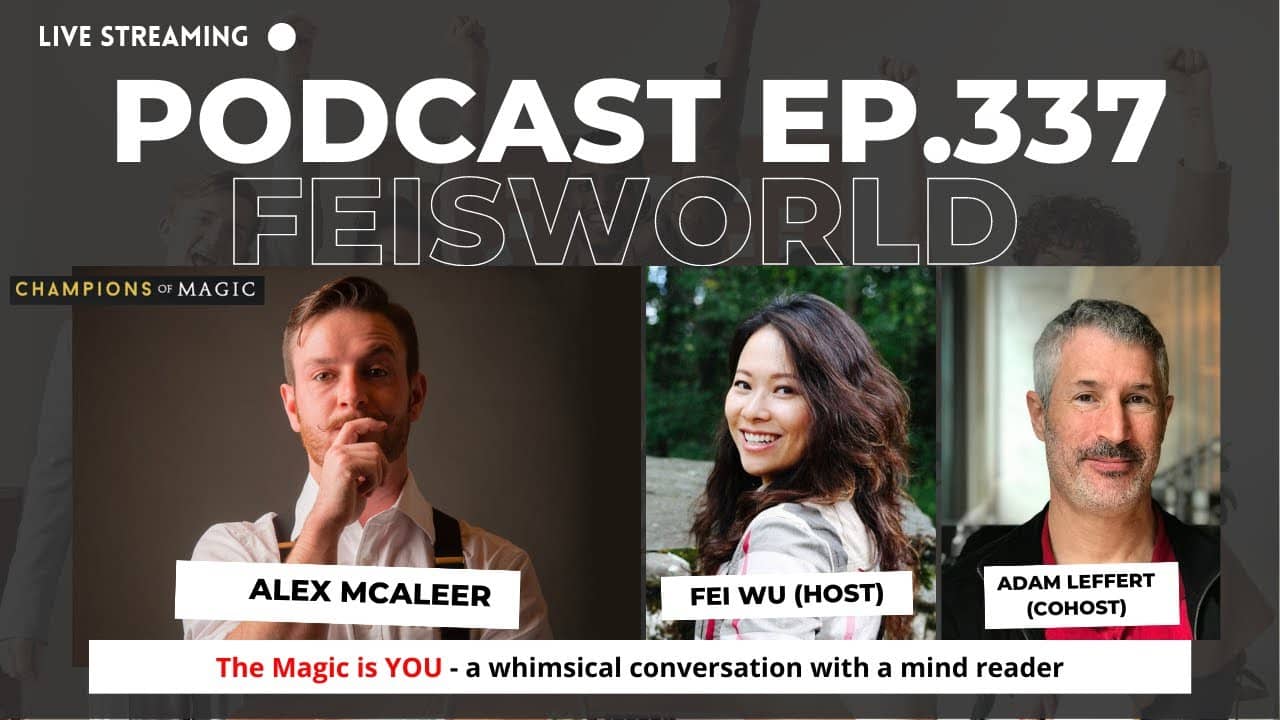
Alex McAleer (mind reader): The Magic is YOU – a whimsical conversation (#337)
Our guest today: Alex McAleer
Champions of Magic is coming to Worcester, MA for a one-day-only show. The tickets are almost sold out, try your luck here.
On today’s livestream (pre-recorded just the day before), we are talking to Alex McAleer, the Mind Reader of the show.
Alex McAleer possesses the uncanny ability to apparently tap into his audiences’ minds and read their thoughts at will. Drawing on a mixture of expertise in psychology, unique mentalism techniques, and masterful analysis of audience members, Alex combines contemporary mind reading with sharp wit and a flair for showmanship.
Watch Our Interview
Transcript
Transcript
Fei Wu: So excited to be here, not only with my co-producer, Adam Leer, but also with our new friend, uh, magician, a mind reader, Alex McClure is, am I saying your last name correctly, Alex
Alex McAleer: Uh, mc or Mcle. Those are both fine.
Fei Wu: I was practicing that. I'm so glad I asked. So I'm so glad you're here with us. And, um, Alex, we're so excited to actually watch you live here in Worcester, Massachusetts, uh, at the Hanover Theater. And I personally have never really been there. I'm so glad this is gonna kick off. You know, my residency, I mean, I, this is where I live, but also as a content creator living. So close to a theater and witness you and four other people in action as magicians. So to kick it off, I'm gonna just briefly introduce you and so people know who you are. So Alex uh, is possesses the uncanny ability. To apparently tap into his audience's minds and read their thoughts at will. Drawing the mixture of expertise in psychology, unique mentalism techniques and masterful analysis of audience members. Alex combines contemporary mind reading with sharp wit and a flare of showmanship. And I know also after watching several videos and interviews that you grew up as his only child. So, so did I. Adam is. One of two kids. And, uh, I, I think that's, that's just really interesting that, um, there are a lot of stories I think that I remember growing up as an only child playing with magic, trying to learn that, a certain part of it, trying to make friends and trying to seem really interesting. Um, kickoff conversations with other kids. But I also know that you have, you know, unique knowledge in terms of the fact that you create courses, you teach. I don't know a lot of magicians who, who do that. So we definitely wanna get into it. So, um, to kick it off, we wanna talk about the show, uh, which Alex introduced us to. We wanna talk about careers, we wanna ask questions that haven't really been asked before. So with that said, let's open up to, to Alex. Could you please tell us a bit about the show and your role in that show?
Alex McAleer: Absolutely. So, uh, the show is called Champions of Magic. It started, uh, over in the uk where I'm from, in case you guys couldn't tell from the accent. Um, it started the UK in, uh, 20 13, 20 14, and it started as a small tour, like three or four venues, and then it grew and expanded. And we came over here in 2017 and started touring the USA and North America, so Canada as well. And we've been back and forth ever since. And it's like, so this year is 10 years. I've beaten with the show since the show started, which is I think the longest career job I've ever had. Wow. But, uh, the show is, yeah, it's five Magicians. Um, uh, so it's me. I do the mind reading the mentalism. I. I delve into people's, you know, minds and tell 'em what they're thinking. There's also young and strange. They've been with the show since the start. They're also British. They're a double act. They're illusionists. They do the boxes, you know, the, the girl gets in banishes, spikes go in, she reappears, but they also do it with a very British sense of humor as well. They've got this brilliant bit in the show where they kind of pay homage and parody cheesy, 1980s magic. So you get to watch the Kool Ladies magic, but also, you know, kinda poke fun at. Uh, we also have, uh, Fernando Velasco. He's been with the show since 2014, I believe, and, um, oh, 2018. Pardon? 20. He is originally from Mexico. He's our escape artist. He does the dangerous stuff, you know, the exciting stuff, upside down a tank of water. Ropes on fire, there's jaws of death. It's exciting. And also Holly England, uh, although she's originally from England, she's lived in, uh, Vegas for like 10 years now. She started her life as a dancer o over in the uk. And then, uh, as a lot of dancers do, they become magicians, assistants cause they can dance and also squeeze in those little boxes. But only over the past few years or so, she has become a magician in her own right. And in this show, she's really found her own. Her own voice. She was quite nervous when she joined cause she's not normally the one doing the talking. She's the one doing the striking the pose. Uh, so she's joined the show and brings her own style and unique voice to the show. Uh, yeah, there's five magicians and you kind of get to see every style of magic in the show. So if you've never seen Magic Live, if you've only ever watched it on tv, uh, or on YouTube, or even worse just on your phone, uh, then seeing Magic Live is a different. Experience because, you know, it can't be set up. There are no camera tricks, there's no editing tricks. Uh, so yeah, Champion's magic really offers a kind of a nice wide variety of magic and also of styles of magic. All packaged in this sort of big spectacular, uh, evening of, of show of entertainment. Yeah.
Fei Wu: Wow. I have so many questions, but I think Adam has to go first.
Adam Leffert: Yeah. So, so, so I'm a huge, huge fan of the genre, uh, being in the seventies, uh, you know, Kreskin or Geller, uh,
Alex McAleer: Eva. Oh, wait. Show you, I CREs. I. I like, I like old, uh, board games, so I have like the original food, the seventies, this
Adam Leffert: Oh my God. Yep. Before the, before the red button. Before the red button debacle.
Alex McAleer: Probably his original hair there as well. Before it was a wig. Why do you think I brought these, these are glasses also. Like this is complete as well. It's not all this stuff. It's got the pener. Very exciting. Anyway, that's open
Adam Leffert: too. So you, you're playing it. You're not just putting it on a shelf for Oh,
Alex McAleer: nerd. But yeah, actually that's cause you mentioned Kreskin and over in the UK no one has any idea who Kreskin is, but.
Adam Leffert: Yeah, so, so tell, and also, I mean, I won't bring the Ouija board up that Faye has told me I'm not allowed to play with. That's a whole, that's a whole other show. So, you know, with that beautiful, hundreds in a sense, even thousands of years tradition, when you go back to the Romans and the memory palace and things like that. Curious, even though we just met, what core parts of yourself do you feel makes your show unique or a unique experience for the people that come, you know, to interact
Alex McAleer: with you? Interesting. Well, it's all about like, um, cuz as, as a, as fa mentioned, like we've all sort, when we were younger, we've learned some magic tricks and stuff. Sure. But everyone starts there. But I think if you become a performing magician, you realize it's not really the trick. The secret behind the trick is easy usually, or sometimes it's really difficult. But if you practice, you can do it. That's how anything works. You know, juggling's difficult, but people can juggle nine clubs, you know. But you realize just putting in something of yourself, your personality, um, whatever sort of core values you have, and it doesn't necessarily have to be, you know, some deeping meaningful message that you have inside yourself. It can just be something you find interesting and fun or fascinating. You just wanna share it. And I think that's, I think we all do that in this show in Champion for Magic. We all have our own passions and loves. Mm-hmm. I mean, those in the performance, we don't understand there and do the trick. Cause that would be, that would be very dull. That wouldn't be entertaining. And I think all the best performance, especially at magic and any genre of entertainment or creativity, they do that. So in terms of what it's, for me, I always think like I don't really have any deep and meaningful. Messages in my, uh, performances or magical mentalism. I don't even like, you know, I don't present myself as psychic, that I have supernatural powers like Kreskin does or did. I think he still does. And I also don't over push this sort of scientific element or anything like that. I just kind of. Do it. I just sort of give the audience enough knowledge to say like, I'm not psychic. I can't talk to the deadline and read poems or predict the future. I read people and I talk to you. That's all I do. And then I just get on with that. And the idea is that we just have a fun time and don't take myself too seriously cuz I don't take anything too seriously. And the idea is it's just fun. And that moment, sharing that moment of people knowing something is true, like there's no way he could go, I'm thinking of right now and then proving them wrong. Uh, it's a shocking experience giving someone that shock of a moment where they're just like, oh, that's what I, that's what I love about magic in general. So I try and share that with an audience. That's why I, that's why I try to take things. Yeah. Beautiful,
Adam Leffert: beautiful. Love it.
Fei Wu: And it's so interesting that I, I can't believe we kind of delve into this so quickly, so early in the show, but you know, Alex, when we work with clients, when we talk individuals on the show, um, we love to connect with our audience. We reply to all the comments about, uh, How do I become a creator? Something has already been done. Everything has been done, and people are so hesitant to choose themselves, uh, to do the work that they, they love because they're worried to be the second best. We're never to be recognized, so I just. Found exactly the essence of what you said. It's really not about the trick. Like you can find out some secrets on YouTube. That's not the interesting part. The fact that you bring yourself, you're creating that environment and we are all in awe. Uh, you know, sometimes I love when street performers approach us, and I love the, the kind of the life scenarios, and you're kind of, you're caught unexpected and, um, you like to believe in the things like, you know, even though it's not necessarily real, But it just, it brings you in into that magical moment. Doesn't, doesn't matter what your age is, you know, I'm almost 40 years old and then just makes me think about, just makes me come alive even in that moment. So I wonder, you know, like, you know, how long it, it took for you to realize that and, and then, you know, what, what's that message for you to even communicate, maybe convey your audience and people sitting there, it's like, I can never do this. Um, but this is really fun.
Alex McAleer: To, I think it's gonna be quite a while to realize that it's not, it, it's you. There's, there's people who've written about Magic United since the 18 hundreds and stuff, Gershwin when you said the magic is you, which is a good mantra. If you're a magician, the magic is you. I think it's a good mantra in life in general. It's almost like a doctor's use quote. There's no one more than you, than you, et cetera. It takes you a while to realize that, which is why, but those, realizing something like that, it helps you. Um, you, it's hard to work out how to communicate that to an audience that, you know, cause obviously someone's gonna watch a, a magic trick and they'll be like, this stuff isn't real. You kind of want to engage that person as well. So if they just dismiss you, you can't dismiss them as, you know, you can't sort of patronize them into believing in magic. You know, they're sort of Doug Henning magic. If you are, are also aware that, you know, of course, of course I can't really know what you are thinking, but I'm gonna make it look like I really could make you doubt for just one second. Maybe you could just know exactly what's going in my head, then I've got you. And that's the game. Then it's just, it's just making sure that everyone feels involved. So just, and it's difficult to, it just takes time. I think it did take me a long time to realize, Uh, how to convey to audience what I sort of believe about what I create. And you were talking about creators, people, they, we could be the second best. My son's just recently got into magic. He's 13 years old and for some reason only now got into magic, which is fine. He's also an only child, so he's giving himself busy, occupied, you know, anything. He's interested and we help, we help him buy the things for it all. Buys some books on it. And um, he keeps coming up with new magic ideas and I said, oh yeah, that's a thing already. I'll look it up for you. And he kind of went, well, but it's already a trick. I went, oh, that's good that you thought of a trick that already exists in this book from 50 years ago. Because you are thinking like someone who's come up with an idea they published in a book 50 years ago, it's already so you're already in thinking in this in the right way. You are creative enough if someone else thought of the idea, it's a good idea cuz you also thought of it. And I think with being a creator, If you are so like your viewers or, or listeners or whatever would be the, what I say to them is just create stuff. Don't be worried about like being second best or worrying about how to, I've got this message, but the more you create, the more you learn. And I'm lucky that I'm performer, so I get an immediate feedback response, like I studied art and design at, at college when I was, uh, younger. But what one thing I didn't like about it is it's not an immediate reaction to what you've created. It's just slowly, every time you might hear what people think about it, or a tutor might give you their feedback. But with performance it is immediate. And on the internet it's immediate, often. Quite polarizing. Cause with the internet, you know how the internet can be, but um, you do get an immediate response from something like a live performance. So I'm quite lucky there that, you know, the audiences that I perform for tell me what they like me doing and what they don't like me doing. So it's a feedback loop.
Fei Wu: How vulnerable, I mean, it's very vulnerable. That's something like some people, a lot of people are avoiding, but you're welcoming it. Could you talk about that?
Alex McAleer: Yeah, it's the, it's the number one fear, isn't it? Above being buried alive or anything like that is public speaking, but also like, I'm like most performers you'd meet, I'm a shy person. I don't really like bring myself up there, you know, with my friends, I'm very, you know, Open and I like making them laugh, but naturally I'm quite a shy person. And it is, it does make you very vulnerable being on stage in front of people and especially putting something out there, it's a part of yourself and also a skill that you have. Uh, it could go wrong, you know, anything could go wrong at any moment. So there is also that extra worry. It's just as you call it, on in stage performing flight time. So like pilots, you know, you could have a 20 year old pilot and a 30 year old pilot, but a 20 year old pilot might be, have more flight time. They've been in the air longer, so they're a better pilot. Uh, more senior and it is just experience teaches you things. You know, it's the first step, like if ever I'm doing new material. On stage, a new trick or new dialogue or whatever, it's nerve wracking. I've stood there in the way just thinking, why on earth am I doing this? Why did I become an account or something? Uh, but, uh, yeah, it's. It does make you very vulnerable. That's kind of the fun part though, as a performer, I think a lot of performers like this that it lives and dies in the moment. You do something and then it goes away again. You can't recreate that, that funny thing you said or that Adlib that you had, and you kind of have to be at peace with that. It does make it more exciting and fun because it's very repetitive. See the same show and the same material over and over and over again. Having those elements which make it different does make it more exciting for you. But, um, a friend of mine, she does perform, she's also a musician and she also has sort of a bit of stage fright, anxiety about performing. But what she's done is she'd never said she's nervous. She always says she's excited. I'm excited to go out there. It's like she's relabeled it, she's reprogramming her own mind basically, that it's not nerves, it's excitement, cuz you are, it's the same you're. If you feel excited about something and you feel nervous, you know, if you took all your blood pressure, you hooked yourself up a computer, it would look exactly the same. So you are excited. You're just excited about it. So just knowing that you're excited rather than nervous, it just changes the way you think and feel about something. Uh, yeah. That's why I suggestions. You're not nervous, you're excited. Just don't worry.
Fei Wu: Love it. Adam, what's up?
Adam Leffert: Yeah. Very cool. So many interesting, uh, so many interesting directions to go in. One that I'm curious about is you talk about how re you know, performing real life comes into performing and performing sort of leads into real life and how you create this, this moment of shock of I thought I knew how, how I think and what I am in the world. And then you show me that maybe I could be wrong, maybe I could be right. I'm wondering in the, the 10 plus years that you've been working, as you then go into your regular person life, do you see, uh, experiences, relationships, like your, the sort of soft psychological side of your own life as that changed given the power of what you've learned in creating your, your
Alex McAleer: performing life? I see. Interesting question. I think, um, it's made me, uh, Because initially when I started performing, I did like close up stuff. So you walk around an event or a party and you have to do essentially interrupt conversations with the promise of something worth interrupting a conversation with. And having to do that for a number of years, it made me more confident in talking to people or knowing that you've got something to show them or share with them. So it's made me a bit more confident on that, and it made me one of those people that chats to cashiers or Uber drivers and stuff and quite comfortable doing that. You just, you know, you've got the patterns and you know how to steer a conversation, then it does. It's helped me in that sort of sense and also, Because of what I do. There's a fair amount of psychology involved in not any kind of match for any kind of performing, but especially mentors and stuff, understanding how people think, not actually what they're thinking, but how people think about things and the sort of patterns they fall into. Hopefully it makes me a better understanding people communicating with people. It's not really for me to say, but I think, I think I, uh, I think I am. Mm-hmm. But, uh, yeah, it does bleed into real life. But having a sort of, but also the me on stage, stage persona and me are two different people, almost extremely. So I can't really, my partner used to tell me off the, Putting on my stage voice in life cuz I've suddenly become a bit more like, I talk a bit more, not sternly, but you know, with more confidence. And Could you hold that there? Like, don't talk to, sorry. Yeah, it does. It just change you sort of changes the wiring in your brain a little bit. Yeah. Yeah, yeah. Cool.
Fei Wu: Yeah, really interesting. You know, Adam and I have had the, uh, pleasure of really traveling domestically, but also internationally to, with the purpose of interviewing, uh, performers. And then I love how you use the word performers because we're talking about, like, we think of them as creators, as artists. We've had numerous conversations with people in c the sole. You are the second magician. Uh, we have interview the first, it was David David Williamson from Circus 1903. Uh, also a ringmaster and I, I feel like the theme, and thank you for giving us a title, that perfect title to this episode. The magic is you, right? And, uh, I just love it for so many reasons, but I think. What I have learned, um, and there's part of me that makes feel like my relationship with these people have become really personal, not just professional, because I care about them. I see them take off in the air. I worry something's gonna happen to them as you are, you know, sometimes as as you're performing on stage. I know you've been doing this for 10 years, but I'll be rooting for you to say Ahha. I hope, you know, like, I hope this works out. And, um, sometimes I realize what's missing or what I hear in conversation with, uh, like seeing like negative, negative reviews for a second here, like, It really hurts me. Like, ugh. I can feel in my gut when people commenting on things like, I know this trick. I know how it's done. Or, this trick isn't dangerous enough. Or, and I, part of me is thinking like I, one, I worry, the art in itself has become for just for complexity's sake. Like, what is the most difficult thing to do as opposed to what's interesting? And, um, the other is, uh, like you said, uh, people take away, just people focus on the technical things. Like I'm, I'm not a contortionist. Oh, this is interesting because I can do it. Um, So I wonder if that question makes sense of like how we as human beings tend to, um, in some ways like complicate things or taking the humanity outside of, uh, the art itself and therefore making our lives. Less interesting and in some ways more miserable. Like we, I kind of wanna, like, how do we shift the mindset so they understand what R really is?
Alex McAleer: Uh, yeah, I agree. I yeah, I really agree with that. Um, I think a lot of that has to do with the things like, got talent show for talent has, it has to, it is more every year. Cause the, the, the hunger of television or how, how the people that make TV think what the public want, they're wrong. But it's that thing of, yeah, it has to be. More intense, more dangerous, you know? Um, I thought there's several examples that came into my head, but you're right. It, i, it really annoys me. Like, cuz you were just talking about the, if you are sat there and as an audience member, you are, you like the person, you get to know them and you want them to succeed. Like, I like playing with, I have couple of routines in my own show. I don't do them at Champions, but in my own show I finished with a routine where it looks like it's gone wrong, which is a classic plot in magic, magician in trouble, uh, But the way I do it, uh, I, I'm toying with that bit that over the past hour of these people being with me, they've got to like me in, in some aspect or another, and it goes wrong to me. And I like slightly playing with their emotions that they feel bad for me in that moment. But oh eight, he's, he can save it at the end, which is a very cruel trick, but it's part of the emotional rollercoaster that I want to put people on. But, um, excuse me, sorry.
Fei Wu: Yeah, take your time please.
Alex McAleer: Um, yeah, I do think it's the people they, they want it to be. There's the thing about, um, I think it's Gill's tall guy. Um, he said about that if you watch tight walker. A hundred feet in the air. It's exactly the same as kin, two feet in the air. But you're more invested. But the reason you're investors is actually kind of a cruel reason, cuz you want to see them fall. There's a potential they might fall around himself. So he always wanted to do this idea. Apparently his producer said no, cause it costs too much, that there'd be a tight rope, two feet off the ground. And he said, if I fall off and touch the ground, everyone in this room gets $10,000. Now they're emotionally invested, but it's not danger. It's the chance of winning money. So it's the same thing. Mm-hmm. But yeah, it's people. I think they try to make it more complex. A lot of magic I feel can suffer from this. And especially if it's for something in like a three minute spot on a TV talent show, we are gonna be judged by people have no idea what they're talking about. Um, they, it has to, you've put in too many tricks into one thing and the simplicity or the elegance. Disappears. There's like a thing in magic where it should be. You should be able to describe what happened in a sentence. They cut the girl in half and put it bag together again. He made the Statue of Liberty disappear. A sentence, not, he made the Statue of Liberty disappear. Then he sold her Rubik's Cube. But the Rubik's cubes together spelt on my NAN'S anniversary when she was, that's too much information then. But because you think to be creative or to be artistic, it has to be. Like brutally original. You're just trying to stack on more and more ideas rather than just realizing that if you just do it yourself and bring something of yourself to it, it's now original and people will like it. Mm-hmm. It's, it's a hard mindset to get into, so I'm creating new routines or things to do on stage. I have to. Try and strip them back. There's something in the show we've been working on for a while, and it went through many different guise, but eventually what we did is strip it back. Let's take out, edit it away. You know, you're an editor, not a writer. Edit. Take things out, rearrange them. And then it's a nice simple plot to follow, something easy to follow. It's quite complex idea. I'm trying to get Williams to understand, seems to make it really simple and it can crescendo at the end rather than going all over the place. Mm-hmm. But um, yeah, I think yeah, just making things too complex. I think it's just a worry within yourself that it's not original or you want more people to like it. But normally simplicity is the key with anything, any creative project, you know. Hmm.
Fei Wu: That's so fascinating.
Adam Leffert: Beautiful. Kind of on that, on that same tip, you talk about minimalism and the ability to kind of shock somebody from inside. I and to the spirit of somebody who might look at magic as you said, kind of like a Doug Kenning, jazz handsy kind of thing, or, or, or like little bit cheese ball, uh, to reach out to those people. I've heard you mention magic as almost related to standup comedy. Yes. Before. And is that's something that people do themselves or, or find approach ball, I wonder like thoughts or feelings
Alex McAleer: on that? Yeah, I said cuz um, as Faye would've mentioned, I do sort of, uh, teach and lecture to other performers, magicians, either in person or online. You know, there's a big industry sort of quietly behind scenes of videos you can buy or lectures you can buy. Uh, but yeah, I say with, um, especially with mentalism, what I do, There's not a lot, lot of props or visual interest or boxes that do interesting things. So I've always said that we have more in common with standup comedians, mentalists do mind readers than we do with, um, a Dove Production Act, even though we're both in the genre of magic and we do deception or we do magic, we're more in common with the standup comedian because. External comedians are kind of, they're engineers, they're engineering sentences, either intuitively or with the knowledge of how the structure of the joke should work. Um, they, they're, they're engineering it, so we should engineer our, the structure of a routine or a trick or a presentation. In a similar way, the understanding of the psychology of how the rhythm should work or how people think. And you know, you don't say the, you say the punchline, the funny bit is the very last thing you say. You don't then add on something at the end, otherwise it's not a punchline. It's sort of a, it's sort of understanding that, uh, and also just, I used to watch a lot of standup comedians, I think. Um, Back when you bought DVDs or VHS's? I just watched them fall asleep to them. So Eddie Iard or Billy Connolly or this record? Lee Evans in the uk and I guess these days there would be other names that more popular. Chris Rock as well. Fantastic Seinfeld. And just watching him sort of observe and understand. What they're doing. You sort of can mimic what they're doing. Not literally. You don't just copy exactly what they're doing, can sort of understand. Oh, it's funny. They do this thing. You know, Dave Chappelle has that famous to me. He always hits the mic on his leg to make a noise. Cause then the audience have permission to make a noise. Like, uh, any of the people watching this who are performers, you'll know that if you sit in an audience somewhere and their audience can feel there's an applause queue happening. If you just go. The whole room bursts into applause. And if you've ever watched me perform, I can feel the audience. I'm gonna applaud. I clap myself, as in I kind of, oh, fantastic. And that just sets them up. It's just knowing those tricks, the trade helps, helps you go, helps, helps you, um, create the feelings that you want, the, the moments you want. The emotion. Yeah. Standup comedians have also, I just, uh, I'm sorry, jealous of standup comedians cuz they can just turn up and pick up the micro and talk and they're creating little, little magical moments and making people laugh. Whereas I do need a bit of production behind me and a big steady chalkboard for me to write on and stuff. But I mean less so that the illusion guys in the, they need trucks, boxes and stuff. Beautiful.
Fei Wu: The noticing as a, uh, as an act like you mentioned. First of all, I'm a huge fan of Dave Chappelle. I know he, it can be, um, controversial, but even with that, I think is so brilliant and, uh, what, what I think you have created, I mean, right now we're in this moment where it's the three of us. We're talking to each other. I'm constantly thinking about you two, what you're saying. I'm not thinking about anything else literally like this. It is like when I'm swimming, then I'm a pretty good swimmer, but when I'm swimming, I'm pretty much just thinking about swimming. So, uh, these moments are really precious in a way, and I think in your act in particular, the person that you are working or doing the magic with, you really have to be very focused on that person and no one else. Uh, I feel like these. This is the sort of thing that I feel like with so many distractions and we interview people about how to manage distractions in Near Yell and the, you know, between this book Hooked and, uh, you know, creating these products, like everything we do is about attracting people's attention, and yet all of us are very distracted. I think in particular, how I feel about going to these shows is like I'm very devoted and dedicated to. Pretty much every single moment, and I find it incredibly enjoyable as opposed to me sitting in a social conversation, driving somewhere, meeting up with friends at a table with five, six people and everybody's on their cell phone for some reason. And, um, I just, you know, I just wonder, I feel like in a way that it gives, has given you the superpower, number one. And I wonder how you, I think Adam asked a similar question, like, how you live through your life, what are some of the advice and tips that you can give, um, other people, uh, focused distraction and, and all that. Um, and I also think secondly, you have a love of maturity as a performer as well. So maybe we'll get into the maturity in, in a second cause, uh Okay. That, that's really interesting too.
Alex McAleer: Uh, yeah, so focus, but it, yeah, it is difficult also. Yeah, you're right on stage. It's my favorite time part of the day. Cuz it is, it's very, as they were saying in mindfulness these days, you have to be very present and it's fun. It's funny sometimes, like after a long run of shows, Like we've just had a little bit of a break, but like, uh, I'm just getting over bit of a, a cold and so I know I'm gonna have to work extra hard tonight cause I'm gonna be distracted by how I'm feeling. Like my ears are a bit blocked and my nose isn't running. So I am gonna have enough if we've been doing a long run of shows. And all five of us are on stage and someone else is talking about their bit. And it's gonna be my turn in a minute, then it's gonna be strange. And if you find yourself just slightly wandering off in your mind, thinking about, I wonder if there's the dinner after the show, you have to like, you know, stop yourself, be present, be be be reacting, or just be neutral. As soon as you find your mind wandering, like, no, no, no, no, no. Come on. Focus, focus, focus. You're at work right now. Um, but yeah, I suspect you'd have to be present. Cause I, I personally love the. Pressure and responsibility of like as soon as I walk out on stage for my first like 20 minute set, it's my job right now for these thousand people here. I have to, it's my job. I have to entertain them and it's all down to me. I have to keep them there and then I have to keep them in nice, happy place so when I go off in young, strange, come on, they've got them and they can play with them now. But yeah, focusing is really, but if you're, sometimes it's difficult in creativity. You have to have moments of. Focus, but also focusing off the subject. You're trying to come up, you're trying to solve, we're always trying to problem solve. Uh, my problem solving is like, I've got this idea for a trick, but it's not working. Gotta problem solve. So you'd have a moment. You have moments of taking in information, reading stuff, even if it's nothing to do with what you're doing or just looking at something artistic or whatever. It's, you're working on something akin to just take it all in and then think about, don't think about that thing anymore. Go do something else. Like if you swim, that's probably your moment to. You can only focus on swimming cause it's hard work how I go to the gym. So you have to focus on what you're doing to make sure you're doing it properly. Not gonna hurt yourself, but it allows your mind to put all the pieces together so it present you with a solution. I like focusing like that, focusing on what I'm doing by not doing it. It's a really interesting way of doing it. There's also a great speech. It's by John Kle. You know, modified them or, and also, uh, faulty Towers. Yeah. John Cle, uh, it's on YouTube. Uh, I think if you just type in like John's, uh, creativity talk, I think it's film in the nineties. He's got a brilliant talk about what it's like to be a creative. And it's funny as well, so it keeps it more engaging to watch and it's, it's some, I can't remember, there's like five things and one is, you know, it's like time, time. Uh, bringing, basically bringing in information, not thinking about the thing, and then suddenly the present, the solution will present itself, but the time, time bit is the time to, okay, I'm gonna spend an hour on this thing. So you sit down and having a buffer of time to know that in that first 20 minutes, you're going to be distracted, you're gonna sit down at your laptop. Right. I need to work on this project. I have to put the bin out later. Trash out later. But I also need to phone Bob and tell him about, okay, focus you need, you need that, that your brain is gonna, once it's quiet for a moment, it's gonna throw this other information that's in the to pile. Just allow that to happen. It's gonna happen. So don't get frustrated. Just allow it to happen. And then you'll find, oh, I've thought about that now. Now I can focus on this task. But also if you are just banging your head against. Just stop. You're not gonna, it's not gonna help you if you just get frustrated in the moment that you're not focusing. Just allow yourself to your mind to wonder, you know, staring at the blank page is nothing creative's gonna come from that. So do something else. Like I, I mentioned I did art and design, or I was to just, just drawing something. I like doing a sketching thing. I just draw a big squiggle and then try to interpret what it looks like and then add in the details and some colors my iPad. And that just allows me to focus on something else. But it just draws, it just draws your attention in. So now you are thinking in that way. So then when you go work on the project, you're now already in a focused state of mind. Yeah, the distractions. I, I talk like I'm an expert. I was home for like two or three weeks. I was distracted at the time. Like I literally went around and tightened all the door handle that. Cause I was just like, I'm not, I just do something. Oh, I've gotta make my son some dinner. Yeah. It can be different folks, but having time and space is really important. Having a space you can go to, like it looks like, is this your office degree right now, Faye, or, mm-hmm. Yeah. It looks like a nice space that's just kind of basically dedicated to creative time. Mm-hmm. Having something like that is really good. Even if it's like a local coffee shop you can go to and sit there, put on some noise canceling headphones, allows her time and space to focus. Yeah.
Fei Wu: No, no, I love it. I'm gonna borrow some serious, uh, tricks. And then even just like, I feel like in some ways these are affirmations because I notice when I get stuck on a problem, Adam is the same way. Adam is also a developer, um, you know, computer scientist. We sit there and we're just like, we've gotta figure it out. We're so close, so close, and you're burned out. And sometimes I go for a walk and during my walk and, and I come back literally within 30 seconds. Like the aha moment is right there. It's like, Why didn't I stop away hours ago? This was,
Alex McAleer: I did this, I did the same thing recently. I was trying to think about something and I go for a walk. Cause I was um, staying at a friend's house in the countryside, beautiful English countryside. And I got about 10 minutes down and then I just called myself. I was on my phone type. I have to write this down myself. Forget by the time I'm back at the house, I like, oh, it worked almost immediately. I hadn't even gone to where I was gonna go and then come back. I was like, oh, it just is instantaneous. There's also a thing in, in script learning and I've done a bit of acting in my time. And I kept getting a line wrong. Or stumbling over something and the director I was working with went, stop. Let's just move to another thing cuz otherwise you're gonna learn the mistake. Yes. And also happens creativity. Creativity in creativity as well, is that if you just keep bumping up against the thing, just do something else. Cause otherwise you're just reinforcing in your brain that neural pathway just getting stuck there. So just go do something else. Otherwise it's gonna put up a barrier rather than it's gonna put up a dam, but you wanna go a really bad dam, so stop early on. So break apart. Go back to it later.
Fei Wu: Oh, love it. Love it. Adam, any reflections from you? Yeah. New questions.
Adam Leffert: Yeah. So, I mean, John, please, just for, for, uh, a, a lifelong hero for fans of his, something you may not have run into his audiobook of his audio B autobiography is extraordinary. Just to lean back and have this man narrated his life. Yeah, for 12 hours, all, all the, the richness. And then you Oh, oh, I, when they were doing that in his real life, this is what was happening there. Um, it is amazing, but as you talk about it, it's also just like, you know, fa and I've been through a lot of like dozens to hundreds of yoga classes together. What you say is exactly the beginning of the yoga class I've got, yeah. Voice and like now everybody I know you're thinking about the oil change or about, you know, you ran outta eggs. There's this sort of dropping in moment. So you have that, that, uh, uh, Ryan of family, I would say presence. Um, you know, when, when you are working. You also mentioned people who maybe have just only experienced magic through their phone or through or through YouTube. Maybe say more about, Of different kinds of people, what their experience has been of a live show, you know, smell of the crowd. How is that different? How is that moment, I shouldn't say special, but you know, maybe more engaging in a, on a gut level than, than watching your phone?
Alex McAleer: Oh, for, for an audience member, how is it different to be in the, in the room? Well, I think it's funny in this show cuz it's a family friendly show. You know, I think, I think all we say is that no one under five, just purely because of the pyrotechnics, would. Scare them the be Jesus. Um, it's, um, there's bits, there's really, there's really silent moments. There's like a couple of really visual things. We borrow a bill from someone in the audience, we'll do something with it. And there's a really visual moment. There's something on the bill moved, so no spoilers, but a printed thing magically like you see it move. And it's funny, you just hear the silence from people over 14, but anyone under the age, you just hear this, what. Because they just can't help themselves. Listen, what? That's not how the earth works. You've just completely ripped away their understanding of everything around them. Um, also this new, I mentioned, there's a new routine I've been working on. It's not new, it's been in the show like a year and a half now. But, uh, there's not, there's a couple of applause cues. We call it the trade. It's like, and here's the thing, um, in this particular routine, there aren't many. There are lots of moments of. Magic, but that the audience don't make a verbal sound. They are silent. And when you are trying something new that's bad, you dunno. Cause you dunno what they're thinking. Cause you can't see the audience on stage. Ironically, if you dunno the thinking, you know, if you get audience to laugh or they, um, clap or something, you know. They're all on board. They all understand the idea at least, but when they're silent, you don't know what they're thinking. But it took me a little while to realize that when this things happen, something's happening on stage, they're silent. Cause they're just going, what is happening right now? I'm, is this real? So it was a good thing. This, this, there's certain types of silence, which are good, that is. As a com. But I think one great thing about magic is it's you get. It's not, if you go see a comedian, you're just gonna laugh, which is good. It's wonderful to see a comedian. And there's different types of laugh. There's that kind of laugh where you know you shouldn't laugh. There's the type of laugh where a laugh, familiar familiarity, a laugh of how clever a joke was. There's even more sort of, you know, colors in the rainbow, seeing a magic show because there's shock from something visually happening or shock from a revelation or, or seeing something as like, You see something you can't quite understand. It's almost like a puzzle if you're just perplexed. There's a real gamut of different emotions that you can go through Watching a show like Champions where you get to see every type of magic, you'll see small stuff, you know, projected on a big screen. You'll see dangerous stuff like Fernando when he is upside down in a tank of report. If, even if you think those handcuffs that were checked, maybe they're special somehow, maybe they're just dissolve in the water or maybe, uh, maybe he can actually just get out quite easily. But you could tell he's underwater cuz you can see there's water and he's upside down and you heard him beforehand doing some weird breathing stuff, which in silence, which is quite tense. Even if you think it's all just a trick, you're like, he's definitely underwater and upside down. This is genuinely dangerous. So you still get that genuine emotion that didn't rush. There's another bit he does, uh, straight jacket escape and I'm in the wing cause I on immediately afterwards. And there are some people that just sat in the front row we can see that are just like this, don't see it. They're just too, to be confronted by something all when there's um, An illusion taking place and the way you see people, like the girls saw in half pulled apart, you see whisper over to their heart what they're saying. They could be going like, oh, I saw this. I'm a vast magician, blah, blah, blah, blah, blah, blah, blah. Or they'd be going like, oh, I thought it like this, but. It can't be because I can see her legs, you know, things like that. You get a real, I think everyone gets a different experience. Mm-hmm. What's nice? All experiencing the same thing at the same time. That's the wonderful thing about live theater. It's so difficult about the lockdowns and things that happened is you couldn't share an experience and it's a really nice experience to, to share something with a whole audience. People. I love being an audience for the show, cuz you're all experiencing at the same time, the same emotions, the same thing. Yeah. Yeah. It's so fun. Nothing beats live theater, I think. Yeah.
Fei Wu: For real. Mm-hmm. It's so fun because, uh, we're such good friends with, uh, Atherton twins from Cirque du Sole, and when they're, they're also from the uk and when they're little kids are watching them from the audience, which happens all the time. The dads are aerial aerialists and, you know, they're flying across the stage and the kids would be like, daddy, daddy, and, you know, and the whole stage can hear them is so adorable. I love where, you know, I love Adam's question, how you answered it and make me think about the fact that, you know, part of actually a lot of our listeners and viewers on YouTube are very, very international. I look at the analytics, it's like 30, you know, in like 30, 40% from the US and, and then. The rest is like 1% there. And it's, it's amazing. I think about in particular, these, uh, you, you know, as a magician, as a performer, I mean, I just feel like it's boundless in terms of who you can influence with or without language, frankly. Um, so I wonder, and I know you traveled quite a bit for your work, and I wonder whether people's primary languages English were otherwise, like, have they reacted to your show to you differently from different places and, uh, you know, I am curious.
Alex McAleer: Cause also I, I, um, as mentioned like lecture and, and write things for the magicians. So that also has opened me up to people around the world as well. So I have followers and people that message me saying, I really like your stuff around the world. And it's, you kinda go, oh wow. But uh, yeah, different countries and different places and even the US cuz the US is like 50 states, but it's basically 50 different countries. Yeah. You know, someone living in. North Dakota has no, I is not living the same life as someone in California. Different people, different lives, but they just happen to both be American. True. Um, but yeah, there are different vibes, I guess from different countries, which, um, I think more sort of. Social and how people grow up in certain countries or social economics, all sorts of things. Now, one great thing, so when we first came over to the us, we'll have this story. All us Brits that are in the show is first US show. We did, so we've been touring the sh UK since, uh, 1340. 15, 16. So four or five years. And before that, we'd all been doing our own thing in various ways. We first came up to the US and, uh, All quite excited, all quite nervous. The lights went down in the auditor auditory of, and the audience started cheering and clapping and we were like, What's going on? What's the noise? And it's cuz the audience are excited cuz like in a, in North America you appreciate entertainment. You've spent a hundred bucks on a ticket and like, I'm ready. Happy to be entertained. Oh, here he is. Great. Fantastic. Get off having a great time. UK is a little bit more, not quite the case, but if you wanna be quite generalistic, they're kind of a bit more like, Come on. And also like the second or third time I walk out on stage. Some of them might have warned me in the uk, but the others are like, oh, here he is again. They press me Now it's like, oh, come on. It's the us. It's a bit more. You are ready to be entertained. And the same if it's the same. Most of the world, like Canada as well, Australia always have great audiences when performed There. Uh, Europe as well is very, uh, the rest of the mainland of Europe, the main part of Europe, not the uk love magic in general. There's lot of well known magicians that, cause they only work in their own language, English speaking based for Nevada. But, um, One thing that is nice though about magic. It, it is universal. I mean, I do a lot of speaking and, and in English, but you know, I've, we've worked in Mexico and I sort of learned bits in Spanish and it still works cuz people like, cuz magic is dealing with changing your understanding of the world and how it works. Break the rules of reality. That's a universe that doesn't matter where you are from. You could be living in a tribe that's only ever seen the western world. A dozen times someone picks up something and it makes it float. That's impossible. When know, end up where you're from. And so Mike does have that kind of universal thing, a bit like, you know how silent comedy does with everyone. Who, Mr. Bean, you know, RO Atkinson. In fact, it's sold worldwide and it's just this guy that in the UK would like, oh yeah, Mr. Bean, that thing that used to be on in the nineties. It's still a worldwide phenomenon, but,
Fei Wu: so yeah, it's, can I just comment on that? Because Mr. Bean became a, It was just the number one show, the most popular show in China. First of all, he didn't, he barely spoke anything. I know. Yeah. Uh, but it was just, the comedy just resonated with the Chinese audience so much, like being in school, trying to cheat during exams and, you know, I came to the us this was, I came to the US 22 years ago. I, I grew up in Beijing, which I forgot to mention, but, uh, I came over here. Very few people here in the US have heard of Mr. Bean. I have of course, hugged my DVDs and everything. I played it. American people are like, What's so funny about this? Yeah, it, to me it was just like, wait a minute, it's Chinese people got this. How can American people.
Alex McAleer: He play, he's playing with the sort of social norms of things. Mm-hmm. I guess Mr. Bean maybe like it's very small world cause it's his England, so him going to church and having a cough suite and all that sort of stuff. You know, where get that. But maybe it's different in America, but American cubist, like the American office versus the British office. Are two very different shows. They just happen to be quite similar. The name's, the characters the same, basically, but the comedy is entirely different. So,
Fei Wu: yeah. But I think it, it's a, yeah, it's interesting. Of course, my mom's comment was, my mom, you know, gr have to like read subtitles. It's exhausting. Yeah. Uh, if you don't understand English, my mom's, I understand why American people don't understand Mr. Beam because the translation, the subtitle was so bad. I was like, And then she is like, don't ever mention this on your livestream.
Adam Leffert: I gotta say a as gray hair dude. I think it's generational because you know, Faye, you know, before we got to Dave Chappelle, before we got his names, people Faye told me, oh, Mr. Bean is, is like, like her, her number one hero, but the second I saw him, I see Buster Keaton.
Alex McAleer: Charlie Chaplin. Yeah. I, I love bus. Also I, I'm, uh, there's not, this is a very niche thing to argue about, but sometimes the people like, oh, that's some things. Um, but, um, I think Quin is much funnier than Charlie Chaplin. Quin is just, has funny bones. Charlie Chap is a bit more Americanist. It's a bit louder and a bit more obvious, the First King things about, yeah. And like the Harold Lloyd thing is obviously the most famous one, but of the club tower. But yeah, it is that, it's that same tradition of things. It's like how teller teller's, the Simon one in pen and teller, but he's never studied any, I believe, you know, properly studied any clowning or uh, or physical movements, which is why he's physical move Could be better, really could be a better silent performer, but it's not really, cuz he's just silent. That's, that's it. He just is an exceptional magician. He's the greatest living magician, I think. Yeah, but he's, he's not a, he's not like a silent, he's not like a, a silent performer. He's just chosen not to speak.
Fei Wu: I was, it's so funny. I were like re remembering. I'm laughing at all the things you guys are talking about. I have the comment that since I left Beijing, I pretty much have been in New England, namely like Boston, Massachusetts, Maine, New York like most of the time. And, and then I traveled for work, you know, quite a bit to California, Arizona. And I just, like you said, it's like. How are people so different while they're from the same country? And I remember, so when you, I'm so curious. After you visited Worcester and performed here, Worcester is only like one city inside the state of Massachusetts, but I. Uh, I not gonna prepare you. I think they're gonna be super excited. I can, I can feel the energy already, but at the same time, it's like people traveling from California, from Oregon, they, these speakers showed up in Boston, a future m or like HubSpots event, and they're like, oh, this is how we saved the world. And Boston people would be like, oh. Sitting there in silence. And then I later interview those speakers, like m Evelyn. He's like, What is wrong with people in Boston? Why aren't they touched by, I was like, well, I was like, trust me, I really, really wanna stand up. But I looked around. So there is something about, I mean, it's called New England, so there are a lot
Alex McAleer: of it is, it's more of an England divide. Especially like even if you go to Boston, it looks like England, like it looks like a bit of London. I remember we're there just beforehand, we've been there before and there's even stores and shops, which are, I've only ever seen in England. I'm like, where am I right now? But yeah, it is just different, um, types of people. Yeah, it is. But you can imagine though, especially like the, um, Californian thing, like if someone came out and said, Fernando Richard from Mexico, he lives in California, lives in LA Pass years. He's young and like full of energy, and he, uh, sometimes he comes out on stage and says like, you know, Are you with me? And they'll get a chair. But US bricks backstage, they're like, you could never say that in England. You could never be like land. Are you with me? Like, yes.
Fei Wu: Oh my God, this is so, so fascinating. We, we also traveled to the UK actually end up interviewing someone there and it was super fun, but they're, it's just so familiar to us. And the crazy thing, I'm not sure if you, you knew Alex, but if you ever look at the map of Massachusetts, you look for every single city street names. Everything replicates the things that we've seen in, in London, like in the UK
Alex McAleer: in general. Oh yeah. It's slightly confusing as a brick. It's so confusing. They're not right places either. Well, we were just going the wrong places. Right. Uh, like a month or so ago, we were in a place called Norfolk in Virginia, and I live in the county of Norfolk in the uk and then we went to Norwich, the same city. I live in uk, but it's like, these are not similar at all. Why did they just, why did they name them after each other? But yeah, new England, it's all the. The street names are named after towns. Yes. But also being a performers, you have to kind of, there's, I think a read the room. You kind of have to read the room of the town or the city you're in. It can be harder on a one night show unless you've been to that sort of area or state or whatever. But sometimes it does take a, a moment to sort of understand the level, to pitch up for the, for the audience where you sort of, Where they are and where you need to be. I kind of like that. It's a fun sort of quiet that I'm doing my job. Cause I know the material, I know what I'm saying and all I'm doing. And I'm sort of tinkering with the energy levels to try and make sure that it's where the audience need it to be. Yeah. Because you can't just try and force your California enthusiasm on a quiet New England.
Fei Wu: So true, so true. I, I know I wanna respect your time and have to let you off the hook at one point, but I wanna take a moment, just ask a couple of career questions on Adams. Very welcome to jump in as well because we have been friends with performers for a, a long time and really by choice even before we started the podcast nearly 10 years ago. And we have seen people really flourish, real thrive, you know. But again, not everybody. Is in your position, right? You are absolutely seen as being successful No. In a and traveling show. And, and I know that even that comes with many ups and downs. Many shows don't run for 10 years. They don't run for a year. Yeah. And, uh, what's your advice for maybe nervous, um, parents or. Or people of really any age, or especially young people in this case, I guess, who want to pursue, um, uh, the act of, uh, being a magician or a traveling artist, uh, or performer?
Alex McAleer: Um, advice. Good question. I think general, cause often people ask, um, for advice now I want some sorts, piece of wisdom or something that I've a, um, A mantra or a goal or something that I've pursued, but I don't really have those. Like Holly, who works on the show is a great mantra to live by, which is something I'd be the, so she's also a producer. She's producer, people shows, and she said, be the director of producer of your own life. Quite like, but I was like, oh, that's a good answer. I don't have an answer. My thing is always like, I don't really have. I don't really believe in like goals or having something you just doggedly stick to. Like I must have my own theater or show or television show or something. Because then if you're only doggedly going towards that one goal, you're gonna miss other opportunities cuz they don't fit in with your vision. Um, so I prefer just kind of ride the waves, say yes to things, say no to things, just try and ride the waves. That's how I've been to the show. Things change and different, um, pressures come on and can you do this? Can't you do this? Can you just ride the waves and sometimes like something old, then you go off this way and you're no longer with this thing. I'm just trying to ride the waves and see what cause new, exciting things have come along. And then sometimes waves just naturally come to an end, or sometimes they even throw you off in another direction. Um, but yeah, being willing and able to say yes to things, also saying no to things is also important. Also, being a performer, I think the key thing is to perform. Same with being any creative or creator. Just create, just make the thing is a, a phrase I've heard before. Just make the thing doesn't matter, don't worry about it. Just make the thing. And also permission to be wrong as well, or fail is really important. I don't like these got talent shows. I mean, I've auditioned for them because I need to be seen on television to sell tickets to things. But, um, the, uh, they, it has this perception of, uh, I don't like them because they, um, Fuel this idea that it's talent, not that it's skill or something we've worked on, it's some God-given innate thing you were born with. It's like people do have natural talents, but you can also learn things and you can refine things and you can practice and try to better at them. And also that you have to be amazing straight away. You can't fail for a bit and then slowly grow. So I'm so thankful that I've been in this show, which is very successful and allows me to do this as a job and get some notoriety, I guess, and become known, but it's not on such a high platform that, uh, I haven't been allowed in the past 10 years to grow as a performer and try things and fail at things and have good nights and bad nights, and good ideas and bad ideas. Um, yeah, I think just performing is the key thing. You've gotta be performer to performer and if, like my son is being interested in performing, he is gonna, he just started doing, um, classes at a local theater for drama and we're gonna sign him up for this thing. Kind of expensive, but it'll come out with the qualification at the end. But he seems to really like it, so we're like, absolutely, we'll support you in this. And I'm delighted cause it's like, I wish I had this, I sort of did things when I. So just sort of being encouraging. Um, and I, I will say to my son, have you no qualifications for a backup plan? Cause I don't be better than I am, but I'm not gonna do the thing of being like, no, no, you must have a, like an accountancy degree and then go try this, have a proper job, and then try this on the side. Which is obviously the sensible thing to do. But, you know, our, the producer of our show. He doesn't actually believe this, but he's always had this idea of like, if you really believe in something, you just sell everything you own and just go do that thing. And he goes, that's obviously wrong and mad. You shouldn't do that. But if it's a real passion, there should be a part of you that could almost do that. You know it's wrong. You're not gonna do it. Cause that would be silly and crazy. And if you have a family, you have responsibilities. But there's also a thing like also I wanna say, if you're creative, look at other creative people. This is why this is fantastic. I've love this conversation. You were talking about how it was, um, Um, it's uh, really focused now cuz we, when creatives talk, even if it's different areas of different, you know, genres of work, you share something in comments, you create something. So you have the struggles that are slightly different. So I love my partner studied writing, so I've read a bunch of books about people who write and their process like Stephen King has booked on writing, which I think you wrote in the eighties and the nineties. And it's fascinating. You can apply the rules in it to any creative field. Um, Also, um, visual artists as well. Their process is always fascinating. It's a bit more abstract compared to other things, but uh, yeah, just looking at the creative world and seeing how other people create this really fascinating and can give you ideas and help fuel your own passions. I think So, yeah, looking at other creators and also just doing the thing I think are. Are the key bits of advice I would give you. Anyone really, and if you're a parent of someone who wants to be a greatest, giving them the space and the, and the freedom to do that. And with your guiding hand, preferably like any parent should do. Really?
Fei Wu: Wow. What a perfect ending to this. Adam, do you wanna add anything else? I feel like I do
Adam Leffert: not. I love where, I love how it's ringing out. I love where you brought it.
Fei Wu: Oh my goodness. This is fantastic. Alex, thank you so much. Uh, we really appreciate your, your time, your wisdom and your friendship in chatting with us and being so openly going into to corners like we really wanna kind of get into, um, and things that we. Really wanted to learn and, and to be able to explore with you and will absolutely love to invite you back on the show whenever you like. Um, and, uh, thanks again.
You might also enjoy…

Written by
Fei WuFei Wu is the founder and CEO of Feisworld Media, a Massachusetts-based digital media company helping brands get discovered by people and by AI. An Adobe Global Ambassador and brand partner to ElevenLabs, Synthesia, and 50+ other tech and AI companies, she hosts the Feisworld Podcast (400+ episodes, 500K+ downloads — guests have included Seth Godin, Steve Wozniak, Chris Voss, and Arianna Huffington) and co-created the documentary Feisworld: Live Your Art on Amazon Prime. Fei writes for CNET, Lifehacker, and PCMag, and her work has been featured in Forbes, Harvard Business Review, and WIRED. She has been publishing on the internet since 2014 — long before AI discoverability had a name.
View all posts by Fei Wu→Stay updated
Weekly insights on content, AI, and digital media.
Keep Reading
Related Articles

Joanne Lipman on Mentors, Untapped Talent and Why Women Should Stop Waiting to Be Perfect
Marc Randolph on Curiosity, Messy Starts and Why “Nobody Knows Anything”