AI voice generators have come a long way since I first started testing them in 2023. Back then, the technology was impressive but inconsistent — some tools made you sound like a slightly off version of yourself, and others turned you into a generic American broadcaster. In 2026, the landscape looks very different.
As a 12-year podcaster, a 7-year YouTuber, and a digital consultant who has helped dozens of brands create content and grow their businesses, I’ve been paying close attention to how AI voice technology has evolved. The tools are smarter, the cloned voices sound more natural, and the pricing has gotten more competitive. But the question hasn’t changed: which AI voice generators are actually worth your time?
In this guide, I’m sharing my honest experience with the three AI voice generators I recommend for creators in 2026 — plus a few other notable options worth knowing about. Whether you’re a podcaster looking to repurpose episodes, a YouTuber who wants narration without recording every take, or a business creating multilingual content, there’s something here for you.
Here are our top picks:
- ElevenLabs – the industry leader in voice quality and the most widely used AI voice generator
- Fish Audio – a fast-rising platform with a massive community voice library and standout emotion controls
- Descript Overdub – a solid voice feature built into one of the best editing platforms for podcasters and video creators
Best AI Voice Generators in 2026 (Our Top Picks)
1. ElevenLabs
ElevenLabs remains the most popular AI voice generator on the market — and for good reason. Their AI model is built to understand the logic and emotion behind words. Rather than generating speech word by word, ElevenLabs processes how each phrase connects to the text around it, which results in more natural pacing and intonation across longer passages.
If you’ve spent any time in creator communities or watched YouTube tutorials on AI tools, you’ve seen ElevenLabs mentioned. It’s the default recommendation almost everywhere, and the voice quality backs it up.

The process of creating your voice using ElevenLabs
Getting started with ElevenLabs is straightforward. You have a few options:
- Use a premade voice. ElevenLabs offers an extensive library of stock voices across different accents, tones, and styles.
- Instant voice cloning. Available on the Starter plan ($5/month) and above. Upload a short audio sample and get a working clone quickly — good enough for testing and lighter use cases.
- Professional voice cloning (PVC). Available on the Creator plan ($22/month) and above. This uses longer audio samples to build a higher-fidelity version of your voice. If you plan to use your cloned voice for published content, this is the tier to aim for.
Once your voice is set up, enter your text, hit “Generate,” and the audio is ready in seconds. You can download files from the History tab, where ElevenLabs keeps a log of every generation — including the voice used, the date, and the original text.
The downloaded files can be used anywhere and for any purpose, as long as you have the right to use the voice – in most cases, this should be your voice. This shows how versatile text to speech AI can be for multiple types of content.
Pricing (as of 2026)
ElevenLabs uses a credit-based system. Credits map to characters of text, and the exact rate depends on which model you use. Here’s how the plans break down:
- Free — $0/month. 10,000 credits (~10 minutes of speech). No commercial use. You must attribute ElevenLabs in any public content.
- Starter — $5/month. 30,000 credits (~30 minutes). Unlocks commercial rights and instant voice cloning. This is the minimum tier for monetized content.
- Creator — $22/month. 100,000 credits (~100 minutes). Adds professional voice cloning (PVC) and 192 kbps audio quality. Best for podcasters, narrators, and creators who need premium output.
- Pro — $99/month. 500,000 credits. Designed for production-scale workflows with API access and higher concurrency.
- Scale — $330/month. 2,000,000 credits. Team collaboration features and multiple workspace seats.
- Business — $1,320/month. Enterprise volume with priority support.
All paid plans offer annual billing with roughly two free months. Unused credits roll over for up to two months on active subscriptions.
For full pricing details check our dedicated guide Is ElevenLabs Worth It? (2026 Pricing & Value Guide)
My take on ElevenLabs
ElevenLabs is the strongest all-around AI voice generator available right now. The voice quality on longer passages — where most tools start to sound flat — is noticeably better than the competition. I’ve heard recordings made entirely with ElevenLabs that nearly fooled me, including AI-generated versions of voices I know well.
That said, my experience cloning my own voice has been mixed. ElevenLabs tends to smooth out accents and flatten the emotional range that makes a voice distinctive. For me, the result sounds more like an American broadcaster than like me. If your natural speaking style has a lot of pitch variation, regional flavor, or speaks English as a second language, you may notice the same thing.
I’ve heard incredible recordings done entirely with ElevenLabs that nearly fooled me, such as this episode of Seth Godin’s Akimbo podcast. I’m very familiar with Seth’s voice, yet ElevenLabs did a phenomenal job
The credit-based pricing can also add up quickly if you’re producing a lot of content. At the Creator tier, 100,000 credits translates to roughly 100 minutes of speech — that’s a few long blog narrations or a handful of podcast segments per month. Heavy producers will want to budget for Pro or above.
Bottom line
ElevenLabs is the safest choice for most creators. The voice quality leads the market, the platform is polished, and the ecosystem of integrations is the most mature. Just test it with your own voice before committing — results vary depending on your accent and speaking style.
2. Fish Audio
Fish Audio is a voice generation platform that handles both expressive text-to-speech and voice cloning in one place. What caught my attention first was the community voice marketplace — hundreds of thousands of user-uploaded voice models you can browse and use directly. That’s not a small curated library; it’s a live catalog built by the platform’s own users.
For creators who need a specific accent, character type, or tone, that range is hard to find anywhere else.

The process of creating your voice using Fish Audio
Getting started with voice cloning on Fish Audio is faster than any other tool I’ve tested. Here’s how it works:
- Sign up at fish.audio — free, no credit card required.
- Go to the Voice Cloning section and upload a short audio clip. Ten to fifteen seconds of clear speech is enough.
- Your cloned voice model is ready in under a minute. No lengthy recording sessions, no 24-hour waiting period.
- Open the text-to-speech editor, type your script, and generate.
The speed advantage is real. Where ElevenLabs and Descript both require more audio and longer processing times to create a usable clone, Fish Audio gets you a working voice from a short clip almost immediately.
One feature that stands out is inline emotion tags. Instead of adjusting sliders and regenerating, you type tags like [excited], [whispering], or [serious] directly into your script. The model adjusts the delivery on the fly. It’s a more intuitive way to shape a performance — especially if you’re writing scripts where the tone needs to shift mid-paragraph.
Fish Audio also supports 80+ languages, which is useful if you’re creating content for different markets or working with multilingual scripts. In my testing, cross-language transitions sounded natural rather than stitched together.
Pricing (as of 2026)
- Free — $0/month. Up to 7 minutes of generation per month. 500 characters per generation. Personal use only.
- Plus — $11/month ($132/year). Up to 200 minutes/month. Enhanced voice cloning, commercial use allowed, API access on a pay-as-you-go basis. Unlimited public voice slots plus 10 private ones.
- Pro — $75/month ($900/year). Up to 27 hours/month. Unlimited voice slots. Full commercial use and API included. Supports up to 3 team members on one subscription.
Credits reset monthly and don’t roll over. The Plus plan is competitively priced — at $11/month you get more generation time than ElevenLabs’ $22 Creator plan, with commercial rights included.
Full pricing details: fish.audio/plan
My take on Fish Audio
Fish Audio stands out for three things: the community marketplace, the emotion tag system, and the price-to-value ratio.
The marketplace gives you access to a massive range of voice models uploaded by other users. If you need a specific type of voice — a particular accent, a character voice for a project, a warm narrator tone — you can often find something close without building it from scratch.
The emotion tags are genuinely useful. Most AI voice tools give you a single “style” or set of sliders that apply to the entire generation. Fish Audio lets you shift tone mid-script, which makes a real difference for content that isn’t monotone — think product walkthroughs, storytelling, or anything where you’d naturally shift between explanation and enthusiasm.
It’s worth noting that Fish Audio is audio-only. There are no video features, no lip-sync, no integrated editing suite. If you need an all-in-one platform that also handles video editing, this isn’t it. But for podcasters, voiceover creators, audiobook narrators, or anyone producing audio content at scale — especially across multiple languages — Fish Audio delivers a lot for the price.
Bottom line
Fish Audio is the best value pick for creators who want strong voice cloning, multilingual support, and fine-grained emotion control without paying enterprise prices. The community marketplace is a bonus that no other platform matches.
3. Descript Overdub
Descript’s Overdub lets you create a text-to-speech model of your voice or use one of their stock voices — all inside Descript’s editing platform. If you already use Descript for podcast or video editing, Overdub fits naturally into your workflow.
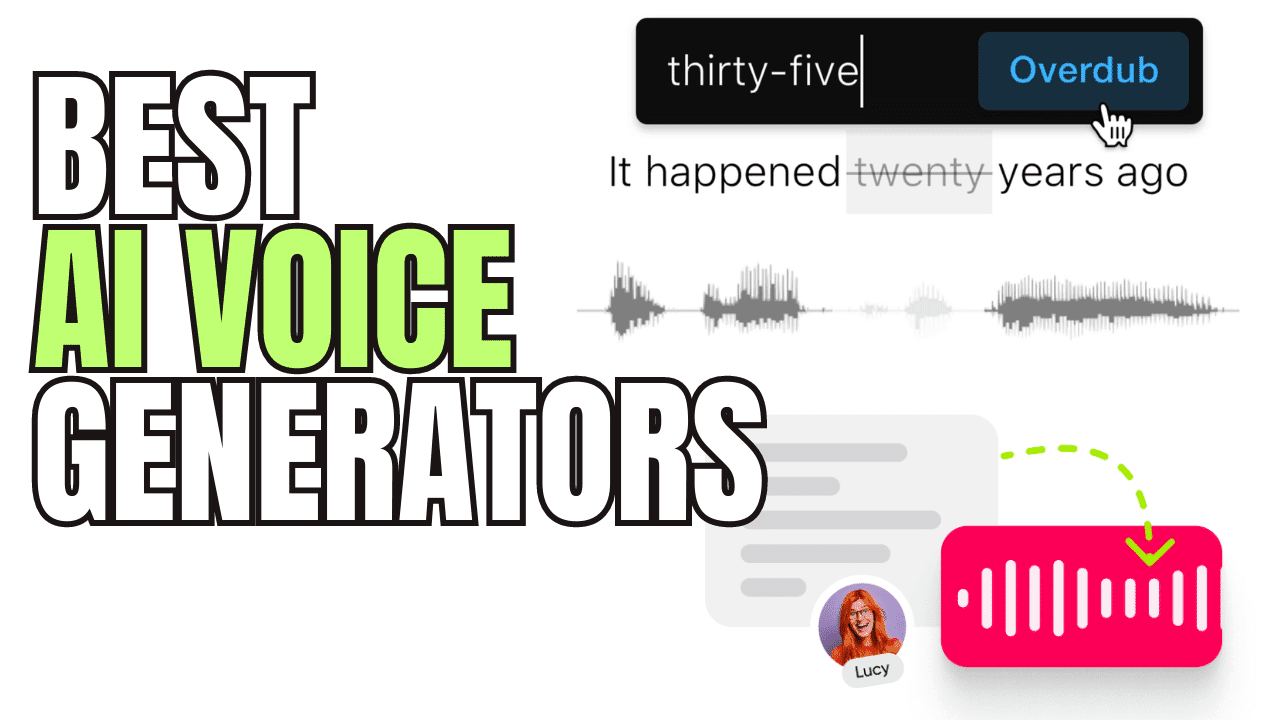
The core idea is simple: edit audio by editing text. If you notice a mistake in a recording, you can fix it by retyping the word in the transcript and letting Overdub fill in the corrected audio using your cloned voice. It’s less about generating entire narrations from scratch and more about making surgical fixes without re-recording.

The process of creating your voice using Descript Overdub
To set up your Overdub voice, you’ll need:
- At least 10 minutes of recorded speech (Descript recommends 30 to 180 minutes for better results).
- A Voice ID consent statement — recorded when you submit your voice for training.
- Processing time of 2 to 24 hours before your voice model is ready.
Alternatively, Descript now lets you create an Overdub voice from existing audio — upload recordings from your podcast or past projects instead of reading a dedicated script. This is a welcome change from the original setup, which required a specific recording session.
Once your voice is ready, you use it directly in the Descript editor. Type text into the transcript, and Overdub generates the audio in your voice.
Pricing (as of 2026)
Descript’s pricing is structured around the full editing platform, not just Overdub:
- Free — $0/month. Access to basic editing with Overdub limited to a 1,000-word vocabulary. Exports watermarked, capped at 720p.
- Hobbyist — $16/month (annual). 10 hours of media, Overdub with 1,000-word vocabulary.
- Creator — $24/month (annual). 30 hours of media, Overdub with 1,000-word vocabulary, 4K exports.
- Business — $40/month (annual). Unlimited Overdub vocabulary, 30 hours of transcription, full feature access.
The vocabulary limit is important: on free, Hobbyist, and Creator plans, Overdub only recognizes 1,000 common words. If you type something outside that vocabulary — a name, a technical term, industry jargon — Descript substitutes placeholder audio instead. For professional use, the Business plan is effectively required.
Full pricing details: descript.com/pricing
My take on Descript Overdub
Overdub’s strength is convenience. If you already live inside Descript for editing, the ability to fix a mispronounced word or add a missing sentence by typing is genuinely useful. It saves you from setting up a mic, re-recording, and splicing audio — which adds up across dozens of episodes or videos.
The voice quality is solid for short corrections. A replaced word or added sentence blends in reasonably well. But Overdub isn’t built for generating long-form narration. Over longer passages, the output can sound flat and slightly robotic. It’s a patch tool, not a production tool.
The other consideration is that you’re paying for the full Descript suite — editing, transcription, screen recording, AI features — not just for voice generation. If you use those features, the value proposition is strong. If you only want AI voice cloning, ElevenLabs or Fish Audio will give you more for less.
Bottom line: Descript Overdub is the best choice for podcasters and video creators who already use Descript and want an integrated way to fix audio mistakes without re-recording. For standalone voice generation, look elsewhere.
4. Typecast AI
Typecast is a powerful AI voice generator platform built for creators, agencies, and enterprises who need natural voice content, fast. What sets it apart is its position at the intersection of naturalness and speed, a combination most competitors don’t fully own. Instead of forcing you to choose between expressive output and quick turnaround, Typecast gives you both, along with a library of 700+ voices sourced from real voice actors (not generic TTS models).
For anyone who’s ever spent hours tweaking pitch sliders or regenerating takes hoping the next one finally lands, Typecast’s approach feels like a shortcut to the finish line. The platform is built around a simple idea: no single voice fits every project, so you should have the speed, variety, and control to find the perfect one, without paying until you actually do.
The process of creating your voice using Typecast AI
Getting a finished voiceover out of Typecast is genuinely fast. Here’s how the workflow goes:
- Visit typecast.ai/text-to-speech — free to start, no sign up or credit card required to try out the AI voices.
- Type, or import your script directly into the editor. No reformatting, no manual line breaks needed.
- Choose from over 700+ voices in the Voice Casting library, or upload a short sample of your voice to use your own.
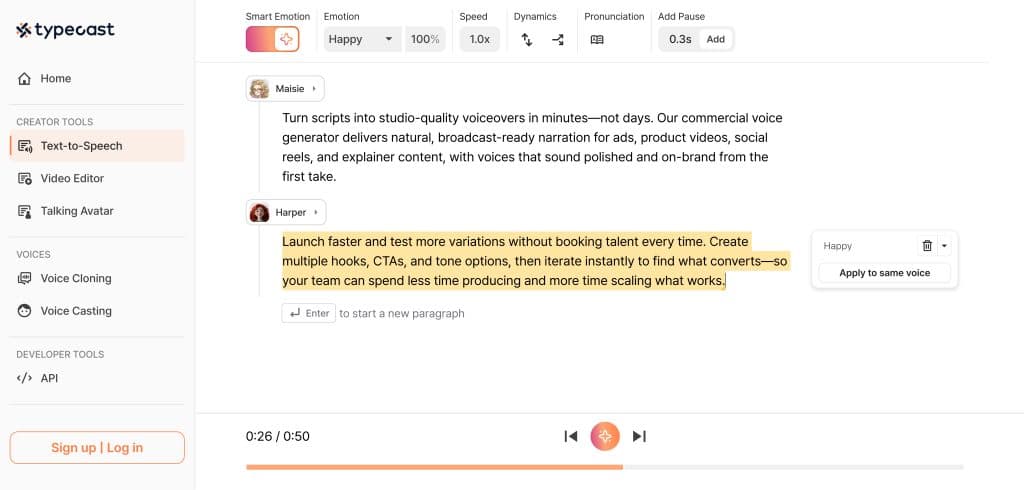
- Apply Smart Emotion — Typecast’s one-click voice intelligence — which automatically adjusts emotion, pace, pitch, and speed to match the tone of your script. No manual sliders, no guesswork.
- Fine-tune individual voice lines on top of Smart Emotion if you need precision beyond the presets.
- Download your audio.
The speed advantage shows up most clearly in bulk production. If you’re producing dozens or hundreds of voice assets — e-learning modules, ad variations, localized content — Typecast’s workflow is built to handle volume without sacrificing quality. Where competitors slow down at scale, Typecast keeps moving.
One feature worth highlighting is the “don’t pay until you’re happy” credit model. You don’t spend credits until you’ve actually landed the voice you want, which removes the financial risk of experimentation. That’s a meaningful difference from platforms where every regeneration eats into your monthly allotment.
The 700+ voice library is also worth dwelling on. Because the voices are sourced from real voice actors rather than synthesized from scratch, the performances carry the kind of nuance (breath, pacing, character) that most TTS often flattens. Combined with voice cloning and full customization, you have room to either pick a voice off the shelf or build one that’s entirely your own.
Pricing (as of 2026)
Typecast offers four tiers, all with unlimited voice generation. What changes is how much you can download, the output quality, and the level of creative control you unlock.
- Free — $0/month. 5 minutes of download credits/month, trial voices only, HD (720p) video, 1GB storage. Attribution required. Best for testing the platform.
- Basic — $8.99/month, or $7.99/mo billed annually (11% off). 60 minutes of download credits/month, commercial license, all voices, high-quality (44.1kHz) audio, Full HD (1080p) watermark-free video, 5GB storage. The sweet spot for solo creators.
- Pro — $32.99/month, or $28.99/mo billed annually (12% off). 2 hours of download credits/month, advanced emotion control & fine-tuning, 1 voice cloning slot, Ultra HD (4K) video, 50GB storage. This is where Typecast’s most differentiated features unlock.
- Business — $89.99/month, or $80.99/mo billed annually (10% off). 6 hours of download credits/month, 2 voice cloning slots, 100GB storage, plus add-on credits and slots available for purchase. Built for agencies and high-volume teams.
A separate Typecast API with usage-based pricing is available for developers, and Enterprise plans can be customized on request.
The standout policy: you only spend credits when you finalize and export, so experimentation is essentially free. For solo creators, Basic annual at $7.99/month is one of the most competitive offers in the space. For anyone who needs the emotional nuance and voice cloning that make Typecast genuinely differentiated, Pro at $28.99/month (annual) unlocks the platform’s full creative range.
My take on Typecast AI
If you’ve ever tried to make an AI sound genuinely sarcastic, devastated, or authentically thrilled, you know how frustrating it can be. Most AI tools just make the voice louder or faster. Typecast actually changes the performance. In my testing, being able to adjust the emotional intensity of a line using a slider was a game-changer for narrative content.
That said, there is a catch. The feature that makes Typecast truly special (the advanced emotion control and fine-tuning) is locked behind the $32.99/month Pro plan. The Basic plan is affordable, but it strips away the granular emotional manipulation that makes the platform worth using in the first place.
Additionally, if you are just looking to clone your own voice for a solo podcast or a straightforward talking-head YouTube video, Typecast might be overkill. The interface is heavier because of the built-in video editor and avatar features.
Bottom line: Typecast AI is the undisputed winner for emotion and character variety. It’s the perfect tool for storytellers, game developers, and YouTube creators who need a massive cast of highly expressive voices. However, if you just want a simple clone of your own voice for straightforward narration, you’ll get more mileage out of ElevenLabs.
Other Notable AI Voice Generators in 2026
Beyond our top three picks, several other platforms are worth knowing about depending on your specific use case:
- Murf AI — A polished voiceover studio with 200+ voices across 20+ languages. Murf is especially strong for corporate presentations, e-learning modules, and marketing videos where you need a professional, consistent tone. The interface is beginner-friendly and includes a built-in video editor. A solid choice for small marketing teams producing branded content on tight timelines.
- PlayHT — An API-first voice platform built for developers and automation workflows. If you’re building voice into a product — think apps, chatbots, IVR systems — PlayHT is designed for that. Less relevant for solo creators, but powerful for technical teams who need programmatic control over voice generation at scale.
- WellSaid Labs — An enterprise-grade platform that integrates directly with Adobe Express and Adobe Premiere Pro. If your workflow already runs through Adobe’s creative suite, WellSaid slots in without adding another standalone tool. The voice quality is production-ready, and the focus on ethical voice data sourcing makes it a strong pick for organizations with compliance requirements.
- LOVO AI — Built for social video and advertising teams. LOVO focuses on short-form voice generation — ads, promos, branded clips, and social content. If you’re producing a high volume of short voiceovers for platforms like TikTok, Instagram, or YouTube Shorts, LOVO’s fast turnaround and creative tools are worth exploring.
Conclusion
Is there a clear winner? It depends on what you need.
ElevenLabs is the safest all-around choice. The voice quality leads the market, the platform is mature, and the integrations are the most developed. If you’re not sure where to start, start here.
Fish Audio is the best value for creators who want high-quality voice cloning, multilingual support, and creative control over emotional delivery — all at a lower price point than the competition. The community voice marketplace is a unique advantage that no other platform offers at this scale.
Descript Overdub makes the most sense if you’re already a Descript user and want a quick way to fix audio mistakes without re-recording. It’s a workflow tool, not a standalone voice generator.
And if your needs are more specialized — enterprise compliance, API-first automation, Adobe integration, or short-form social content — one of the notable mentions above may be a better fit.
The AI voice space moves fast. Tools that felt experimental two years ago are now production-ready, and the price of high-quality voice generation keeps dropping. My advice: pick one or two tools from this list, test them with your own voice and your own scripts, and see what actually works for how you create content. The results will surprise you.
If you found this guide helpful, share your thoughts in the comments below — and pass it along to a creator friend who might find it useful.
You might also enjoy…
- Best Webinar Platforms in 2026: My Top 3 Software Ranked & Reviewed
- Top PDF Editors: How to Be Even More Productive in 2026 (My Top 5 Picks)
- Best AI Tools for Email Marketing in 2025 (MEGAPOST)
- Best AI Repurposing Tool for Video and Audio
- Best AI Tools for YouTube (MEGAPOST)
- Best AI Tools for Business (That Are Not ChatGPT)

Written by
Fei WuFei Wu is the founder and CEO of Feisworld Media, a Massachusetts-based digital media company helping brands get discovered by people and by AI. An Adobe Global Ambassador and brand partner to ElevenLabs, Synthesia, and 50+ other tech and AI companies, she hosts the Feisworld Podcast (400+ episodes, 500K+ downloads — guests have included Seth Godin, Steve Wozniak, Chris Voss, and Arianna Huffington) and co-created the documentary Feisworld: Live Your Art on Amazon Prime. Fei writes for CNET, Lifehacker, and PCMag, and her work has been featured in Forbes, Harvard Business Review, and WIRED. She has been publishing on the internet since 2014 — long before AI discoverability had a name.
View all posts by Fei Wu→Stay updated
Weekly insights on content, AI, and digital media.
Keep Reading