Brigit Esselmont @Biddytarot: How to Get Started With Tarot for Digital Content Creators (#331)
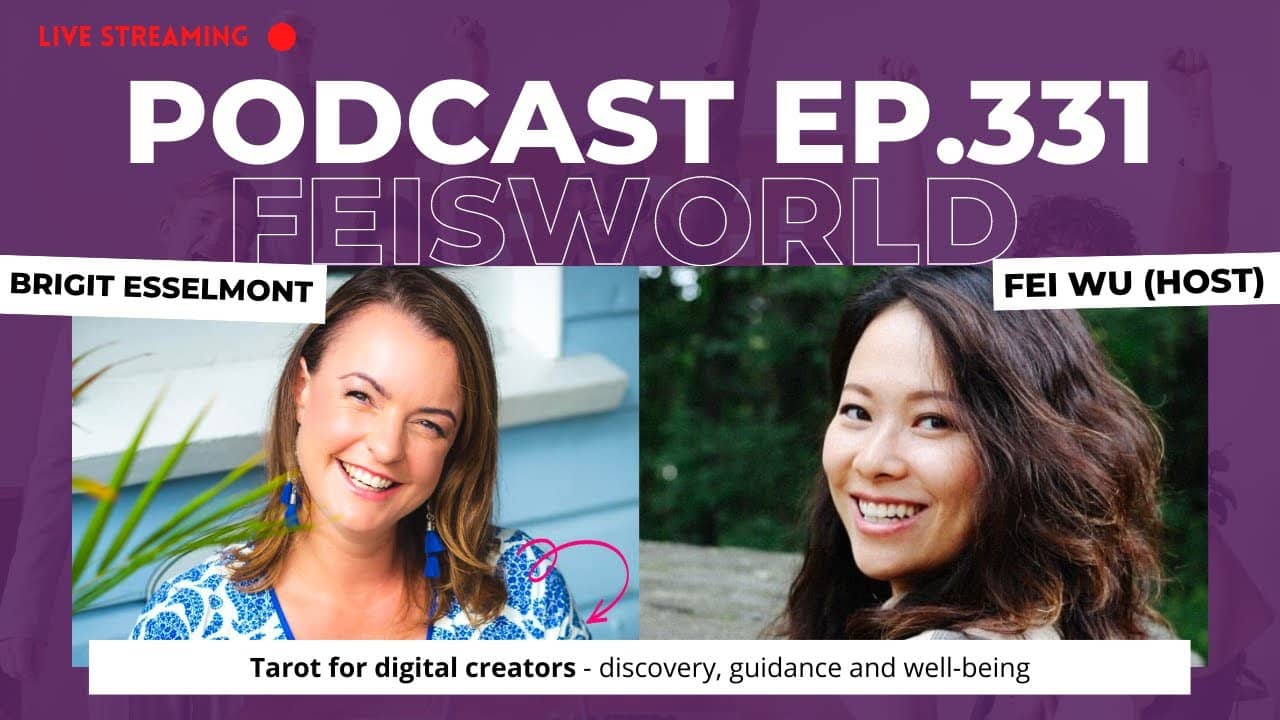
Our guest today: Brigit Esselmont
Meet Brigit Esselmont, Best-Selling Author of Everyday Tarot, Intuitive Entrepreneur, and Founder of Biddy Tarot – the #1 Online Tarot Education Source.
Brigit started Biddy Tarot when she was still a teenager. For more than 20 years, she’s been reading Tarot and helped millions of people all around the world create personal and intuitive connection with the Tarot cards, through courses, books and a thriving online community.
Together we are on a mission to bring Tarot into the mainstream, as a modern, intuitive tool for purpose-driven people such as digital content creators.
If you are a creator who’s feeling lonely, stuck, even burned out, this livestream will be your best companion to uncover new ways to connect to yourself and your creative work.
Watch Our Interview
Transcript
Transcript
Fei Wu: Excited to introduce you to my friend Bridget from biddy terrell.com and, uh, you know, I, I, first of all, I want this intro to be sort of unscripted because as I'm. Going to different stores, meeting new friends. Even going to these so-called like a spiritual stores that are popping up in the US these days. I walk in as, and I say, have you heard of Bridget from Biddy Tarot? How come you haven't? Here's, I literally like sharing URLs with people because I have been really transformed and so appreciative. Um, of getting to know you and the things that I have learned through you because, um, Bridget, you are the founder of Biddy Taro. I would say the biggest and number one, you know, not just tarot reading, but to understand, I think our spirituality, our creative energy, uh, at the next level, you know, you're. , one of the biggest sites out there, and I have since then purchased books and, um, these cards of books on my laps. That's why, and I highly recommend to anybody who is, you know, very new to this world, feeling a little intimidated, perhaps we're gonna play some games as part of this live stream. I highly encourage, uh, you to join in, and I certainly will be very, as vulnerable as I possibly could. Um, with that said, yeah, Bridget, welcome. I'm so thrilled
Brigit Esselmont: you're here. Thank you. I'm excited to be here and I've gotta say it's been so beautiful just watching you open up and blossom to Tara just from a few little creative sparks and it's just landed for you. And that's, you know, that's the magic that I love being able to create in different people and being able to offer that, um, that doorway really. And hopefully we get to do a little bit of that today.
Fei Wu: Well, I'm so excited. I was really surprised too because prior to knowing you, I had like zero experience with tarot. Uh, I, I couldn't even tell how many cards in the deck. I, I couldn't tell you exactly what the process is like and was very intuitive, which is part of your business, like an intuitive, uh, business. And, uh, you know, before we opened up, I mentioned, you know, I try this, I try this experience on my mom who's, you know, turning 71 this year. Chinese and you know, by the sun. And, uh, she found it so interesting and every evening she's like, it's time to play taro again. She's reflecting. So are you, I guess you're not so surprised by that, but we're, you know, even though we're not maybe your target audience necessarily, we was, you know, we weren't your target audience, but we're really able to benefit from this. Yeah,
Brigit Esselmont: I think that's, that's the beauty of taro is that it is actually can be so very accessible to anyone who is ready just to open up more, to like their intuition and, you know, personal reflection and so on. For so long we've thought, oh, taro is like, you
Fei Wu: know, woo woo,
Brigit Esselmont: or um, like it's something that's spooky or even evil. Mysterious and so on. But that's really been my mission through Biddy Tower, is to bring it to people like you and who may not have necessarily thought of Tara, or maybe they've been a bit worried about what it might be like to use the cards. Um, and it's, I I almost see it like as an awakening or a re a remembering, excuse me. So that remembering that feeling of, of inner knowingness, we spend so much of our lives kind of in this external space and like, what does he say about that? What does she say? Let me Google it, um, what have you. But Taro really helps us bring that energy and our attention inwards, and it's just a way of being open, of opening up to ourselves and reflecting on who we are and what our role is and our purpose is in
Fei Wu: life. Hmm. It's very, very telling. I was, uh, surprised by and, and frankly, one of the reason. For me to wanna engage is because of knowing you, watching your videos on YouTube, reading your website, knowing that you've started this business. And when you're just a teenager, 16, 17 years old and this business has, it certainly inevitably in creatively has grown with you. Uh, and I think. For me, like that intuitive part is also like liking and trusting the creator and the founder behind the brand. I think I would have probably thought about tarot very differently if I were stumbling upon a different site. Um, so with us that, I would love for you to talk about your origin source and then really maybe start with, uh, who is or what is
Brigit Esselmont: viti? Yeah. So, um, bit Tower started all the way back in 1999. Um, and that's when I just started learning Taro and I thought, okay, if I'm learning taro, maybe I could share this with, you know, one other person on the internet. And the internet was very, you know, new at that time. Um, and so I started learning how to hand code a website and Bitty Tarot was born. very different to what it does now. Um, but really it was that passion and that desire just to share something that I really loved and thought, well, maybe someone out there somewhere in the world could benefit from this. Um, over time, you know, I worked in corporate, um, I was a management consultant. I worked in HR and. I would always do my taro readings on the side. It was my beautiful, creative, intuitive outlet, I suppose. Um, it wasn't until kind of like the late two thousands, uh, that I picked up Tim Ferris's four hour work week and I thought, oh wow, you know, this, um, this love I have for tarot could be. An information product, it could be something that I could generate an a small income from. And so I started selling e-books. I started creating like more SEO on my website. Um, and within, literally within a few months bid Taro was up in the Google search rankings, like number one, number two, and you know, it has stayed there ever since. I'm deeply grateful for that. Um, wow. . And then 2012 is when I left corporate because my income through my business finally reached the same that I was getting through corporate. And I thought, why am I showing up to a job that's not feeling in alignment anymore? And why not pursue this, uh, new avenue and. Again, like fast forward over that last sort of 10 years or so, we now have online courses. We have a membership community for our Taro readers where they can practice readings and connect with one another. Uh, we have certification for our bitty taro, um, advisors, and we have books on Amazon, which I just, I realized one of our books is the Ultimate Guide to Taro Card Meanings Self-published. We've sold over 50,000 copies of that in the last. Five years. So it's pretty amazing. Um, we also have the everyday tarot deck. We've sold over 400,000 copies of that. And uh, I know you've got that one there. Um,
Fei Wu: such good quality too. Yeah.
Brigit Esselmont: Oh, it's, it's lovely. And it's a nice mini, so you can take that with you. And we're about to launch this one, which is the bitty taro deck. Um, and so cute. I've got some cards here so we can kind of play like side by side with these two different decks. So, mm-hmm. . Yeah. There's a lot happening in our world. Um, and really just motivated by the mission to make taro accessible to all, um, really to help everyday people connect with their intuition using tarot cards as a guide.
Fei Wu: Oh, I love that mission. And I also like the design. I, I feel like. , your branding. Certainly you've had 10 plus years at this point to refine it. But I just feel like, one thing I wanna call attention to, since a lot of our viewers on YouTube, LinkedIn, you know, there are, they are creators and entrepreneurs, small business owners, one of the things that come up all the time is like, how do I make my brand compelling, uh, memorable and, you know, consistent across different channels? And I notice with bitty taro, it certainly is the way. The purple as the color. You know, we don't have the perfect purple background today, but it's something that I definitely wanna echo because of your brands. And also, uh, the cards, you know, the design, the quality of the cards very thick you can hold onto. Uh, and, you know, my mom and I have been using it regularly and it still look brand new. Uh, and, and it just also, the cards is very, you know, people can't really see all the details. Very friendly, not cartoonish or anything, but it's just something that, that takes almost the fear away. The, the, you know, it feels familiar, it feels really touchable, very accessible. Um, so I really like that aspect about your brand.
Brigit Esselmont: Oh, good. Yeah, that's definitely our mission. It's just take away a lot of that kind of, uh, misinformation, I think about Tara. Um, yeah.
Fei Wu: Mm-hmm. Misinformation. Oh, I, I know. It's like, it's something that we were a little afraid of, uh, for some reason. Like for me it's like, what if I pull out a really bad card? Um, do I just, you know, grab another card and pretend it didn't happen? But it was very reflective. And something that I think a lot of people don't, don't realize, um, right off the bat is, uh, I realize that. , not that you ab I think there's a lot of your in intuitive, uh, in your intuition, the way that you have, uh, understood business and that kind of instilled into this book. It's really not about good or bad, rather it's a very reflective experience. So, um, to kind of spit it out, like one thing that I did even the first round roundabout, and I don't remember exactly the cars I picked, but it was. Reflective of my situation. This was late last year and I've mentioned it to you. It's basically three cards saying, you know, you know, Faye, you've worked hard. And uh, also, you know, you have reached a certain level of financial stability. , and maybe it's a moment to pause and a moment to really enjoy and celebrate that, and then that made me feel so good that night. It's like, oh, I don't have to be up at one in the morning like writing another blog post. It's like, maybe just relax and just enjoy this moment.
Brigit Esselmont: Yeah, what I, I called taro, like the mirror to the soul, and I think what's really beautiful is that you probably already knew that that was the answer, right? Mm-hmm. , you knew that you needed rest, but your conscious mind, which is lovely and productive and wants to, you know, aim high. Is there going, no, come on va, let's keep going. Let's go, let's go. Right? Yeah. But you know, in your heart, like, oh yeah, I need to just chill for a bit. Um, what the Tara does is just reflecting that back to you, um, and it's kind of opens up these corners that maybe you haven't really paid attention to or you've been actively just trying to ignore. Um, and so it's kind of like, This tool, this thing that now can reflect back and go, actually this is what you're really feeling on a deeper level. And you need that imagery and that card to tell you that. Um, because we are not yet fully trained, many of us are not trained to really be able to access that intuition. just go like, okay, what's my intuition saying right now? So the terra for me is a little bit like the training wheels to our intuition and the thing that helps us open up more to our intuition.
Fei Wu: Mm-hmm. , I couldn't agree more because I think, you know, people are lucky enough to have the, the financial means, for instance, hire a psychologist or hire a men, you know, mental coach or hire a coach in general. I mean, that's not really accessible to a lot of people. When I think about these cards and that book. , maybe $20, $25 on Amazon is something that you can travel with, you can bring with you. And it's like, it's almost like having an partner, having an actual coach to, but even better yet, it's actually all coming from within, right? It's like that inner dialogue that, like you said, you already have the answers. It just needs to be triggered and you need to be reminded the right way. And that's kind of how I felt and thinking, wait a minute, this for $25, I. Stay, you know, stay with me as opposed to an actual, you know, a usually, um, a session with a shrink, with a psychologist, two, $300 in the us. Uh, that is just, uh, I feel like in a way that all of a sudden there's kind of no excuse anymore. I mean, this is right up Yeah. At your fingertips. .
Brigit Esselmont: Yeah. I mean, of course psychologists have their value in, in certain ways. Um, but yes, definitely, you know, this is another tool that's available for that self-reflection and it is very accessible. You know, even just a daily card pull for five minutes is probably why your mom's going like, pull me cards, because it, yeah, it gives us that time to reflect. It's great.
Fei Wu: Mm, absolutely. And she's so eager. pull her own cards. I was trying to shuffle. She's like, no, I, she's like, I need to be in charge of those, the shuffling process. So it's more me. And then she's right, she always pull out very, like more, much more relevant information. So, uh, yeah, bridge. I wanna like play if, uh, , try a few things out if you're up for it.
Brigit Esselmont: Yeah, of course, of course. Yeah. So one of the things that I was thinking of, um, if you wanna kind of go in this direction, cause I know, you know, watching, uh, like amazing content creators, YouTube creators, and to be watching you might be thinking like, oh gosh, taro , I don't know anything about taro. Um, that's very nice. Yeah, it sounds good. Uh, see you later. But hold on, because I wanted to show, uh, a few ways that you could actually use. in content creation. And it doesn't matter if you have read Taro before or you've never read Taro, you've never even thought of it. Mm-hmm. Um, because I think Taro can actually support us in the creative process, really in a really powerful, uh, way. And one of the things that I thought of is, you know, if you're thinking about your next. YouTube video. Oh gosh, what earth am I gonna do? And it doesn't matter if you're in like, I don't know, loan refinancing or you're in showing YouTube creators how to, um, improve their YouTube profile or, you know, whatever it might be. Um mm-hmm. , if you can get some tower cards or even get them online, you can pull cards online is just think about, okay, what's my. What's, what's some inspiration for my next, uh, video content topic, right? Mm-hmm. , and I'll get Yeah, you do this too, Faye, and we'll, we'll have a little play with it. So . Oh, great. So like, let's say, um, If I'm in like, let's do loan refinancing. It's funny that I brought that up because now we've got the Ace of Pentacles and Pentacles is very much about money, looks like a giant coin. And even if you look at this imagery, um, you'll see like you can start to get some ideas of what this card might be. I'm talking about. So there's this giant like hand coming out with the coin on it, and it's as if there's a new opportunity, a new financial opportunity being shown to you. Mm-hmm. . And you really need to take, make that decision. Am I going to accept the opportunity? And then walk through this little, um, gateway. And behind that are some of the mountains. And the mountains can really talk about, um, the challenges. You know, like, yes, this golden opportunity, but you're gonna need to work for. , and so then you might go, oh, well that's interesting. , wonder what I could do with a video around that. So maybe in loan refinancing. I don't know. This is not even my area of expertise. I don't know why I've chosen it, but,
Fei Wu: um, there's a great example. I'll keep going ,
Brigit Esselmont: but it might be like how, how to evaluate the right loan refinancing options for you and then, uh, not just what looks great on paper, but you know what, what else comes? Like, what is that hard? That comes after the opportunity. What will you need to do to really maximize that? So there's a video content that you could do just by looking at a picture and a card. You can always go and look up the meaning online as well, and that might give you some insight. Um, and it might just send you off in, in a direction, particularly if you've been creating content for a while. And sometimes you get a little bit stuck and you think, what's next? So Faye, what did, did you draw a card?
Fei Wu: Let's see if we can find, oh, I wanna like, yeah, I, I, first of all, I thought that example was so interesting because of the financial downturn. I mean, there's a lot of like, for instance, layoffs in the US and that when you pull that card, I was just thinking. You know, there are a lot of, you know, senior engineers like Google, Facebook, they're making enormous amount of money for many years. Having that comfort and that cushion to sit on and that that's something that, you know, they always visualize, right? They've really done it, achieved it. And now if they're laid off, like to me that mountain represents, you know, certain obstacles, but maybe behind that mountain, uh, there are new opportunities that they just couldn't see before. So, uh, I wanna show people how to shop. Shoveling cards are like, very challenging for me, but, uh, . So, okay. I'm gonna pull a card right here and, uh, uh, oh my God. This is like, should I be scared? It's a hang man. .
Brigit Esselmont: Never be scared by a card. I know. Sometimes they might look or sound a bit scary. , but No. Yeah. So just start describing, tell me what do you see in this picture?
Fei Wu: Oh, I, I love where we're going with this. So, first of all, I see a person that's like upside. and. , you know, and then at the same time, there's, you know, uh, his or her, uh, feet, uh, you know, for one foot is tied to the tree, upside down, and then, but there's, there's a tree behind it. To me, it signifies growth. And sometimes I also see, like when, first of all, I'm not even relying on anything. I, personally, I don't have any experience memorizing the cards, but to me it signifies like a new vision, right? Like when I remember when we were so playful, when kids, I love being upside down. Uh, that's kind. Comfort zone when I was a kid, but also I know a lot of friends from Cirque du Sole. Literally that's their comfort zone. I'm thinking about you Gaia after 10. And uh, so it actually, to me, there's a new. It's kind of a new vision where maybe sometimes I like, oh, what I'm doing now, maybe I do just the opposite and see what happens. So these are the thoughts.
Brigit Esselmont: Yes. That's awesome. And you know, notice like that halo around his head as well because that is that kind of new insight, new vision. Um, and I love the analogy of, you know, when you go upside down, the world looks entirely. And that is, yeah, sometimes we need to do that, like look at things completely from a different angle to see things, um, in a new way. And then, you know what, how could that translate into a YouTube video for you? Like what would a topic look like? with
Fei Wu: that in mind? Yeah. To me, I think they're, they're, it's a new mindset. So, uh, I can think of a number of, you know, YouTube video ideas and think about the opposite. So for instance, one of the things we do is how not to do something or the way that you should not, you know, if you're trying to. trying to maybe, um, talk about a website or a software, like what are the reasons not to use that? And, uh, kind of the opposite ways or even for us to, for me to think about creative work. For instance, one of the videos, um, that I did, uh, which I wouldn't say it's the most popular video, but several clients ended up watching that video and hired me because, uh, it was about a live streaming tool. Instead of using it and say, One minute. In this three minute I'm gonna show you how to go live. And that's kind of what the software was about. It's going live like very frictionless. But I, when I used the software, I said, I'm gonna do the opposite of just recording. Uh, my take on this. And the video was about 10 minutes long for me as a first time user and actually looking into each option. Slowing things down and not skipping any cl, you know, clicks and things like that. So people love watching that video because we were like, I know exactly I can follow her, you know, throughout the entire journey. And, uh, just opposite thinking sometimes really helps.
Brigit Esselmont: Yeah. Awesome. I love it. Yes, it's kind of like the what not to do. Um, and you know, another element of Hanged Man is about like temporary pause and suspension. So it's almost like, Hey, you're doing this thing, , stop doing it. Do this instead, . Um, so there you go. Like, look at just how one card, and, and you didn't even look it up in the book, you just worked off the picture, which is exactly what I recommend people do if they're new to Taro. Um, and you've already generated some different ideas that you could use in your own content. So you can see how a tool like this can just be that creative inspiration, um, for anyone. Doesn't matter if you know about Taru or you don't.
Fei Wu: Mm-hmm. , I mean, this is so. Fascinating. And you know, I, I think there's just so much to dissect and the fact that bridging, you know, a lot of people in creative work as a YouTuber content creator, which I'm gonna be interviewing several in the coming month, um, is that people have the feeling of like, just stuck. Um, , you know, could be on big or small things. So we're talking about either, either facing a blind page that you need, you know, you need to write 500, maybe a thousand words, or sometimes just social media copy. Sometimes it's just just a subject line where a title for a video that people feel really stuck. So in ways that I feel like playing with tarot cards really unblocked people. Have you seen things like
Brigit Esselmont: that happening? Yeah, absolutely. Um, and, and you'll notice we haven't done any. predicting the future Here we just use it as a tool for creativity. So a lot of people think, oh, Tara, you tell the future, but we're not telling the future of your video and if it's gonna be successful or whatever. We're actually just using it as a creative prompt. Um, and so there are, yeah, many different ways that you can use. Taro. Um, because even if you were a creator and you're starting to feel a bit stuck in your whole process, maybe you can do a little bit of self-reflection. Like, what is it that's blocking me right now as a creator and how can I release some of those blocks? So I'm just, let me just pull a couple so we can do this as a, I was gonna do the
Fei Wu: same thing. I
Brigit Esselmont: love it. So, let's see. Like it is hypothetical what's blocking me. Well, maybe it's not hypothetical . It never is. . Um,
Fei Wu: it looks so cute. I love the
Brigit Esselmont: drawing. Cause you know, we, we are looking at our YouTube strategy right now. I'll just give a little, uh, story, but, um, And I'm so excited to do the YouTube strategy, but I know that we've gotta have process in place. We've gotta have the right infrastructure for it to really flow, um, and get off the ground in a, in a big way. So it's funny actually because have a look at this card, the Night of Swords, what's blocking me? This is a huge amount of energy and wanting to like, push things forward, but sometimes that desire to do things, Quickly and like, why aren't we just doing it now? Um mm-hmm. , that can actually be a blocker because sometimes it's important to just to slow down. And what's really interesting is the release card, like how to release that energy. Is the two of Pentacles, and you'll see that he's juggling these two coins and he's kind of having to balance different priorities. And that's certainly what we're experiencing for bitty Taro and being on YouTube is there's so many different priorities that we have. And while I have a lot of energy and excitement about creating content here and now, we actually have to juggle it in the context of, uh, you know, other priorities. at the moment. So, there you go. What about you, Faye? Do you wanna draw? Are you ready to like, open your heart to your community? Um,
Fei Wu: oh, what's blocking me? Oh, I'm ready. This is so much fun. So you mentioned the, the idea of a release card. So, um, do you, in this case, pull two cards instead of one?
Brigit Esselmont: Yeah. So first one, think about what's blocking you, and then second, you know, what action you could take or how to release that blockage. Yeah.
Fei Wu: Okay. Okay. I'm here. I'm here. Okay. So the first is, what's blocking me, and this is, let me read it. Page of wands. Mm-hmm. and really interesting cards. I wanna make sure my camera focuses on that. So I see a person using a, so this is a wand I guess, and, uh, uh, is it, or is it, uh, I, I think Oh, interesting. And I see the background and I don't know if I see the sun, uh, what's blocking. How do I read this?
Brigit Esselmont: Okay. No, this is good. I'm glad you're getting a little bit stuck with it because I'll show you how to kind of get unstuck. . You too. Um, have a, like, have a look at the man. What is he, is he going somewhere or is he staying in one place? Yeah, one place. And he is kind of, uh, he, does he necessarily have a plan yet, or is he, is he, wait, does he feel like he's waiting? What's, what do you think his thoughts or feelings might be in this point?
Fei Wu: Yeah, I, I am, you know, I think he's maybe standing still. And then maybe, I wonder if it feels a sense of like loneliness as well. Like is he thinking, uh, kind of independently on his own? Does he feel like he has a level of support? Where does he go to? I don't know. There's clarity that
Brigit Esselmont: he has to yet. . Yeah. Interesting. And then the ones are very much about inspiration and is he waiting for some inspiration, perhaps? Is he like, what's next? So maybe the blockage is around, um, getting inspiration and really tapping into like, feeling like sometimes, you know, we can create, if we're creating content in just our little bubble and we are not thinking about what is. Community, what is our customer avatar? Really neat. There's, and, and if we don't have that strong connection to our customers and our community, it can start to feel like, oh, I don't know. I don't know what to write. I dunno what to produce. Um mm-hmm . And so maybe there's kind of that waiting for some inspiration and to feel lit up. How does that land?
Fei Wu: Yeah, well that, I have an opening card as well, but as you mentioned, because I didn't really fully understand that wand is in a sign, is a sign of inspiration to me. Like ones that I, you know, ones that clarity is there for me. I'm looking at as a situation of like, for me personally, to finally put my foot down and say I wanna focus on YouTube strategy for small businesses. And all of a sudden, I mean, just today, you know, I have a couple of clients reaching out to me, uh, actually. I would say prospects, clients I had before and reaching out to me to say, we want a turnkey solution for, to work with someone, an agency on our YouTube strategy. And to me it's like setting that focus all of a sudden is driving the, the results that I'm expecting for and that focus I, I need to grow my business. So,
Brigit Esselmont: yes, and I'm hearing putting that stake in the ground being like, and that's almost what it looks like. I put the stake in the ground, say, this is who I am and who I'm here to serve. Beautiful. Yeah. And what's, what's kind of, what's your second card?
Fei Wu: Oh my God. This is the five of Pentacles, right? Yeah,
Brigit Esselmont: yeah. Interesting. What do you see and what does it mean
Fei Wu: for you ? This one. Oh, interesting. I see these, so five Pentacles, and there's a woman, uh, covering her, you know, wearing this long gown and uh, kind of walking away. And, um, so like, based on her. Posture that makes me feel like, is she upset about something? Is she, you know, um, I, is this like, is she energetic or is she feeling upset? I don't really know, but I, the way I see it is when I think about like five, I know it's just arbitrary number, but I think about all the things I ended up. Working on like Life Dream podcasts and all the things I'm truly passionate about, um, helping me do sometimes like parting ways with a million services that I have invented. It. There is a sense of, um, almost a sense of grief, like, you know, realizing that of course I can do them again. But right now I really, I am shifting all my energy towards, uh, YouTube strategy because I know that's the right thing to do. So, That's, that's really interesting to me. But I know, like, to me, this is so very activating because I, I can feel the sense of energy to say like, this is the right thing to do. I just have to believe in me. Yeah.
Brigit Esselmont: Yeah. Awesome. Okay. There's so many layers in there to unpack and what you've shared is like, beautiful. Um, cool. So the fives, fives are interesting because it's halfway point between the one, which is very much about new opportunity and 10 which is about completion. And when we are in that state of kind of, it's like a transition state, you're no longer like making something new. Now you're heading, heading towards completion. just as like when the tide changes, say in a river and you end up with like the waves of looking crazy or, um, any kind of change or transition, it can create a little bit of friction. Um, and so you might be experiencing some of that like friction about which, which way am I really going here? Um, the other thing about the five of Pentacles can sometimes be a bit of a scarcity. and cuz she's out in the snow and she's locked in, like locked away from the um, church. So the church is actually there and available for her if she wants the warmth, but she's out in the snow, so she's kind of like, oh, poor me, I'm, I'm lacking, you know? And so what might be interesting for you is as you lay out that desire to work, Small business. There may be a part of you that's like, oh, but I should, maybe I should keep all of these other clients who may not be fully aligned. But what if I don't? Like, what if I run out of money and what if I run out? You know, what if there's not enough? Um, and so it's kind of working through some of that mindset as well and just being like ready to embrace what it is that you have, uh, committed to.
Fei Wu: Yeah, you, you're absolutely right about this. It's so funny. Earlier today was just editing some shorts for, uh, our lovely mentor, Dory Clark. And one of the things that, one of the last videos I watched is the fact that the things that we're working on that are especially worth pursuing actually takes time. It's not that we're not smart, it's not like we haven't figured out the hacks. It just valuable, meaningful things that actually take time. So as you were mentioning about this card of, um, you know, five. Zero to 10 we're between one and 10 is like, sometimes it's so easy to give up or to doubt ourselves, to question, uh, you know, our commitment question, our patients even on our way to achieving something greater. Absolutely. A agree with that. And, uh, and also, like you said, version about letting go, letting go of the clients that are no longer aligned with our vision, with our, uh, business. And, uh, it's hard to say goodbye and. To do that in the past couple of years. And, uh, it's, uh, ultimately that is the right decision. And, um, so, oh, this is so , this is so revealing, more so than I thought. So , I
Brigit Esselmont: love it. Good. Yeah. Yeah. Awesome. And so you can just see like how. Easy it is to access these types of insights. And again, we have not looked at the book, we have not looked at card meetings online, which are all available and accessible. Um, but there's so much that you can get just by looking at the pictures. And the reason that works so well is because. What it does is it starts to bypass our conscious mind. Our conscious mind likes sort of words and thoughts. It's a little bit more logical, um, but our subconscious really responds well to the imagery. And so the imagery in the card is what actually helps us go deeper and beyond just our conscious thoughts, we get deeper into our more subconscious and our, like, our intuition effectively. Um, and I think what's also neat is it's. It almost gives you a bit more license to go, oh, well the card, the card, look at the picture. That's what's happening in the card. So it has to be that way. Um, whereas if we consciously think, that's when we start to doubt ourselves. Like, oh, is mind just making this often? But cards really help us go, oh, okay, yeah, there is a different way, or there's something new there that I haven't seen before. .
Fei Wu: Mm-hmm. . Mm. I absolutely love this. And uh, and if anybody's watching here live, please feel free to drop us a no drop your questions. Nothing too silly. I know we can't see everybody like coming from LinkedIn for instance, but let us know if you have any questions now or after we've gone live. Um, one thing, Bridget, I think we don't realize, like people who haven't started their business just yet, where. Just starting out. They don't realize all the ups and downs that actually do happen, uh, with entrepreneurs and from all walks of life. And, uh, I see your business bitty tarot as a very, very successful one in many ways that some people could be surprised because it feels really niche. Yet, you know, it, it is very successful. It targets beginners, aspiring taro readers and professionals. So I would love for you to maybe talk about some of the ups and downs and whether you use tarot to kind of conquer that, to, to have you breakthrough. I would love for you to share some of those stories. It's so valuable.
Brigit Esselmont: Yeah. When I reflect back on the entrepreneurial journey, I mean there's so many different ways that you could look at it, but I really see like these transition points between. Oh, I'm just doing something fun. And you know, it's a hobby to, oh, I could make money out of this person. Like, and then it's a bit more of a personal brand and you're basically creating a job for yourself and that's super fun. Like it's flexible. You don't usually have team members and so on. Very creative. Um, but I believe that that can only go so far. And then I reached a point where I realized, actually, no, I wanna go beyond that. I wanna have a business, um, and. With the business, I think you start to open up a lot more to growth. Um, maybe you start to have team members and so on, but also that's when you do have to show up quite professionally. And so if you don't feel like it too bad because you've made a commitment and you stay consistent. Um, whereas, you know, I think when you're in kind of that personal, like, oh, just, you know, an income you can, like, if you don't feel like it, great, go to the beach. Like, it's all, it's all good. Uh, and so I'm really consciously made that decision to move to business. And then I think the last few years has definitely been about, no, I'm gonna build a company and I really wanna build a company brand that can live beyond me. Um, because I, I know we. So many people. We like literally millions of people every year. And I don't want that to be just dependent on me, um, because I want that to continue to live on regardless. Uh, I, I mean, I know I'm a factor in the whole picture , but I really wanna be able to create something that has that longevity. Um, and so I think when it comes to like the ups and downs transitioning. Company per se. It's, it's got a lot of great things about it. You know, the amount of growth that we've experienced. We have, um, 15 million visitors a year to our website. Uh, we have a team of 15 who work virtually and all around the world. Um, and yeah, we just, we literally have, you know, thousands of thousands of students and with that comes a huge responsibility, um, to make sure that we are sustainable. and we have that long term factor. Um, and also, you know, I think being a company per se, Yeah, it does come with the responsibility and sometimes you have to make some really tough decisions to ensure the sustainability of the business. And, um, you know, a couple of years ago we had a team of 30 and we had to reduce down to 15 just so that we could stay really focused and streamlined with how we are serving our community. And I've gotta say, like Tara has definitely helped me through those tough decisions. Um, I do pull cards when. Need to make a decision. It does not determine my decision. It's information. It helps me through an intuitive process. Um, but it's certainly really supported me and helped me stay in alignment as I've led a company and led this growth, uh, in the company. So I, I think, you know, whether it's taro or any other kind of intuitive or reflective tool, I think as entre. Having access to that is incredibly important because we pour our heart and our soul into our work. And if you don't have that level of self-awareness, um, and that time for self-reflection, you could end up on paths that you realize later on, you know, burnout, um, exhaustion or like, what the flip if I just created here, and how do I get outta it? Yeah. You know, so staying in alignment is so important for success as an entrepreneur. and we're seeing it more and more. You know, I hear like Sarah Blakely talks about it. Um, Steve Jobs talked about hi, you know, using intuition. Um, just hear more and more of this connection to intuition for entrepreneurs.
Fei Wu: Mm-hmm. Mm-hmm. , I, this is so timely of a conversation because even just, you know, yesterday, the day before, I've spoken with very successful female entrepreneurs and we have large followings making, you know, Lots of money, yet I really sense that like that self imposter syndrome is quite severe, uh, among many people. So I wonder if you did experience that, still experience some part of that, and perhaps when you set that 2012, that turning point of you realizing that, wow, that's a little baby hobby thing, is now turning into real business. Like, could you maybe speak to maybe self imposter syndrome and then what to do about it perhaps.
Brigit Esselmont: Yeah, it's, it's interesting because, um, I speak to other business owners who are at an earlier stage in their journey and they go, oh, you know, am I really the person to do this ? I'm like, look, this feeling, it never goes away. I still feel it and I'm like, you know, we've created an amazing business, um, an amazing success, but pretty much every week I'm thinking, oh gosh, am I really the right person to do? Who am I? You know, all of that kind of stuff. And in Australia in particular, we have, um, what's called the tall poppy syndrome. So you typically don't kind of big note yourself, uh, and boast, you know, talk about like your successes. So our culture's a lot more just kind of like, oh, you know, quite humble and so on. Um, and yet we have an American audience, um, and. Quite a few Americans on my team, which I'm really grateful for because they're like, Bridget, you've just gotta get out there and you've gotta say you are the best. I'm like, oh, okay. Yep, sure. Um, . . So I often have that feeling, but what's got me through is just I am just like, that will always be there no matter what. Um, I will not let that get in the way. I know that little voice will come in at various times, but just go, all right, thanks very much, . Carry on. Because if I stop, because I'm worried if I'm not the right person, um, I'm doing such an in the disservice to the people that I am helping, and again, there's millions of people that I'm helping and I can't not do the work, you know? Mm-hmm. can't let to this stupid self-talk stuff get in the
Fei Wu: way. . Wow. Yeah. This is so important. And, and, you know, bridge, I gotta admit, like talking to you for 40 minutes, feels like I've been talking to you for 15. Can you, do you have time? Do you have a meeting immediately afterward? Can you go over five minutes? No, I'm
Brigit Esselmont: good to go a little bit longer. Yeah, I'm good.
Fei Wu: Okay. Thank you. I appreciate it. And uh, the reason why I think what's so incredible is like you have this big smile. I mean, this is not just us going live, but the moment I, I met you, I just, I saw the. Of you running the business. Not to say any business, anybody's life is perfect, but it seems like you really, you have found, uh, the perfect mix and, and just the energy-wise, the size of the business feels right, right now. And I love looking at your marketing deck. It is just like painfully clear and I absolutely love it. There's no ambiguity. There's, there's realistic expectations. I hope your team is, is aware, like how lucky they are to have. Grounded founder like yourself, but I have to ask like at what point have you realized this is a race size for you? Lately in early, uh, 2023, I've watched so many videos from, you know, Ali Abdal on YouTube and then Vanessa Lau, uh, all talking. I know we've both are, you know, watched Vanessa's channels and they're so open about creating a business. They, they once loved three to four people, so nimble to now multimillion dollars, 25 to 30 people on the team. They all kind of start at one point, like hating the stuff that they were doing. , you seem to have already gone through this part before they have, and I wonder how you kind of like found the, the setup, the model that works for
Brigit Esselmont: you. Yeah, great question. Uh, cuz I know when we had 30 team member, team members, I very grateful for all of them. But I know that I was waking up in the morning with a feeling of dread, uh, and I have not had that feeling for like a very long time. And I'd be like, oh gosh, it's a workday. Uh, Yeah. And I knew like, oh, I can't sustain that. Um mm-hmm. and really, yeah, I mean, the reason why we brought the team down, mostly like the financial side, just to bring our costs under control a little bit more. Um, but also, yeah, I just, I wanted to have a team that felt really good. And I think once you get to 30, what we noticed was that you need to have, Policies, processes, hr. We started hiring for an HR manager and then realized like, what are we doing ? Um, and it was insane. And yeah, and then you've gotta have all these different layers of like management and so on for it to really work. So now that we're back down to 15, I feel like we've got a really yummy magic that's happening in our team and it's really manageable and it's. , a nice group size that everyone knows each other, has rapport with each other, can connect and collaborate very well. Mm-hmm. The other thing that's been incredibly important is, um, well I am like founder and c e o of Bid Taru. I work alongside, uh, Kaylene, who is our C O O, and she's really the day-to-day like the integrator. I, we really. Now that model of me staying in that visionary and very strategic place, cuz I love strategy. Like I'm not just a creator, like, oh, let's do this thing. Cause I'm thinking strategy of like, oh, okay, what's our two, three year plan? Mm-hmm. . But Kaylin is the one who's. Taking that vision, turning into a strategy, getting the team to align to it and start and work, um, and bring it into manifestation. So that has been absolutely critical for my own wellbeing so that I'm not managing directly other people. Cuz that drives me. It's a lot Um, it, but you know, I think that is actually what can lead to burnout for a lot of founders when they're growing teams is they get stuck in a model. , they are now managing six 10 people. Mm-hmm. and I have had many friends who've just gone, oh, I don't want a team like fire everybody. And now they're back on their own. And um, I know that I don't want that. Um, I am, but I know that for that to work, I've gotta have that really nice structure that has the visionary integrator and then the team that works.
Fei Wu: Hmm. Well this is so helpful. Uh, I so appreciate you sharing that cuz a lot of people don't really see it coming, you know, they just, everybody, every voice is saying get, you know, go bigger or go home. And it's all about more, making more money. Lately I've been thinking even just from pulling card to realize, okay, what about the quality of my life? Am I okay with, uh, making the same amount of money but having more time on my own, playing the guitar, hang out with mom friends and, um, so it's just like, Ways of looking at life, not just a single dollar amount, which we so often use to kind of like validate the decisions that we make. So, uh, that is so helpful. Bridget, I would love for you
Brigit Esselmont: to, can I, can I just add one bit in there? Because what was really interesting is that, um, when we reduced our team, our actual margin went right back up again. And so if you look at it at the, kind of the actual, um, The money that you make, like from a smaller team. Mm-hmm. , it's, it can be more, and I'll tell you why. It's because when you have a team of 30, you can actually get very bogged down in, now you've got three people who've got strategic, um, perspectives and opinions, and then you have to work out, oh, which one of those is the right way to go? Can get into a bit of self-doubt and so on. So it slows the whole system down. Whereas I think when you go a little bit smaller, you can actually create a lot more efficiency. You are having much more impact with your community, and that inevitably impacts the financials in a positive way. So I think, I think more in terms of what's like that sort of scalable, profitable growth versus just U vanity, like revenue or sales. that we saw that quite clearly that we could grow sales, but the costs were like just matching, you know? Um, and when we were more efficient as a team, we could create a lot more value in a more efficient way.
Fei Wu: Oh, that is so fascinating. It's, you know, what's the point of, yeah. Making more sales. But at the same time, the operations, cost advertising are just totally over the roof. Um, yes. . Yeah. This is very, so much for me to reflect on after the recording, uh, the livestream as well. And, uh, and I would love for you to maybe just like in closing, like talk, let's talk about what's next for Vidi Taro and, uh, you know, I know that you're always transforming your vision. You're such, such a visionary, so please share with us like what is the future of
Brigit Esselmont: Fitty Taro. Yes. So we're very excited to be launching the, um, the bitty taro deck. So that will be out. End of March, but you can sign up for the wait list right now. And that's over@biditarot.com slash deck. D E C K deck, . Um, and uh, yeah, we'll be doing a first release. To our wait list, so definitely jump onto that. If you are interested about the bitty taro deck. Um, I really see a whole new world opening up through this deck and the potential to create some more physical product, you know, high quality taro, um, swag, I suppose. Uh, we know we're really interested to see what might happen in that space and. The other thing is, uh, we're very soon to be opening our bidi tarot certification program for this year. Um, already we've had, uh, thousands of students take part in this program, so it's great to do another round. I think we might be in our six. Year of it actually, uh, if my memory serves correctly. So, um, that's very exciting. And, you know, we continue just to serve our community through our courses in our community. And, uh, I think we'll be investing a lot more into content, video content, and sharing more content online. As well, which is great. And I can see, uh, these wise cards you're asking about to start to see a few of the cards. So let's have a little peek. Um, I'll just pull out some random ones. So there's the moon and the sun. You see like just beautiful, um, uh, just a beautiful color palette that we. . Mm-hmm. . And very easy, like what we were saying earlier is, you know, these cards aren't kind of scary. Like, okay, here's the devil card. A lot of people don't like the devil, but you know, it's nice, uh, , it's not too confronting. And this is great because if you are reading for friends and family who may not be open to Tara yet, uh mm-hmm. these kinds of cards, like here's the tower, this is another kind of scary card. Mm-hmm. . Um, but. , you know, it's, it's easier on the eye. It's like, oh, okay. Oh, okay. Yes, there is a breakthrough. Oh, I'm okay. You know, . No,
Fei Wu: I'm okay. That's so cute. Who is the, uh, the, in terms of the, who's the artist or what's the kind of the creation process, uh, behind that? You're so excited and we love the design.
Brigit Esselmont: Yeah. So, um, we're very lucky that we've had a team of designers, uh, collaborate. So this really is a collaborative, um, project. And even my husband who is a designer, he designed the box. I love the box . Love the cover. Yes, it's my favorite. Card in the deck. Um, but yeah, we've had a couple of designers and I was working with them on like the creative direction. Mm-hmm. , just to really bring that energy all into alignment. So, Good.
Fei Wu: So good. So good. Thank you so much for your time vis, for everybody who is watching this now later, please check out biddy terrell.com and especially if you're new to this, even if you're blogger, a YouTuber, content creator, copywriter, uh, you're thinking about starting your journey. Maybe you're going through something right now, you wanna kind of unblock. I would say that everything you find on the site is just so invaluable. There's so many free tools. E. Beautifully designed. I have personally downloaded like 18 different things and , you know, absolutely love it. So please do go check it out. Um, with that said, Bridget, it's such a pleasure, um, to have known you to be able to share those conversation. Thank you so much, so much for spending the time with me
Brigit Esselmont: today. . Oh, thank you, Faye. It's been a pleasure. And again, it's so beautiful watching you just open up and blossom with your tarot cards and how you're integrating them into your life. Fantastic .
Fei Wu: Thank you guys. And, uh, definitely go check out, um, definitely this, you know, the new card. And also I absolutely love this book, intuitive Tarot, um, without memorizing and really connect with yourself. So, with that said, I'm gonna take us offline. Thank you for being here and, uh, we'll see you next.
Connect with Brigit Esselmont
Learn more about Biddy Tarot
Getting started with Tarot
You might also enjoy…

Written by
Fei WuFei Wu is the founder and CEO of Feisworld Media, a Massachusetts-based digital media company helping brands get discovered by people and by AI. An Adobe Global Ambassador and brand partner to ElevenLabs, Synthesia, and 50+ other tech and AI companies, she hosts the Feisworld Podcast (400+ episodes, 500K+ downloads — guests have included Seth Godin, Steve Wozniak, Chris Voss, and Arianna Huffington) and co-created the documentary Feisworld: Live Your Art on Amazon Prime. Fei writes for CNET, Lifehacker, and PCMag, and her work has been featured in Forbes, Harvard Business Review, and WIRED. She has been publishing on the internet since 2014 — long before AI discoverability had a name.
View all posts by Fei Wu→Stay updated
Weekly insights on content, AI, and digital media.
Keep Reading
Related Articles
Joanne Lipman on Mentors, Untapped Talent and Why Women Should Stop Waiting to Be Perfect
Marc Randolph on Curiosity, Messy Starts and Why “Nobody Knows Anything”