Chris Voss: Tactical Empathy & Skillful Negotiation for Digital Content Creators (#330)
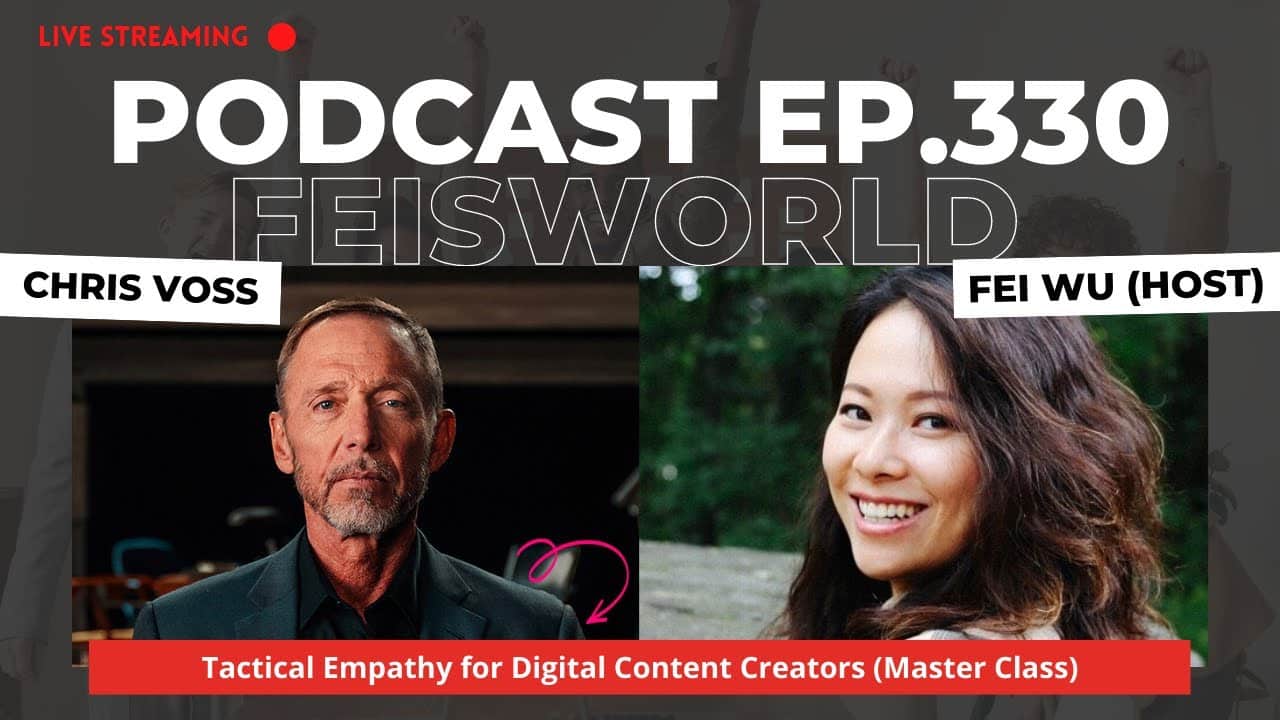
Our Guest Today: Chris Voss
Chris Voss is an American businessman, author, and academic. Voss is a former FBI hostage negotiator, the CEO of The Black Swan Group Ltd, and co-author of the book Never Split the Difference, and The Full Fee Agent.
In this livestream, we’ll be discussing Chris’ latest project The Full Fee Agent (released in November 2022 and available wherever books are sold), as well as Tactical Empathy & skillful negotiation for digital content creators.
If you are a YouTuber, podcaster, content creator who’s looking to grow your brand and your business, this is going to be an invaluable master class delivered live by Chris. Don’t miss this opportunity!
Watch Our Interview
Transcript
Transcript
Fei Wu: All right. Hi everyone. Uh, this is Faye from Face World Media. I have a very, very special guest today with me, uh, Chris Vos. Uh, I have chatted and maybe interviewed Chris several times already in the past, and we actually met up in person in Venice, California in 2018 for the phase world documentary. That was such a memorable experience. Um, Chris and I just absolutely, I learned so much from you that day and, and all the, and the years leading to that. So, before we get started, I'm gonna introduce Chris to those of you who are not as familiar with his work and uh, here we go. So, Chris Voss is a former lead F B I negotiator and and dynamic speaker who debunks the biggest myths of negotiation. Chris engages all groups with captivating stories, insights, useful tips, and business for business and everyday life, as well as interactive audience participation. Chris has LED lectured and has lectured on negotiation at business schools across the country and has been seen and featured on A, B, C bs, cnn, Fox News and Forbes. Kris's keynotes are based on his book, never split. The difference and topics include negotiation secrets from an F B I hostage negotiator. Why yes is the last thing you want to hear? Two words that immediately transform any negotiation and guaranteeing execut. How to ensure follow through. And in this livestream we'll be discussing Chris's latest project and book, the full fee agent released in November, 2022, and available wherever books are sold, as well as the tactical, empathy and skillful negotiation for digital content creators, uh, including. For instance, if you're a YouTuber, podcaster, social media influencer, content creator in general, who's looking to grow your brand and your business, this is going to be an invaluable masterclass delivered to you. Bye Chris. So don't miss out this opportunity. And with that said, Chris, welcome. I'm finally seeing you here.
Chris Voss: That's fantastic. I'm really happy to be on with you. You're wonderful and energetic and colorful, uh, all at once. It's fun. Yeah.
Fei Wu: Oh, thank you Chris. Thank you so much. For those of you who are watching, we can't really see you if you're on, on LinkedIn, so feel free to drop any comments once again. So Chris, I'm so excited to learn about this project. I'm subscribed to your newsletter. I definitely follow through on everything. You have my favorite masterclass on masterclass.com and I've watched it on my own with my family and friends. Uh, it's just incredible. But we're gonna. Open with this brand new project book that you co-authored called the Full Fee Agent. So I'm really curious, how did this project come about for you?
Chris Voss: Well, um, uh, my co-author Steve s Schul, uh, when he got in touch with us probably about six years ago now. Wow. Um, And actually got, uh, he got in touch with the company, talked to my son Brandon, who's, who's really sort of built the company and been running things. And, uh, Brandon said, look, you just gotta talk to this guy Shaw. He's, he's a good guy. We gotta see what he is going. And it was, it was a perfect partnership. I mean, I, you know, I like the guy from the very beginning, uh, no nonsense, straight shooter coaching real estate agents. Mm-hmm. in the LA. and he said, look, you know, uh, your material applies a thousand percent. You just come on and we'll talk about it with my agents. And so we started, you know, tailoring never split the difference Black Swan Method into the real estate business. And his agents started making more money with less work and were just happier. And so over the course of several years of working, we decided, you know, we gotta, we gotta put a book out. It's kind, it's kind of the same way. We did never split the difference Brandon and I previously. Mm-hmm. , we'd been teaching it in business schools, improving the content concepts over and over and you know, once Steve and I had been doing this enough that absolute proof of con concept and like literally. one agent who completely applied the methodology and then tracked her results. She said I worked 80% less over the last 12 months, and I made the same amount of money that I made the previous year. Wow. Which means she got her life back and she started enjoying life. You know, being a, being a real estate agent is a tough gig. I mean, it is tough, tough, tough. It, it's so hard. The attrition there is. And it's a really important thing for, for people to do. Help somebody get a house, help help somebody, put their kids in a better house, better future for their family. Mm-hmm. . So we wrote the book and people that are following the methodology are making more money and happier more than anything else. Mm-hmm. , they're happier because it's not as stressful.
Fei Wu: I love this approach and what I'm hearing, one of the key things is instead of focusing on, you know, double, triple your income, what if people are actually happy with their income but can actually choose to work a lot less? That's incredible. Yeah.
Chris Voss: Yeah. and it's, it, it's fun to watch these people, like a couple of people that f first on, you know, real estate agents are used to being available 24 7, taking calls in the middle of the night, stressed out clients. Weekends, I'm there for you evenings and weekends. They don't need to be there then. Mm-hmm. and one of the agents sent Steve a text saying like, I'm thinking about binging on Netflix this weekend. Is that okay? . .
Fei Wu: What do I do with my free
Chris Voss: time? Yeah. Yeah. What, what if I have a life again? And, and that's really cool. And, and the other thing that's, that I get a, a kick out of is, um, you know, like a lot of the top agents in, in the LA area mm-hmm. you know, they're selling 30, 40, $50 million. they almost never get full fee. Never. Mm-hmm. and the, and the, the people at the top end super successful. When Steve started coaching him, said, this is the first time I've gotten full fee in seven, seven years. Like, I thought I was good. Mm-hmm. , and now, now I'm getting full fee at the top end. Like, it's just, it's crazy how, how much real estate agents give their money away and how unnecessary.
Fei Wu: That's right. You know, I actually knew nothing really about real estate until, as you know, Chris, uh, you know, nearly two and a half years ago I bought a house. I remember you were the first few people. I, I, you know, I mentioned this to and I learned so much, such as, , you know, working with Redfin who takes a huge cut of the fee and, and other services. Whereas agents who can represent themselves and charge full fee, that's, that's actually not as straightforward as people would think. So, um, I was just wondering, every time I mentioned the book, never split the difference, including my client. You know, Michael Lackey is like, of course I love that book. Talking to him in a an hour and a half. Everybody knows this book yet. I was just wondering, to me, the learnings are so universally applic. I, as I was reading, the full fee agent, um, about 50% through on Kindle. For those of you who like to read on Kindle, it's there so convenient. Uh, and I love physical books as well. I probably would wanna get a copy as I did with never split. The difference is, Chris, how did you find, in terms of the difficulty of translation, did you have to translate anything or a adapt to the real estate agent mindset and, and market at all for this book?
Chris Voss: Uh, it's more. them, recognizing what's really holding, helping them see what's really holding 'em back. Mm-hmm. , and then helping 'em, creating the analogies that, um, that really jump out at them. And then, and then just busting them. The myths that are just lies, you know, like most of the advice on negotiation out there and on business and on real estate is it's just a numbers. . You know, just do more, just work harder. Just do more, go out, knock on those doors. One, you know, one more time. And then the percentage of success is really low and you're killing yourself to make a living. Well, there's a, there's a bunch of those times when it was a waste of time. Mm-hmm. . So what if you could figure out how not to waste your time? Now this is a challenge for everybody and I think it's particular challenge because, , if you're a decent, trustworthy person, tru, you trust mm-hmm. , trustworthy people, trust, so they're trusting other people to be honest with 'em and to not waste that time. Mm-hmm. or for it to be a malicious or evil thing. Some people waste your time. They don't mean to, but they do. Mm-hmm. . And so how do you, how do you tease that out? Every, everybody's got the same challenge. How do I, I don't even gotta get better. I just gotta eliminate the people that are wasting my time. Mm-hmm. and getting the real estate agents to grasp. that there are a lot, you know, those listing presentations are a waste of time. They, they are a waste of time. Before you went out there, the buyer's mind is 90% of the way made up or you're never gonna get the deal. So what would happen if you could figure out where their head was before you went to see 'em? And. Where are those trigger points in your life where you're wasting time? And in point of fact, they all kind of have the same profile. So you start looking out for the profile and you start seeing it in advance, and you, you change
Fei Wu: your life. . Mm. What are some of the tricks people can actually do that? As you were saying this, I can't help translating all the sales calls. I end up getting on as a creator with brands, with people who wanna work on YouTube strategy with me. And I'm thinking like, I need to learn some of the, the tactics here.
Chris Voss: You know, some of it is, um, everybody knows where the friction points are gonna be in, in every sort of interaction, every sort of deal. And the smart move is to bring it up, honestly, upfront and gently. Mm-hmm. . . Um, not in a mean way. I mean, like everybody loves straight shooters. What does a straight shooter do? A straight shooter tells us the truth right up front, but they don't club us with it. They don't beat us with it, but they, they know where the problems are. So for, for real estate agent, the ones that start getting their own lives back and in the first five minutes, if not in the first sentence, they say, I'm a full service, full fee. and then they go dead silent because you're not gonna get a full fee unless you lay it out up front. Mm-hmm. . And you don't deserve a full fee if you're not full service. Mm-hmm. And then, and a real estate agent who's full service, who's good at what they do. , they, they, that 6%, that, that's the, that's the, that's the most ridiculously cheap deal on a planet. Like if you get a finder's fee for putting two people together for a great business deal, you're looking for 10%. Mm-hmm. . Mm-hmm. , you know, and, and, and, and you gotta earn that 10%. You gotta do more than just introduce people. You wanna finder's fee in a business deal. You shepherd the deal. You stay in touch with everybody that's involved. You make sure that it's a fit. You more than earn that 10% and every. everybody's better off. It's a lot more than just an introduction. Mm-hmm. agents kill themselves. You know, they gotta navigate this whole process. So you should be honest about it up front. And if you, if you say to, uh, a potential client, I'm a full service, full fee agent right away, very matter of fact, you know, it would be like, you know, I, I wear glasses. You know, you're just stating something. That's true. Mm-hmm. , then they're impressed with it and they appreciate the fact that you brought it out up. and, and they're gonna, they're gonna be more interested in, you know, what's your service than what your fee, if you think your service is worth a full fee, let's talk about what the service is. Mm-hmm. . So it's, it's little things that upfront people that get really good at their business, understand what are the things they won't do and what they need to do a great job, and they talk about it right away. Mm-hmm. .
Fei Wu: Hmm. I love that. I'm, I'm taking. and uh, I really wanna encourage people really, whether or not you are a real estate agent. For me, this book is in a way, very. . Very, very helpful, insightful, but it's not difficult to read. I find it, it's very, you know, it's storified. I really love your co-author, Steve, who's able to kind of instill his own experience, the struggles he's had and all the transformation he's had with you. And it just made me really intrigued. And for those of you who have not picked up a. Never split the difference. This is a life-changing one. This is, you know, a, a staple on nearly every bookshelf. I'm aware of all my clients, my friends read a ton of books. This is their go-to, so I, I highly recommend people to, to pick it up. . So Chris, I'm selfishly, since I have this limited time with you, I also want to express, you know, my gratitude for knowing you have, for having you as a mentor in my life that really transformed my business. And you know, I actually started my business in 2016. I remember shortly after that I picked up your book and the learning has been continuous because as a creator I went from. , you know, just working as a consultant to, all of a sudden, since I started my YouTube channel in 20 19, 6 months later, I started having brand deals, talking to software companies. Um, Mo most of them are software companies, but working with people and marketers, uh, where their internal marketing teams who are really trying to say, Fay, we actually are not entirely sure what we're doing for this whole creator economy, this influencer program. How much do you charge? They literally don't really have a lot of data just yet. So, um, I would love to, I don't love the the phrase pick your brain, but I'd love to have a discussion with you about, uh, your vision, what you see currently in the creator economy, and maybe some of the pitfalls or mistakes that we tend to make as creators.
Chris Voss: Wow. Um, , you know, it's, I, it is probably a little bit what you've, I don't know if you do it consciously or unconsciously, but, you know, never stop learning and, um, you know, don't ever give it up. You know, don't ever quit. Don't ever quit on yourself. Mm-hmm. . And I think that some people, you know, the creator economy, Samsung and looks, uh, really easy to some people, you know, and, and didn't wanna be famous without really working that hard at it. Or, you know, they want, I want, I'm an influencer. Mm. , you know, the, the, the phrase, uh, there's two, two times to plant an oak tree. 20 years ago and right now, well, a lot of people. Don't want to have planted it and grow it, but they want the oak tree right now. Well, you, you know it, it'll grow pretty fast. And so I think if it, you know, any, anybody who is not trying to constantly put forth value or I see an awful lot of people now, what I see the worst of it is, uh, around cryptocurrency. Mm-hmm. . And I see an awful lot of people trying to jump into this craze really quickly and self-appointed experts. and I've, I've figured out just about enough of it right now to be able to detect, um, a BS artist. They're either, they're either, they're either full of it or they are absolutely delusional about it. Mm-hmm. , either way you. Like, uh, you are jumping into the game late here. You don't wanna learn, you haven't been studying it for a long time. You hear about people becoming millionaires, billionaires off of crypto. You don't know anything about crypto. You wanna start advising on it. Like, I, I'm, I'm shocked at the people that I see spouting this stuff and are listed as experts, and I know it's nonsense. And that's where I'm seeing it most now. So, you know, . If you're following a crowd, if you're, if you're lazy about it, if you think this is, if you're a poser, you know you want great pictures of you as opposed to actually doing work mm-hmm. , you're gonna find it very frustrating and you're wasting everybody's time. If nothing else, you're showing people what somebody doesn't know what they're talking about looks like. But if you, if you wanna learn, if you do, won't give up like Gary V, what the hell did Gary V know when he. probably nothing. But the dude just won't give up. And he's constantly learning and he's constantly after it. Yeah. And he's, he's constantly willing to be smarter. And, and if you could be a creator at anything, if you're constantly willing to get smarter and bring more value to the table than what you get paid for, and then you'll, you'll be capable of bringing more value to the table constantly, which kind of makes your earnings, you know, your earnings are only limited by your ability. Mm-hmm. . Hmm. And I dunno if that was a rambling answer or I, I'm sure it was all over the place.
Fei Wu: No, that's so interesting actually. It kind of piqued my interest in something that I wish I thought of last night when I was planning the, the questions. But you're absolutely right cuz so, so many of us, I even, I make mistakes where I get really, it makes. So it feels so cringey when I look at a banner that says, oh, your seven figure first course launch. Follow me here, try this there. Um, from using, I think some of the learnings from never split the difference, I find someone, your position, who are just so much better at identifying these frauds or, or inaccurate descriptions or expectations. What are some of the tactics you have in mind to like maybe help people? You know, maybe other creators wanna be even more successful to quickly see through a pitch that's simply unrealistic.
Chris Voss: Um, well if it, you know, you sort of, for me, like on crypto, particularly these days, as soon as I use, as soon as I hear people talking about buzzword and jargon, um, that like, You know, when people start talking about crypto and they go, you know, this is great, you know, decentralized finance. It brings power back to the individual, gives the individual power again. You know, these evil governments and these evil banks, you know, they've been repping us off for years. And, um, you know, there's a reason that there's governing bodies. Mm-hmm. , you know, there's a, there's a reason that there's referees in the game. , this new area has been rife with fraud. And as soon as I start, talk, hear anybody talking about the, you know, decentralized finance is a great thing. I, the, it's a great theory. Mm-hmm. , but then the application, you know, alright, so what are you saying right after that? That really brings us to life and gives me some, some specific proof of concept that that's true or. , you know, we're better off without governments. Uh, we're better off without banks, which means governments and banks. You know, I always ask myself, did they evolve for a reason? Is this, is this, is this an evil thing? Or is this, you know, a necessary element? Mm-hmm. , I, you know, I guess I'm probably rambling a lot also, but I'm always looking for specifics. Mm-hmm. and much more. . And then I also look around at people that know about this stuff that I, I respect their intellect. And you try to get, somebody really understands finance. Mm-hmm. in navigating finance and, and they're, you know, they're, they're not, they're interested in what works, you know, they're interested in global investments and see what they say about whatever topic. I find an awful lot of these guys keeping their. And so when somebody that I know to be really smart fails to speak up in support of something mm-hmm. , I'm getting that. What the, there was a phrase a long time ago. The silence is deafening when people are keeping quiet about stuff that I, that I know to be really smart. That's, that's when, when my spidey sense starts to tangle that it might be a problem. Mm-hmm. .
Fei Wu: No, I love it. I'm so glad we got to really chat about this. I, I wouldn't be, you know, I, I don't find talking about cryptocurrency very easy. Like some people just come in so hotheaded and to hear from you and, and how you visualize this and, and really explain in ways, uh, that most people can relate to and understand. It's so powerful. If I may pivot a little bit into the tactical empathy, which is such a powerful tool that I notice I, whenever I think about your book, I think about a list of, you know, seven different emotions. All these things, mirroring all these techniques, and I notice a lot of the times my audience or people that we host like these webinars, immediately go to technical empathy. And I love the metaphor, which is, is your Swiss Army knife for navigating human relationships and and behavior. And I feel like. Applicable to so many different areas. And so one thing I really wanna probe here, Chris, is I find myself surprising in a situation where I'm often communicating digitally, um, via a screen. I'm smiling into the screen. I learn that from you, helping people relax and connect. And even brands reach out to me to say, Hey Faye, I really like your slow pace. You know, you slow down. Smile, you make the software tutorial seem so much more understandable. We love your style, um, but sometimes hard for me to put into words a as to how, what am I doing right versus wrong? And how can more creators kind of learn from your techniques to project and deliver that tactical empathy through a camera as opposed to in person. .
Chris Voss: Yeah. Uh, well, it's relatability. I mean, it's, uh, uh, there's, uh, I, I heard an expert throw this number out a long time ago. Uh, you're six times more likely to make a deal with somebody you like. So there's, there's, there's advantages to be likable. Um, you make yourself smarter, you make the person talking with you smarter, wouldn't, you're likable. Um, uh, Sean Ackers, Harvard Ted Talk. Uh, I think it's a happy secret to better work. He says you're 31% smarter in a positive frame of mind. So what does that have to do with tactical empathy via zoom, via electronic communication? I mean, what are the things that make you more approachable? Mm-hmm. , um, to start with, it's just your demeanor. I mean, there's, there's no shortage of upside of having a pleasant, fun, smiling. y you know, you're just sharper and if you're more on your game and helps other people be on their game, so that in, you know, that encourages people I think via, um, uh, digital media. Mm-hmm. ,
Fei Wu: what, how do, go ahead. Yeah. Sorry. Go ahead. Chris. ,
Chris Voss: I, no, how do you appear? I mean, and then, and then do you say the things that are really gnawing at people, and do you say 'em in a relatable way and what does that mean? Um, , you know, I'm just, I'm just, I, what I see a lot is people disguising pronouns using the word we, when they really mean you. Mm, mm-hmm. . Um, and that happens a lot. Mm-hmm. or even using the word we, when they really mean, I, you know, I think if, if you're talking about, if I'm talking directly to somebody, and even if it's one. Which is essentially a digital, I'm gonna say, look, you, you feel this way, this the, the attempt at empathy. Like, we all feel this way. Well, you know, we see that in movies and TV all the time and, and in movies and tv, you know, the use of the word we, they're the people they use it on. You know, they go like, oh my God, thank you so much. But it tends to fall flat in real life. I think it's one of the things that movies and. get wrong. You know, the speaker says, you know, we've all been there. Well, that doesn't work in real life. , you know, that doesn't resonate with anybody. It's a, it's a temp kind of at this, you know, this weak collective experience with this thing, that common ground, which is very weak. Mm-hmm. . And it, when you begin to stop doing the things that make you less approachable than automatically, uh, people can relate to you more quickly.
Fei Wu: Wow. This is so fascinating because this question comes up all the time. My clients ask me when it comes to web design or even like you said, scripting for YouTube videos, they always say, should I use. Uh, you know, I, or we, for my company, I'm on my company to peer bigger. I wanna use, we, so we look more grown up. And I always kind of wanna say, especially on your about page, if it's really your own origin story, it's better to use, uh, yourself, you know, referring to yourself. Uh, thank you for clarifying that. It's true. Make it really flat and less interesting when you, um, change the pronouns. . Yeah. So I have a quick question. Looks like Adam sent a question. I am gonna pop it up here. So, Chris isn't traveling the world sharing knowledge and skills human, um, nature's universal, but have you learned any new perspectives while working outside of the United States?
Chris Voss: You know, not necessarily new perspectives, but realizing what empathy really means, you know, and the adaptation in into that culture. in every, every region of the world. Um, they have ways that they see themselves in a way that they see others. And so it's helpful to get there and find out what it is. Mm-hmm. and I've, I've gone back and forth to United Arab Emirates a number of times, uh, over the last year trying to develop a partnership there. And Dubai, I enjoy going there. They're very business oriented. You know, but realistically, if you want, if you want to deal with an Emirati, you gotta understand how the Emirati sees the world, which is not the same as if there's a difference in culture. I'm still gonna be who I am. Um, some, you know, someone might say I'm very American, you know, but I can relate to them as long as I understand how they see things. And so digging in and saying, saying things like, every, every ethnicity has a peck. I mean every ethnicity internally within an ethnicity, they got a hierarchy. Now you don't need to agree with it, but just recognizing that that's how they see things. Then they feel more understood and every human being wants to be understood. And in the Middle East, you know, the history is, uh, Egyptians were where the Pharaohs were, and the Egyptians see themselves as top of the air of food chain. And everybody knows that every, every, every Arabic country knows that, you know, they don't like it, but you know, the Egyptians, you know, we're the pharaohs, you know, we, we, we ruled the world. And so just recognizing how they see the world without agreeing with it, without being offended by it, but just saying that you recognize it. Uh, I've, I'm continually, I'm more reminded of that whenever. overseas, and I've been overseas more the last year and a half, and I don't have a problem with that. This is how you see the world. I neither agree nor disagree, but I respect that. This is how you see it. And I'm, uh, I like it's not a new perspective on it, it's just a reminder what, what empathy really means. Empathy is about what is your counterpart's perspective. and not being afraid of it and being able to respect it and know that you can respect it without disagreeing with it. So you pick up those nuances. Some when, when you're, when you're overseas that you forget about in the United States, because, you know, we get all this ubiquitous media here that is so non, uh, discerning. , you know, like, we wanna lump China into one country. Like we talk about China as this, as if it's this monolithic en emp entity where they all think the same, you know, and the China, Chinese, you know, they're collective thinkers and they're this, and they're that. Well, a book that, uh, I'm, I'm reading now that I'm finding really interesting, the Missing Crypto Queen, talk about this worldwide scam selling a cryptocurrency that never actually exist. The people that were drawn to that were people who were trying to get ahead, the people who were entrepreneurs, people who had bigger hopes and bigger dreams for their lives, and, and in many ways were vulnerable to some of the get w get rich quick schemes, and the Chinese and the Africans and everybody worldwide fell victim to the same emotional. that this, this con had going. And so wait a minute. All these people from China are showing up to Malaysia to a tennis conference about multi-level marketing for cryptocurrency. Well, that's individual drive to get ahead for you and your family. No different than the individual drive in the United States and no different than the individual drive in Africa. Mm-hmm. . So they're still human beings wherever you go. Mm-hmm. ?
Fei Wu: Mm-hmm. . Wow. , this is super helpful. Uh, thank you for, I'm
Chris Voss: all over the place too. Yeah. What the hell is this guy talking about?
Fei Wu: No, I love this. I just, again, shows like how friendly you are with me and my show. I, I really love when we get to. Talk to each other as we are just, you know, meeting up after all these years. And, and like I mentioned before, I hit the Go Live button, it's, I love the opportunity to connect with people like yourself, Chris, and, you know, my friends like Dori Clark and maybe later on Seth Goden to talk about things that they don't get to really talk about on other shows. Like, I don't wanna like cookie cutter you into answering the same questions over and over again, but literally that question Adam just brought up is something that has been. Something that I've been thinking about and really struggling with is that, for example, uh, as you know, I was born and raised in Beijing, China. People who know me really well can, I'm sure you can, to identify like my. Origin story or accents or things I don't even recognize, like people who are very, you know, insightful thinking about this, can realize that I'm probably from another culture and I'm proud of it and I, this is something I teach, I embrace on my YouTube channel, but sometimes I work with other creators and even some of my clients who are very sensitive, uh, towards their or embarrassed, I don. Overuse the word embarrassed, sensitive to their accents. They will apologize in via email to me. They want to, um, they wanna correct it. And on top of that, there's a cultural layer of, you know, art gestures, what we're bringing to the camera. They're, they freeze up and it takes a while to kind of break through. So, um, given your experience, uh, what are some of the things and advice that we can give to them to, to empower them?
Chris Voss: Um, never take advice from anybody you wouldn't trade places with. Uh, and I think that's the first thing because I think, I think people start to shake, you know, they, they get, they become afraid of their identity. They, they become afraid of where they came from. You know, maybe I got a, an accent that I gotta get rid of. Maybe I got hand gestures that are inappropriate. . Well, you're not gonna get any good advice. You're gonna get a lot of advice on that, but you're not gonna get advice from people that are successful at doing, doing what you want to do. Mm-hmm. , you know, like when did Arnold Schwarzenegger lose his accent? never, never. Like I I pr and you know, and like he's as American as could be. I mean, he was governor of California. He was a politician. He proudly pro proclaimed himself a Republican all along. Mm-hmm. , I would imagine that he actually went out of his way to keep his accent. Yeah. , you know, uh, he probably practiced it, so we made sure he didn. . I mean, there's, there's a great example of somebody hanging on to who they are and where they came from and being proud of their roots, but not trying to be proud of their roots in such a way that it diminishes anybody else. Mm-hmm. , like if you're, if you feel diminished by Arnold Schwarzenegger's accent, that's your problem. Yeah. Because he's not doing anything where he is trying to make people feel less. , like he works ridiculously hard. He al he is always been clearly one of the hardest workers. You know, he is, he's collaborate with the, the survivors of Hollywood. Mm-hmm. , uh, continue, continue to get stuff done and, but always, you know, clearly proud of where he came from and, and never wanting to cut, turn that loose. And ideally, you know, I, I think, uh, my early days in New York, everybody there wanted to know what your ethnicity. and wanted to know how many generations your family had been in the United States, but in a way that they were curious about mm-hmm. and interested and, and not trying to get you to blend in. And so I, I, I, I love people who clinging, are proud of and enjoy, uh, grateful for who they are. and wanting to fit in, but not blend in, I guess is the, uh, is maybe the way it is, you know, be successful. Let go of the things that are in your, your fears that are holding you back. And so the first one is, you know, never take advice from somebody wouldn't trade places with, if there's a, uh, if there's a social media creator that would be a good role model for you in terms of how they handle themselves and the kind of success that they have, that's who you. Mm-hmm. . Now, if that social media creator, do you go to that social media creator for advice on your taxes? Probably not. Maybe they're gonna tell you who's helping 'em with their taxes, but also understand what somebody's capable of giving you advice on. And I think there's an awful lot of bad advice in all aspects of life from very well-meaning people. A lot, a lot of the bad advice is from jealous and envious people. That's called c. You know, it's advice in disguise, but there's a lot of advice from really well-intentioned people that don't, don't know what they're talking about. They love you, they care about you. There are things they know about, but on this particular topic, you know, they don't know what they're talking about.
Fei Wu: Hmm. Isn't that eye opening? What I'm also hearing, Chris, perhaps, is the, these cultural elements, um, when you start mentioning about the UAE and traveling and, uh, am I also hearing potentially that they, from a technical empathy perspective, it actually can help that person, that brand, the content they're delivering. Maybe they're perhaps more memorable, um, and and more approachable to some people.
Chris Voss: Yeah. I. . I, I think so. I think that's a really good point. Mm-hmm. , the more you are unashamedly yourself, then the more approachable you probably are. Mm-hmm. , you know, you're not gonna win over everybody I heard. Um, uh, wow. I'll, I'll think of his name. An interview of, of a guy who's, uh, uh, um, oh. , uh, anyway, he, you know, somebody was criticizing something he said, and he said, I'm not, I can't be held responsible for everybody. And I said, these people are gonna get hurt by what you said you shouldn't. I, you know, you're not responsible for everybody. Mm-hmm. you, you don't want to intentionally, you wanna avoid the behavior that you know, and, uh, is gonna harm people as long as they're not trying to be victims and be overly sensitive. But, um, you can't take responsibility for every. .
Fei Wu: Mm-hmm. . Mm-hmm. . Love it. Love it. All right. I'm gonna have so many questions I wanna ask. One thing I think we're warming up to this, which is a little bit on negotiation. I think a lot of creators, they ask me because I have put together some mini courses on brand deals, sponsorships, how to work with brands, as I mentioned a little earlier, it's just a kind of a, not undefined, but not well-defined area. Creators are often getting an email, hi, I am from X, Y, Z company. I found you on YouTube. Your content look great. How much do you charge for? Um, creating a video? And people freeze and they don't really know how to respond, uh, via email. Sometimes you end up scheduling a call and, uh, Creators don't really know how to approach it. I wonder if we could like give them a little mini lesson on, on these issues or Chris and personally, how would you approach something that maybe it is less defined? Like how would you ask those questions to those companies as well?
Chris Voss: You know, the first filter is a really counterintuitive filter, uh, which is if you don't know who the fool in the game is, it's. So are they looking for, actually, are they looking for free consulting or are they looking for you to be a competing bid either way, and which means in neither case do they plan on using it. And people do this a lot and people are, people are actually conditioned to do this without really knowing it. So on how much do you. under any circumstances, we pivot away from that as quickly as we can. So the first be, best answer to that is a lot
Fei Wu: love it.
Chris Voss: And you're immediately going to get an idea whether or not they, they wanna work with you because they wanna work with you, or they just need a competing bid. Now the, the more focused they are on getting a price out of you, the more likely it is that you're the competing bid. You're, you're the rabbit. Mm-hmm. . Um, I didn't used to think that until I came into the private sector. I heard about this, but I, I, I never believed that the rabbit existed. And there was, um, a gentleman, uh, who had written a book on negotiation. I think he called it Bare Knuckle. and he called me up shortly after, never split the difference, came out and said, I love your book. It's a great supplement to mine. So I thought, all right, cool. Well, I gotta read this dude's book. And I read the book and it's all about, was all about the fact that, you know, the, there's a rabbit, you know, and you were the rabbit. You were there to run, run everybody else into the ground. You're never gonna get the deal. The dogs are gonna, you know, you're gonna chase the deal, but you're never gonna get it. And I remember reading that book thinking like this. I thought this was a. . Like I, I, I, I saw a movie with, uh, Vince Vaughn, where this was the whole point of the movie, and I thought that Hollywood was making this up, that it didn't really exist. Like when I wrote, never Split the Difference. We had no idea how often this whole rabbit thing, uh, comes into play. So when they call you and they, they want, they wanna know your price. You gotta find out whether or not you're the rabbit or you driving somebody down. Mm-hmm. . And this, you know, you, you, you characterize the price a little bit a. you give 'em a chance to react. That's gonna give you more data, more feedback as to, you know, do they wanna work with you? Um, mm-hmm. , if, if, if you say a lot and you wait and they come back on you just after the price, after the price, after the price, chances of them using you, unless you do it for free, are extremely low. I talked before on a full fee agent, like, how do you not waste. . So let's say they pursue some more. Well, there's something that we call a law of gravity, which is vision drives decision. Everybody has a vision for where their actions are gonna take them before they take their actions. Everybody, it's just just human nature. So you want to know if they had a vision for working with you before they called, or if they're just looking for a price. If they're looking for a price, they got no visionable working with you. How do you find out if they got a vision of working with. something as simple. You know this, this MacGyver tool skill that we talk about all the time called the label. Next thing we're gonna say is, seems like you had something in mind before you called, and then you gotta go dead silent. Let him, let him fill in the gaps. This is gonna give you a lot more information as to whether or not they had anything in mind. If they had something in mind with. , they're going to be able to articulate it at that point in time cause they feel like there's no obligation. It's getting people to have conversations where there's no obligation. So it can be an honest conversation. So now you, you also wanna begin to feel 'em out on a price because, you know, prices have sweet spots like the most, if you can maximize the dollars out of them, you might get the deal and they will probably never do business with you. You also don't want to come in too low because you're leaving money on the table. You need to find out what their sweet spot is, and then you need to find out also like what goes with the price. Mm-hmm. , like what? You know, price pays a bill. Price doesn't build your career. You know, the delivery of what they're looking to expect, where it's gonna land. How it's gonna be used, how it's going to continue to both sides in an ongoing relationship. That's really how you build your career and how you build what you do. So price even, even if they, they don't using you, even if they don't, giving you good price and you do a phenomenal, do you get attribution? Do they talk about. Um, do they use you as an example to let other people know that they worked with you and they were really happy with work that you did and that they'd repeat? I mean, these are the things that are much more valuable than the price. A lot of people are just starting out, they're being hopped on price. You're thinking like, you know, you're talking about long term advantages and I got a mortgage now. I got, I got, I got rent, right? , and it's really, it's really hard to get out of this mindset, but as soon as you're out of the short term mindset and you're working long term, long term's coming, long term ain't that far away. You know, next month is gonna be here pretty soon, six months from now, it's gonna be here pretty soon. You start thinking more long term building value. That's that planting that oak tree. And, and in point of fact, the oak tree grows pretty fast once you start to nurture. Mm.
Fei Wu: Oh, I am, as you're talking, I just feel like I'm playing this movie in my head of how I have negotiated like so many brand deals in the past couple of years. Chris, I have the tendency when they ask for something and I rely on some past data to say, okay, I guess I charge $500 for a mentioned a thousand dollars for a fully integrated video, and I send them the pricing sheet. You're right, sometimes I don't hear back and I. Start to immediately focus on price itself. And they, I feel like they even lose that vision. Even they had one to begin with and they start focusing on how to get more for the money that they're paying for. Um, I'm also learning, as I'm hearing, is sometimes I am absolutely leaving money on the table. Uh, not by not letting them speak first, um, they have a price in mind and in between us, like personal finance companies pay multiples of what a software company is willing to pay, which I didn't know before. Um, and all of a sudden there's a new price dollar. Um, and my follow through isn't as great as I thought I was. Uh, like you said, I, I forgot that just because they don't have the budget now, for instance, in December, um, for q4, doesn't mean that it won't have a new budget in, in q1. And there isn't a mechanism I built for my business to be able to nurture that and follow those things through. So I'm just taking notes, verbalizing my action. The next steps. .
Chris Voss: Well, and these are all really easy things to do because you, you know, you're trying to make things work now. . Mm-hmm. . And in, in a point of fact, anybody that actually wants to deal with you, they've probably got something ridiculously valuable that they could do for you or with you. If you could just figure out what it is, it'd be worth more than a fee. . Hmm.
Fei Wu: Yeah. What could that be? I'm, I'm trying to like, , like please stop brainstorming on a live stream. But one thing that I've tried for the first time, Chris, is that when a brand is very apologetic and say that the budget isn't there just yet, sometimes I offer to kind of run the test. If I love the brand so much, I will create a video for them for free as opposed to charging so little, um, That's one option. And sometimes we, I will say, how about I write a featured post, um, and, you know, they can link back to my website and we can really establish something so that their manager, their content lead could take a look. Do you think that's, that's a false action, or that's something to be
Chris Voss: No, I think that's a great idea because you also want to know, you know, how reciprocal is a relationship gonna be. Hmm. You know, and if, if they're, and you know, you lead first. and you, you're gonna, you will have learned from the experience, let's say they're not reciprocal at all and they're taking you for a ride. Mm-hmm. , you just got some orderer through the process. You got, you got a better idea of what that, what the user looks like. You know, the, uh, uh, my, my buddy Joe Polish likes the phrase half hard, annoying layman, frustrating. You know, you got a better instinct for what somebody who's half is. . I mean, there's nothing but learning. And I, I think it's a great idea. And I also, I love, you know, there are people that are, I love working with people that are generous. Like, you're a generous person, and so like, whatever you want, if we can do it, you know, we're gonna pull a trigger and you want me to show up in, uh, in Venice Beach for a documentary film, like, I'm there. I don't even, I don't even need to. Oh, and you know, you're, you're, you're a generous person and, and generous people attract other generous people and they continue to collaborate and pretty soon everything you're doing is lifted up. I mean, there's a documentary film, uh, that was just recently comp completed about my company called Tactical Empathy. It focuses mostly on Brandon and. and I, I, and the guy that did it, um, Nick Nanton, you know, I, I, we, by sheer coincidence, we bump into each other in the airport in Nashville just a couple days ago. Like Nick is a generous dude, like, and I think he would call it servant-based leadership service, you know, he'll do for you before, um, the, his first move is to do great stuff for you, and he's done extraordinary things. He's as a documentary filmmaker as 1 22 Emmys. . Wow. Like, that's still not gonna protect you from getting taken advantage of occasionally. Like, like my buddy Joe, very generous, uh, he's been taken advantage of. Mm-hmm. , you know, every now and then Nick's gonna get taken advantage of. It doesn't make you bulletproof. What it just does is to make you happier and more successful than you would be otherwise. And you're gonna take a shot occasionally, you're gonna do something generous like what you were just talking about for a client. Let me do this. Let me try this. Let me do this for you for free. Mm. Seven outta 10 of those people, it's gonna be, it will be a great move now. Three outta 10. You, you wasted your time. They took advantage of you. Like a 70% win rate at Vegas will make you ridiculously rich. You only gotta get to 51% in a casinos to have more money than anybody else does. Mm-hmm . But as human beings, a 30% failure rate is like it's heart wrench. , you know, we feel stabbed in the heart. We, we blame ourselves. We, we feel we, we should have been smarter. I'm never gonna let that happen to me again. I mean, that's kind of how you leave money on the table. Uh, that 30% failure rate is just, can be soul crushing and you forget that a 70% success rate is like awesome and will make you and all your and your family wealthy for generat.
Fei Wu: I know this is gonna be a killer microcontent. I can't wait to take out, I cannot believe I didn't see the fact that by failing 30% is not a detriment. It's, you know, I'm not being taken advantage of. Um, and then 70%, it's people who do come back and say yes, and we develop. , the long-term relationship. And, and also to add to that, Chris, sometimes I feel like, you know, by running my business in 2016, yes, occasionally I only admit this to you, like, oh, all these other people are doing so well. A 25 year old woman on YouTube takes one year to build a six even, uh, multi seven figure businesses. I'm like, oh my God. But I forgot that most businesses do fail and there's certain things that you just reminded me that I wanna like go celebrate later. You
Chris Voss: should. Excellent. .
Fei Wu: Excellent. So, one thing I um, I kind of like reflected all the years of learning from never split the difference and, and really practicing. Um, I, and I wanna respect your time, so I'm like trying to pick the right question. One thing Chris, I noticed is the things that throw me off my game, um, which is different for different people, but for me, I realized some of that could come from, you know, trauma, childhood trauma. I know I'm not the only one, but I, you know, for a period of time, I grew up in a household which was not my parents, where people screamed and shouted at each other. There was a lot of tension constantly. You know, I, I slept poorly, so I n I kind of like put that experience in the box. But until I read your book and realized, oh, I'm doing well, I. All the boxes. And when it comes to negotiation or, or having even just a normal conversation with a client, when they raise their voices, when they start arguing, I feel very triggered and I feel very off balance. Um, so I just wonder are there ways where, for me, um, as a very mature, a adult now that I can pay attention to and, and, and to be able to minimize and. melt that away in those moments. ,
Chris Voss: uh, you know, that's a challenge for everybody. What are their triggers and how do we deal with them and experimenting, you know, there's probably two or three ways to deal with it. And, um, and how do you get better at it? Mm-hmm. , I mean, anytime you can run the tape back in your head and then you go in and you re-edit it and you envision your. reacting the way you wish you would've, you know, with calm, um, with empathy. You know, and this is not running the tape back in your head, and I know you wouldn't do this, but a lot of people do. You know, this is what I wish I would've said to him. I wish I would've told him. Now it's, you know, I know you're not doing that. That's not the way to finish. , but, uh, I'm, I'm a huge fan of Andrew Huberman s Human Labs podcast, like he is my source for neuroscience data, human performance data, the cutting edge stuff, and how the the brain works. You know what I just talk, what I just mentioned is what athletes used to call visioning. They would imagine them doing themselves, doing it right, if they missed the game-winning shot, they go into the gym and they mentally rehearse making the game-winning. , you know, they took their failures and they go back and they mentally rehearse them as successes. And it's something called visioning. And it's the way athletes actually improve their performance. Well, you can do this as a human being. You go back to where you failed and you reimagine yourself doing it properly. Now, what made me, uh, mention Huberman Huberman then on one of his podcasts recently talked about. that you know the voice that we think we hear in our head. , some neural speech mechanisms that's actually a voice are the mechanisms that engage our voice are actually engaged when we hear the voice in our head, which is what makes these rehearsals in our brain real. So if relive the moment and we just, oh my. I'm gonna react like this. This is way I always re react. You've just rehearsed doing it wrong. Mm-hmm. . But if you take those moments, go back in your head and then reimagine yourself doing it right, or let's say you're coming up on an interaction with somebody that triggers you all the time. What do you do? I know they're gonna do this and I know I'm gonna get Ed and I know I'm gonna get mad. Well, you're rehearsing doing it wrong. Mm-hmm. . So all you are gonna do is step in at that point in time, be the director of your movie and say, alright, now let's try this with another take. Let's try this with another. And if you imagine yourself doing it right and imagine it enough times. Which usually it takes about 63 to 64 repetitions to build a new habit. I got reason for saying that and I'll, uh, which would bore you, but just 63 to 64 tries. It sounds like a lot, but over a course of, I mean, how many times are you gonna rehearse it wrong over the course of the coming year when it's 63 to 64 rehearsals? In two to three weeks, you've rewired a different way of. . So you can go in there and you can work with that wiring and you can fix it. And the way that you fix it is by imagining yourself doing it right, and you've imagined yourself doing it right enough times it's gonna stick. Hmm.
Fei Wu: Oh, this is so revealing. Absolutely. Um, thank you Chris. I, I also, uh, like you said, practicing the talk to clients where I don't do the talking all the time, especially during a sales call. It was, it took me a long time. I even measure it through different software tools. I can see that I'm doing a lot of talking, so I wanna make sure to let you off the hook in, uh, in a few minutes. But the last thing, Chris, I have to ask you is you. Then you are seen as someone who is highly successful. I've known you since 2016, interviewed multiple times, and now I'm seeing you in even more places. You know, you name it, I, it's gonna take me a while to even go through the list of people who shows you appeared on, and, uh, but I, I just wonder like how do you manage your own success? How, how not to feel overwhelmed all the time to be recognized all the time. Like how do you still preserve. That, that version of yourself.
Chris Voss: Well, yeah. You wanna go fa you wanna go fast, go along. You wanna go far? Go as a team. I mean, we're constantly working on the team, constantly trying to bring in people in my personal professional life where I share core values with those people. And on, you know, it's, it's a struggle to remind myself to just enjoy the ride and just enjoy the ride. Don't quit. You know, you can't, Molly Bloom. I'm a huge Molly Bloom fan. Molly says, uh, you can't lose it if you don't quit. Don't quit on yourself. Like, maybe you shouldn't be in the right position. Maybe you're in a right, not in the right place in life. There was a Harvard professor, I wish I could remember his name of the business school, who talked about quitting his way to happiness. What he did was he left situations that were bad for him, but he never gave up on himself. You know, he never quit on himself. , changing your circumstances and changing your surroundings may be the smarter move. Don't quit on yourself and, and do something, you know, uh, cliche. Do what you love. Find, find what makes you happy. Stick with it and I mean, what I do makes me happy and I'm sticking with it.
Fei Wu: Hmm. . Thank you so much, Chris, um, for your wonderful lessons and reflections. I wanna remind people who are watching this now or later to check out the full fee agent on Amazon everywhere book is sold. If you don't have a copy, you've never split the difference. This is a absolute must have. So please get both. . And last but not least, my mom, Shung Lee Art from my mom's Shung Lee is a, for forbid, city master artist who spend months painting this silk painting. And uh, I will include a link as well for people to check it out. And this is, you know, uh, Chris is my North star and we have this painting right outside my office and I get to see. And it's a great reminder and thank you so much Chris. I really hope you get to see this painting in person. It's truly phenomen.
Chris Voss: I know it is. I look forward to that day. ,
Fei Wu: thank you so much. I'm gonna take us off a line now. I'm gonna end this stream. Thank you so much for all the life participants. So we'll see you next time. Bye.
Connect with Chris Voss
Get The Full Fee Agent
Get Never Split the Difference (a must read for anyone!)
Learn more about Chris’ company the Black Swan Group
You might also enjoy…

Written by
Fei WuFei Wu is the founder and CEO of Feisworld Media, a Massachusetts-based digital media company helping brands get discovered by people and by AI. An Adobe Global Ambassador and brand partner to ElevenLabs, Synthesia, and 50+ other tech and AI companies, she hosts the Feisworld Podcast (400+ episodes, 500K+ downloads — guests have included Seth Godin, Steve Wozniak, Chris Voss, and Arianna Huffington) and co-created the documentary Feisworld: Live Your Art on Amazon Prime. Fei writes for CNET, Lifehacker, and PCMag, and her work has been featured in Forbes, Harvard Business Review, and WIRED. She has been publishing on the internet since 2014 — long before AI discoverability had a name.
View all posts by Fei Wu→Stay updated
Weekly insights on content, AI, and digital media.
Keep Reading
Related Articles
Joanne Lipman on Mentors, Untapped Talent and Why Women Should Stop Waiting to Be Perfect
Marc Randolph on Curiosity, Messy Starts and Why “Nobody Knows Anything”