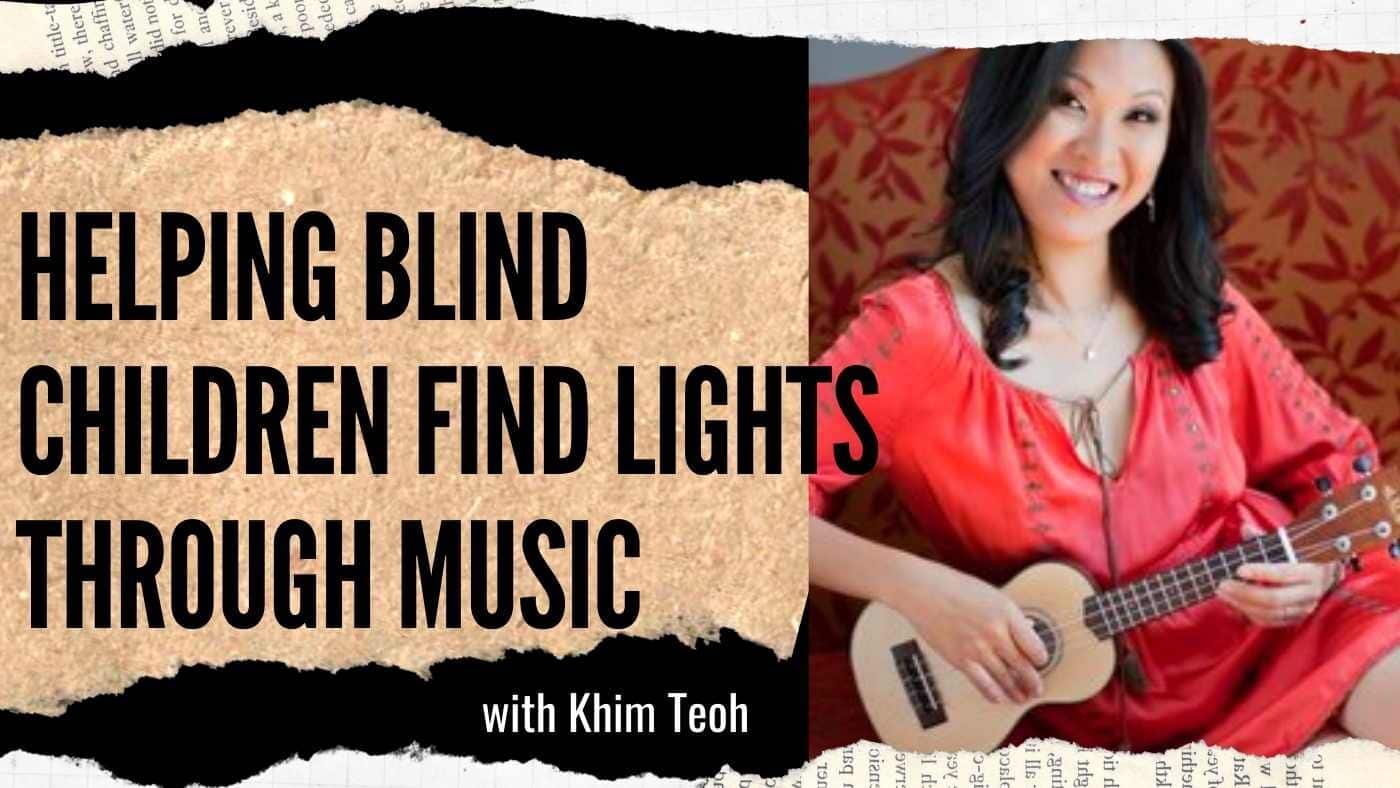
Our Guest Today: Khim Teoh
Khim Teoh is a music teacher and Assistant Director at AMB (Academy of Music for the Blind) helping blind children ages 4-19. Originally from Malaysia, Khim now lives in Irvine, CA with her husband and teenage daughter.
Khim was born and raised in a family of entrepreneurs. She began building her own business in her early 20s. After years of hard work, the business has become more mature and is now self-sustaining. Khim was able to begin looking into other places and causes she could contribute to.
Academy of Music for the Blind is a non-profit school of music founded by Director David Pinto. AMB is dedicated to “addressing the unique talents and challenges of blind youth by developing their musical, creative, cognitive, physical and social skills through education in music and the performing arts.”
I had a lot of questions Khim and she opened up to answer each and every one of them.
How do visually impaired students learn to play music? What are some of the mechanisms, structure and workflow AMB established that are proven to work? How does this learning experience impact their current students and graduates, whether or not they choose to pursue a career in music? How do the students feel about this unique learning opportunity?
We also covered some difficult topics such as the financial model of running a non-profit such as AMB. Their directors, music teachers, volunteers would love to grow the academy so that many other children in need can benefit as well. I encourage you to visit OurAMB.org, there are many ways to help in addition to donation alone.
Show Notes
- [05:30] In your own words, what is the Academy of Music for the Blind?
- [10:00] Your origin story at AMB: who introduced you to this organization and how?
- [15:30] What was the process of planning the academy’s curriculum and content? Did you receive any help?
- [18:00] How do you manage emotions and expectations when you first began teaching at AMB?
- [21:00] How do you interpret the progress the growth of your students?
- [25:00] How can we help the non-sighted community? Are there any sighted/non-sighted guides available, to help educate people better interact with one another?
- [30:00] How can people help AMB and get involved?
- [32:00] Could there be an exchange program between non-sighted children from multiple locations? Do those programs already exist?
- [36:00] What’s the financial model at AMB towards tuition fees, costs and funding?
- [38:00] Can you share a bit about your upbringing, your mother and your family?
- [41:00] Tell us a bit more about the business you started in your 20s
- [49:00] What kind of food is Malaysian food? How does is relate to your new business venture, the restaurant?
Favorite Quotes
- [06:30] We do more than just teaching a blind kid how to play music, I believe that we really try to create them as whole person, to give them as much resources and adaptive learning, that they can acquire at this very important age.
- [10:30] I’ve always been an avid learner, and in the process of acquiring knowledge and skills, I always felt this huge desire to teach. That is the greatest joy, when you are able to impart a certain knowledge, specially children, is just magical.
- [12:30] I didn’t have much. My mom was a single mom raising three kids, but there were two things that made me feel I didn’t need anything more: books and music.
- [22:00] The world is already so limited to them, because many people feel the sympathy, so they prefer to have nothing to do with them. […] never use the blindness as an excuse, because if we don’t have time to feel sorry for them, they don’t have time to feel sorry for themselves. That time and energy is far better used improving themselves and acquiring skills to overcome the mountain of obstacles they have…
- [29:00] Simply having a conversation, for them, meeting you and speaking to you, that is being able to see you as another person, that they can fit into their realm of understanding the world. By the act of interacting, you are already enriching and expanding their universe.
Tools and Resources
- AMB webiste and AMB videos
- AMB Facebook page
- Finding the Lights Foundation
- Season’s Kitchen USA (Khim’s family’s new restaurant)
If You Enjoy This Episode, You Might Like These Stories From Feisworld
- Mick Ebling from Not Impossible
- David Delmar from Resilient Coders
- Polly Chatfield from Commonwealth School
- Mariann Bucina Roca from Friends of Boston’s Homeless
Transcript
Transcript
Fei Wu: Welcome to the Phase World Podcast, engaging conversations that cross the boundaries between business, art and the digital world. We do more than just teach a blind kid how to play music. Simply by the act of interacting, you are already enriching and expanding their universe for them meeting you and speaking to you. That is being able to see you as another person that they can fit into their realm of understanding the world. I didn't have much, my mom was a single mom raising three kids, but there were two things that made me feel that I didn't need anything more. That was books and. When you connect with people, there's something, when you share the experiences, there's something magical. Hi everyone. This is FA w, and welcome to another episode of the Face World Podcast. Today on phase world, I would like to welcome Kim Teo. Kim is a music teacher and assistant director at a B Academy of Music for the Blind, advocating for a better world for our children. Originally from Malaysia, Kim now lives in Irvine, California with her husband and teenage daughter, born and raised in a family of entrepreneurs. Kim began establishing her own business in her early twenties that has become a self-sustaining business today, which enabled her to begin looking into other places and causes she can contribute to. Academy of Music for the Blind is a nonprofit school of music founded by director David Pinto. AMB is dedicated to addressing the unique talents and challenges of blind youth by developing their musical creative, cognitive, physical, and social skills through education, in music, and the performing arts. Their vision is a world where a comprehensive education, the music and the performing arts will be available to blind youth regardless of their economic status or geography. With the development of their unique talents, they'll be able to integrate into mainstream educational and workplace settings. While inspiring and contributing to our larger community, as you can imagine, had a lot of questions and Kim helped patiently answer each and every single one of them. How do visually impaired students learn to play music? What are some of the mechanisms, structures and workflows AMB established and proven to work? How does this learning experience impact the students lives now and perhaps into the future? Whether they choose to pursue a career in music or not, how do the students themselves feel about the experience and the opportunity to learn music? I must say many of Kim's answers really surprised me. We also covered some hard subjects such as the financial model of running a nonprofit organization like amb. A mission such as this certainly comes with struggles. Yet these wonderful teachers, volunteers have never given up, but they would love to grow the academy so that many other children in need can experience the magic and find their lights through music. I encourage you to visit our amb.org. There are many ways to help. In addition to donation alone, I've also included videos of real stories told by AMB students and parents on our blog. As part of my conversation with Kim am I experience speaking with so many compassionate people who choose to help others in need, such as Mc Ebling, friends of Boston Homeless Organization, David Delmar, hacking the Opportunity Gap with resilient Coders. Newton North High School's Sues for initiating a project working directly with inner city kids and many more on Face World Podcast. What is that underlying desire and motivation for these people to choose to help others, not just once, but for years, often dedicating the entire life to this endeavor. While thinking about all this, I discovered Ken Wilbur going from sympathy to empathy. We're going from first person, single, or I to first person, plural. When we help others, we then have the ability to see much beyond ourselves. For some people, this action helps relieve the pain they experience through their personal lives via accomplishing other things, and for most people, it helps us seek bigger purposes in life. I hope you check out the social service section of the Face World Podcast. Perhaps you too can be involved in an organization in your city to help others in need. If you're already doing so, or in the process of seeking out such opportunity, please share your stories in the comments section of the Face World blog. Thank you. Without further ado, please welcome. Kim to, to the Phase World podcast. Welcome to my podcast . Thank
Khim Teoh: you very much for having me. I appreciate
Fei Wu: it. I got a ton of questions, but before Sure. Um, I jump in here. I would love to kind of have you introduce yourself a bit and about the organization, academy of Music for the Blind, um, as well. Absolutely.
Khim Teoh: Uh, my name is Khim Teo and, um, I'm the Assistant Director at the Academy of Music for the Blind. I've been involved in this wonderful organization for three years now. Um, if I had found it earlier, I would've been involved even longer. It's, it's been an incredible life changing thing for me. Um, it's in a, it's a non-profit that is dedicated to provide comprehensive music education for talented blind children, ages four to 19. Uh, so we do more than just teach a blind kid. How to play music. I, I believe that we really try to create them as a whole person, um, to give them as much resources and adaptive learning that they can acquire at, at this very important age, you know, in development, so that they can be on level playing field if they do decide to pursue a career in music.
Fei Wu: Mm. Nice. So four to 19 is kind of a pretty big age range. I'm using this as a reference because I, I teach TaeKwonDo, um, martial arts little kids, you know, the strategies for, you know, even age four to five, which we call little kids, and then, you know, six to 12, six to 11 ish. And the high school kids and young adults are completely different. So I guess it's a, it's a loaded question here. One would be, what are some of the common age? Like where do you see that age kind of concentrate in certain area?
Khim Teoh: Absolutely. Uh, well, we. We typically, um, because it's very specialized teaching, it's a lot of one-on-one. So having this big age range isn't, um, a very big problem because a lot of the students receive one-on-one instructions when it comes to instruments, vocals, piano, but they do have group lessons as well. And that's where we do break them up into juniors and seniors. And what we found, um, with the blind community being very small, we, we currently serve 25 blind children and that's a lot that have found us and that are able to dedicate their entire Saturdays to learning music. So we found that it's very healthy to actually expose them to the different age group as well. As much as the younger ones may feel that they're a little bit behind, it's actually very healthy competition because they can look at their bigger siblings or bigger, you know, older friends and, and reach for the higher goals. So it's, it's very good to give them that healthy competition because in a regular environment where they're surrounded by sighted peers, they do feel at a disadvantage. So with this group, even if they're with an older blind kid, they can at least look up to them and ask, seek advice and you know, how can I do this better? How can I learn this? How can I overcome? And they get encouragement too from the older kids. So that's, it's a healthy environment I think.
Fei Wu: I think if we both remember when we were little kids, I'm speaking on your behalf now. I remember always wanted to hang out. Kids who are older, even by, you know, when you're a little kid, even six months or a year, made a huge difference. And someone who were ahead of you and kind of like a big brother or sister who are not necessarily your sibling in this case, is really encouraging. And to me, as you know, in my, in my early thirties, I really enjoy hanging out with the little kids as young as five year old, 10 year old, 15 year old. They teach you so much and I feel like I have so many questions, just learning so much about the organization. So let's actually shift gear and talk about you first, because I think what's. Really intriguing to me on Face World as yesterday was at a barbecue. People asked me, what is that theme? What is that one topic? And I realized it's not like I'm excluding people from in certain industry to say, you must be in software, you must be a woman, you must be, you know? But instead, I'm really intrigued by people's stories kind of on their own, what happened three years ago and who introduced you to this organization that you're so, so passionate about and you wish that you got involved earlier. So I
Khim Teoh: guess with a little bit of background, I grew up in Malaysia, 17 years of my life, and my mom, um, was a teacher. So I would say that, A big part of me had always, um, admired that and wanted to be a teacher. I think I've always been an avid student, an avid learner, and in the process of acquiring knowledge and skills, I've always felt this like huge desire to, to teach somebody. I think that is the greatest joy when you are able to impart a certain knowledge and the other party spits it right back out to you, especially children. It's just magical and. Always wanted to be a teacher, and that's actually when I went to University of California Irvine. That's what I started off pursuing, but I somehow derailed into EC economics and management because at the time it was necessary as far as, you know, what pays the bills and, and teaching did not seem viable at that time. Um, when I graduated, it just seemed like they were laying off a lot of teachers. My decision to go into economics and business was something out of necessity. I grew to really love it, but I think there was always an inner passion to get back to teaching. And so setting out on the path as a business owner for the past 15 years, I finally got to a point in my life where I can actually coast and, you know, not really cruise control, but at least I know the business is paying the bills. Therefore, I have this chunk of time that I choose to carve out and give back to the community or, or teach. Really, I think, I wouldn't call it a selfless act because I think it did start off as something that I'm trying to feed my desire to teach and and to work with children. And then the other question, I know a lot of people ask. Working with blind children because that seems like such a huge challenge for someone like me. I did not have training in working with blind children, so where I made the connection was this. I've always loved music, and growing up in Malaysia, I didn't have much. My mom was a single mom raising three kids, but there were two things that made me feel that I didn't need anything more. That was books. That were free from the library and music, whatever music that I could get my hands on, even free music from the radio. So these two things made me feel like I had enough, I didn't have to have the latest toys, I didn't have to have, you know, I just constantly filled myself with books and music. We could not afford music lessons and I've always wanted to. So whatever music that I learned, I learned from church for free. Um, so, so I kind of made that connection. How can I work with kids and teach them how I learned without proper lessons? Because we simply didn't have the resources to, so I volunteered at a blind preschool. I said, well, at the very least I could sing Twinkle, twinkle Little Star to these kids. That's something I could do. I may not be able to play Mozart or Beethoven for them, but I can sing nursery rhymes. And that's what I did. And that's actually where I started. And. Prior to that, I had already picked up the instrument ukulele. I was self-taught, I learned on YouTube and taught myself and, and amazingly because of so much music that had been seeped in into my brain, everything just started connecting and it was in incredibly fun and challenging for me to be a student again and really hone this
Fei Wu: skill. It's so funny that I know you play multiple instruments, but you reminded me of things that I realized was even part of my research, that the idea of being able to teach or work as a teacher without, let's just say the official fully established structure, whatever that may mean, a degree, a PhD in education or the fact that you need to have. I don't know, four or five children, uh, on of your own and things like that. But something that was really intriguing about it, because unfortunately I don't remember these women's names, but I know that there are stories in the United States and Japan and all around the world, these retired women who decided to open up their homes and teach underprivileged kids how to read and write. And then there's one woman who started at the age of 60 and she continue on way into her eighties. Just something so beautiful about this, because as you were speaking, I thought to myself, there's several professional musicians I've interviewed on Face World, and honestly, I, I asked myself how many of these professional musicians out there in the world are dreaming about, you know, my endeavor will be to teach blind children how to play music. And I'm sure many of them once requested, they would think it's such a interesting endeavor to explore. But at the same time, I think. Typically musicians are raised in a way to think about the Carnegie Hall, right? To think about traveling around the world to make a living. But is it true that, to a degree, I mean, did you kind of invent, in part, invent your own curriculum? Did you consult with the other music teacher? Did you guys just like figure it out almost like a startup? What was that process like?
Khim Teoh: Um, definitely. You've brought up a great point. I have to say as, as you know, you teach little kids and they teach you so much. So I think a lot of it is putting the hours and the experience that you have and to learn from the mistakes as well. So for us at Academy of Music for the Blind, we don't have a rigid curriculum. We have certain things that we really want to teach them at the beginner level, the intermediate level, and the advanced level. And we have several methodology. One method may work for one kid but may not work for two. So it's not a one size fits all. Therefore we have that one-on-one attention and a lot of times it is. Problem solving it is figuring out what is this block that we have to overcome in order to get the students to the next level. It's not always the vision that is the stumbling block. There could be a lot of things with their dexterity, the balance in their body. That's why we even offer dance in our school, because if you think about it, if you are blind, your balance is thrown off. You know, and we've, we've actually have blind children that learn martial arts as well. So it's very important for them to learn, given that their sight is taken away from them, how to use the other senses to compensate and to overcome some of these huge obstacles that they. But
Fei Wu: it makes so much sense because I remember now to relate to that. There are days where, I mean even used as an example, like sometimes I had a, a couple of very minor vision related issues. I remember once happened when I was a child later on, you know, kind of having an as simple as an eye infection. I remember just losing kind of context of your environment and not being able to function. When it comes to physical limitations, there's so much of that can throw us off completely. And vision is a very, very important one. And kind of orient our listeners. I remember even the little kids, you know, while you're sitting, but as you're playing your, you know, there is that encouragement of like your body movement cuz you're, you're getting emotional, you're just not steady like, you know, you're not set in stone. And I remember there was a little boy who was singing as well and while he was standing up and I remember one of the instructors was kind of as, he was getting very emotional, one of instructors trying to hold onto him, is that, Is that kinda, yeah,
Khim Teoh: definitely. Uh, I mean, we constantly, our students perform on stages and they perform in large events. We constantly have to correct their posture. We constantly have to remind them to smile to them, them smiling and, and having a straight posture doesn't really mean anything to them because they can't see themselves. But we constantly have to remind them, their audiences that are looking at them. And this, this is aesthetically pleasing. So they have to learn what the visual world appreciates and, and in order to be a great performer, um, even if it's something that doesn't mean anything to them, it's just, it's just part of, um, honing that skill as a performer.
Fei Wu: It's incredible. I remember when I was a little kid, um, when I was in China, that's where I grew up in Beijing. I was also 17 and before I moved here. So, so much of what you said, I felt like we could be like evil twins, . Um, no, no. I I'm probably the evil one. Um, and uh, I remember watching the documentary in so much part of my podcast, I realized talking to people, you know, friends of Boston and homeless and organizations are really supporting people either with, um, physical challenges or, you know, who are underprivileged or in this case, you know, could be a combination of both to be honest. And, uh, which would be a really tough situation for, for the child. I, I can imagine is how to respect these people, offer them help, but without sounding as we are pitting them or as I was watching the video and the articles you sent to me, it's like, that's something that. People like us must treat them a certain way or how is their world really like? I think we had a lot of assumptions and a lot of them are completely inaccurate. And I can see so much from a little child, from your organization that they're, they respect themselves, they're very confident, they're ready to write music. I've not never written music myself. And what, what was it like to kind of be in that environment and then in your case, as an adult, watching these kids kind of flourish and blossom like that? Absolutely. The
Khim Teoh: first week that I volunteered at that particular blind preschool, uh, before the academy, I literally. Could not sleep. I was almost crying every day. I was filled with so much sympathy and helplessness. I felt like, gosh, I don't know if I have it in me to work with these kids because I feel so sorry for them and, and I think feeling that truly for the first week made me understand that if I'm feeling this way, the rest of the world, when they encounter a blind child or a disabled child, they must feel this way. And instead of feeling crippled and feeling like I can't do anything, I'm fearful that I might cause more harm than good. I slap myself and say, wake up. Do whatever you can, whatever little that you can I'm sure will be, will enrich this child's life or will enrich this group of children and, and make, expand their world a little more because their world's already so limited. Because so many people feel that way. They feel the sympathy and they feel like, well, maybe I can't do anything, so therefore let me have nothing to do with them. So I approached it in that manner that I need to do whatever I can and whatever I can will hopefully grow their world and give them more experiences that then they can, in turn be more equipped and be more prepared to integrate. With society, and therefore at the Academy of Music for the Blind, we do not view their blindness as a disability. It's just a condition that they have to overcome. And we give them the resources, the tools, the ingredients to flourish and never use the blindness as an excuse. Because if they start, we don't have time to feel sorry for them. They don't have time to feel sorry for themselves because that time is far an energy is far better used. Improving themselves and acquiring more skills to overcome the mountains of obstacles they have.
Fei Wu: Yeah, absolutely. I'm thinking how sometimes just how long it takes for me to, to do certain things, right? Chores, errands, and it will take a blind person that much longer and effort and obstacles to overcome that. So if they spend, you know, if they, or we spend the majority of our time feeling sorry for them, then like you said, there's no time for that. Something I, I, I actually like the, the way you said it, so as you're describing from the beginning till where you are now three years in, which is to me, working in this environment is an extensive period of time. By the way, are you full time? Are you there five, six days a week or?
Khim Teoh: Um, our school is only on Saturday, so as far as teaching, it's an all day thing on Saturday. Um, throughout the week I do a lot of fundraising, outreach. I'm in charge of the social media, so I really do put our students out there more than anything, more than just focusing on, on keeping our academy afloat and, and continuing to serve more blind students. I think what's key is we're trying to bridge the gap between the side and the non sided community, and hopefully also be an inspiration to other organizations around the world that we start with these kids, but the community that they reach around them, that they are able to contribute back to society. So I would say, because it's my passion, I spend. A lot of hours on it. I do have my regular businesses to run still and, and I have a daughter, a teenage daughter. So I'm juggling all of those things and it can be a little spread thin and difficult sometimes, but I constantly have to tell myself to do the best that I can.
Fei Wu: Wow. You look so young when you said teenage daughter, I was so surprised. I like when. Brought up that I never thought about trying to bridge the gap between sighted versus the non sighted community. Tell me a little more about that, and really what is that and how do we do it?
Khim Teoh: Um, so the simplest thing would be when you see a blind person walking with a cane, sometimes you feel like you wanna help them, but how do you approach them? So the best way, if you see a blind adult, then you offer, you just offer an elbow, can I offer you an elbow to lead you where you're going? If, if it's, whether it's across the street, because they have the mobility skills to navigate. But it certainly helps a lot if they're trying to navigate between crowds or trying to get to their bus stop. Uh, so if you. At that time, that was, that's the best way to approach them. And I think, um, the word people are afraid to say the word blind because they feel like that's mockery, but it's not blindness, it's not having sight. So sometimes it's just, you know, educating even little kids at the playground that this child that cannot see is not helpless. They see differently. If you are offering them something, you don't put the bag of chips in front of their face, you hand it to their hands, so you make contact with them. So it's through touch that you can communicate with them. It's through speaking. So when I'm around my blind students, I narrate a lot to them. Things that they can't take in. If we are in a room, I will narrate, you know, what's happening in and around the room. So it, it's a lot of that. And I think society can help just by. First learning and, and being around blind people and learning ways to be of help. There's sighted guides are needed constantly, especially with children because we wanna make sure that they're safe. Their mobility skills are really not fully developed yet.
Fei Wu: Wow. I remember the, when I was on my way to work in downtown Boston, and there's a very, very busy traffic circle or. You call it, the highways are all merging in. And Boston's a very small town. And there was a gentleman, you know, since I left my full-time job, I had not seen him. But, um, there was a gentleman who always walked from the same direction. We somehow always arrive at the same spot at the same time every day. Right. I mean, not every day, but like most days. And for a couple of times I wanted to help him and I hesitated because I, he seemed to have done fairly well on his own for one. But finally there's one day I saw, and it's always women, and I saw these women walk up to him and El kind of offer that elbow and walk him through, so kind of diagonally through the street. And so I tried to do that a few times and he really appreciated that. That's great. That's wonderful. And then, you know, I especially enjoy the fact when there's one day. I knew I was a little bit late for a meeting due to traffic, and I don't remember, it's not like it, the meeting was probably pretty important, but I decided to take those 15 minutes to kind of walk him through across the street. And then turns out he, um, worked at this, uh, piano shop, a a really, so he fixes, he tunes the piano as he can hear. So I wanted to put him on my podcast. He was very soft spoken and it was such a phenomenal experience because by the time you get to work, you realize that what was I, you know, everybody little stressed to like, oh, the TPS report and all these things, and you're thinking just put yourself, put your mind in a different, different perspective. So thanks for sharing that. And are there any cited, non-sighted guides or to kind of, that exist today that, that we can share with people?
Khim Teoh: Well, I think the main thing is even a simple interaction. Um, you know, with, with a blind child or a blind person, it just opens up their world a little more. So just even simply having a conversation and for them meeting you and speaking to you, that is being able to see you as another person that they can fit into their, uh, realm of understanding the world. So I think that's simply it. Not being afraid to interact with blind or disabled people. You know, that there's simply by the act of interacting, you are already enriching and expanding their universe.
Fei Wu: Wow. It's, uh, well it's really amazing. So, One of my questions is how other people can help. And I think you articulate in a way that's super accessible, uh, in a way that there's no excuse. You don't need the tool, you don't need to be trained, you don't need a guideline. Just give it a shot. You know? And even if I'm thinking, even if, if the other person isn't as engaged and that's okay. Cuz I feel like sometimes we put certain experience sort of on a pedestal for one reason or the other. Maybe one thing is because we were a little nervous going into it and then we had that expectation that has to be great. It has to work out so well and that feels to me as the artificial, the wrong approach in a way. Yeah. You know, because we approach people all the time and we are not going to fall in love with people constantly, or not absolutely treasure every moment. But how could people potentially help your organization? They're in relatively close to you or kind of people far away from you? Absolutely.
Khim Teoh: Uh, well, we have classes every Saturday in Witty and California, and we do open our, um, school to volunteers for sighted guides. They can help with the students lunches. They can be a cited guide for the younger kids who are not, you know, get them from class to class. So absolutely volunteering in our events and just coming to our school is, is a great, uh, way to help. The other way is just to support us on social media. We have a lot of followers. I've grown the academy on social media to probably about 2000 followers. It's not much, but they're so supportive. And we have people from the East coast that say, I love, I love the performances that you put up. It just, it just put a smile on my face. Um, so I think. Expressing that support. And of course we do have a social, uh, we do have a scholarship program that we extend to our students and they can, and people can go online and donate on our website, which is www.ouramb.org. So we're on YouTube, we're on Facebook, Instagram, Twitter. I think just showing your support that way. And we try to have two fundraising concerts a year where our students get to really put on a, a fantastic show and they love just hearing the audience, you know, applause. And that's what. Encourages them and gives them the confidence to really, um, excel in this field. Wow.
Fei Wu: So I happen to live very close to, uh, two schools for, um, blind children. I think you may know that Boston is kind of known for. This one is the Perkin School Perkins, and then the other I believe is Carol Carol's very close to me and, uh, I feel like I drive by there all the time. I think Carol's School for the Blind and Perkin is something I I've noticed since I was a kid and there was a movie about the little boy playing the piano. And, and are there any it kind of exchange program where kind of, I know it's a long, long distance and Boston doesn't have to be the only solution, but are there any sort of exchange intermingle opportunities among these children in the United States? I find that the US has done a much, I feel like it's done a phenomenal job in supporting them. And I wonder if there's any benefit or such program where. Maybe children from the Perkin school could go to California. I'm sure many of them are into music. I know they have a very strong, uh, music program kind of for the kids to meet and greet and, and to be able to learn from one another. Uh, do you think that could be a good idea? One, and or are there already programs that you, you are aware of that will offer something like that? You're
Khim Teoh: definitely a, a forward thinker. Cause I, I see that now, now that you've put it out there, that's such a wonderful idea actually, to have that experience of, of another blind, um, organization, you know, collaborating and, and benefiting from our program. I've gotta put that in the works. That, that sounds really intriguing and I think that would be a wonderful opportunity. We have had, uh, blind students reach out to us from other parts of the world and of course we don't have the funding to, you know, say, Hey, hop on a plane and we'll settle you down here and you can get into the program. But I think the sky's the limit. I think with, with the right resources and funding, I think things like that could happen in the future.
Fei Wu: Yeah, I, there's something very intriguing to this situation where I'm, because I, I consider my company to be kind of a little mini startup, and I'm all about, I, I feel like we are very similar in nature where we find ways to make it work. And I'm gonna also very quickly transition to kind of your upbringing and your, your business endeavors, which enabled you to do these things. I can see, you know, the smiles on your face and just one day a week and everybody needs their weekend. But this Saturday it means so much to you. Saturday also happens to be the time that I go teach children at my TaeKwonDo school, during my time off. So, you know, when I watch. Documentary and also the movie, uh, about Perkins School for the Blind. And I know that Massachusetts has been the state that puts so much emphasis, uh, on such endeavor, but yet not everybody could physically go to that school or to be able to afford to go to that school where they simply don't have, they have finite, uh, admissions. You know, unlike a university that can take in 20,000 people at the time, these specialized schools can only take in so many. If I have to guess, I would say it's in the hundreds versus the thousands. So I do think, however, Because they have been doing it for a long time, potentially they may have more significant funding. And there's that networking opportunity. I feel like it's gonna be so unique and kind of world shaker event. Absolut, you're right
Khim Teoh: about that. Connection is everything sometimes, you know, and it just takes the right person to, to hear about us. Um, you know, we've been very fortunate to get Josh Groins find your light foundation giving us grants and that that helps us. But it's a constant thing with sustaining a non-profit.
Fei Wu: So is it, I mean this is, I know 20 to 25 kids and you all wanna grow the school into bigger school, not for financial reasons, but simply want more children to be able benefit from this program. And, uh, I know it would be heartbreaking to have the term kids away. Um, are there considerations such as like tuition or is there something the family, um, could do to kind of help? Support the school?
Khim Teoh: Well, we, we do, um, hire professional musicians, a lot of them from the Berkeley College of Music in Boston. Nice. So a lot of our teachers are trained musicians. They're not specifically trained in, um, working with blind children, but that's part of David Pinto's job to coach them and give them the correct training in working with a blind children when they first get hired. So that's our biggest overhead and just operating our school. Right now we are operating at first Christian Church and that's just through the kind graces that we are able to use that building. Eventually, if we grow into a bigger, you know, we have to serve more students, we would need a facility and a facility would cost money. So we're not at that point where we actually can afford our own facility and, and be better equipped for our students. But we make it work, you know, and we, we've hired a grant writer and we're working on things like that, but it's, it's still all a very big challenge for us. Whatever it is. We've been around for 12 years and, and we hope to continue doing the best that we can and, and serving as many blind children that could benefit from the service.
Fei Wu: Wow. They're very lucky to have you. Um, I can see you're just force of nature and, uh, so we wanna kind of shift gear and talk about you for a second. I read the article, uh, from, I believe it was post in 2007 that you moved here when you were 14, you said 17. So right around that time
Khim Teoh: with your mom. Yeah, yeah. 17 is the official age that I moved, that I made the big, you know, immigration move. But prior to that I've had the opportunity to come to America, um, during school holidays, but the only condition was I was, I had to work at my uncle's store to pay for my air ticket. So . Wow.
Fei Wu: You were here by yourself at the age of 14? With my mom. Okay. Yeah. So, so you, you mentioned that you have two siblings, Yes. Yeah. Three children. And, and then I, I also noted the term of a family of entrepreneurs. And so tell me a little more about that. Your mom seems to have a lot of influence in your life.
Khim Teoh: Absolutely. Well, like I told you, she was a teacher in Malaysia, so growing up we really didn't have much. Uh, but she had always taught us to just use what we can. Just make the best of everything. Always count your blessing. So I, I think we. With that philosophy that no matter if we have a dollar, then make the best out of that $1. If we have a hundred dollars, make the best out of that a hundred dollars. And I think just seeing her, you know, raise us and sacrificed everything that she had to bring us here to America to start a new life. We literally came here with just two suitcases and a dream, the dream that most immigrants have to, to pursue a better life in, in America. I think that was, that's really my story. And I think that story resonates with a lot of immigrants that you come here with dreams and, and the thing about coming from Malaysia at. At that age, that's a big part of my growing up. To me, Malaysia was home. I didn't feel like there was anything wrong with the country. I loved the country, but I, I knew that this was the only way we could get a university education. This was the only way that we could afford to work and support ourselves through school. This is where it's possible, and that's what we did. That's what I did as all through college. You know, I worked at a restaurant, I was a food server at Blake Angus and I, you know, that I got student loans and I literally was able to pay myself through college because for my mom, just bringing us here to America was the ticket was all that she could possibly do for us, and the rest was really up to us to get it, you know, for ourselves. If I
Fei Wu: have to guess, are you the oldest?
Khim Teoh: I'm
Fei Wu: actually the youngest. Oh man. You sound like a second mom to all your siblings, but I couldn't believe you're, you're the youngest. Well, so what if you were 17 when you moved here? Your older siblings will be around 20, early twenties.
Khim Teoh: Yeah, we're all three years apart. My sister had already, um, she came to America on scholarship and so she was already making her way, you know, and she went to law school at usc, so my brother was the same way. So I think all of us had the same path. I think all of us was, we were constantly supporting each other and encouraging each other and that we're gonna make it, we're gonna make it, we're gonna get our college degree and, and have jobs and be able to feed ourselves. You know, really that's the goal at that point.
Fei Wu: Nice. So I saw that one of your first businesses, I'm not sure if it's still the carton one, is a gift mart. Tell us about that. Is that still ongoing?
Khim Teoh: Yeah. Yes. Well, so one thing we, I'm very blessed because my family is very big and through the years, you know, all of us have somehow made our way here. And we're all in the same retail gift shop business, let's just call it that. Um, and when I, after I graduated from uci, I actually did the corporate thing because that's, That's what paid the bills, and that's what I thought was what I wanted. I wanted to climb the corporate ladder. A year into it, I realized I'm not a number cruncher. I'm not a person to sit at a desk, nine to five. I need to interact with people. And, and the thing that I did while I was in college also, I was managing my mom's gift shop that called me very strongly that I wanted to work for myself. No matter how difficult it was, no matter how, um, humbling at times, you know, because it's not glamorous. I'm not wearing business suits, selling candy at the gift shop. I am just almost like a gift shop cashier. Nobody knows I'm the business owner when I'm taking care of my store. So I think I just. Wanted to do something, to build something that was my own. And I told my mom that, and my mom said, if you're ready to lose it all, then do it. That's the only condition, you know, if you're gonna start your own business, you gotta work so hard. You gotta work really hard. And nobody tells you what time to wake up, what time to go to sleep. Nobody tells you you're doing a good job. You know? And, and when everything starts falling apart, , it's really you that have to just cry yourself at night and say, what, what, what am I doing? You know? But, but that's what being an entrepreneur is. It's just taking risk and just taking, just setting goals and making, constantly trying to make things better and trying new things. Just taking risk all day long and, and knowing that at the end of the road, if you just stick with it, it will somehow be better. And when it gets better than. Then, then, yeah. You know, it's easy for me to say it now because, you know, things are, are at somewhat, um, of a level that I'm, I'm happy with. I mean, for me, I, I'm easily contented. If it pays the bills, I'm happy, you know, so, uh, but there were times when I felt like I was a sinking ship. There were times when, you know, I would go into the gift shop and I'm not doing even enough sales to cover the labor cost. Yeah. And things like that. So, There were a lot of hard times and with our business are specialized in serving, um, guests at hotels, casinos, and hospitals. So I have built and operated gift shops in hotels, hospitals, and casinos, which are three very different, um, types of clienteles. The key is that they, they are a captive audience. So the key is to try to find that balance of merchandise to offer to them and to listen to the customer's needs and to just be there is the day to day grind that makes it with a business owner. I think that's
Fei Wu: fascinating, um, because. I wonder how many, um, stores do I have currently? And at the beginning of the show that you mentioned that you now have basically a business model that's kind of running on its own. So how many
Khim Teoh: stores? Um, well the history with Gift Mart, um, I had seven stores at the time, but you know, with this industry, it gets affected by the economy too. So when nine 11 hit, I had to close two stores down because it was simply not viable. So there are cases where we open the stores and we have five to 10 year leases, or we have short term leases, three, and, and when the lease isn't renewed for various reasons, we move on. So currently, um, I have four gif, we have four gift shop. My husband and I run the business and it's called Simple Gifts Now, uh, gift Mart was. Old business. So we have three gift shops in hotels and one in a hospital where we're out of the casino scene. And that's the main reason why we were, you know, making the big move to transition into opening a
Fei Wu: restaurant So let's talk about a restaurant as well, cuz I, I notice when Chris Young introduced us, that's one thing I saw immediately. And I love Malaysian food. You do ? I do. And then it's, I, I don't know whether it's a fusion is a bit of a fusion. I'm also half Cantonese. So tell us about the restaurant and I, I will make sure to post pictures because they look absolutely delicious.
Khim Teoh: Well, um, I think for us, you know, we've been in. I've been in retail for over 15 years and, and I feel, I believe as individuals, if you're not growing, then you're stagnant, and if you're stagnant for too long, you'll be dead. So I like the idea of dabbling into new things using the skill sets that I've acquired and the experience that I've acquired. So food is, Probably my number one passion after music . So I've, you know, that's the one thing if you ever talk to people from Malaysia or Singapore, it's, it's, we miss the food more than we miss our friends or anything else. Um, there's just this unforgettable flavor that we've grown up with. And, and every time, you know, I, I'm a firm believer that if, if I eat really good food, nothing else matters. You'd be
Fei Wu: in a really good mood, .
Khim Teoh: Exactly. Exactly. So, um, with, with my husband, he's actually, um, he's, his passion's always been in cooking, so we're a great match. He likes to cook. Wow. And I like to eat . Yeah. Um, and I think he has really honed his culinary skills. Um, and, and he's always cooked for our family. And I, I know that this is his passion and I think for us, we view it like, it's like opening a gift shop, but we're serving food. It has. A thousand more bigger challenges than open opening a retail store. But I think that's what we are seeking as well. We're seeking, we're seeking that challenge to grow ourselves as individuals. Um, and I think more than anything, the business model that we have chosen for the restaurant that we're gonna open called Seasons Kitchen usa, it's more of a quick service type restaurant. So we're not a full on, you know, offering a hundred menu item. We're offering the, um, key signature dishes that we feel are comfort food for us. One of our top one is Chashu, which, which is, is, you know, it's definitely. You know, a Hong Kong cuisine and Japanese people also use chashu, which is pork belly. And, but the Southeast Asian way of cooking it is slightly different. So I think that's what we want to introduce is more of that Malaysian flavor of, of food. We want to be able to share that and make a chasu, you know, meal an everyday thing. Just like how fu is, just like how sushi is and, and how Thai um, and nowadays poke is everywhere. Five years ago, nobody knew what poke was. So to be. Poke is that Hawaiian, um, fusion bowl with raw fish and a bunch of other stuff. Oh, it's really a huge trend
Fei Wu: out here. Oh, it must be in California. I'm sitting here in Boston thinking what , you know, I have to go out and, uh, how
Khim Teoh: to spell that? P o k e. Poke.
Fei Wu: Yeah. Poke. I'm, I'm going, uh, for my food, uh, adventure, going on food adventure today, if I can find it. But, um, what exactly is a Malaysian flavor?
Khim Teoh: Okay, so, um, I'm Malaysian Chinese and I grew up in a very diverse, uh, background. Malaysians, uh, comprised of the Malays, which is Malay cuisine. A lot of heavy curries and rundown and spices. Um, and then we have the Indians that have migrated to Malaysia as well. And so that, that's also a lot of spice Indian food typically. But Southern Indian, um, and the Chinese food, the Chinese immigrants, they take Chinese cuisine, but I think they add. Just a different twist to it. I cannot really explain to it, but I think it's the special, uh, different mix of herbs and spices that we tend to use, um, to make it more flavorful. So, so the other, the other dish that we want to introduce that is currently not available here is Ba and Baku is actually a hockey dialect, which directly translate to bone, meat, tea. And in Mandarin it's rota, you know, so it's actually like a herbal pork rib soup.
Fei Wu: Oh, oh, I'm so hungry. Right?
Khim Teoh: Now's a herbal pork rib suit that you actually serve it as a dish, you eat it with rice. And then it also has, you know, sites like tofu mushroom, and you dip it with, Chopped garlic and soy sauce. So that is something that's a little bit more exotic that I think that would be well received in, in the, um, Asian community and non-Asian community. We've test marketed it to non-Asian community and they at first be kind of intrigued by that, that soup flavor. Like, what is it? What is it? But then it, they want more of it. So it's, it's kind of like unforgettable taste that, that we hope that they will be able to crave and, and grow a palette for.
Fei Wu: Do you think most of your customers will be Asian necessarily, or do you think what, what would that split be? You know, Caucasian or like from other ethnicities or
Khim Teoh: Right. Well, we're opening it in, in Anaheim, um, just 10 minutes from Disneyland. And in that particular plaza that we're opening, it, it's, it's an Asian plaza. So I would say that probably 75 to 80% of our customers will be Asians. Um, but there are also non-Asians there that, um, you know, we have a lot of the Mexican community and also Caucasians. And so I think it's a good, uh, diverse mix. And like I said, the signature dishes that we are offering are very palatable. They're not mysterious. You know, internal organs that you can't recognize, which I love , which I love, but you know, that's not what we're serving. It's, it's just, it's not so incredibly exotic and, and authentic that, that you would be afraid to try it. It's, it's very recognizable. We have our, um, signature flavorful Jasmine rice that we, you know, it's a special recipe that we, that's been passed down to us by our family. So, so we have that signature rice and that is paired with the signature meats, like the cha shoe, and we also have yo, which is rose pork and also it's suffering right now. So, so we just like this podcast, we'd like to make, um, the, we'd like to just make Southeast Asian food, be more out there, you know, in this foody culture in Orange County, because you can find everything here in Orange County. But I think Malaysian restaurants are. Like under five in this area.
Fei Wu: So true with Boston as well. There's one, one of my Chinese friends visited me after five years and one of her command was, oh, let's go to Panang, which is the, the only Malaysia restaurant I know of in Boston. And it's delicious. There's like mango chicken where mango's cut open and with the slices, uh, kind of mixed. Chicken, which is something that you basically wouldn't see in China, right? But it's also, it's so flavorful. So when, when will it open? When will the
Khim Teoh: restaurant be open? We're about, um, three weeks to our opening. So we're shooting for November 1st, and I'm very excited because this, it's all coming together and, you know, sometimes, like you miss that hard day's work, you know, that 12, 13 hours, it, it brings me back to my roots where, you know, when I first came to America, that's all I did was. Double shifts and work weekends. I didn't even know what a Saturday was. , you know, for the longest time because that's, that would be valuable working time. So, um, sometimes it's nice, you know, when you, when you feel like you've worked really hard to get to where you are at, you kind of miss the hard times. It's true. Maybe looking, you know, for us opening this restaurant, we're, we're chasing more, we want more suffering to, to grow ourselves as
Fei Wu: a person. You know, I get, I can see that there is something about you that just hardworking and just being disciplined, it's part of your system, is part of your dna and it doesn't matter how many, millions, billions you will be making, I think you really enjoy doing this. Um, and I think also restaurant offers you a lot of opportunities to interact with people and customers see them smile and. Have them take a, you know, yesterday for instance, I would, I was at a Mike's pastry in Cambridge, and uh, their original location opened up in North End and it just packed, packed with people. And so yesterday I ordered a canole after dinner and after one bite, it just, oh, your whole sensation, that's just like, like, this thing is so good. And then you can see the look on the, the owner's face is
Khim Teoh: like, yeah, got you. Like, like, I got everybody satisfaction. Right, right. So, you know, I think that's what it is. I think the bottom line is I love connecting with people. So I think in the business that I've chosen and also the nonprofit engagement that I've been involved end of the day, I feel like when you connect with people, um, there's something magical. There's something that you're, when you share the experiences, whether it's through food, through music, it's, it's a really a wonderful thing. And I think that has probably. Made me feel very complete as a person. I still have my down moments, you know? Of course. And, and, and I think I look forward to that. I look forward to, to be able to share a little bit of, of my culture, my story, and connect with other
Fei Wu: people. I love that. So, final question, I promise. Uh, what's a connection with Chris Yen? How did you.
Khim Teoh: Yeah, Chris Ye is is an amazing friend of mine and I think we hit it off because she lived in Singapore and when we talked about food, I think both of us just went crazy. It's like, oh, hi, non chicken. And so I think, um, I met her through a old college friend and it was just really, you know, serendipitous how we met. And we just connected. We both love the arts. She's an actress and, and I was writing my book at the time, so I got a lot of inspiration from her to tell my story. You know, even though she lives in LA and I live in Orange County, we don't see each other as often as we'd like, but the time that we spend together, we, we just simply connect and we just, you know, we have this common ground of love, of food, love of dogs, love of arts, and we just encourage each other in that, in that sense. And I'm so proud that she got into entrepreneurship. And as, as, As difficult, as much as we've all warned her, I think she has it in her, she has that inner strength to, to just fight whatever challenges that come her way. So Chris, Chris and I definitely connect on that level, you know, where we understand each other, we're kind of on the same journey. We can share stories and, and I think she's a real family oriented person. Um, and I think I've, I've grown up that way. So we share that value as well.
Fei Wu: Oh, that's beautiful. You mentioned your book. Has it been published?
Khim Teoh: Yes, it has. It's actually more of a self-published project. It's more of a tribute, um, to my mom. It's, it's this candy girl book that, um, but I, I, it's on Amazon. Mm-hmm. . Um, it really is just capturing that immigrant story of mine, which I, I write it in a very simplistic terms, kind of like talking to a friend, because I realized that in my interaction with, with a lot of immigrants, they are intimidated to pick up American literatures. I'm not gonna be able to read a hundred, you know, pages because there's so many words that I don't understand. So I decided that I would like to share my story, but at the same time share my love for writing and, and telling stories, but in a more, um, accessible manner. So these are really just more of a memoir, more to capture and to bring me back to the time that, you know, that I was there to always remind me of my roots. That I come from humble beginnings and therefore I need to be able to connect with people that are in that juncture in their life, that are struggling to pay the bills and, and. And they come here not knowing the language, not knowing people how difficult that must be. So I always like to be reminded
Fei Wu: of that. Yeah. I'm sure other people find a lot of, uh, kind of create that space and that, you know, to be able to relate to that. And there's nothing wrong with, um, you know, you said simple English. I think what we just did, it's like to good friends, having the conversation, you know, it's, it's not 60 minutes, not an interrogation. Right. So I think people really, uh, prefer that over a very structure conversation. And I'm personally a huge, huge believer and fan of self-publishing. And, um, there's nothing wrong with doing that. And I have encouraged so many of my friends who are good writers thinking about writing. Some of them are rejected by publishers, and I said, more than enough about self-publishing. So this is fantastic. Well,
Khim Teoh: thank you. I love thank you for the opportunity. I love what you do. It's, it's amazing you telling stories, you're, you know, you inspire so many people because it takes so much time to, to be able to dig into these stories and, and do what you do. So thank you
Fei Wu: for that. Oh, you're very welcome, Kim. And, uh, I hope, you know, hopefully we can celebrate over like Chashu Bow or. Everything on the menu. Everything. Absolutely .
Khim Teoh: Thank you. Thank you so much. Appreciate
Fei Wu: it. Thank you. Bye. Have a good day. Bye. To listen to more episodes of the Phase World podcast, please subscribe on iTunes where visit phase world.com. That is F E I S W O R L D, where you can find show notes, links, other tools and resources. You can also follow me on Twitter at Face World. Until next time, thanks for listening.
Written by
Fei WuFei Wu is the founder and CEO of Feisworld Media, a Massachusetts-based digital media company helping brands get discovered by people and by AI. An Adobe Global Ambassador and brand partner to ElevenLabs, Synthesia, and 50+ other tech and AI companies, she hosts the Feisworld Podcast (400+ episodes, 500K+ downloads — guests have included Seth Godin, Steve Wozniak, Chris Voss, and Arianna Huffington) and co-created the documentary Feisworld: Live Your Art on Amazon Prime. Fei writes for CNET, Lifehacker, and PCMag, and her work has been featured in Forbes, Harvard Business Review, and WIRED. She has been publishing on the internet since 2014 — long before AI discoverability had a name.
View all posts by Fei Wu→Stay updated
Weekly insights on content, AI, and digital media.
Keep Reading
Related Articles
Joanne Lipman on Mentors, Untapped Talent and Why Women Should Stop Waiting to Be Perfect
Marc Randolph on Curiosity, Messy Starts and Why “Nobody Knows Anything”