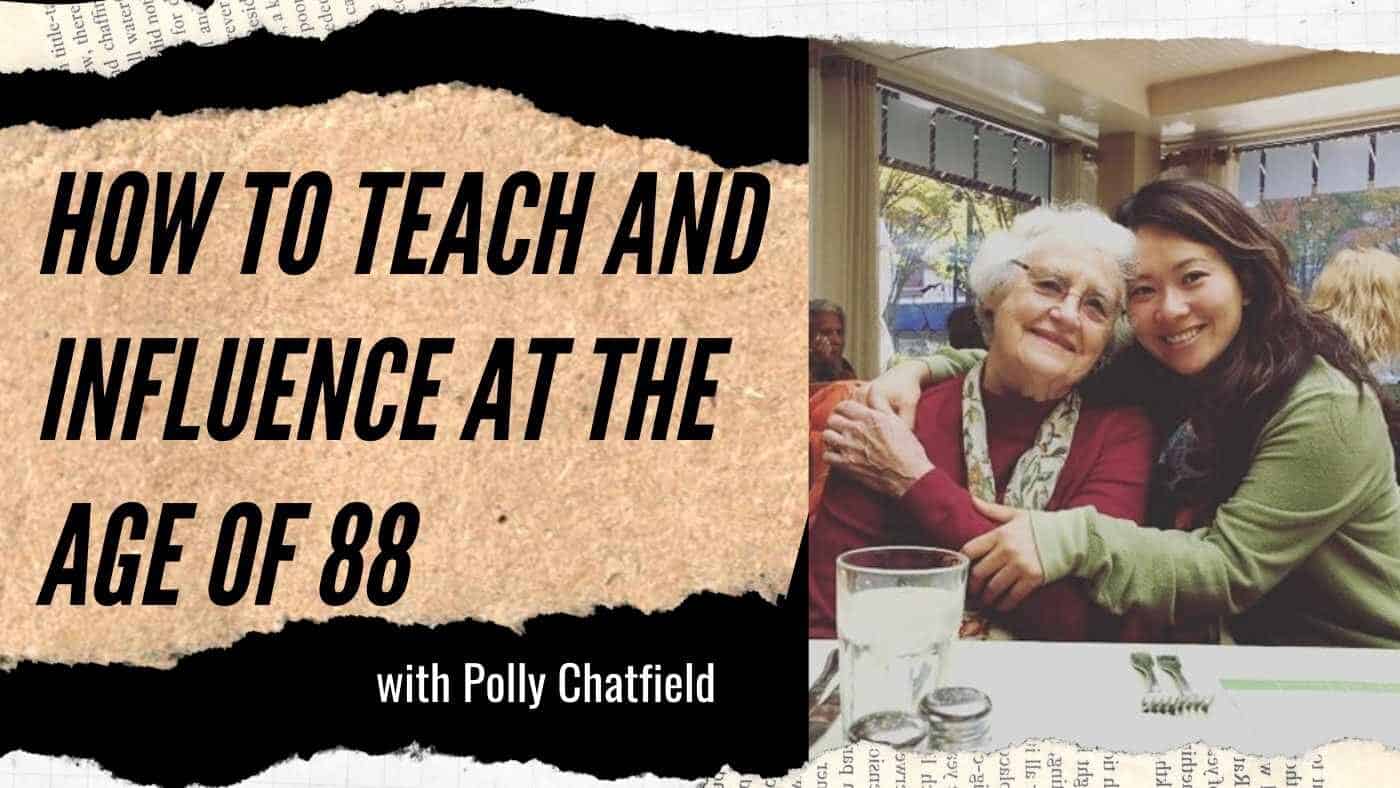
Our Guest Today: Polly Chatfield
Polly Chatfield is teacher, poet and winner of a National Endowment for the Humanities Fellowship for her topic “Patterns of Simile in The Divine Comedy”. I met her during the 2016 Merrill Speakers Series at the Commonwealth School.
For over twenty years, Polly taught various subjects at Commonwealth. Associate Producer of Feisworld, Adam Leffert, fondly recalls Polly as one of his favorite teachers of all time. He is not alone. Decades after graduation, many of Polly’s students still walk up to her at the school, on the street and express how she changed their lives, for the better. I met a few of he students including a Senior Producer from the New York Times and a Judge at the US Circuit Court.
If you didn’t know anything about the Commonwealth School (Boston, MA), they are an independent, coed day school for grades 9 through 12, enrolling about 150 students in four grades. They are “academically rigorous, catering to bright, curious students who enjoy intellectual adventures in classes often taught at a college level”. With nearly 75% of graduating seniors recognized as National Merit Finalists, Semifinalists, or Commended Students, and some 35% recognized by the AP Scholars program, Commonwealth School is one of the most recognized and successful private schools in the country.
As an outsider looking in, I had always been curious with the Commonwealth community – so small yet it creates such synergy decades after people already graduated from the school. At this point, I’ve had a long standing history with the Commonwealth School, interviewing a few graduates including Van Le, Julia Holloway and Anne Morgan Spalter on Feisworld Podcast. Van and Julia are both actively involved in the Alumni Committee at Commonwealth alongside Polly.
Polly took us to so many places in this conversation, including her passion for volunteering at different organizations, including an after school program where she teaches underprivileged children how to read and write.
If you like this story, you might find a few others that interest you on Feisworld. I’m currently putting in some more effort in building an online community – hop over to Facebook and you’ll see updates from a couple of times a week.
Show Notes
- [07:00] Polly’s origin story (she has not shared with many others)
- [08:00] Adam’s memory of Polly as a high school student at Commonwealth School
- [13:00] Polly on the “Mermaid” story-telling session (scroll down to watch the video)
- [15:00] Polly shares her summer stories back in 1950s
- [17:30] What made Polly decide that she wanted to be a teacher, and a great teacher?
- [25:00] What was Polly’s family dynamic raising 7 children under one roof?
- [28:00] What was it like at Commonwealth back in the 1960-1970s?
- [33:00] What does Polly think of her role as a teacher who can influence and change the path of future adults?
- [34:00] How did Polly’s teaching impact Adam in his adulthood?
- [42:00] What does teaching mean to Polly?
- [48:00] What’s Polly’s opinion on the generational shift that happened in the recent years?
- [49:00] How did Polly manage to teach highly intellectual students from highly intellectual and powerful families?
- [49:30] What are some of the beliefs Polly had to be a successful teacher?
Favorite Quotes
- [36:00] ‘To see people’s faces light up when they discover something on their own, it’s just wonderful’
- [41:00] ‘Something has been lost since, it is one’s duty if you have either the mean or the time, to serve, to give, if they can. If I’m only for myself, what am I?’
- [42:00] We are bound, and not only to ourselves and to those close to us and to humanity, but we are bound to honor this earth, to care for our planet…’
- [48:00] ‘The greatest gift is to be able to give. It’s just huge…’
- [50:00] ‘At the bottom of it all, you really have to love two things: more importantly than the subject is the kid. You have to love them all, and to give them a sense that they can value themselves, you have to value them first.’
“The Mermaid” presents Polly Chatfield
One of the stories shared during “The Mermaid,” a storytelling event presented by the Commonwealth School Alumni/ae Association in November, 2014, at the Burren in Somerville, MA.
Special thanks to Janetta Stringfellow for introducing Polly to Feisworld Podcast.
Transcript
Transcript
Fei Wu: Welcome to the Phase World Podcast, engaging conversations that cross the boundaries between business, art and the digital world. We are bound, and not only to ourselves and to those around and close to us and to humanity in general, but we are bound to honor this earth to care for our. The, the greatest gift is to be able to give. It's just huge. It is one's duty if you have either the means or the time. To serve in some way, to give as generously as you can and to, to give your time. If your kids don't become your colleagues part way through, you've essentially been a failure. The bottom of it all is you really, really have to love two things and more important than the subject, almost is the kid. You have to love them all and uh, to give them a sense that they can value themselves, you have to value them. Hello everybody. This is FA W, and I am here for another episode of the Phase World Podcast. Today I have a very, very special guest whose name is Polly Chad. Polly is a teacher and has been since the 1960s. She's also a poet and winner of the National Endowment for the Humanities Fellowship for her topic, patterns of Simile in the Divine Comedy. I met her at the Meryl Speaker Series at Commonwealth School with our revealing her age. You wouldn't believe me even if I. Poly radiates positive energy. She loves her students, and nearly everyone in the event across multiple generations have taken classes with her, including my associate producer and life partner, Adam Leard. For the first time ever, it's a conversation with three people. Good news is that our voices are quite distinct from one another. I don't think you have a hard time to tell who. Oh, by the way, if you didn't know anything about the Commonwealth School, they are an independent co-ed day school for grades nine through 12, enrolling about just 150 students in four grades. They are academically rigorous catering to bright curious students who enjoy intellectual adventures in classes, often taught at college level. And by the way, they're also very successful with nearly 75% of the graduating seniors recognized as National Merit finalists, semi-finalists or commended students, and some 35% recognized by the AP Scholars Program. For over 20 years, poly taught various subjects at this very school, including Latin and history. Today, her students walk up to her at this school on the street and tell her repeatedly how she changed their lives forever. Most of them have children, some have college aged children. I met a few who now work at the New York Times or the Supreme Court. They hugged and kissed Polly as if time never left. As an outsider of Commonwealth School, I had always been curious with their community so small, yet it creates such synergy decades after people already graduated from the school. At this point, I've had a long standing history with a Commonwealth School as a podcaster or interviewer who have spoken with a few graduates including VA Lee, class of 1988, Julia Holloway, class of 1984. By the way, both of them not only remember Poly vividly, but also are involved in the alumni committee at Commonwealth School, where Poly continues to contribute significant effort on a regular basis. Polly took us to so many places in this conversation, and it doesn't stop short. At the Commonwealth School, much of what I learned is about a woman's life who overcame so many hardships while keeping her head up high and didn't forget for a second that she could still be funny, lighthearted, and strong. I also learned about history. What it was like to grow up as a woman in the fifties and sixties, and I thought about how I want to be a parent one day, the value I want to instill in them first. I want to read to them a lot, not just at bedtime. Second, I hope they choose to give back to their community and help people in need. Poll has never stopped doing that. She volunteers at various organizations today, including an afterschool program where she teaches underprivileged children how to read and write. It's not possible for me to summarize it all here, and I hope you enjoy this conversation and share with others who might wanna listen. If you like this story, you might find just a few others that interest you. On Face World, I'm currently putting in some effort in building an online community, so hop over to facebook.com/face World and you will see updates from me just about a couple of times a week. Without further ado, please welcome the one and only Polly Chadfield to the Phase World Podcast. I'm so happy to be here. Poll and just walking through your apartment and just looking at all the books and, uh, made me
Polly Chatfield: feel like this, this is so alive. I'll give you a whole arm when you leave. Like, I just, they just collect.
Fei Wu: Yeah. Yeah. I mean, they're beautiful and I, as I mentioned before, I grew up in a household full of books and something that is very, um, so very intimate. I feel very, that's very familiar to me. But we met at this wonderful, one of the many Wonderful Commonwealth event just a few weeks ago, and I remember. When Adam, my co-producer on the show, uh, who's also in the room here with us, mentioned to me, said, Polly is, you know, one of my favorite teachers of all time. And literally five seconds later you walked over, tapped on those shoulders and said, I recognize you from the back of your head. And, and then we exchanged conversation, the busy room for 30 seconds. And I thought to myself, I wanna be like you when I grow up. And I, you know, I feel like we're all there in people's lives for even a brief moment. There's a very clear purpose. And I've come across another gentleman, uh, previously at a job that I had and Matt Lonely. I said, I wanna be like him when I grow up. But then there's you, there's a very special energy and bond. And so thanks so much for having us at your lovely.
Polly Chatfield: Oh, you're dear. When I think of how much my students have given me over the years, a chance to, uh, be part of their lives at, um, a crucial moment. I think 10th grade, which I particularly love that age, is when people discover that there are, they're a. And a particular kind of who, and, and it, it's, uh, it's a privilege to be part of that discovery.
Fei Wu: Wow. So Adam, when did you start learning from, uh, I wanna say poly, but really is Miss j ? Oh, come on, Paul. I got, again, I, I've gotta get, I
Adam Leffert: think ninth grade. I ended up studying Latin for seven. Uh, I wanted to keep going, but they made me take calculus, which for the record, if you're not gonna be engineered, no, you don't need it in real life, it turns out. Should have kept going, but I, I believe it was ninth grade Latin and also history, uh, and art history.
Fei Wu: Yeah. Renaissance Ren. And
Polly Chatfield: Renaissance. Renaissance, yeah. And, uh, I didn't have them for English. No.
Adam Leffert: I kind of Then who did? Oh, John Hughes in ninth grade. Yeah. I remember a lot of, I guess maybe there were corrections on papers. Which I passed on to the people. Oh. Feel like, yeah. I felt out in English education, even if not under that rubric, under that title.
Polly Chatfield: Oh. And when somebody made a the same mistake over and over you, you've gotta imagine how a teacher gets irritated. Mm-hmm. and, uh, John Hughes, instead of saying that he was. He put next to these, these mistakes, PGPs, which, what meant? Polys, grumbled, poly chadfield, grumble.
Fei Wu: I feel like I'm a secondhand, uh, English learner from you. One of your students in this case, Adam. I've, uh, arrived at this. In this country when I was just 16 and my English was considered pretty good. Mm-hmm. and I really faked my way through fairly comfortably in China, I would literally just make up English words and grammar. Nobody would know.
Polly Chatfield: Well, even English speakers would. The poor people who have to learn English. It's so full of diverse influences and the way Anglo-Saxons conjugated their verbs and the way Latins conjugate their verbs are so, And all of that is feeding into, into English in, in ways that I wonder that ESL people don't just throw up their hands and say, somebody else should do this. My
Fei Wu: mom is certainly one of those people who, uh, ready to invent her own grammar. Yeah. Um, but I've benefited so much and it's so funny that I've known. I've known Adam for 14, nearly 14, 13, 14 years. Mm-hmm. and my English has improved drastically over that period of time, including when I was in college and really struggled. I decided that I was, um, not that I was so cool, but since I'm in this country anyway mm-hmm. , I wanted to learn English with regular American students. So I gave them my privilege to learn with the other ESL students and my. It was such a struggle, but then, you know, Adam came into my life and, and taught me so much. Not just specific words, but about, and then Latin was my gut. If I could just hit a button to say how many times the word Latin. And it even comes up, probably tens of thousands, no joke. But he was able to teach me a way of thinking and learning about the language and really having the structure to it and be able to memorize it so much more easily because there's a Latin, uh, root to it. Mm-hmm. . And then 14 years later, and you know, I met you and I realized, oh no, it's,
Polly Chatfield: oh, my , well, I'll tell you something about million languages. We had a year in Rome in 19. 73, 74 with all the children and I had to learn Italian. To function, to buy the groceries, to get the children, doctor's appointments, to get shoes, God knows what. And uh, so I, I learned by the scene of my pants and , my oldest daughter who was majoring in Italian at Connecticut College and that year went to the uni in Peru for her junior year and speaks beautiful Italian who was heard to say you. Mothers speaking Italian until you listen close. I had the song alright, but I didn't have constructions that I just had to learn to, to get by in a big hurry. Mm-hmm. . But
Fei Wu: I wonder, you know, I heard this, uh, story of yours on YouTube. I think it was reported in 2014, and it was during one of the standup sort of moth. Uh, Commonwealth School, uh, storytelling session. I'm not sure you do that video with you, they on YouTube, but it is, and that was one of my very, kind of a window into who you are, your life. Mm-hmm. and, you know, you told us about the story that happened in 1947. You know, when
Polly Chatfield: I, when I worked that summer, I worked three summers in a row at the Trap Family Music. I'd gone up the first summer as sort of my younger brother's chaperone. He's, he's very musical, but he had asthma and he couldn't go to real camp, and my mother thought it would be wonderful to go to this music camp. Well, it turned out that everybody there was sort of, Middle aged, either spinsters or uh, older men looking for Spinsters, , and they were, I mean, they were all singing, they were all directed. The director of the Trap family group were taking you through a. Mozart mess or bras something or another. But, um, I rapidly discovered that college students were working in the kitchen and the dormitories, and my little brother discovered the youngest of the trap boys, and he went off into the woods with him. And I started working in the kitchen and we became, we just, I just became very close to the family. Wow. And was right behind you. And Dr. Cupboard in the middle shelf right there. You see that photograph there? There I am is a bridesmaid, Erica and Verner's wedding. Wow. And that's me. Oh my
Fei Wu: goodness. . Wow. It's when you said 1947, it was the number I remember cuz that's a year my dad was born. Yeah. You know, and when I hear that's like, wow. You know, all these different
Polly Chatfield: moments happening. So I, I had just this wonderful. Being with the family, singing in between these things, like these 10 day sing fests. There was four days to clean up the place and then to have fun. And we would go climbing Mount Mansfield or go swimming in some waterfall someplace or sing with the family as they practiced for concerts. Wow. And I remember once we were in the rec hall, I was up on a riser and there. In the soprano section. There were others behind me. We were doing a Mozart mass, and I was singing better than I had ever sung. It was quite wonderful. And because there was this woman behind me with the glorious voice, it turned out it was Roberta Peters before she was discovered, but her vo voice coach had brought her up to visit the family. Mm-hmm. and. If you're next to somebody who is trained and can, can open their throat and say, oh boy. Yeah. It happens to you sort of momentarily in this most wonderful way. That's so
Adam Leffert: true. I, I had the same experience. Uh, very briefly. One of our other guests and a friend of mine for over a decade is noting of Barry Alexander, who I've known since the nineties, who Fays now working with and when we first met and opera. Honestly, I'm really not connected to in any way, and I can't even carry attune my college. As often brag that I can sing the National Anthem in five or six keys at once. Cause in school, you know you're a freshman. Your orientations, I know, I know all about that. He's now a professional actor and singer. And I can just switch keys in every few notes. But yeah, stand this way, breathe this way. And. In my entire life. One note a friend back, he's like, do this, do this, do that. And one Operat operatic note came out of me, , and I was so shocked that it all completely came crashing down. But I had that experience even for only that moment.
Fei Wu: It's true. What, for me, it's like a, a tennis game. I've, that's a game I've never, ever mastered. But when I play with someone who knows what he or she's. Your game just, and you learn that for, for life. Yeah.
Polly Chatfield: Well, my father was tone deaf and he used to sing us Harvard football songs. And when I went to my first Harvard football game, I was amazed because the words, those were the words I knew, but that sure wasn't the
Fei Wu: so,
Adam Leffert: so it's the opposite of Italian. You had the tune for Italian, but not the words. He had the words for the songs, but not the No, that's good. That's all fits
Polly Chatfield: together. Oh,
Fei Wu: so, so Paul, what I wonder what you were like as a little girl, and I'm looking at this picture, you know, what are some of the memories that you've had maybe right around that time that make me wonder, uh, is this sort of this vast knowledge that you have for Latin, for appreciation too, for language, for history, for art, and. You know, what made you decide to wanna be a teacher, and not only a teacher, but you know, subject
Polly Chatfield: matter of so many. Oh, gracious. Well, first off, Books were part of my childhood. My, our parents read to us every evening. I mean, not just the bedtime stories upstairs in bed, but we were, after dinner, we would be gathered in the living room and be read to my, and it was really for the older ones. I was number five in a family of six. And the reading then was for, uh, my older brothers and sisters Dicken. And Wa, Jane, Austin, whatever like that. And so I had that and then I was, um, I went to strict convent school, but it was a very, uh, dedicated order of teaching nuns and we were, uh, made to memorize quite a lot, which was. Poems and things like that. Not algebra rules, but uh, lovely bits of texts that we could carry with us. One of them, remember one of the nuns saying, the things you learn now, you'll be able to say when you're 80. And, uh, you may not keep things all through your life, but you'll keep the things you learn earliest. And it's. And my mother used to make us memorized too, so that we, we, uh, I've got a bunch of poems in my head still. And, and then I married a teacher. Right out of college. As a matter of fact, I was young going to college cuz I'd learned to read when I was four. So this made me skip first grade and I was in college when I was 16. Wow. And, uh, I met him as a blind date for the Harvard, Yale game when I was a sophomore. And, and, uh, he decided right away he was gonna marry me. I gave him up for. Year after year, but to know fail .
Fei Wu: But he knew that he wanted to marry you at the game. He
Polly Chatfield: knew that very day of the blind date. He, he, uh, he went home and told his parents that he'd met the girl he was gonna marry. And I was only just 18. I had the faintest idea, , you know, and I lived this very, um, sheltered life. I'd never been on a date before I went to. I didn't even wear a bra. My first roommate in college was horrified. I was so, such a Rube , but, and so we were married, he was drafted for the Korean War. We, as soon as he got outta basic training, he was sent to. For Sam Houston to teach cuz he was already a teacher and so he did nothing but teach all his two years of being drafted. And we had children, we had five children. He came back and was teaching at the gunnery a school in, in. Connecticut and then taught out at, um, north of Illinois in Winnetka and North Shore Country Day. And I did a little Latin tutoring then because I majored in both English and Latin and college. But the notion of teaching, but then he died. and I applied to colleges all around, particularly in Chicago area, but I didn't, my brother, younger brother encouraged me to apply to Harvard, and I got in. So I came and was, you know, the oldest graduates. Student in my group by a long shot, cuz most of them were fresh out of college. What you mean like a master degree? Yeah. I was getting to get a master's degree. Mm-hmm. and uh, to where I, I worked on, I didn't get a PhD but I passed my orals and I was working on a thesis. And my second year as a graduate student, I met this other age graduate. I was having, I'd gotten into a seminar in the sixth book of the Fair Queen. Mm-hmm. And, uh, the prerequisite was, you've read the whole of the Fairy Queen. Well, nobody's read the Fairy Queen. You read Book 10 in in English. And that's it. So I was reading the Fair Queen Every Minute I went across from Wyner Library to this restaurant called the University Restaurant, which we all call the unrest. I sat at the counter, I was reading the Fairy Queen, and my sandwich came and I pushed a copy over and there was another copy of the fairy Queen. And behind it was this nice man who said, I see you're reading the Very Queen. And I said, I'm a widow with five children. . I just, I. So afraid I get to like somebody and he would get to like me and he didn't know what I came with. Wow. But that didn't seem to keep him from talking to me. How many showed me pictures of his two kids? He was divorced, his wife had left him, and he had two young children. And uh, we were married the following summer and he went to teach at Commonwealth School. . I went to be a teaching fellow, uh, which I'd already signed a contract to in the middle of the second year. He came back from school one day and said, would you like to teach English and Latin of Commonwealth? And I said, would you like me to teach you ? And. . He said, I wouldn't have brought the message from Mr. Merrill if I hadn't wanted you to. Wow. So that's how I got to teach at Commonwealth School. What year was that when you first That was, I had done, actually, we had a dear friend, Seymour Den, who was one of the founding teachers of Commonwealth who taught the Latin and in the fall of 67 and into 60. He was quite sick. He was dying actually, of pancreatic cancer and I took his Latin classes. Um, it was able to fit in and around what I was doing at Harvard because it was teaching ex spas and I could. Fiddle with the schedule at Commonwealth, not with the Harvard schedule and teach. So I had had taught, so Charles knew I could teach Latin if he, if he wanted another Latin teacher, and they said they had somebody for a year in between with who was not. Very comfortable. Mm-hmm. , I don't know whether it was the ethos of Commonwealth or, or what, but anyway, he decided it was not for him, and Charles sent the message home by my dearly. And so there I was. And that was, so that was the spring of, it must have been spring of 68 because he was not coming. That guy was not coming back. Wow. 68 you started. Yeah. So I was already involved in Commonwealth's life, un know coming, coming up almost all seven children sleeping in the barn for Hancock and all of that. So I was very. No, no in, they're already going to plays and all this stuff, but I only knew you guys from the outside, not the in.
Fei Wu: Wow. What really amazed me in that, uh, story is so you went from raising five children on your own to now a household of seven children. Mm-hmm. . And what was that dynamic like? I don't know how old your children were at the time
Polly Chatfield: versus your husbands, uh, Charlie and when Charlie and I were married, Roger was five. My stepson, he was six, Peter was seven. My stepdaughter, Sarah was eight, Callie was 10, and Barbara was 12, and Michael was 13. So it was little kids and, and a teenager, two teenagers. Really. Charlie was a saint. He was an absolute thing. And a dear, dear Precious man, I don't. Wow. Just the love, no kissing in the corridors was his ,
Adam Leffert: which was often obey. Not completely, but, uh, well,
Polly Chatfield: that's what it, I mean that, you know, I, I would swing by his office and just Oh, mean you
Adam Leffert: guys
Polly Chatfield: No, no, US guys. And Charlie would say No kissing in the car, .
Adam Leffert: And that was to keep you guys under control.
Fei Wu: That's right.
Polly Chatfield: To give, give a good example. Oh wow. And do you remember Eric courting Judith? Were you there
Fei Wu: then?
Adam Leffert: No, I remember them being a couple. There was two. Two English teachers. Yeah.
Polly Chatfield: Well, they, they, uh, actually, yeah, there was a certain amount of kissing in the corridors with them. I remember the end of it. Very, very precious. We were all watching this love of affair begin to blossom. .
Fei Wu: Well, before we move on to, I have so many questions for Color Wild school and. You know, I have, uh, I've known out of for a long time, but I have not been really deeply involved with Commonwealth until the, maybe the summer spring of 2011. Mm-hmm. . And the reason was because I started hosting like an art workshop, which turned into a summer internship or high school students mm-hmm. in particular around design. And that's when I met. Larry for the first time. Mm-hmm. , I decided to combine students from Newton North High School with Commonwealth School, which was literally down the street from the office I was working at, at Sapien. Mm-hmm. and uh, just kind of opened up their eyes to say like, don't be scared. In some cases, don't be ashamed to be an artist. You know, express yourself. These are all these options. Look at, these are real artists. They have jobs, they're getting paid well. But that's basically kind of my, my way into getting to know the community. Uh, and I was just so in awe, like in so many ways because it's such a eclectic group of people that I got to interact with. Even though the place is so small that most people don't even know that even today there are maybe just a little over a. Students
Polly Chatfield: 50, maybe hundred 43.
Fei Wu: It's the smallest. I mean, one of the smallest schools that I've ever come across. And you know, from 1968 till I believe that maybe you retired right around
Polly Chatfield: 1990. 1990, I, uh, and June, 1990 at graduation, he retired and I stayed on for half a year as mentor to. Young English teacher and did some ex spas and stuff, but not just, I was just in the background. Judith had just come on and Charlie Filler was very important that we both leave together and not have me be there to be somebody to be complained to about how the new Ed wasn't doing for that, you know? And he was right, though I hated it. I did, I, I really did not like to stop teaching. I still. Tried to do, I'm tutoring now at the school where Barbara is a librarian cause I miss it still. That's wonderful. Wow. Where, where are you tutoring right now? She, uh, I'm tutoring at the community charter school of Cambridge. It's Cambridge's only charter school and my oldest daughter, class of 71 is librarian there. And. It's 99% under the poverty. No, 99% minority. 97% under the poverty line. And they have to work like prot. They take triple math when they come in, in sixth grade, they have this Drop Everything and read program and, uh, all these, these honors reading groups. I did one of those last spring, but they, they have. after school, high school and middle school study holds every Monday, Wednesday, Friday, and I go in and you know, it's just like the homework project is school. Mm-hmm. , they stay and then they can have pizza or something, and then they do a little more work and then head for home. My problem. Is remembering names because names have changed. Yeah, I hear you. In the last 20 years, what are some of the names before versus now? Well, I think the names before are names like Adam and Seth and Tom and John and I have names like hos. Whom I taught tutor to last should be
Fei Wu: familiar.
Polly Chatfield: Right. Well, that, that sticks in my head. But some of these others, I had a wonderful girl I worked with a lot last year, whose name was Chris Nolly. There was somebody in my reading group whose name was Sequoia, that was, I could connect, but some of these names are, So off the wall mm-hmm. to this anglosaxon ear that it's very hard to, hard to remember them. Well.
Fei Wu: I'm so glad you said that because I've been struggling with names at work. Outside of work. It just, there's so many names that I never learned in English textbooks when I was in China, and I don't even, were they, they're the same name, but they spelled differently like Christina with a y and you're like, Why would you do that Better?
Polly Chatfield: Yeah. Jack will end with Ws and things like that. . Yeah. But they're, you know, what they need is half tutoring and half a listening ear or, or arm around the shoulder, you know, to give them a sense that it's possible because they are working so. And it's a wonderful school. They, they've had seven graduations now, and every single kid is going to college. They haven't all stayed because they don't have the money. Mm-hmm. , you know, and if they don't get a full scholarship, they have to work. And then it's so hard to balance and mom is working two jobs, so they work harder. Then they don't, can't get the college work done, but they were prepared enough to be accepted at college.
Fei Wu: I think what's really stunning is, um, what's incredible, uh, to be a teacher, and I remember when I, I was in school, in middle school and high school in China, we have, we have. Teacher's day, by the way, which I was so surprised to find out that that doesn't exist in this country. And it's September 10th, conveniently after school starts. And I remember in, in the classroom of 50 students and when, when the teacher asked, who do you wanna be when you grow up? Nearly a hundred percent will raise their hands to say they wanna be teachers. And the reason is because I think there's that, I guess, preconception of if you are a teacher, whether your parents, you know, your parents read to you, but then when you step on on stage, you are instantaneously influencing young adults across entire classroom and kind of distilling a message of an emotion, whatever that may be, or hope, you know, and then they're able to carry that on. I think it's kind of magical. I mean, have you thought about that at all?
Polly Chatfield: Does it occur to you? No, I, I somehow, I didn't think of myself particularly as a figure of authority in the sense of of discipline. I didn't think I knew more than my students, and the thing is that I really wanted them to know what I knew because it gave me such pleasure. For one thing to know that sort of stuff and to be to see how many windows get opened when you know this, and to watch the windows getting opened for people. Yeah,
Fei Wu: I mean, I think what you described is kind of like making, learning, not just. Fun, but a way of approaching how to problem solve in a way that, you know, Adam has just shared how many books, I mean, I'm, I'm, you know, how many books he end up are reading and then even into college to realize, wow, I better stop. It's like this becomes, you know, well, what was your, I mean, how did it impact you? Into your adulthood.
Adam Leffert: Um, anyways, going back a little bit actually to some of the things I probably said. I can't claim a difficult background in economic sense, but I think just being that age, being 15, which is magical, but sometimes magical in a spell cast on a sense, versus magic of discovery, the different, the sort of warning sides. And I do specifically remember I told Fetus already, your hand on my shoulder when it came time for the Latin AP. Because it was sort of this pride commonwealth, this not snobby proud in a, in like a fancy clothes sense or, or in a looking down at other people's sense, but in a hard work sense and kind of going that extra mile. Talk about reading the entire book. So I dunno if I get the numbers right, but was it 1, 2, 4, and six of the needed that everybody else read? Yeah. And so the advanced placement exam comes up and Mrs. Chatfield says, And you are gonna take it. And I'm thinking, no, I'm not going take that. Cause it's 12 books, right? I remember correctly. And you remember, just remember that moment, which was I guess 35 years ago, you put your hand on my shoulder and you're like, oh yes, dear you are. And then I realized the spell is cast. Yes dear I am. And that what I know, you know, but maybe aren't saying is at that age, I think everything is chaotic for everybody. So instilling that hope in somebody that comes forward and the joy of the materials and, and carrying that forward. Both the stuff that we read and that is kind of a jumping off point for things to read on your own in the future. I remember the integrity of the primary sources, but being able to feel like you've got, you know, in my sense, not a control of the whole cannon, but a sense. So almost that's a skeleton. And then as you go forward in your life, you can build on
Polly Chatfield: that. Yeah. And then you can trust your own opinion. That's why the primary source is if you, you have a right to think about those things as well as some scholar who's written a book about them, and, and that's part of the, Learning who you were. That what I was talking about, why I loved the 10th grade. So of course you really were fashioning your yourselves at that moment. Mm-hmm. . And to be a part of that and to see people's faces light up when they discover they discovered something on their own. Mm. Is wonderful.
Fei Wu: Absolutely. And I almost sense that there is an obligation I'm speaking, uh, from my own experience as a third generation, uh, really in this, in this case, that I sense that Adam has and, and perhaps many of your students sends an obligation to pass that along to people that they know, you know, people who are close to them, people. Encounter and you know, for instance, the reason Adam has been a, a huge help on my endeavor of trying to be a podcaster and kind of sharing stories of what we call the song and unsung heroes and unsung heroes. So busy doing what they do. People very much like yourself and you don't have necessarily the time or energy or resources to really broadcast me. If I. At my own TV station, I would've followed you, um, to the school and to all these like after school programs that you're doing because somehow people can relate to that. And I've heard so many stories and I was so touched by, um, a very similar story about this teacher. I believe it's somewhere in India or Mexico. These stories of women, you know, after they retire at around age 60, well into their eighties and. Sometimes they open up their apartment and invite these students to come in and read and then they grow up. It just like draws like tears to my eyes, you know? Oh,
Polly Chatfield: that's lovely. Yeah.
Adam Leffert: Well, Faye is recovering emotionally. I'm gonna mention something to, to the audience and to the group because I don't think it would cross phases mine to know to ask it. I want to say it before I sort of lose the opportunity and make sure I don't get choked up so we can keep all together here and I'll pick it up from there. In that time, when you talk about the Windows opening or sort of to me kind of watching the lights come on, I knew I wasn't all of those things and honestly, I'm still trying to figure out which of those emotions, ideas, and warring forces I am. But what I remember, which could bring us to discussion of the church or social service or social service organizations mm-hmm. , but what I, as somebody. Really didn't know what I was talking about or, or where to go, was a very rare, almost unseen, deep moral sense with no what I would call judgment. So that, and I remember and as listening to things you've mentioned to Faye and thinking back on what you know, the challenges and kind of turmo that time, that everyone knew something that we wouldn't verbalize at that age. That I remember the questions that I remember the answers. I remember coming to you once with something that I felt was a moral question and I said, okay, is is this right or is this wrong? And to this day, I remember your exact answer, which was, don't ask if it's right or wrong, ask if it's wise. And I instantly knew, yeah, probably was and wise So that that sense, to be honest, to be frank, gave me a better sense of religious. Because I had kind of a finger waggy impression at that time. Mm-hmm. that there was kind of like the librarian shushing everybody and don't do this and don't do that. But a, a sense of morality and religious morality that really came from a humanism and a humanity as opposed to a, you know, a more Santa Claus view of, you know, who's good and who's bad. And that, that's, that's where I. Got to appreciate religion more, or people who had devoted a lot of their lives to, to a religious life or having that be part of their life. So I know kind of how to work into the questions, but I know you do a lot of work with social service organizations and I know you have, um, Charlie was a deacon in the church, right? Well,
Polly Chatfield: he was, he was on the vestry of the church. Okay. Vestry. That's the, that's the Episcopal. Um, well that is something that I came from my parents who. Served on boards of various sorts, and I just thought that was something you, you just did when it was a sign of being grown up and it was just something you did. And now I'm distressed because. Many, many people in their fifties and sixties who should be serving on wards of I, I'm on a board of a family services organization and two actually in, in May. We can't get people to, to serve and why? I'm, I'm not sure, but, but I think something, something has been lost that sense that it is one's duty if you have either the means or the time. To serve in some way to. As generously as you can and to, to give your time. Mm-hmm. , if I'm only for myself, what am I, you know, we are bound and not only to ourselves and to those around and close to us and to humanity in general, but we are bound to, to honor this earth. To care for our planet.
Fei Wu: Yeah, I think, I think social service has been such a theme on my podcast as well. I've interviewed people across all ages and um, a couple of folks I can, there's one who was the president of Digitas and there's one gentleman, CEO of digital, and you know, each one of them have contributed and actively involving not just the. But people from their company mm-hmm. , uh, to be involved, you know, uh, horizon for homeless children. And, uh, both Al and I are involved and friends of, um, Boston homeless. And there is that tremendous joy when you realize that. What you do isn't just for money and it's your time and your energy spend that's really contributing to the greater goods. And that just, there's an indescribable amount of joy I think, of people who truly try it and they will be able to see it for themselves. And it's
Polly Chatfield: addictive. Yes. The, the greatest gift is to be able to give, it's just huge that, uh,
Adam Leffert: there may be some hope. Um, not to say anything against my generation. So we have, uh, nephews that are millennials that are like early twentie. And one Sam, who, I dunno if he's been, he's been involved in many podcast related things, but has sort of pushed back now that he's working at Sapien doing marketing saying, well, millennials aren't all the same. There's no, there's no specific kind of millennial. But one thing I've heard about that group as a group is maybe kind of the sixties are coming back, even though some of it is, you know, hashtag activism, some of it's a little bit shallow, that there is a deep sense of caring. You know, if you look at the Bernie Sanders support, whether or not he'd actually be a good president, he certainly seems to care and certainly seems to be trying. Yeah, that, so I guess a two part question. One is, I think there may be some, you know, the eighties was stereotyped as greedy in the nineties, you know, you know, a little bit better. And then different economic times. 2003, 2008, made it difficult for people to be generous. Yeah. Maybe these people that were disenfranchised, worse, dying industries, auto workers, coal miners. Yeah. Uh, but a co sort of a common question. One is, Maybe this next generation is naturally a little more socially conscious. They certainly seem to be, and in the years that you were teaching, I know they're universal. One of the reasons we read the thousand year old things is multi-hundred years to appreciate that people are the same. But on the flip side of that, have you noticed shifts or changes as you're still teaching between what the students and kids were like through those years and and decades? Do you think there have been, have you noticed shifts in their spirit or focus or personalities?
Polly Chatfield: Well, I tell you, it was pretty exciting in the late sixties and early seventies, which was all the Vietnam time, and we were so afraid for our kids who wanted to go out on the, the common and protests and whatnot and, and, uh, or the ones who lived around the square and were in their wanting to protest. And, and you know, one was both. to their passion for things and terrified for their lives. Remember once going out to dinner with Charlie, it was on a Sunday evening with some friends in Cambridge, some professorial friends, and we stayed talking there until about two 30 and I said, Charlie, we're never gonna get up tomorrow. if we don't go. But, you know, we were all worried about the kids. And then that seemed to, you know, with the, with the end of the, the war and the sort of the disillusionment of the Nixon presidencies and Watergate and all of that, that sense of. Being involved in, in deep social issues sort of disappeared. People were saving the whales and stuff like that, which was all very good. But it was, it, it, it, you weren't so passionate about it. And, and you know, when somebody got up to make an announcement about saving the whales, it would be groans. But here, here comes again. Yes. She's gotta be in her bon about the whales. Then I, you know, I left school just at a time when there was going to be a new sort of political wave. The last year I was at school, I did a half course in the history of Islam, cuz I. That was something that people really ought to know a little more about. I didn't realize we were about to get into war and Kuwait and that it was gonna be so vitally important, but I did have a sense that part of the world was, was in turmoil. So I didn't get into the generation that absolutely had to go into. Fortunately, maybe I would've saved some of them from the , from the pit boy. Um, what
Fei Wu: about the students in the, uh, in the eighties? I, now I think about it, recently interviewed on Ann Spolter, and specifically she mentioned the thing she's probably in a similar class, um, graduation class is Adam. She's now an. And then she did mention early on in her career, I'm trying to calculate that would be around mid eighties, I guess. Mm-hmm. , mid to late eighties. She. If necessary to get into banking and finance and how just absolutely miserable she was for those couple of years. Yeah. Before she kind of changed course and became an an artist. And now I feel like for my generation, you know, graduating at around mid 2000, 2005, six and then the generation after me, there's a huge shift from what I could observe from I gotta go to Wall Street, I have to do this, this, and that, and make my million dollar before I turn 30. I feel like all that somehow has
Polly Chatfield: he vanished me. Wonderful. wonderful. I love it too. Yeah. Yeah. Wow. It was interesting because the quite a number, my Apache went into film. Sean started to write. There were, there were. A number in New York class who were, were, uh, went that way already. I wonder what is it like
Fei Wu: to teach not only one highly intellectual kids coming from highly intellectual families whose parents are incredibly powerful , you know, what was it like to teach particularly these kids a commonwealth? Was it, I mean, it. It doesn't appear to me that you're in, you're intimidated by that at all. .
Polly Chatfield: Well, I, I never thought about it. They didn't know what I had to teach them. And so there they were. They were, they were ready and, and, uh, the kinds of things they ask and the kinds of things they'd like you to find out more about are stimulating you. Mm-hmm. too, to, to hunt for things. Look up special things for them to read or whatever. Mm-hmm. , I mean, it's, it's a two way street, two way teaching is definitely, it's not handing stuff down. Collegial. If your kids don't become your colleagues partway through, you've essentially been a failure. Wow.
Fei Wu: And you just answered kind of my next question, which is I, I wonder what was that? Clearly, you know, your teaching kind of. It, it's staying with them, with, with them, with your students, with generations, with their children as well. Um, what are some of the things that you think about in terms of being a, a successful teacher or having successful students? What, what do they mean to
Polly Chatfield: you? I think the, at the bottom of it all is he really, really have to love two things and more important than the subject, almost. To kid. You did. You have to, you have to love them all and, and, uh, to give them a sense that they can value themselves, you have to value them first.
Fei Wu: That part is, is very, it's so true. Actually. I was just thinking that, um, we, Adam and I both, we met at TaeKwonDo school and over the years we actually, um, come across a lot of kids who were, um, were adopted by these lovely parents. And then I talked to them about, Literally how old were the kids when they became part of the family, even as a tender age of like eight months, a year old, because they were neglected. Literally, it, it produces such trauma in their lives and these American parents are trying to, trying to fix that in a way. Mm-hmm. , they're trying to influence that and it's really challenging. But I was So by what you said just now about the interior belief of yourself. You know, recently we got into an Allen. And I'm just, every word coming from that man. And it, it just so fascinating to me because like you said, we are reaching to, we're getting to know who we truly are, what is our fullest self And we are constantly told by, you know, I'm a daughter. I'm not yet a mother and I'm not a sister. I'm the only child, but I'm so many roles for these people. And so much of that is reflected upon me to say, that's who you are. But who am I really? You know? Yeah.
Polly Chatfield: And that, that part is so powerful. I mean, it's the work of a lifetime to become who you are. Uh, if you're lucky the way I have been and blessed you have, you have a lot of love along the way.
Fei Wu: To listen to more episodes of the Phase World podcast, please subscribe on iTunes where visit phase world.com. That is F E I S W O R L D, where you can find show notes, links, other tools and resources. You can also follow me on Twitter at Face World. Until next time, thanks for listening.

Written by
Fei WuFei Wu is the founder and CEO of Feisworld Media, a Massachusetts-based digital media company helping brands get discovered by people and by AI. An Adobe Global Ambassador and brand partner to ElevenLabs, Synthesia, and 50+ other tech and AI companies, she hosts the Feisworld Podcast (400+ episodes, 500K+ downloads — guests have included Seth Godin, Steve Wozniak, Chris Voss, and Arianna Huffington) and co-created the documentary Feisworld: Live Your Art on Amazon Prime. Fei writes for CNET, Lifehacker, and PCMag, and her work has been featured in Forbes, Harvard Business Review, and WIRED. She has been publishing on the internet since 2014 — long before AI discoverability had a name.
View all posts by Fei Wu→Stay updated
Weekly insights on content, AI, and digital media.
Keep Reading
Related Articles
Joanne Lipman on Mentors, Untapped Talent and Why Women Should Stop Waiting to Be Perfect
Marc Randolph on Curiosity, Messy Starts and Why “Nobody Knows Anything”