The Shanti Bhavan Impact (@ShantiBhavanSchool) with Ajit George (COO) and Tripti Chandorkar (#351)
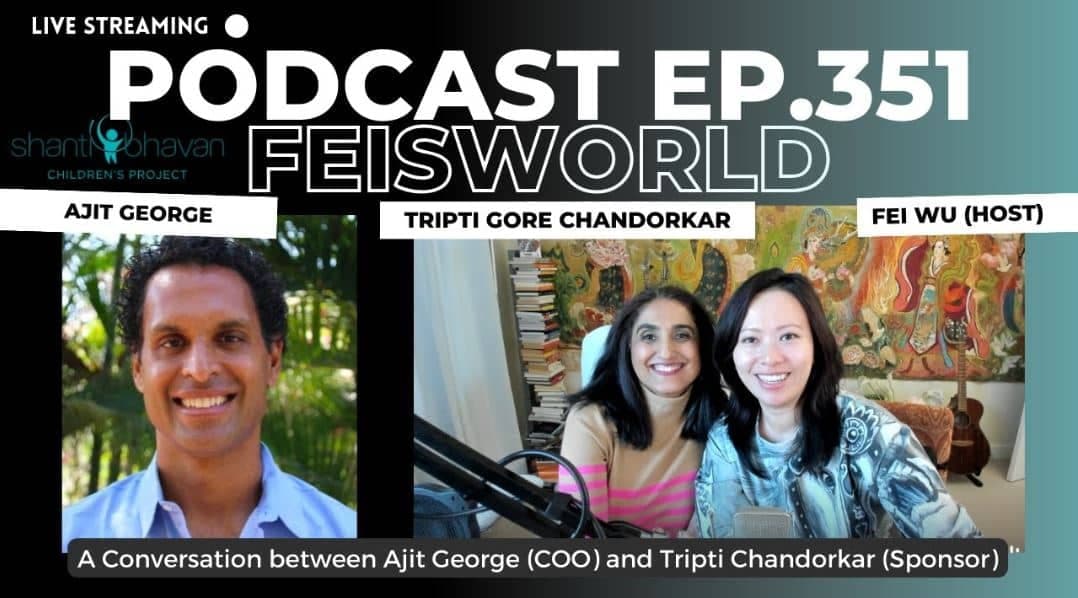
Our guests today: Ajit George and Tripti Chandorkar
A number of years ago after watching the Netflix series, “Daughters of Destiny”, I decided to interview the COO of Shanti Bhavan, Ajit George.
Years later, I was sitting down for dinner with my dear friend Tripti Chandorkar and found out she had been a sponsor for the Shanti Bhavan project for years. Through sponsorship, Tripti is able to sponsor a child at the school which helps pay for every aspect of a child’s schooling, including housing, food, and medical care.
It’s a privilege to sit in this conversation and listen to their stories as a COO and a sponsor. They were able to learn so much from each other’s experiences too.
Together we hope you enjoy this episode, share with a friend and learn more about this incredible organization.
Watch Our Interview
Transcript
Transcript
Of
Fei Wu: meeting you years ago and had that conversation and had no idea where that conversation would go, and you know, thousands of downloads later. I didn't realize one of my dearest friends. Trip Actually, not only watch the Netflix series, listen to our conversation. It has been a patron for, for a long time. So I'm, the conversations can flow anyway. I come in as a moderator only as needed. But consider this time as you two, connecting, learning more about each other organization and encourage, hopefully encourage other people to be part of this whole
Ajit George: movement. It's wonderful to be back and yeah, that conversation was, was really great and it's been so many years, so, so much has happened since then. But it, it's, it's really great to see you, Jen, and Trip is really nice to meet you.
Tripti Chandorkar: So Yeah, and it was all like, so off the cuff, right? We were meeting for dinner the other day and. We talked about Ashanti Baan and she connected us, and it was, it was just wonderful. I know.
Fei Wu: Yeah. So let's kick it off. Maybe have Aji tell us a few things about Ashanti Baan, like, again, I'm a creator. Tripti is a, a patron, and I would, we would love to both learn more about the development and including anything that you feel comfortable sharing.
Ajit George: Sure. Should I talk about Hanman in, in, just in case people don't know the basics about it. We should
Fei Wu: definitely assume that people who are listening through this may not have found out about what it is. Right?
Ajit George: Right. So Shati Bowman is, it's a poverty alleviation, but we use education as our tool to reach our goals of uplifting children from the most discriminated communities. The most imp poverty impoverished communities. We are a boarding school based in tumble Nado, India, which is in the South. Every single child that comes to Shati Baba and starts with us at the age of three and a half, four years old, preschool. They stay with us until they graduate from 12th grade. Then they go on to college, which is either supported by us or they get full scholarships of partial scholarships, and then we cover the rest either in India or in the us. So our commitment with each child is, is really from the first day of school to the very first day. The impact has been radical. When we think about poverty alleviation or we talk, think about, you know, education. Usually it's incremental changes. You know, maybe a, a child from poverty will have a slightly better life. Maybe they're able to cover, you know, have a slightly better place to live in. It's, it's really tiny, tiny incremental changes for our kids who come from urban slums or rural villages where they don't have a house or it's, it's one room shack with no electricity, no indoor plumbing, no water, no toilets. They go on to work at Google, Amazon, Mercedes-Benz or Goldman Sachs, and that radical change in their life only empowers them to, to escape poverty, but it helps them uplift their families in, in their communities.
Tripti Chandorkar: Wow. It's like the real, real impact that when you see them working in, you know, these world class companies or studying in world class universities. Yeah.
Ajit George: It, it is, it, it really is about that Our theory of change is invest in catalysts that that can impact their own communities. Right. I think one challenge sometimes with governmental intervention or geo intervention is we're trying to do too many things at once, and that dilutes the effect of all of the things we're, none of the things we're doing effectively, none of them are doing, being done well. They're doing it at a, at a level that doesn't really. Change, change the dynamic or does it change what's happening on the ground? Ours is to focus very specifically on a, on a smaller set of kids, but empower, uplift their lives, uplift their communities, and have a ripple effect morale. And we see that I think in the modern day, like for good or for bad, singular individuals can have an outsized impact on their community. Whether it's like local community leaders who, who maybe start unions or, or lead unions. We'll see unionization now of different companies to obviously corporate leaders. Some of them great, some of them not, but they have huge impacts on society. We believe that kids from our community that from Chante Baum, they, they're kind of the secret sauce. There's something magical about that. Something really special. And here's what's special about them. They came from the worst and most challenging circumstances in if they have seed it all, alcoholism, physical, sexual abuse, deprivation, malnutrition, trauma, uh, and of course extreme poverty. But they've, they've been in the worst situations, but they have all the tools and all of the education of, you know, upper class, white collar education. They're, what we do for them is not, we do not discriminate and think, oh, well you're from poverty, so we shouldn't give you a lot. We give them the best we can afford. We really empower them with all the tools to be successful themselves. And what we see and what we believe is they'll take those tools, those really powerful tools, and go on and do some really amazing things, but they'll have the consciousness and the awareness. Those who have very little, who came from deprivation. And so we will hopefully do something different, right? But they won't replicate that cycle of oppression. But actually they'll take those tools and do something really unique. Something that I can't see 'cause I didn't grow up in that, but maybe two of you couldn't see. But something that's really unique and I, we are already seeing them thinking.
Tripti Chandorkar: Hmm. Yeah. So actually, can I Yeah. Jump in, mention something here. So that's exactly what I think is the major like differentiator of your, your organization from all the other NGOs back in India, sort of, you know, trying to help alleviate poverty, poverty or, you know, educate the girl child and things like that. I think it's the idea that. Your organization supports a child from like A to Z so that it's like a full, it's like a fully paid boarding school for them, not just like a day school where they can come during the day and then they go back to their old environments, their environments, which are not very conducive to continuing education. Right. So that is what typically happens in India, that yes, you can give them free education, but they'll still go back to their homes. Mm-Hmm. Which are not very supportive. So I think that's the key differentiator of your organization, which is what makes all the difference in terms of how it would impact the students who graduate, get jobs, and then how they can give back to their communities. And in, in, this is how, this is what sort of really also like pulled me towards wanting to support your organization because I have seen in my own life, like my mother, my grandmother. All of them sort of trying to help the children of, you know, people who are household help. For example, traditionally in India you have people who come and help you at home doing different tasks around the house and then. Like my grandmother, my mom, they would always want to educate their children, you know, the boys, girls or whoever they, whatever that, that might be. But I would, I have always seen always that they never continue with the education of, especially the girl child. Even though, let's say my, you know, they, their education was paid for by my family. I'm just giving an example, let's say, right. One of the girl, girl child's education was paid for. But once she reached like high school, either they only had two choices. She would either get married off or she would start helping out in somebody else's household. Mm-Hmm. So that's that. That's how I think Shante B is changing the pattern of empowering these children and these communities. So, pulled me, that's what pulled me towards your, uh, organi organization's mission.
Ajit George: I appreciate that trip and I, I think you, you really hit on some really complex and nuanced ideas that a lot of people don't understand. I think first and foremost, we. We see in the US there's there, you know, for, for decades there was this, a basic literacy, that idea of just reading and writing and you didn't really kind of analyze what that would mean, or, or, or they would go into primary school or just get, get to the classroom. Get them to get in the classroom. That's all the idea that getting 'em in the classroom is enough, really avoids the elephant in the room is. They're outside of classroom. What? They go back home. What happens? Right? Do they have enough food? Do they have a safe environment? Is there an abusive, you know, parent or sibling in the house or an abusive uncle? You know, is is there electricity? Can they, can they read at night? Can they, can they study? Does the girl have to walk a mile to find a safe spot to go to the bathroom with some privacy? Right? All of those are issues that our kids deal with if they're back home. Yeah. And, and a bunch of others that we're, we're not talking about, but there is a lot of issues that they face. So that's the first problem. And the second is, and I, and I alluded to this before, but these are unconscious bias that all of us have, which is I think we, we believe that a child from poverty, maybe not just quite capable enough or maybe that like it's okay for them. To get a little bit of education, but there's a glass ceiling. Their capabilities are limited, so if their education is limited, that's okay, is they're, they're getting to where they could probably go, but they can't go further. And, and Shante above is very much defines that. Our belief is that a child from poverty is just as capable and justice as skilled and just as smart as anybody else, but they need a couple of things. They need all the resources that a child from a middle class or an upper class, bam. They need, they need that high quality education and they need an infrastructure around them. And that means the individuals, the caregivers, the administrators, the teachers who believe in, who love them and say, yes, you can do it. Yes you can do better. And to push them sometimes with like that Indian tough love and say, no, you can perform better and I know you can do it and I'm gonna give you the resources to do it. But I haven't been also given the expectations. A child will know if you don't believe, a child will know that you don't think they're capable, they'll read it in your face. They'll read in your voice. They'll read it in the things you don't say to them that you don't urge them to do, that you accept like a low, low school or that they didn't study or they didn't do their homework or all those things. And so Shanti Pavin really handles all of that or really tackles all those complex challenges by the boarding school. Simultaneously we're tackling the complex. Finally challenges by negotiating with the parents and really like holding them off and saying, no, you aren't gonna marry off your daughter at 14, or put her to work, or put your son in the quarry and have him start breaking stones at 15. Yep. We, you have to keep them in school. You need to invest on their education. A lot of complex negotiations, a lot of complex conversations, but that is part of what makes us different.
Tripti Chandorkar: Yeah. Yeah. Can I ask one question? So does it, how, how often does it happen that the parents will take the kids out of the school halfway or some, some part of the way? A
Ajit George: lot less than it used to. In the first years, we had high attrition, you know, 40% of the class, 50% of the class. So it was really heartbreaking and that was really tough. And that would be throughout. Through the whole life cycle of it, you know, of, of a child being at a, at the, at the school, but it could be at any age. But we had a lot of challenges over the years. We've gotten a lot better at kind of mitigating that, explaining things to the parents, explaining why they should keep their child in the program, what was important with it, why education matters, why they should go into college, why what will happen if they get a job. That's helped a lot that we've had a lot of graduates who come from the same communities or the same regions. They're role models for the parents with younger kids. So they're able to almost act as and are ambassadors and are are communicators with other parents who still have their kids there is to say, Hey, I was Ashanti Garman, now I'm working at Google and I'm making all this money and I am able to take care of my parents. You keep your child here and they'll be able to take care of you. So that helps. That said, within the, even now to this day. Within the first two to three years at Cho Bev there, that's when they were most vulnerable to be pulled out by a parent or a grandparent who gets very insistent grandchild. So we will probably lose one to two kids every year, maybe three kids every year and get pulled out in the first, in preschool, kindergarten, or first. I passed first grade, second grade, then the parents stopped pulling. They're, they're really invested. Yeah. And
Tripti Chandorkar: I have, like, I, I asked that specific question because I had firsthand experience with that because the first year, the first couple of years that I, uh, officially became a sponsor, I was sponsoring one, this one particular child, and then I think late last year, mid or mid May of last year, I. Got communication from your office that they have changed the child who I'm supporting now because Al had left the school because his parents had taken him out. Yeah. So I'm like, why? I was like a little sad. I was like, why did they take him out? And I, I had gotten used to seeing his videos every quarter. Like, you know, they would send me some greeting cards signed by him or. How painted by him and a little video, and I, I kind of like, you know, become attached to seeing. Yeah, no, of course. Well, yeah,
Ajit George: so that's how that thing Yeah, it's, it's, it's tough. As, as hard as that is for you, it's, it's like 10 times harder for you every time I hear that news or we have that problem and we try our best to convince a parent, but there's, there's sometimes it's, it's strange circumstances, like they're completely moving from the region and that's one of the, okay, among the many questions that we ask parents when they first enroll is. Are you planning to stay in the area for a while? Is there any, any plans to move, you know, will other life circumstances happen? Sometimes it's a religious issue too, sometimes because we're, we're a, you know, a non-sectarian organization. There isn't religious services or anything like that. There's quiet prayer areas where you can go and pray it quietly. But we have had parents pulled out because they want to send their kids to something with more, a more religious element to it, or. Okay, so there's, there's so many like weird complexities to like, why a parent. Make those choices.
Fei Wu: Choices, yeah. By the way, I'm just, I'm just loving and please no, yeah. Honey permissions to start asking each other questions. Okay. Okay. Because I, I really, I, I'm just absorbing and hearing this and the fact that you reflected on the fact that you get images, you get signed, right? Yeah. And is it seems like
Tripti Chandorkar: you Powerful. That's powerful. And you know, I recently. From the new, new kid. Right. They sent me a video Mm-Hmm. Of wishing me happy New Year and stuff like that. And he, he actually wished me Happy New Year and he called out my name at the end of the video. And that was just so touching, you know? It was just so, I'm like, I wanna go meet this kid. But I know you, you also have some policies about not letting too many details. Yeah. Many details about the kids.
Ajit George: It's a, it's a complex part, you know, one on one hand, we, we wanna make our supporters aware of their child's reality and lived experiences, so that's why they do communicate the way they do so that you, you know, what their day-to-day life is on some level. Like, they're able to communicate pieces of who they are, because a lot of our, our supporters will never come to the school and visit. And we, and, and also we get a lot of requests, so it becomes very difficult to navigate those. So like, it's. You know, I think sometimes a visitor thinks like, oh, well I'm just visiting school. It's not gonna take a lot of effort. But actually from our point of view, we try to be good hosts. So it does end up taking a lot of effort from us and it can distract from our school and our classes. But so, you know, to ensure that our supporters do have some kind of understanding of what's really happening there, we try to have that kind of communication so that you do have a real connection and understand that what's happening is important and it's real, and it's impactful to us. And there was another part to this that you maybe you didn't think about. Tripp D is we want to install, instill in the kids a sense that somebody else cares about them. Mm-Hmm. Somebody cares about their life and somebody's willing to give money to them even though that person may never see them. Yeah. Entire life. This person is stuck forward. Right. And that child doesn't owe you something. Yeah. Churn. Yeah. Except maybe passive then on to somebody else. It's a passive. Yeah. And that's something I talk about a lot with the kids. I'm like, you know, there's so many people who donate to you and help out or give to the school and all. You don't know owe any, any anything to that. Like they're not asking for anything in return. They're asking for their money back. It's not a loan, it's a donation. Yeah. But you do owe something to them to give it.
Tripti Chandorkar: Yeah. No, I think I really appreciate that idea behind, behind this, you know, paying it forward, helping it forward, and doing it without any, without letting them know who's doing it, you know? So. Yeah. Yeah. I also had another question, so I don't know if, I think, I think or I, I think told you about how I, I. Got introduced to B and the, the movie, the Netflix film. So, you know, she's a really good friend of mine and I value all many of her opinions and the recommendations. So years ago she had recommended Shanti Pavan, the Netflix documentary to me. See, and that's how I started. And I didn't watch it for almost a year because I, a lot of times, like I would see the, the Netflix Shanti B sort of ad, you know, a being advertised on Netflix, but I was. Somehow I never got around to watching it, but I finally did after about a year of you telling me. Mm-Hmm. Um, and then I watched the first episode and the way the movie's been made, like in terms of following the lives of whatever, the five or six vulnerable students. Right. Right. From the childhood too. Mm-Hmm. What they're doing today. So I, I watched the first episode and I was hooked. Right. I was like, okay, I wanna see the next one. I wanna see what happens in their lives. Right. What are they doing next? So that's how I got hooked onto it. And it, it just had like a profound impact on me, as you can tell. And the, so the other thing I wanted to discuss, just kind of like explore was, so the, the documentary sort of is a jo is, is a documentation of the journey of these five or six kids from the time they get admitted to the school, to the time that, you know, they get jobs. Is there, is there anything Shati Pavan is doing in terms of measuring how they are, you know, what's happening after their jobs? Like are they, how are they, how are they helping their communities back, or how, how are they bringing about a change?
Ajit George: Yeah, I, I, you know, we actually have, we, we have a very thorough process. We have a, we have a team member. Who does alumni affairs and her job is solely to like communicate with the alumni and track these kind of developments. Right. And I should probably, you know, I, I'm going to try to open up this document and find her, her, her stats because it might be interesting to just chat about a little bit. But one of them, you know, first of all, I should probably add, you know, I'm really glad that you like the documentary. I have very little to do with it. I cannot take any credit for that, that. Was the product of Vanessa Roth, who is the documentary filmmaker, and she's an independent documentary filmmaker. She, she was very clear that we would have to be a hundred percent hands off. Mm-Hmm. And we would have no editorial control and we wouldn't even really see it until like, she showed maybe clips every once in a while. Like, she's like, oh, here's what I just shot, you know, and X, Y, and Z. Right. But she never allowed me to like. She just never, she, she never let me had like, control over what we were doing, so what she was doing. So it was very much like, it was a little bit like, you know, you're holding your breath and helping everybody goes well. But yeah, it's, it's, I think it's probably powerful because it isn't something we did, it's something that an independent person did. Uh, and like they really, you know, they were very, it's just very true. It's very real. True. Exactly.
Tripti Chandorkar: Yeah. Yeah.
Ajit George: So, yeah, we track where they are and, and what they're doing. And, and maybe I haven't answered questions around stats, but like, maybe these two antidotes will be more powerful or, or kind of, you know, help your, your listeners kinda understand what has happened or the impact of, of shop development. Right. So this is this first one. I'm gonna keep being south of this, but I'll just say first one's from a young man. And he said my family was in terrible debt. When I finished college, my father had committed suicide and we had money lenders knocking on her door to collect. I needed to clear all of my father's debt high up. Over the years, thanks to my accounting and finance education from Shahi, Baban and from college, I was able to get the money lenders to renegotiate the terms of the loan, and I restructured the loans that pay them off all, all over the next five years for a long time. I used most of my income to clear the debt, but now I'm able to save and provide for my, my mothers and families. And the second one is from a young lady. Wonderful.
Tripti Chandorkar: Right?
Ajit George: Yeah. Yeah. Powerful. Right? And then this, this is from my, from a young lady. My first job outta college was at Amazon where I worked for two years. I covered the house rent, the cost of basic necessities, my father's de eviction expenses, my mother's medical bills, and my brother's education. However, the four of us still lived in a single room with one shared bathroom. After Amazon, I changed shops to work at the VF Corporation leading hood, put work the increase in my salary. I moved my family out of the slum into into into a safer environment with a regular supply of water and electricity. I continue to pay for my brother to attend school, and I support my aunt and my three cousins with their education. Since father was murdered, I've gone on to do my MBA with the help of, and have been hired by Google. My father passed away from health complications due to his alcoholism, and I'm now the sole income earner or my family. Well, she is, she's this young lady is now 27. I actually just had a call with her last, so pounding. Yeah. My, so these are the extremes that they come from and they're dealing with even as they get their first jobs. But then here you're seeing some of the impact having Right. Okay. What, what, what's going on there? Yeah. And that's one of the important things about Shante Baba. Is that we really track very closely as to what are alumni doing, how they're doing, the challenges they're facing, give them advice around some early career decisions. You know, how to move up the, you know, the ladder and in their opportunities. Yeah. But also how to like, deal with like loan issues, money lenders, and loan issues. The big one is some of the biggest ones. All of those things. Yeah. So it is, it, it's a, it's a, it's pretty complicated, but we have very good insight into what's going on. We should be
Tripti Chandorkar: a girl. Movie of that side of the story as well. Yeah. Kinda like close the loop. I think it would be
Ajit George: helpful for people to understand how Yeah, yeah.
Tripti Chandorkar: Exactly. Yeah. And, and now through your journey for the last your, your dad's journey, right. I think for the last 20, 25 years with this,
Ajit George: this is, so this is gonna be the 27th year. 27th year of the, of our
Tripti Chandorkar: organizations. Wow. And your dad's story is also like, so inspiring. And again, that was only through. Only because I watched the movie that I could, you know, hear his story and it was just so inspiring. Have there been other, I, I don't know any other organization in India doing this kind of work, but, so since now that you, you all have been and doing this for the last 25 years or so, have there been other organizations doing something similar or. Any other interest from people who wanna do something similar?
Ajit George: As far as I know, we are the only organization in the world that does, from the very first day of school to literally the very first day of world. It's world. Imagine. Yeah. I don't think that there's ever been an organization that does it well, like we do. And I don't think there's any that still that do, wouldn't even to decide. We've heard or organizations doing Now they there, there is now starting to move away from like. The basic literacy as like a benchmark and more, you know, in depth. And so now there are a lot of programs that are longer and that might encapsulate, you know, three years, five years, you know, you know, all of high school, something like that, right? Uh, but we're also seeing them trying to cut wonders in a different few different ways. So, you know, I want to, I wanna be careful about not naming names, but like, I know another organization that does a mixed model of like wealthy kids. And poor kids in a, in a a boarding school environment, that's supposed to be pretty good. And they actually did a lot of fact finding with us before they started theirs. And then they came back to us six, seven years later kind of bet for help to solve problems. And when they explained that they actually, they wasn't just for poor kids, so they had wealthy kids as well. We realized what was going on. And what we found was there was a class system between. The wealthy kids in the place. Yeah. And it doesn't really matter that you try to say no. Like it happens and you notice that the wealthy kids have iPhones and they didn't ban all of those things. So they have iPhones and they got all this technology. They got fancy clothes, black markets were starting to build out in the school. It was, it was, they were dealing with these structural issues and we're like, Hey, I can't actually give you advice on how to handle this because this is not our model. This is not how we structure. Like you took some of our ideas, but then you really radically went. I've seen another program that's also longer. But they've, like, they have, you know, they made choices that are, that like, you know, I don't, I, I worry about the, the, the long-term consequences of it, like big one is that they've lowered some of their standards in their curriculum. It's an easier curriculum than ours. And what I've noticed is that they have lower expectations, you know? Of their kids and they do, they don't have the same pressure in the, and, and when you interact with the kids and you talk to them for a longer period, like lovely kids, so much, so much is great about them, but you know, they're not performing academically at the same level and their, their own dreams and ambitions and desires for them seeing limited okay. Seems, seem limited. They, they, they seem to, they, they themselves have started to create glass ceilings for themselves at a young age. So. I think our unique mix of this long-term, you know, structural model along with our systemic approach where there's, we we're thinking about all the complexities around education. 'cause it isn't just education. There's all of these issues around life that, that we're attacking as well. And we teach these skills. You know, I think I, I should have probably explained that, like it's not just education. We're teaching the kids, we're teaching them a tremendous amount of soft skills. Public speaking and interview skills and, and, and teamwork and interpersonal support systems. All of these things are there because we need them to understand that like, life isn't just about the book. It's also about, you know, interacting with other human beings and navigating these, these spaces that are maybe uncomfortable for you, that you're not used to. Like, if you grew up in poverty, then you're going to have climate challenges of entering like white collar professional spaces and being around people who grew up in wealth or, or you grew up in. So we teach them all of these things, all part of the curriculum. It's really complex about how we approach. So I think we, I we to right now, I don't, haven't seen an organization that still has that kind of combined approach and that holistic. Yeah. And with that high standards.
Tripti Chandorkar: Yeah, so I think I'm right in my observation that this so far is the only organization that's doing this kind of this model been model.
Fei Wu: Yeah. Right. Like I'm wondering if the model works so well. Like how come
Tripti Chandorkar: we not more like
Fei Wu: people Yeah. Or organizations. I'm not just like individual. It's
Tripti Chandorkar: a good question. Really good question. I, I
Ajit George: think it's, it takes a lot of work. It takes, yeah. It, it takes some, it takes a lot of work, but it takes a lot of resources and it make, it takes a lot of like specific decisions, right? Like, um, I'm married, but I don't have kids and there's no a plan for me to have kids because I don't think I can divide my attention between my work. Yeah. In, in the way that I, I, I feel like I'm almost like a parental figure to hundreds of kids, and I don't know if I can navigate between that thoughtfully. Our team is on call all the time. 'cause there could be a medical emergency, there could be some kind of emotional crisis going on with kids in college. Like it's, it's a lot of work, it's a lot of resources and that level of dedication and devotion takes a really unique individual willing to kind of put all, all of that work in. So our, our staff is very specifically vetted in a really very, I'd say like they're true believers. Like they, they believe in the cause and the crusade and they're willing to give their all for it. And so it's. It's intense work, intense resources, and I think it takes a very specific ethos and mindset to approach it at this level. Yeah. Yeah. And also, and also I'd say that like from a fundraising perspective, right, it's harder, we find it harder to convince individuals when they say, well, how many kids do you have in your program? I'll say, well, at the school there's about 300. At college is another 50. And of course, you know, a hundred and, you know, 150, 160, I've graduated from it. And they're like, well, that this other organization I know of has 3000 kids in that 10 times more than, yeah, right. And we're doing this and this and this and that. That's, you know, it's easier to convince donors if you're doing thousands and thousands of Yeah. My question often to them is, Hey, do you, does that, do you have any doubt about where those kids are after they graduate from the program? Are they, yeah. Do they have good jobs? Are they able to like take care of themselves? 'cause our data when we, we've done research shows that they basically go back to the same level.
Tripti Chandorkar: So, and that's what you Yeah. You have like small, I guess you're starting small, making sure there is, it's like really well, well tested and everything before scaling up and making it.
Ajit George: I don't, I don't know if we'll scale a lot like we're building a second school and that's gonna, that's opening up starting this year. But I'm, I'm a strong believer in the high touch model and, and kind of what we said, what I said before, which is I want to create catalysts that will go on into other things that will have impact. So, so what I believe is that our graduates will build the next generation of both as individuals, as but together as well. Right? If we think about. Some of the biggest companies that came out in the world, you know, meta Facebook was a bunch of Harvard kits together, right. You know, mark Zuckerberg, everybody knew his hand, but like, it was actually like his roommates and his, his friends and all of them working together and that they, they started off then the Google Boys or Google, right? It's the people you know, and you build things together with, and it's the same way with Ashanti BA who are doing engineering. They're doing business, they're doing law, they're doing all of these different things. They have all the skill sets from all of these different areas. If they all grew up together, they can start building companies together. They can start, you know, building new NGOs together. They can start running for all political positions together. I think they're going to be the catalyst of change behaviors that will have large impact on the world, in, in very, very unique and special ways. My role and Shante Bowman's role is to build that bridge to, to, to, to empower these catalysts, to, to, to go on and do those. So I don't want to scale where we're doing tens of thousands because. For us, it's not sustainable. Like I would have to find a enormous amount of resources in terms of monies. But like let's say somebody decided to drop a couple billion dollars on us, even then I would need to find like the people that would trust. 'cause like once you get past a couple, two, three schools in the leadership even know what's happening in the schools, right? I spend so much time like walking those classrooms and going to the dorms and seeing what's happening on the ground. And like when we book the second school, I'll be dividing my time and I'm gonna be moving full-time to India actually. And so I will be able to travel between these schools and see what's going on. But once you get past a certain level of growth, you start losing your, your insight and understand, I don't want to ever have that time. Yeah. And you have to trust, like your team, you, you have to have really, really great team members. Like it's one thing when it's a corporation and you, you're giant because it's like cool, you know? There's no, there's no major risk. I mean, sure the company could grow so big that there's corruption and, and there's gonna be inefficiencies and there's gonna be stealing and all of that, or, or, you know, funneling of money or something. I'm sure there's, you know, people doing stuff with their expense accounts. There's, they're not supposed to, whatever. Not the biggest problem in the world when it comes to human lives, when it comes to children. I never want a single child in my organization. I. To to, to ever have that situation. I wanna be able to understand everything that's going on the ground intimately. And so I would be very reluctant to scale beyond.
Tripti Chandorkar: Yeah, no, that's, that's true. So actually. Like, while you were talking about all this, it also struck me like to, to this point about why there aren't other organizations or other people wanting to do similar work. I guess it, it also takes like this one person who is motivated, like your dad was, who has the resources? Mm-Hmm. And the, the will and the purpose. Wanting, wanting to do something like this to, you know, kind of like just be dedicated to it a hundred percent with the resources that he had. So not everybody wants to do that. So, yeah. Lucky. Have you,
Fei Wu: you have not had lucky to have you, I mean, you're looking at a painting behind me and 18 others. My mom has painted. I also don't have children and. Part of the reasons why I feel like, oh, I just have kids and they'll carry on her work and that's not guaranteed. Right, right. Can't just expect, I think it's, one thing is that you should have children energy. You could force him to like what your, what his grandpa did. Well, that's not guaranteed. I think, I think this is such a legacy piece and there they're, it's a very complex right matter, but you also, you know, can assume that somebody can just assume their responsibility. And I love the fact that we didn't, last time we didn't really get to talk about the scaling of it all. But now more so these days, I've been running a, a business since 2016 and a lot of clients are like, phages, you can scale this, you can make so much money. And I, for every business I started, I said, no, I wanna service, I. A handful, a small number of clients. Really well. Yeah. And they love us. Yeah. And that's how we're happy. Yeah. If I scale right, I'm not gonna spend time like this, which 50 I'm not gonna care. Give to my mom. This is like the perfect model. Yeah. In a very sustainable way. In fact, in the US especially. You see so many business, all they wanna do AI or otherwise is about scaling. And what's gonna happen in three months, six months, one year max, they're all burned out, you know, crash into flames. And I'm so glad that, you know, Shante Dovan has such a, like a wise leadership to know precisely where you fit and where you want to go, so yeah.
Ajit George: Yeah, that's that's absolutely true. I mean, it took somebody like my father, who's a serial entrepreneur, an ex-military man, to have the vision and the drive and the like. You know, the persistence, the peer perseverance to created Exactly. You know, he's done incredible things beyond Shanti Oven. I don't know if I talk about it the last time while I was on, but he, he, he did the largest testing and treatment of lead poisoning ever done in the world, and he did in India in the nineties, and helped and introduce Unli gasoline in India. It forced the government to, to change its laws around on mito gas lights. That was one of my, my father's pioneering works and. In terms of environmental impact that that you know, has a impact for Billion Depot off. He was big about fanfare or getting news about it, so he didn't really care. He did it and moved on. I was like, dad, man, you should have really should have hired a PR firm and gotten you like a major humanitarian prize for it. He got a few awards that hinted about the metaphor and a couple other things there, but he didn't really bother. 'cause that wasn't really, he's not here for the rewards or the public. Yeah. But it was his drive and vision. And I grew up in this culture and attitude and mindset, and so you're right. You know, a child can go in a very different direction and can, can either, you know, believe in a parent's vision or can completely go in an absolutely different direction. But I, I really believed and understood my father's vision and I see opportunities for growth beyond what he's built. And I, I think I can expand on, not necessarily the size, but things that we can do. I've got different ideas about how we might. Evolve and, and figure out new solutions to new problems. And, you know, sup, give better support, give better roads to success for our kids. Those are the things I, I'm, I'm, I'm working on. And then after, after my time, I think, you know, passing it on to Chante, Bowman graduates themselves. Yeah. They're the ones who grew up in the environment and yeah. I would the best, and I think the next generation of leaders after my time will be those who grow up at Shanti Bump. Wow.
Tripti Chandorkar: So, yeah, so I have to tell you this, and maybe I did mention that in my email to you, but talking about soft skills, teaching them soft skills, you know, there was a gala here in the Boston area Yeah. By Tivin last year and I had attended that and it was just a pleasure to be there and meet all the kids and some of the staff, you know, who had flown from India. I'm gonna go next time the kids. Yeah, I'll, I'll let you know they're here next time. The kids, I have to tell you. So there were three boys that, I don't remember their names, but I remember talking to them, interacting with them. And one of them was also, you know, addressing the whole crowd who were there. So I have to say, I was so impressed by, you know, the soft skills. They, they were so confident, they were so articulate and so self-assured and, you know, it was. Just amazing to see that. And they were all, they were all studying in really good universities over here and know one of them was in Dartmouth and I also shared my phone number with them. I was like, anytime you guys have any questions or if you're in town, wow. You need any help, let me know. But of course, I haven't got any calls from that. I'm guessing they're all good.
Ajit George: Yeah, we, we have a, we have a really good support system that kind of checks in on, um, Kirk Christina, who's our manager of Alumni Affairs, is always watching over them. I believe for Boston we had. I know we had Sam Samuel, who is at Dartmouth, and then yes, Don was also there and he's also from Dartmouth. So we have two students who are there. I wonder if Nave, if you said there was three boys there.
Tripti Chandorkar: Never saw Sam and Don. I
Ajit George: remember. So I think it was just two. I think it was actually just two of them.
Tripti Chandorkar: I, okay. I thought there was one more. Was, is Danish like the public speaker? He, he likes, I think
Ajit George: Sam spoke hats. Okay, okay. Both, both of them. So. The thing is, every single child, Ashanti Bow gets trained to speak. Okay. I, I think Sam Olley was only when who was spoke, but Thunder just spoke in Austin and then Oh, okay. So, um, among the many different things that we train among is on public speaking. Like we, we, in, we struck, they, we start at the very young stage when they're in preschool after they're a few months at the school and they, they've learned English. Yeah. Because they most, they don't know English and they, they feel confident. They come up in front of the stage and do this really cute song, and they say their name and where they're from and how old they are, and, and everybody in the entire school is there for this. And so there's, they're, they're seeing all of the kids and all the staff and all the teachers. We cheer and applaud for them and really encourage them, and they feel really great to do that right As they get older, they do, they do things like reading the virtue for the day. So like, if you watch the series, they'll see something like patience or generosity or those are the virtues, and they'll do that in front of the entire school. And then when they're older still, they'll, they'll do the news where they're, they're communicating news articles for the day and discussing it, and they're, they're feeling questions from the audience on the news questions. So they really need to know the news. They have to have it like they, they, and they're not allowed to read from like a strept. So this is all done from like their knowledge, um, absorbing the news. They communicate the news like a news, one news article. Each of them, there's four of them, they communicate this news article and then they field questions to them about the news article under, while everybody in the entire school is watching. As you can imagine, this is high pressure and a lot of kids like they hate it while they do it. They're like, this is the worst. Later on as they get more confident and go, this is the best. Like what it taught me is to be able to handle myself under incredible pressure. Stand and deliver a presentation in front of everybody, like hundreds of people. Yeah. Be able to feel questions and creatively think an answer. And if they don't know the answer, they're supposed to do two. One of two things. Take an educated guess lo, like try to logically puzzle it out. Or they're, they're supposed to say, Hey, I, I, I don't know the answer to this question, but I will get you an answer tomorrow. And by tomorrow they're supposed to have a response for,
Fei Wu: I just noticed something so profound that you started naming people from an event. You didn't even attend person. If you have 3000 people at the school, you'll never be able to name anybody
Ajit George: down. Yeah. You, you, you start, you start to lose sense of who's who and what, what they're dealing and, and so on. So. It is, it is that intimate knowledge of each human being that is within our, within our school, and then I am ultimately responsible. That, that's really important.
Fei Wu: I, I had to ask a, a very real question. You're, you named, both of you named a bunch of kids attending schools in the US and I know you didn't start doing this just a few years ago. So as we all know, like going to college in the us, one of the most expensive. Places in the world. Yeah. College tuitions will knock a family like upside down as it's happening to a number of people. I know. Yeah. Like how did you not only get kids to go to US College, but go to places like Dartmouth as you named, and you know, later when you said working at Google or Amazon, I assume actually both locations, right? Seattle as well as maybe some, yeah. Your primary locations in India. Like, how do you encourage kids to do so, like while bringing on potential financial burden for, for Shante, Bob? And I just wonder.
Ajit George: So actually, uh, until a few years ago, all of our kids did do college in India. And that for exactly the reasons you just, you, you brought up Fay. We did not feel like we had the capabilities or financial abilities to like, to tackle this question. We didn't even have the knowledge about how to tackle this question and then. In 2019, we, we made the move and that caused some problems because the pandemic happened and then like the kids who got in had to like de defer for a year and stuff like that happened. But what happened was we weren't in the position of growth in the organization. We said, Hey, I think we can tackle this problem. But we, we looked at the analysis of it and we realized we can't tackle this problem unless the kids get a hundred percent scholarships. 'cause in the US the costs are just, even the living, like let's say get the full academic scholarship, if the living expenses a loan will just ta tank our entire budget. So they have to get both a living expenses and the academic, and we will, we'll pay for the incidentals, which is like maybe a plane ticket over from India. Maybe it's plane tickets. To some place while they're on vacation, maybe some extra, you know, things that they needed in like the door that still ends up being thousands of dollars a year. Yeah. But it's, it's much more like doable. But we basically, we, we took the highest performers of every year and that was a, actually a real motivator for them to take their studies real seriously. 'cause they're like, oh, I get a chance to study abroad. And they had to apply on merit to these colleges. And so. We have been really successful over the years. We, we, we've gotten a few kids into, to different colleges. One young man at Stanford, two at Dartmouth. Wow. One at one at Duke. Scholarships. Yeah. They're a hundred percent living expenses and educational. Middlebury. University of Rochester. University of Chicago. And, and I, I'll share some good news that like isn't public knowledge yet. A young man just got into. Princeton on a full scholarship, a hundred percent scholarship. Oh my God. So his package is like $95,000 a year. Is like, 'cause it covers both the tuition and the living expenses. So that's, and we've had a couple other kids who are like, didn't, didn't get an early decision, but their, their fingers crossed that they'll get on a regular decision to other colleges. They're not trying for Princeton. So that's also part of our right, is that like we, we have to build out a programming. We're like. Oh, you went to school in India at Chante and you have to take the ISC exam. That's their, their their final exam, which is a national exam, which is very tough. And then you have to pivot right after you finish that and you have to take the SATs. Because while some of these colleges are sat t optional, most of them aren't. And even if they're SAT optional, we have to show them something. 'cause they're four students at a nonprofit school and they gotta prove that like. They can, they, they belong in these institutions, so they basically finish their I-I-C-S-C exams in like late Feb or middle of March, early, actually middle of March, end of March is what? Usually when that they finish it up. They pivot immediately and study for a couple months, and then they take the essay and then they apply to college. So it is like break next speed of like hard work and discipline. Again. I'll tell you this, our kids at these colleges are at basically 3.5 GPA's or better. So they're competing at these top colleges with the best of the best across the world, and they're getting a 3.5 or a 3.7. Oh my god. They're, they're, they're getting internships at like private equity firms or, or investment banks. They're doing, they're doing amazing. And it really does prove the model that, like Sean Levi isn't just good for the region is it isn't just good for a small nonprofit school in, in South India. And it's not just good for like TTO and it's not just good for India. It's good on a global level. Yes. Like that these kids are competitive with the best of the best across the world at these best at these premier institutions.
Fei Wu: And I think on top of that it's great. I, I think what I personally find most valuable is the fact that. They're men. When I look at the movies, like mental health wise, they're really, they're really checked. They're really nurtured. Yeah. Yeah. And which is a, something that nobody can say much like anywhere in the world, right? Like, kids are struggling with all sort of things and mental health is often ignored. And you mentioned, you know, kids coming from the slum moving to, you know, the city like big cities in India. I remember seeing from the documentary, but now we're talking about you kidding me? Like. Stanford, Princeton, I feel like they're ready, you know, because they've already mentally prepared for a lot of these changes to happen, and that to me is just so profound. Yeah. Then, yeah.
Ajit George: Yeah. Yeah. I mean, I mean, the young man at Princeton, like, you know, he came from family that he's an orphan actually, and his, oh geez. His father had committed his, actually, both of his parents committed suicide. It's a really, really tragic story. And when you think about like, I knew this story really well and it for his own privacy sake, I didn't want to like go into like a large detail on, on. Podcast, but like when you think about what he, what happened in his childhood at this extremely young age, and what he lost losing both parents in these really tragic ways. As, as, as we all know, you know, an, an orphan in the us rarely can, you know, they were in tough, tough positions. And then there's a lot of extra hurdles in front of them. And then in India there's like a hundred more hurdles like attached to a child that, that that's, that's an orphan. The idea that an orphan could go from there to Princeton. Yeah. On Unreal. On a full scholarship.
Tripti Chandorkar: Right. It's unreal that that's what it is. Yeah.
Fei Wu: And I'm so glad, Princeton. What is a Princeton's privilege to have a child at their university? Not just right for exactly, or not just diversity, but it's just I feel like they're the kids. So many, we assume that people at Harvard and Princeton are so brilliant. Yeah, but who are we to say that? You know, people are nurtured and loved their whole life, right? They're able to climb up there. Yeah. Had a child who came from absolutely nothing, no parents to be able to be there. He deser, he deserved more than anybody else. Right? Like really?
Ajit George: I think, you know, to give Prince and lot of credit, their admissions team felt the same way. They were very princess. Yeah, they were, they were very warm. Like they, it was like he got this lovely letter, but then he got a personalized like response from the admissions to people who were very generous in their praise and generous in their attitude. Like, I was very surprised. I was like, go Prince, I love you guys. You guys have a very positive shout out awful mindset. So they're, they're I, you gotta give them so much kudos to the admission. We'll send the, they said they, they, I think they thought all the things you just said, they like, they, that, that was their attitude.
Fei Wu: Wow. Incredibly. Yeah. So I wanna respect to everybody. Yeah. I know you guys have got crazy travel schedule. Are you currently in
Ajit George: the US or? I am. I'm, I'm about to leave tomorrow for India. So you caught me right before I, I fly out the shop. Wow.
Fei Wu: So you're moving there permanently, are you? I am.
Ajit George: This is, this trip is not about me moving permanently. I'm to be there for two months on the ground. Ashanti Baba, which is, which is my normal trip. For, for the last 16 years of my life, I would do four months in India, two months in January, and two months in June and July. That's another reason why I, you know, the choice of being a father was not something I thought was reasonable with my work schedule and my, my dedication to the organization. But then my wife and I are moving full-time, India, and she'll be moving first, and then I will be joining her at the end. Wow.
Tripti Chandorkar: And you do this hun. A hundred percent for this is de
Ajit George: Yeah. As I think that you can probably tell from all the complexities we've discussed today. Yeah. We've always expressed the surface of really all that's goes on with the organization. It's a, it's a full-time, job and a half. Yeah.
Fei Wu: Oh my God. That's, that's a lot. So, yeah. So Aji, we will wrap it up by, you know, saying like, how can we best people, best support your organization? How to learn more about your work.
Ajit George: I think to learn more, better work. I, you know, you can always still watch the documentary. I think watching Daughters of Destiny on Netflix is,
Tripti Chandorkar: I think now you'll catch a lot of other details that we talked about. So
Ajit George: it's, it's a great documentary and it really does, it covers seven years of our life at four episodes. So four hours, really still seven years distilled to four, four hours. But it's, it really will give you an insight about who we are, what we're doing, why we're special. I think it'll be very powerful and emotional journey watch show. But you can also, you can also jump on the website and you know, we're at shante bain children.org and you can always learn about that. And then there's also a book written by one of our graduates called the Elephant Chase Daughter. That's another great insight about Shanti b and org. So I'd love to, you know, invite people to get involved. So if you, you're able to support us or donate, always welcome it. If you're interested in volunteering down the road, it's a bit of a commitment, but if you're interested, you can always apply to be a volunteer. So there's different ways to get involved.
Fei Wu: Thank you so much Aji. We, I just want to find a way for us to keep in touch and continue to contribute something maybe we can do in, you know, in Boston or the general Massachusetts area. Yeah, no, that'd
Tripti Chandorkar: be great. Thank you. Oh, this was a wonderful opportunity to talk to you and, you know, get information directly from you and add hope it was helpful.
Ajit George: No, this was of, it was great talking to you both and thank you for such a interesting questions. Struck de it, it was. It was a very special interview because I think it was different in terms of your perspective today. Your your are.
Connect with Ajit George and Tripti Chandorkar
- Learn more about Shanti Bhavan’s sponsorship program
You might also enjoy…

Written by
Fei WuFei Wu is the founder and CEO of Feisworld Media, a Massachusetts-based digital media company helping brands get discovered by people and by AI. An Adobe Global Ambassador and brand partner to ElevenLabs, Synthesia, and 50+ other tech and AI companies, she hosts the Feisworld Podcast (400+ episodes, 500K+ downloads — guests have included Seth Godin, Steve Wozniak, Chris Voss, and Arianna Huffington) and co-created the documentary Feisworld: Live Your Art on Amazon Prime. Fei writes for CNET, Lifehacker, and PCMag, and her work has been featured in Forbes, Harvard Business Review, and WIRED. She has been publishing on the internet since 2014 — long before AI discoverability had a name.
View all posts by Fei Wu→Stay updated
Weekly insights on content, AI, and digital media.
Keep Reading
Related Articles

Focal Alpha 50 Evo Review: My 2026 Pick for Creator Studio Monitors

Joanne Lipman on Mentors, Untapped Talent and Why Women Should Stop Waiting to Be Perfect